#BreakingTheSoundBarrier Column: On The #Smithsonian and #Slavery: #PresidentTrump’s #DonaldTrump’s #POTUS’s Whitewashing of #USHistory #AmericanHistory #WorldHistory #BlackHistory

Weekly Column

Thursday, August 21, 2025

By Amy Goodman & Denis Moynihan

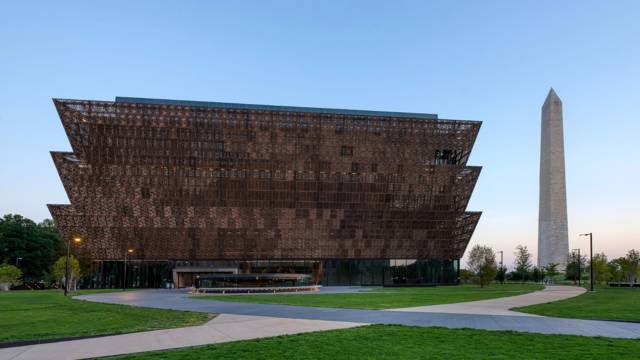
On Tuesday, President Trump attacked the narrative long taught in US schools and documented in museums, about the abhorrent, centuries-long practice of slavery. He focused on The Smithsonian Institution, the world-renowned center of learning and culture based in Washington, DC.

Trump wrote on his social media platform, “The Smithsonian is OUT OF CONTROL, where everything discussed is how horrible our Country is, how bad Slavery was.”

“How bad slavery was.” It is simply unbelievable that such a statement could be uttered by a president in 2025. Yes, slavery was bad, President Trump. It was evil and remains a stain on this country. We should never stop talking about it.

Lonnie G. Bunch III is the 14th Secretary of the Smithsonian, overseeing the entire institution. Prior to that, he was the co-founder of the Smithsonian’s internationally renowned National Museum of African American History and Culture.

Democracy Now! interviewed Bunch in February, 2020, just before the pandemic struck. Bunch described the importance of depicting slavery:

“One of the most important things for me was to talk about the slave trade…I felt that we had to find real remnants of a slave ship,” Bunch said.

“We found the São José. It was a ship that left Lisbon in 1794, went all the way to Mozambique and picked up 512 people from the Makua tribe, was on its way back to the New World when it sank off the coast of Cape Town. Half of the people were lost. The other half were rescued and sold the next day.”

Bunch recalled Trump’s visit to the African American Museum in 2017, at the beginning of his first term as president:

“The first place Donald Trump visited in an official capacity was the museum. I think he was stunned by the stories we told, and there was so much he didn’t know,” Bunch said. “What I realized is that if people who didn’t know but had political influence could come through the museum, I could help them understand, hopefully, something that would change the way they did it.”

Given Trump’s new assault on The Smithsonian, it seems his visit to the African-American Museum didn’t have Lonnie Bunch’s hoped-for uplifting impact.

In late March of this year, Trump issued an executive order targeting the museum conplex. The order alleges that “the Smithsonian Institution has, in recent years, come under the influence of a divisive, race-centered ideology.” The order further creates a committee to review the contents of exhibits for “improper ideology.”

Trump has set the tone, normalizing the rejection of history, of the indescribable horror of slavery in the United States. His loyalists follow suit.

In 2023, Florida Governor Ron DeSantis promoted a revision to the state’s school curriculum, to include instruction on “how slaves developed skills which, in some instances, could be applied for their own personal benefit.” DeSantis defended the offensive guidelines, saying “I think that they’re probably going to show some of the folks that eventually parlayed, you know, being a blacksmith, into doing things later in life.”

Trump’s Defense Secretary Pete Hegseth recently joined a growing Christian Nationalist congregation. The church’s co-founder, Doug Wilson, has written that slavery “produced in the South a genuine affection between the races.” Hegseth has ordered that previously removed statues of Confederate officers be put back, and is restoring Confederate names to military installations that had been recently removed.

The National Park Service has announced that the only outdoor statue in Washington, DC honoring a Confederate, Albert Pike, which was removed following the racial justice protests of 2020, will be restored. Pike was a Confederate general and alleged member of the Ku Klux Klan.

And as Trump has successfully defunded public broadcasting, some are advocating that PBS content be replaced with material from the rightwing media company PragerU. In one clip from Prager already being used in 10 states, an animated cartoon Christopher Columbus is shown downplaying slavery:

“Being taken as a slave is better than being killed, no?”

Annette Gordon-Reed, professor of history at Harvard University, president of the Organization of American Historians and Pulitzer award-winning author, said on Democracy Now!, “It’s an attempt to play down or downplay what happened in the United States with slavery…This is a whitewashing of history.”

With Trump’s all out assault on truth, learning, and the institutions that preserve and curate our collective history, places like The Smithsonian Institution are more important than ever.

“In the era of Donald Trump,” Bunch concluded in 2020, “the museum has become a pilgrimage site, a site of resistance, a site of remembering what America could be, and a site to engage new generations to recognize they have an obligation to make a country live up to its stated ideals.”


The original content of this program is licensed under a Creative Commons Attribution-Noncommercial-No Derivative Works 3.0 United States License. Please attribute legal copies of this work to democracynow.org. Some of the work(s) that this program incorporates, however, may be separately licensed. For further information or additional permissions, contact us.

BREAKING NEWS: Seton Hall University Africana Victory

🙂 What’s the phrase? “If we fight, we win,” right? So they fought and won! Congrats to the courageous Seton Hall University students and the integrity-filled leadership of past Africana director Dr. Kelly Harris and current, interim director Forrest Pritchett!

https://www.nj.com/opinion/2023/05/seton-hall-students-if-we-dont-get-it-shut-it-down-their-history-making-protest-pays-off-opinion.html

OCTOBER 17th UPDATE:

https://www.shu.edu/arts-sciences/news/africana-studies-program-welcomes-new-colleagues.html?fbclid=IwAR3DD1YpyJbJVTc9nbySql74wavUZ2QUXAS74yqgZ5NmT0dkCmtY7R8WBwg#

Book Mini-Review: The Glossy Raised Fist

Writing history, making history, repeating for generations, then becoming history

Our Kind of Historian: The Work and Activism of Lerone Bennett, Jr.

E. James West.

Amherst and Boston: University of Massachusetts Press, 328 pp., $27.95.

West uses his mastery of the histories of Black Chicago and Ebony/Jet well here, significantly building on and adding to his previous work on the topic. An author explains an author in a wonderful intellectual history that sticks to very exciting facts: Lerone Bennett rises in a rising time, gaining knowledge and experience and pointing them toward what he would call in print the Black Revolution. He transforms himself from journalist to historian, from moderate, Kappa Morehouse Man to Pan-Africanist revolutionary. Absolutely necessary for those who want to understand 20th-century Black press history and, perhaps more importantly, how one “Black-famous” author’s Black history texts–all the outgrowth of one national Black magazine, a 20th-century legend once on every Black American coffee table–were significant weapons in the Black struggle before African-Americans had full access to local and national broadcasting and now international streaming.

Asante Sana, Dr. Julia (“Judy”) Miller and Glen Ford

The Male Principle and The Female Principle, grit and fierceness inner and outward.

Coming out of the 1960s into the 1970s, both pioneers filled with revolutionary consciousness, both using work to create new space for words to propel The Race forward.

One celebrated for her expansive heart, the other celebrated for his sharp machete.

Personal versus/and ideological.

But both understood the power of planting yourself within a role, and then being left to the never-ending, back-breaking, un-privledged, un-advantaged labor of pulling out your own weeds.

And, by doing that, creating your own eras.

Chadwick Boseman, Howard University, and Linkages

Why these Carr-Hunter discussions are growing in popularity. Look how Dr. Carr links Chadwick to: a) Black playwrights, b) Black bookstores, c) Black protest, d) to Black cultural development. And then e) THOTH!

Do You Know The Way To Wakanda? One Year Later, It’s Clear That “Black Panther” Finished The Conversation That “Roots” Started  

This month not only marks the first anniversary of the release of “Black Panther,” a.k.a. The Film That Won’t Go Away. What will be little noted is that this February is also the 40th anniversary of another well-remembered African/African-American moment.

On the small screen in February 1979, James Earl Jones, fresh from his then-uncredited voice-over role as Darth Vader in the first “Star Wars,” was seen in a safari shirt and glasses on every ABC-tuned television in America, stabbing his pen into a pad, shouting the following into the then five-channel television universe: “You old African! I found you! I found you! Kunta Kinte, I found you!”

“Roots: The Next Generations,” the mammoth 1979 sequel to the groundbreaking 1977 original, ends with Haley’s (Jones’s) journey to the Gambia to search for the young ancestor who was captured when, as the Haley family legend goes, he went into the woods to make himself a drum.

The search for Haley’s fantasy-ish Juffure resonated with African-Americans (in fact, it’s partly how we eventually accepted that term for ourselves in the late 1980s), and with millions more who wanted to find out about themselves. It’s the core story, the central idea that, in 2019, spurs those Ancestry.com commercials and has given Henry Louis Gates, the Harvard Africana Studies professor, a new career in public television.

Haley’s historical novel and the vision of comicbook legends Stan Lee and Jack Kirby hold more similarities that one thinks. Aren’t both the imaginary product of 1960s magazine content producers? Isn’t Killmonger just a version of Kunta Kinte who finally makes it back home and reclaims his birthname and birthright? Isn’t the Juffure showed in “Roots: The Next Generations” a low-tech Wakanda of sorts—a (relatively) unspoiled, seemingly un-interrupted Africa?

Although “Roots” was created for television as an American family tale, it nevertheless brought home the central tenets of Black Power and Afrocentrism—that we are an African people. ABC broke through with a depiction of Africa that defied the “Tarzan” movies from the 1930s through the 1950s that were a staple of Saturday afternoon viewing on local television channels. For a people that had recently abandoned “Afro-American” for Black, the contrast was jarring. I was 9-years-old when the first “Roots” miniseries aired, and it shook me to the core. But not completely: I still loved those Tarzan films, watching them for years afterward, but I began to wonder why I couldn’t understand the Africans, and why they kept dying consistently.

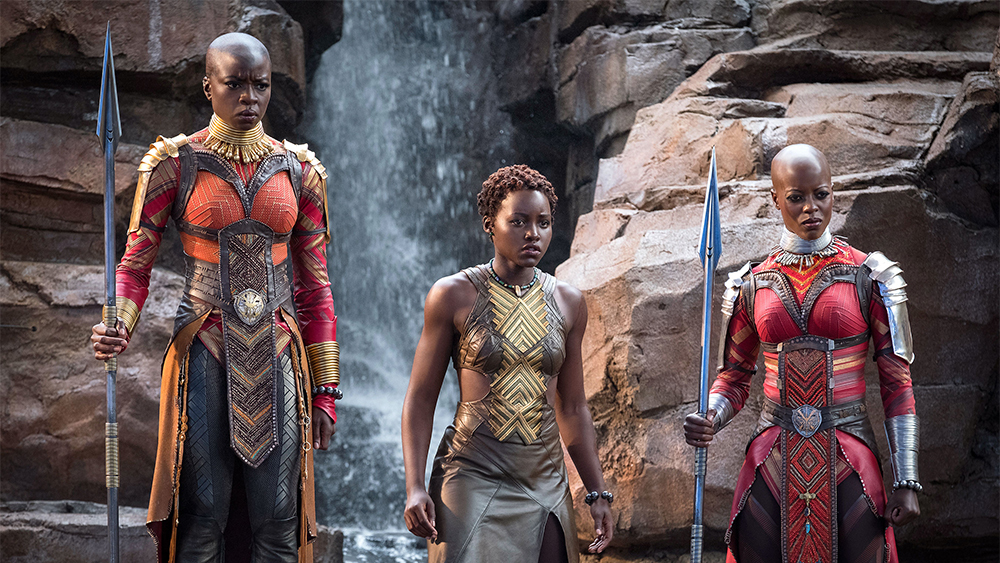
Marvel Studios’ BLACK PANTHER
L to R: Okoye (Danai Gurira), Nakia (Lupita Nyong’o) and Ayo (Florence Kasumba)
Credit: Matt Kennedy/©Marvel Studios 2018

What happened between “Roots” and “Black Panther?” More knowledge. Africana Studies—now in its 50th year, struggling to survive, but back then growing and expanding as a discipline. Sci-Fi-era technology that allows us to see Africa and converse with Africans every day. World travel not being a big deal anymore.  A growing Afro-futurism movement that is including all people of African descent, regardless of geography, gender or gender orientation. So “Panther” came right on time, as a production of visual African/Black nationalism, a visual sense of Black/African victory, to counter the white nationalism of Trump and Brexit.

The very idea that the African Union has set out to create a Wakanda shows that even Africans are searching for the Africa they see in their own minds. Imagination serving its highest role—as inspiration. (I hope and pray that the AU, thus inspired, will turn down requests for the Chinese to build it.)

For better or worse, Black History Month now has an imaginary element. We have merged with Kunta Kinte, and have turbo-charged his drum with Vibranium. Using American mid-20th century fantasy, we have gone in our minds from victims of colonization to superheroes forging our own destiny. In 2019, we have checked our DNA, and know more fact than fiction about ourselves. Of course we are of African descent, we now say, confused how anyone could think otherwise.

Whether “Black Panther” wins any Oscars later this month is much less important than this truth that might double as fact: Ryan Coogler, T’Challa, Okoye and Shuri have killed Tarzan, for real this time.