Tag Archives: Okoye
Do You Know The Way To Wakanda? One Year Later, It’s Clear That “Black Panther” Finished The Conversation That “Roots” Started

This month not only marks the first anniversary of the release of “Black Panther,” a.k.a. The Film That Won’t Go Away. What will be little noted is that this February is also the 40th anniversary of another well-remembered African/African-American moment.
On the small screen in February 1979, James Earl Jones, fresh from his then-uncredited voice-over role as Darth Vader in the first “Star Wars,” was seen in a safari shirt and glasses on every ABC-tuned television in America, stabbing his pen into a pad, shouting the following into the then five-channel television universe: “You old African! I found you! I found you! Kunta Kinte, I found you!”
“Roots: The Next Generations,” the mammoth 1979 sequel to the groundbreaking 1977 original, ends with Haley’s (Jones’s) journey to the Gambia to search for the young ancestor who was captured when, as the Haley family legend goes, he went into the woods to make himself a drum.
The search for Haley’s fantasy-ish Juffure resonated with African-Americans (in fact, it’s partly how we eventually accepted that term for ourselves in the late 1980s), and with millions more who wanted to find out about themselves. It’s the core story, the central idea that, in 2019, spurs those Ancestry.com commercials and has given Henry Louis Gates, the Harvard Africana Studies professor, a new career in public television.
Haley’s historical novel and the vision of comicbook legends Stan Lee and Jack Kirby hold more similarities that one thinks. Aren’t both the imaginary product of 1960s magazine content producers? Isn’t Killmonger just a version of Kunta Kinte who finally makes it back home and reclaims his birthname and birthright? Isn’t the Juffure showed in “Roots: The Next Generations” a low-tech Wakanda of sorts—a (relatively) unspoiled, seemingly un-interrupted Africa?
Although “Roots” was created for television as an American family tale, it nevertheless brought home the central tenets of Black Power and Afrocentrism—that we are an African people. ABC broke through with a depiction of Africa that defied the “Tarzan” movies from the 1930s through the 1950s that were a staple of Saturday afternoon viewing on local television channels. For a people that had recently abandoned “Afro-American” for Black, the contrast was jarring. I was 9-years-old when the first “Roots” miniseries aired, and it shook me to the core. But not completely: I still loved those Tarzan films, watching them for years afterward, but I began to wonder why I couldn’t understand the Africans, and why they kept dying consistently.
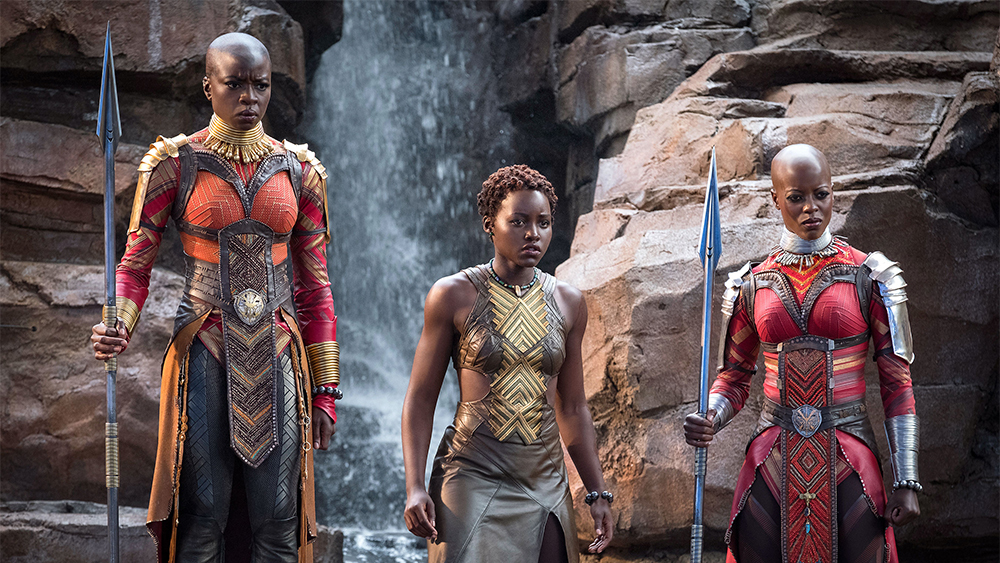
Marvel Studios’ BLACK PANTHER
L to R: Okoye (Danai Gurira), Nakia (Lupita Nyong’o) and Ayo (Florence Kasumba)
Credit: Matt Kennedy/©Marvel Studios 2018
What happened between “Roots” and “Black Panther?” More knowledge. Africana Studies—now in its 50th year, struggling to survive, but back then growing and expanding as a discipline. Sci-Fi-era technology that allows us to see Africa and converse with Africans every day. World travel not being a big deal anymore. A growing Afro-futurism movement that is including all people of African descent, regardless of geography, gender or gender orientation. So “Panther” came right on time, as a production of visual African/Black nationalism, a visual sense of Black/African victory, to counter the white nationalism of Trump and Brexit.
The very idea that the African Union has set out to create a Wakanda shows that even Africans are searching for the Africa they see in their own minds. Imagination serving its highest role—as inspiration. (I hope and pray that the AU, thus inspired, will turn down requests for the Chinese to build it.)
For better or worse, Black History Month now has an imaginary element. We have merged with Kunta Kinte, and have turbo-charged his drum with Vibranium. Using American mid-20th century fantasy, we have gone in our minds from victims of colonization to superheroes forging our own destiny. In 2019, we have checked our DNA, and know more fact than fiction about ourselves. Of course we are of African descent, we now say, confused how anyone could think otherwise.
Whether “Black Panther” wins any Oscars later this month is much less important than this truth that might double as fact: Ryan Coogler, T’Challa, Okoye and Shuri have killed Tarzan, for real this time.

