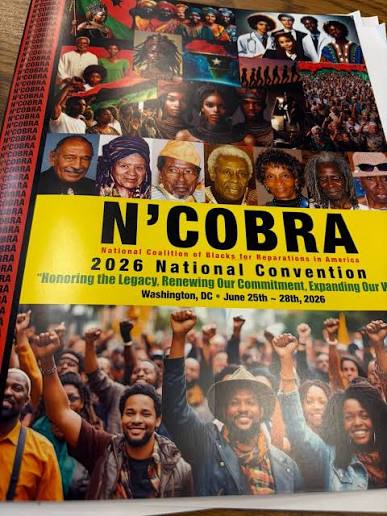
#NCOBRA: Report from #NCOBRA2026CONVENTION

This article was conceptualized, directed, and authored by Wautella Ibn Yusuf with digital composition and editorial assistance provided by #AI.


In June 2026, members and supporters of the National Coalition of Blacks for Reparations in America (N’COBRA) gathered in Washington, D.C., for a National Convention that became much more than a four-day gathering. Planned under a remarkably short timeline, the convention nevertheless brought people together for serious dialogue, powerful teaching, practical organizing and celebration. By the time participants left, the prevailing feeling was not simply that the convention had gone well. It was that N’COBRA had renewed its sense of purpose and had laid important groundwork for the year ahead.

The convention opened June 25 with one of its most consequential and courageous conversations: a discussion of reparations eligibility and the longstanding debate between a lineage-based approach focused on descendants of enslaved Africans in the United States and a comprehensive approach focused on Black people of African descent in the United States.

The session was designed to bring differing perspectives into the same room for substantive discussion rather than allow disagreement to remain a source of division outside the room.

Attorney Adjoa A. Aiyetoro, a founding member of N’COBRA and a longtime leader in the reparations movement, played a central role in bringing this difficult conversation to the forefront. The session demonstrated the value of creating space for disagreement while insisting on engagement, critique and a shared commitment to the larger reparations struggle. The discussion was not without tension, but its very existence was significant: a serious movement about achieving reparations must be capable of confronting hard questions openly and continuing to organize together.

The next two days moved from debate to education, analysis and action. Friday’s plenary, led by Dr. Cheryl Grills, offered a powerful examination of N’COBRA’s Five Injury Areas. Her presentation connected the historic injuries produced by enslavement and its legacies to the ways those injuries continue to affect Black people of African descent today. She also drew attention to newer and less visible forms of injury embedded in contemporary institutions, structures and technologies.

The Five Injury Areas framework gave the convention an important bridge between history and the present. It also connected directly to the work of N’COBRA’s commissions. The commission workshops were deliberately designed to be “work”shops: participants examined the scope of each injury area, reviewed work already undertaken and then developed plans for the coming year. Rather than simply listening to presentations, participants were expected to leave with concrete direction for July 2026 through June 2027. The response indicated that the approach worked.

Attorney Nkechi Taifa, another founding member of N’COBRA whose leadership in the reparations movement spans decades, moderated Dr. Grills’ plenary. Her role helped sustain the energy and engagement of the audience and contributed to the quality of the discussion. The presence and continuing leadership of both Aiyetoro and Taifa offered a visible reminder that N’COBRA’s nearly four decades of organizing history remain connected to its work today.

Saturday’s keynote plenary featured Dreisen Heath, a major voice in the movement’s federal legislative work. She focused on the importance of state and local reparations efforts in building toward federal reparations and described additional federal initiatives that could provide forms of reparative relief to Black people of African descent. Her presentation underscored the relationship among local, state and federal organizing and the importance of continuing the work around H.R. 40. Heath’s participation also reflected the significance of bringing leading movement strategists into direct conversation with N’COBRA members.

The convention’s program demonstrated that N’COBRA is not simply preserving a history of reparations organizing. It is continuing to develop the analysis and strategies necessary to move the struggle forward. The commission sessions, in particular, gave members an opportunity to translate knowledge into plans and to identify work that can be carried forward over the next year.

The convention also created opportunities to celebrate the movement and the people who sustain it. At the Gala Banquet, keynote speaker N’nanba (Robin Rue Simmons) brought the experience of Evanston, Illinois, into the room as evidence that reparations are achievable. She spoke of the progress made in Evanston and elsewhere and emphasized that legal challenges should not necessarily be understood as signs of failure. Instead, they can be evidence that reparations demands are being taken seriously and are helping to establish the legitimacy of the movement’s claims.

The Gala’s theme, “Yes, We Can,” captured the evening’s spirit. After the formal program, participants filled the floor with dancing, old line dances and newer ones alike. The celebration was more than entertainment. It was an expression of the joy, community and persistence that make long-term movement work sustainable.

The convention concluded June 28 with a journey to Great Falls, a site connected to the lives of enslaved Black people in Maryland and Virginia and to the post-emancipation period. The trip offered a fitting opportunity to honor ancestors and connect the present-day reparations movement with the people whose lives and labor created the history being confronted.

Brother Greg Carr’s libation at Great Falls provided a particularly powerful moment of remembrance. Participants described the ceremony as deeply moving, with a palpable sense of connection to ancestors, including those who lived at Great Falls and the founding and former leaders of N’COBRA who have passed on. Corey Shaw Jr., co-chair of the N’COBRA D.C. Chapter, provided an informative presentation on the history of Great Falls and the Black people who lived there.

Corey and fellow D.C. Chapter co-chair Kibibi Tyehimba deserve particular recognition for the chapter’s willingness to host the 2026 National Convention in Washington. Hosting a national convention places substantial demands on a local chapter, and their leadership helped make it possible for N’COBRA to gather in the nation’s capital. The convention’s success therefore belongs not only to the National Convention Planning Committee but also to the local leadership and members who assumed responsibility for welcoming the organization.

The Commemorative 2026 Convention Program Book is another lasting product of the gathering. Designed as more than a temporary event program, it preserves information about N’COBRA, the convention and the broader history and perspectives of the reparations movement. Wautella Ibn Yusuf was the driving force behind the publication, with longtime N’COBRA friend Zama Cook contributing to its printing and culturally grounded design. The book stands as a resource that can continue to inform members and others long after the convention itself has ended.

The convention took place just days before the July 4th celebration of the United States’ 250th anniversary, creating an important broader context for N’COBRA’s work. In its July 4 statement, N’COBRA challenged celebratory narratives that present the nation’s history primarily through claims of democracy, freedom and wealth while failing to confront the foundational role of enslavement and the continuing injuries produced by it. The convention’s discussions of injury, resistance, reparations and repair therefore occurred against a national backdrop in which competing versions of American history were very much in view.

That context reinforces the importance of the Five Injury Areas work and N’COBRA’s continuing educational mission. The organization’s developing website materials offer readers an opportunity to examine the injuries produced over centuries, the ways those injuries have changed and the continuing resistance of Black people of African descent. The convention did not stand apart from that work. It was one expression of it.

Most importantly, the convention produced momentum. It brought people together around difficult questions without allowing disagreement to erase the larger purpose. It deepened understanding of the injuries that reparations must address. It created concrete commission work plans. It connected federal, state and local strategies. It honored the ancestors. It celebrated the victories already achieved. And it sent participants home with work to do.

That may be the most fitting way to understand the 2026 N’COBRA National Convention. It was a celebration, but it was not simply a celebration. It was a place to learn, to argue, to plan, to remember, to laugh, to dance and to recommit. It demonstrated what can happen when people with a long history of struggle come together with the determination to keep building.

As N’COBRA turns toward 2027, the challenge is to build on that momentum. The recommendations coming out of the debriefing call for an earlier start to planning, a host chapter with a committed core membership and a national-local planning structure established well in advance. Those changes can help ensure that the next convention has the benefit of the lessons learned in 2026 while preserving the spirit that made this gathering so meaningful.

The final message of Washington was therefore a simple but powerful one: the work continues. The knowledge gained at the convention will inform the commissions. The plans developed there will guide the coming year. The history remembered at Great Falls will continue to ground the movement. And the spirit of “Yes, We Can” will carry forward—not as a slogan, but as a commitment to the continuing struggle for reparations, justice and repair.

************

FROM AI:

The National Coalition of Blacks for Reparations in America (N’COBRA) identified five major injury areas suffered by African descendants due to chattel slavery and its ongoing systemic legacies. These five areas are Peoplehood/Nationhood, Education, Health (including mental health), Criminal Punishment, and Wealth/Poverty (Economics).

The Five Injury Areas Defined

Peoplehood/Nationhood: The loss of the right to culture, language, family structure, and self-determination as a distinct group.

Education: The historic and ongoing denial of equal learning access, including laws that made teaching enslaved people to read a crime.

Health: Physical and mental health disparities stemming from centuries of trauma, stress, and unequal access to medical care.

Criminal Punishment: Disproportionate and discriminatory treatment within the legal and prison systems originating from slave codes and Black codes.

Wealth/Poverty: Severe economic disparities and wealth gaps caused by unpaid labor, systemic exclusion, and restricted financial resources.

For more context on how these categories shape repair strategies, you can review the outline provided by N’COBRA. Additional historical insights are also discussed by the National Conference of Black Lawyers.
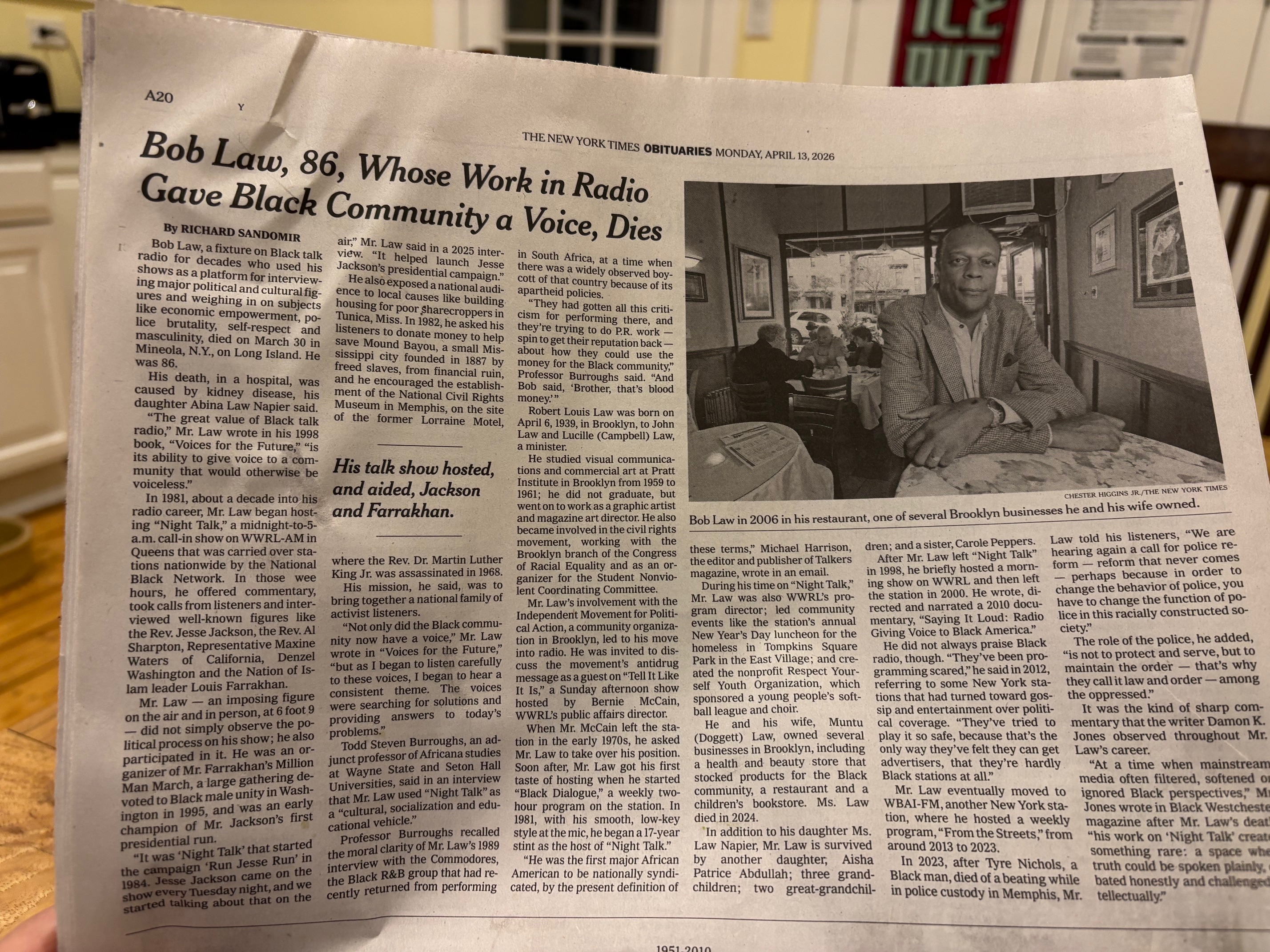
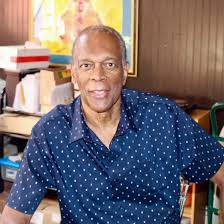
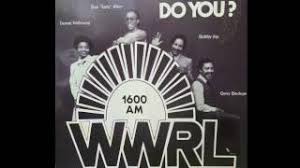
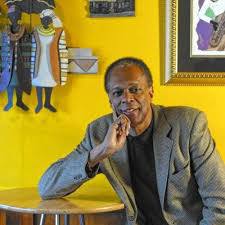
Remembering Bob Law–And That Era #BobLaw #Nighttalk #WWRL #NighttalkwithBobLaw

Airwave Dijelis (Griots): Asante Sana, Bob Law #BobLaw #Nighttalk #NighttalkwithBobLaw

From my 2001 doctoral dissertation. The references have not been updated. Any mistakes–factual, grammatical or ideological–are mine, not the University of Maryland’s.

He stood at the mic like a lighthouse, unblinking in the storm. A voice for the people, a spine for the truth. Fearless in witness, relentless in love for his community. An icon — not because he sought it, but because he earned it.”

– New York City radio broadcaster Rennie Bishop, from an email upon hearing about Law’s transition into the Realm of the Ancestors

BOB LAW, TO MY surprise, was not born with a radio microphone in or near his mouth; once upon an early-’70s raised fist, he was a hell-raising New York City civil rights activist. In the previous decade, he had worked with the radical Brooklyn branch of the Congress for Racial Equality,  a national civil rights organization. He also worked in the 1960s with the Northern Student Movement and as an East Coast organizer for the Student Nonviolent Coordinating Committee. He had learned graphic design and communications arts at Pratt Institute, a New York City arts college. Law said one of his greatest influences in the 1960s  was Malcolm X, whom he called “…the great educator.  The great teacher.  He raised questions about what we were doing in the movement. He raised questions about street life. And he was a primary influence in the lives of a great many people, particularly the group of young people that I was a part  of.” 

Law led a group called IMPAC–the Independent  Movement for Political Action.  He appeared on Bernie McCain’s WWRL-AM Sunday afternoon show “Tell It Like It Is” to talk about his organization’s campaign against the use of the drug Ritalin, a drug that counteracts hyperactivity,  in New York City’s public schools. Law and other activists believed the drug was disproportionately being used on  Black schoolchildren.  Law said McCain was a pioneer of “activist radio,” where a host would actually campaign–and get his listeners organized–against an injustice. When McCain became program director at  KDIA-AM in Oakland, California, Law became WWRL’s public affairs director and host of a show called “Black Dialogue”–an interesting, and typical for Black radio, version of, as the expression went at the time, from the streets to the suites.

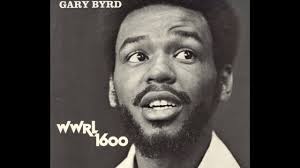
In 1981, the same year WLIB, a rival AM Black-formatted station, began Black news-talk programming, “Night Talk with Bob Law” premiered on the National Black Network, originating on WWRL. (The station’s all-night slot had been held by Law’s friend Gary Byrd, who soon moved his “Gary Byrd Experience” show down the dial to WLIB; more on his story here.) “Night Talk” with Bob Law was the first national Black radio call-in talk show.  It ran weeknights, from midnight to 5 a.m., Monday through Friday mornings. It was a national forum for Black issues in the news and Black politics. One scholar said  it “quickly became the  most popular Black talk radio show in the country.”

Law said the value of the national show was that  Blacks struggling for social justice in one area “learn that their situation is not isolated.  And  [they]  are  even encouraged by [other] people  who  struggle against that  oppression.”  Using his ’60s swagger, he used the forum  not just to inform, but also to prepare his  listeners  to spring into action.   Early in its history, civil rights leader Jesse Jackson Sr. was Law’s “Night Talk” Tuesday co-host, using his visibility to prepare for his 1984 Presidential campaign. Law regularly invited activists and scholars, such as John Henrik Clarke and Dr. Yosef ben-Jochannan, to discuss their specialties.

The wee-hours host used his late-night pulpit to run many campaigns and crusades. When I began listening to the show in 1987,  a major focus was fundraising for the New York chapter of the Black United Fund, a self-help philanthropy group.  Named New York Coordinator for 1995’s Million Man March, “Night Talk” pushed hard for a large national turnout. In his 1998 book, “Voices for the Future: Appreciating the Past in Order to Understand the Present, While Planning for the Future,” Law lists some of “Night Talk'” s crusades, with special emphasis on one campaign in particular:

And there are many examples of NIGHTTALK’s influence on a national level: We helped raise  $100,000  for a  Kansas City teenager,  we financed a summer softball league for children on behalf of  [Law’s]  Respect  Yourself Youth  Foundation, and  we helped  [in  1982]  to save the Lorraine Motel,  the  site of Martin  Luther King· s assassination [from an auction] …[Local businessmen]  wanted to convert the hotel into a Martin  Luther King museum, which  I agreed  would  be much  more fitting  than the stone marker and plastic flowers that had been placed at the  door  of Dr.  King’s room.  The  plan was  to prevent the  auction  by paying off the debt owed by the motel. and then raise the money to build the Martin Luther King Museum.

I agreed  to make the appeal  and organize various  fundraising events in local communities around the country,  in  conjunction  with   my  on-air   activity.  I wanted the museum to make one adjustment [,]  however.  I wanted the museum to be dedicated to the entire   Civil   Rights   Movement,  with  Dr.  King   as  its centerpiece. The group agreed, and we launched a national radio campaign on NIGHTTALK…  The   NIGHTTALK   audience also responded by calling the Judge who was to rule  on the auction, to assure him that they were donating to the memorial fund  and  that  the  money  was indeed  on the way.  On the strength of those phone calls and the renewed and expanded enthusiasm for the  project, the Judge  delayed  the auction, giving  the Memorial Foundation a few more days to receive  contributions from  its new supporters throughout the country.

We were successful!    The    Martin    Luther   King    Memphis Memorial Foundation  was  able  to  buy  the  motel  and  the  time  they  needed   to  raise  the additional funds  to  build  the  excellent museum of the  Civil  Rights  Movement that currently  exists at  the  site  of the  old  Lorraine  Motel.  Strangely  enough. there  is  no  mention   of the  NIGHTTALK campaign  in  any  of the  museum· s literature, nor was a promised plaque  installed in the museum’s entrance to acknowledge  the  donations of African   Americans around the  country.  These donations did in fact make  the Civil  Rights  Museum possible.

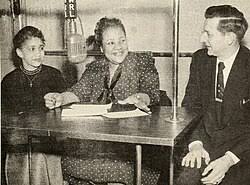
IN 1989, LAW’s FRIEND and former WWRL co-worker, now (or on the way to) calling himself Imhotep Gary Byrd, was on a roll so he decided to openly celebrate a role. His “GBE” also had evolved–or, within the next two years, would be do so–into the “Global Black Experience: Africentricity.” On WLIB, Byrd’s self-styled call-in radio magazine grew so popular that by 1991 it had begun broadcasting live from the Apollo Theater. So literally and figuratively, on and in a new stage, he took full advantage of that in 1989, devoting a week to big-upping his Black-oriented media peers. From Monday through Thursday during a late-August week, the soon-to-be-new, dashiked ”GBE” hosted a tribute to New York City’s “Pioneers in Broadcasting.” With a packed studio audience from the community, he honored the late Alma John, whose WWRL show was a ’60s Black radio staple and whose New York area community work was still remembered. Byrd also honored New York radio legend Hal Jackson, who was celebrating his 50th year in radio broadcasting.  In addition, Byrd honored two of his peers: WABC-TV’s Gil Noble, producer and host of the award-winning Black public affairs television program “Like It Is,” and Law. (More on Noble and his show here.)

Onstage at the Apollo, which had basically become an African-centered Black community space during the hours of Byrd’s broadcast, Noble spoke with his friend about his career and professional philosophy (his professional journey began in the 1960s as a WLIB newscaster). Noble recalled how he learned from Pan-Africanist Queen Mother Moore that, as a displaced African in America, he didn’t even know his true [African] name. She “made me understand the severity of my condition … I didn’t even know my name.”  That perspective, according to Noble, helped him to “ward off the intoxication” of becoming successful in a white-dominated industry. He said that he always remembers it was the Civil Rights Movement, particularly the 1967 Black insurrections in Newark and elsewhere, that got him his job at WABC-TV “..and  that’s why I’ve spent my career trying to give back.” The program, he explained, was important for Blacks and whites because “white people need to learn the truth about themselves, too.” The predominantly Black audience laughed and applauded. Noble blamed America’s Eurocentric educational systems as the reason why Blacks who enter journalism all too often consider themselves journalists first and African-Americans second.  He thanked Byrd for honoring him, noting that he was glad his radio friend had such a public forum to be praised by callers and members of the studio audience, the latter of whom began moving to microphones near the Apollo stage to join the conversation.  A Black woman, identifying herself as 83-year-old Beatrice Johnson from Queens, said she never missed “Like It Is” when it was broadcast on early Sunday afternoons. “I don’t miss it. That’s like church to me,” she said. One Black man asked Noble why he didn’t try to go after the lucrative and powerful WABC “Eyewitness News” weeknight anchor chair.  “I am constantly reminded of the condition of our people,” responded Noble. “And that it is severe and grave.  And that is my focus. And  I don’t believe  I can make a [similar]  contribution anchoring the news as [I do with]  ‘Like It Is,” since he said it was the only program on New York television controlled and conceptualized by people of African descent. “I think it is important for  ‘Like  It Is’  to  stay  alive  because   it  allows   people  to  see  the  world through the eyes of the majority of the people in the world instead of the minority.”

The  next  day  on  the “GBE,”  Law was  honored on the Apollo stage for his work on WWRL and on “Night Talk.” He talked to Byrd about his activist history in  New York City prior to becoming a broadcaster–particularly the  influence Malcolm had  on him. He mentioned that Hal Jackson, whom Byrd had honored earlier that week, was the host of “Community Forum” on WLIB.  where Law,  as a young activist, would appear as a guest in the late 1960s. He said that the future of radio,  especially AM radio, was talk and information, and that format was  “…absolutely  necessary in  the  African-American community,” since  radio “is  the  only  thing  on in the  Black  community 24 hours  a day.”  A  65-year-old Black woman from the studio audience confirmed this. saying that she had gotten a thorough political and cultural education from her “daytime man” Byrd and her nighttime “husband” Law.  The audience applauded and cheered, and both broadcasters quietly and humbly thanked her for her statement.

“LIKE IT IS,” WWRL-AM AND WLIB-AM are textbook examples of the multiple roles of Black media. The three forums have attempted to present an  African-centered worldview using mass media.  The hosts of these programs discussed here argue that their shows are antidotes to white mainstream media programming, which, due to its disproportionate control by whites,  collectively present a white view of the world as mainstream.  These forums allow African-Americans in the New York tri-state area and, in the case of WWRL’s “Night Talk” nationally, to see and hear themselves from the varied historical and cultural perspectives of  Africans and African-Americans. They also allow a counter-narrative from the culturally white and politically right-wing views of white mainstream talk radio in New York City. Because the distinct roles they play are well within the concept of the Black media imperative. The mass communication products of Noble, Law and Byrd exemplify the Two-Pronged Black Critique of White  Media  Hegemony:  l) the critique of white media supremacy and 2) the Black counter-narrative.

Noble, Law and Byrd share common professional and personal characteristics. All are tall,  charismatic men who are more than  50 years old.  The Civil Rights and Black Power movements forged all three ideologically, but as those movements developed in the North — specifically in New York City, the headquarters of the movements of Marcus Garvey and Malcolm X. They did not formally study journalism, although Law learned the basics of communications at Pratt. All started their careers in Black radio during turbulent years in  American society.  The three work as communicators who say they attempt to use their craft for the improvement of African-Americans. All three are artists: Noble, a piano player, led the Gil Noble Trio, a jazz band, in the 1950s;  Byrd is a performance poet, songwriter and entertainer; Law is a graphics artist.

There are some slight differences.  Law  is  the only  one  of the  trio  with  a college  degree.  Noble was the only of the three not known to have been an athlete as a youth, unlike Byrd (football) and Law (baseball).  Noble is the only one of the three working in white mainstream media.  Law is the only one with a background in community organizing.

All three broadcasting forums are strongly focused from a Black worldview. For more than 15 years, the “Like It Is” title sequence has started with drums and a visual collage of the  African-American experience, ranging from drawings of Africans being enslaved through pictures of the abolitionist period and the  Civil Rights  Movement to “Like It Is” interview clips from the  1970s to,  finally,  a still picture of a baby being born.    After the collage,   a red,  black and green flag–the universally accepted symbol of  Black Nationalism–is created onscreen,  with the title of the show appearing in front of the flag shortly afterward. Law’s radio  show started   with  an  announcer saying   “Night  Talk” was “for  people   who  live  in  the Black community and whose    actions   affect   the   Black   community.”  That description could easily apply to all three programs.

Not surprisingly, the shows sound different. Noble’s on-air demeanor, if not his line of questioning,  is very calm and “objective;” he does not blatantly express his opinion on the air.  Law and  Byrd, on the other hand, have been open  advocates  on-air whose  opinions on  most  topics  are  clearly  known.  Unlike  Law and  Byrd.  Noble does  not use music during the show;  the show’s transitions to commercials and closing credits are  done  in silence. Noble is  “Like  It Is”s’  only interviewer,  while Law and Byrd took calls  from their audiences. Noble’s show is a weekly hour; the others had at least 16 hours of radio time to fill every week.

All three seem to be addressing the same audience–one seeking the Black media imperative as preferred programming. In my view,  the audience Law, Byrd and Noble seem to target is composed of serious-minded African-American adults who want to l) learn about   African-American politics, history and culture and 2) do something to improve the condition of African-Americans from a left-of-center, Nationalist-oriented point of view. The hosts seek to increase understanding of the African-American experience by creating programs that inspire African-Americans to become race-conscious citizens. By doing this, from my perspective, they serve the movements that created them and push a new generation to be exposed and, hopefully, become actively involved in social justice struggles.

The fact that Law, Byrd and Noble are part of a generation of  Blacks influenced by the Civil Rights and Black Power movements does not make them at all unusual; millions of African-Americans were also shaped by “the Sixties,” the period between 1960 and 1979. What makes the story of these  three men and their forums worthy of scholarly study is how, as media professionals,  they consciously chose to make the mass media their own instead of being made by the mass media. As Black men who see their history, politics  and culture as central to their identity as  American citizens and human beings,  they decided to make media from that experience during virtually the same time period–the late  1960s; they chose to make media that matched their beliefs,  thoughts and opinions. They chose to use the media to present and discuss the  African and  African-American experiences from the often-controversial perspectives of their activist peers, not from the “objective” perspective taught in journalism school to Black and white journalists alike.  In so doing,  they became both proponents of the Black media imperative–”living mediums” standing on electronic stepladders–and ideological heirs of the movements they have championed.

https://americanarchive.org/catalog/cpb-aacip-529-ks6j09xd10

https://www.youtube.com/results?search_query=bob+law+night+talk

#BreakingTheSoundBarrier Column: On The #Smithsonian and #Slavery: #PresidentTrump’s #DonaldTrump’s #POTUS’s Whitewashing of #USHistory #AmericanHistory #WorldHistory #BlackHistory

Weekly Column

Thursday, August 21, 2025

By Amy Goodman & Denis Moynihan

On Tuesday, President Trump attacked the narrative long taught in US schools and documented in museums, about the abhorrent, centuries-long practice of slavery. He focused on The Smithsonian Institution, the world-renowned center of learning and culture based in Washington, DC.

Trump wrote on his social media platform, “The Smithsonian is OUT OF CONTROL, where everything discussed is how horrible our Country is, how bad Slavery was.”

“How bad slavery was.” It is simply unbelievable that such a statement could be uttered by a president in 2025. Yes, slavery was bad, President Trump. It was evil and remains a stain on this country. We should never stop talking about it.

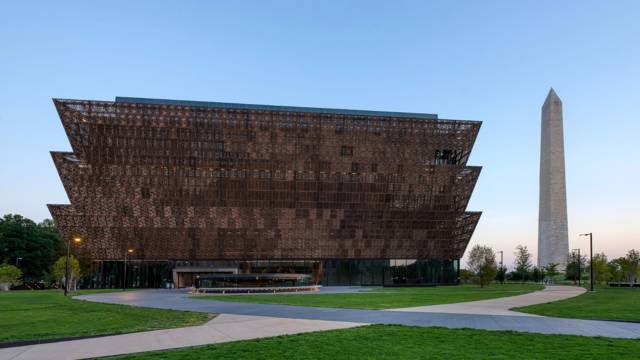
Lonnie G. Bunch III is the 14th Secretary of the Smithsonian, overseeing the entire institution. Prior to that, he was the co-founder of the Smithsonian’s internationally renowned National Museum of African American History and Culture.

Democracy Now! interviewed Bunch in February, 2020, just before the pandemic struck. Bunch described the importance of depicting slavery:

“One of the most important things for me was to talk about the slave trade…I felt that we had to find real remnants of a slave ship,” Bunch said.

“We found the São José. It was a ship that left Lisbon in 1794, went all the way to Mozambique and picked up 512 people from the Makua tribe, was on its way back to the New World when it sank off the coast of Cape Town. Half of the people were lost. The other half were rescued and sold the next day.”

Bunch recalled Trump’s visit to the African American Museum in 2017, at the beginning of his first term as president:

“The first place Donald Trump visited in an official capacity was the museum. I think he was stunned by the stories we told, and there was so much he didn’t know,” Bunch said. “What I realized is that if people who didn’t know but had political influence could come through the museum, I could help them understand, hopefully, something that would change the way they did it.”

Given Trump’s new assault on The Smithsonian, it seems his visit to the African-American Museum didn’t have Lonnie Bunch’s hoped-for uplifting impact.

In late March of this year, Trump issued an executive order targeting the museum conplex. The order alleges that “the Smithsonian Institution has, in recent years, come under the influence of a divisive, race-centered ideology.” The order further creates a committee to review the contents of exhibits for “improper ideology.”

Trump has set the tone, normalizing the rejection of history, of the indescribable horror of slavery in the United States. His loyalists follow suit.

In 2023, Florida Governor Ron DeSantis promoted a revision to the state’s school curriculum, to include instruction on “how slaves developed skills which, in some instances, could be applied for their own personal benefit.” DeSantis defended the offensive guidelines, saying “I think that they’re probably going to show some of the folks that eventually parlayed, you know, being a blacksmith, into doing things later in life.”

Trump’s Defense Secretary Pete Hegseth recently joined a growing Christian Nationalist congregation. The church’s co-founder, Doug Wilson, has written that slavery “produced in the South a genuine affection between the races.” Hegseth has ordered that previously removed statues of Confederate officers be put back, and is restoring Confederate names to military installations that had been recently removed.

The National Park Service has announced that the only outdoor statue in Washington, DC honoring a Confederate, Albert Pike, which was removed following the racial justice protests of 2020, will be restored. Pike was a Confederate general and alleged member of the Ku Klux Klan.

And as Trump has successfully defunded public broadcasting, some are advocating that PBS content be replaced with material from the rightwing media company PragerU. In one clip from Prager already being used in 10 states, an animated cartoon Christopher Columbus is shown downplaying slavery:

“Being taken as a slave is better than being killed, no?”

Annette Gordon-Reed, professor of history at Harvard University, president of the Organization of American Historians and Pulitzer award-winning author, said on Democracy Now!, “It’s an attempt to play down or downplay what happened in the United States with slavery…This is a whitewashing of history.”

With Trump’s all out assault on truth, learning, and the institutions that preserve and curate our collective history, places like The Smithsonian Institution are more important than ever.

“In the era of Donald Trump,” Bunch concluded in 2020, “the museum has become a pilgrimage site, a site of resistance, a site of remembering what America could be, and a site to engage new generations to recognize they have an obligation to make a country live up to its stated ideals.”


The original content of this program is licensed under a Creative Commons Attribution-Noncommercial-No Derivative Works 3.0 United States License. Please attribute legal copies of this work to democracynow.org. Some of the work(s) that this program incorporates, however, may be separately licensed. For further information or additional permissions, contact us.

#DonaldTrump #POTUS47 says #Smithsonian should portray America’s ‘Brightness,’ not ‘how bad Slavery was’

The fact that we still have to explain this in 2025 is disturbing. What we should be “over,” using the conservative panelist’s words, is having to still debate about this.

Book Mini-Review: #BlackBoomers Teach #Movement101

A Protest History of the United States.
Gloria Browne-Marshall.
Boston: Beacon Press, 360 pp., $31.95.

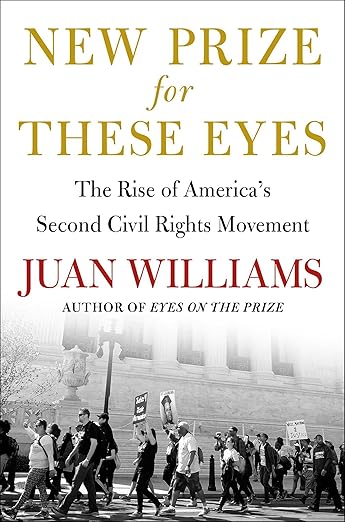
New Prize for These Eyes: The Rise of America’s Second Civil Rights Movement.
Juan Williams.
New York: Simon & Schuster, 288 pp., $28.99.

These books have never been more timely than today since they will probably be blocked from being adopted in school libraries and taught at universities across several states. Marshall, a modern-day, award-winning hyphenate in a way the late #MayaAngelou would be impressed with, and Williams, often known as a liberal (contrarian), both give context to the evening news’ #PresidentTrump executive orders. Both explain how the war is never-ending and that protest is constant and normal when you are up against oppression, whether historically naked or cloaked in the latest fashions. Williams attempts to B.C. and A.D. two different and consecutive #CivilRightsMovements, with #BarackObama on the cross. The first is the traditional, analog, PBS one (and Williams is an expert, having written the original #EyesonthePrize companion book) and the second is the one we have now–digital, fast and furious, with #BlackLivesMatter demanding the right to grow and make mistakes in public. (As we know and as Williams writes, the organized white-nationalist, right-wing response is equally digital but more deadly.) Marshall dissects protest to illustrate that it is, among other things, “primal” and an “investment,” the carbon dioxide exhaled within the racist/sexist/capitalist carbon-monoxide-filled American experiment; it is a visceral and always-correct response to the Dollar Eagle’s generations of Nos and Thou Shalt Nots. If #LeroneBennett and #HowardZinn adopted a child and raised her, it would be Marshall. And if Newark Mayor #RasBaraka #MayorRasBaraka #NewarkMayorRasBaraka is right in that perhaps the only legitimate thing about America is the struggles within it for democracy, then these Boomerooks 🙂 should only be read outside on campuses, in between demands for #Palestinian grad students–the new, respectable #politicalprisoners!–to return to a 2025 America the authors know all too well from the historic shadows and breaking-news currents they present and represent.

Book Mini-Review: The Glossy Raised Fist

Writing history, making history, repeating for generations, then becoming history

Our Kind of Historian: The Work and Activism of Lerone Bennett, Jr.

E. James West.

Amherst and Boston: University of Massachusetts Press, 328 pp., $27.95.

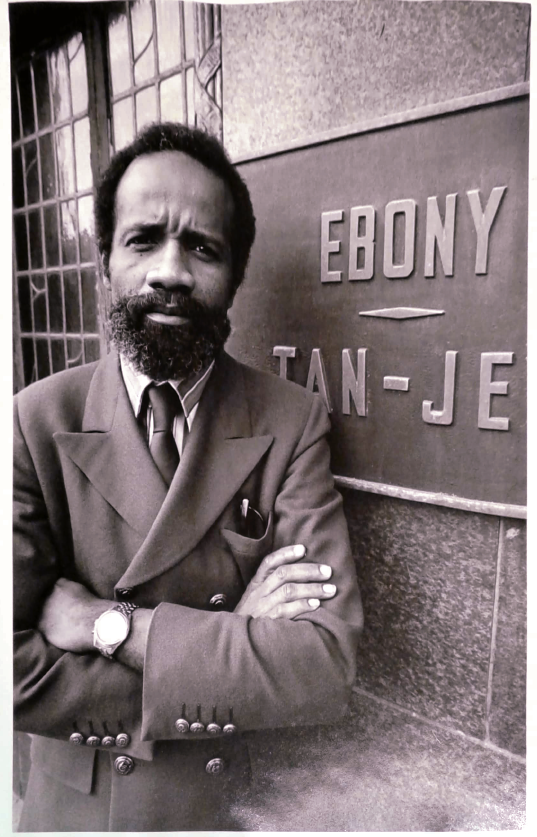
West uses his mastery of the histories of Black Chicago and Ebony/Jet well here, significantly building on and adding to his previous work on the topic. An author explains an author in a wonderful intellectual history that sticks to very exciting facts: Lerone Bennett rises in a rising time, gaining knowledge and experience and pointing them toward what he would call in print the Black Revolution. He transforms himself from journalist to historian, from moderate, Kappa Morehouse Man to Pan-Africanist revolutionary. Absolutely necessary for those who want to understand 20th-century Black press history and, perhaps more importantly, how one “Black-famous” author’s Black history texts–all the outgrowth of one national Black magazine, a 20th-century legend once on every Black American coffee table–were significant weapons in the Black struggle before African-Americans had full access to local and national broadcasting and now international streaming.

New Book On Lerone Bennett Jr. Out Now!

A 20th-century one-of-a-kind, forged and operating during a historical era

I put my request in tonight, and I can’t wait!!!!

Lerone Bennett Jr.: Until That New Biography Comes Out Next Year……

…………I’ll have to be satisfied with this new, and fine, journal article by Christopher M. Tinson.

The biography, coming early next year, will be called “Ebony Magazine and Lerone Bennett, Jr: Black Popular History in Postwar America” by James West.

West tells me that I need to check out a forthcoming book on Hoyt Fuller by Jonathan Fenderson. It’s now on the list.