***********
Tag Archives: Barack Obama
#BlackLiberationMedia: Myth: Anti- #Obama Race Traitor (w/ Dr. #JaredBall and Dr. Todd Steven Burroughs)
CORRECTIONS and COMMENTS:
- Of course I meant “Mandela” at 29:00 and “Project 2025” at 1:56:34! LOLOLOL!!!
- Here’s the link to the John Ridley article I mention at 32:36: https://www.esquire.com/news-politics/a162/esq1206blackessay-108/.
- Here’s the Michael Eric Dyson article about Cornel West I mention at 1:19:12: https://tayiabr.wordpress.com/2015/05/10/the-ghost-of-cornel-west-michael-eric-dyson/
- And my book review of David Garrow on Obama (42:30; starting at 57:47) is here: https://atlantablackstar.com/2017/06/04/barack-obama-purposely-learned-wrong-lessons-malcolm-x-martin-luther-king/ ; and here’s the middle section that Atlanta Black Star cut out: https://drumsintheglobalvillage.com/2017/06/04/my-atlanta-black-star-review-of-david-garrows-looong-biography-of-barack-obama/
- The Democratic activist group I couldn’t remember at 1:42:27 was Organizing for America/Organizing for Action. It was the first term, not the campaign: https://en.wikipedia.org/wiki/Organizing_for_America
How We Got To Today
JANUARY 21st UPDATE:
Jared Ball, Black Power Media and “The Penny Trick:” What I Thought About Peacock’s “Lowndes County and The Road To Black Power”
As usual, I’ve gotta come here to fix my many goofs! The “her” I’m talking about @ 00:27:00 is Melissa Haizlip, director of the Mr. Soul film and the niece of the Soul! host/producer.
My Recent Webinar Appearances
Book Mini-Review: Ballad For Americans

New York: Crown, 701 pp., $45.
I finally understand accept Barack Obama. When I was in elementary school in the post-Civil-Rights/Black-Power 70s, we were taught, and ultimately performed in a school assembly, a suite of songs called Ballad For Americans. Some guy with a real deep voice led the chorus on the record we heard, studied and copied (And on that starry morn…/Oh, Uncle Sam was born! [Some Birthday!]). Reading 44’s account, the first of two volumes, I felt the same energy and purpose in this wide memoir–one, like its subject, does the amazing trick of A-1 narrative lacking first-person emotional depth; the real Obama is somewhere within his first memoir Dreams From My Father and in the books of his biographers. What remains is an account for the future American believer, written by a champion of the American downtrodden, not the oppressed. In Obama’s world, only two choices exist: a) give up (cynicism); b) work within the system for change–change meaning incremental moves. The post-Ballad Paul Robeson–the one that got in what Obama hero John Lewis has popularized as “good trouble,” real good–can’t appeal to 44, because the Obama of this book sees his white grandmother’s reflection in the mirror. He’s the kind of person who, as a child, waved an American flag with his family for the Apollo 11 astronauts, a person who hypothetically believes that reason leading to common understanding one day will, to give an example not in the book, pull down a Confederate statue. (Obama is not the only “new” American on the scene: He is symbolically aping the Ballad Robeson, while Lin-Manuel Miranda imitated him more literally.) He admires the Tea Party’s radical organizing but refuses to commit to it himself: “I’d spent my entire political career promoting civic participation as a cure for much of what ailed our democracy. I could hardly complain, I told myself, just because it was opposition to my agenda that was now spurring such passionate citizen involvement.” The Trump-ish forces represented by the Tea Party, then, understood/stand they’re in a (racial) war for the future of America but Obama sees it as mere (angry) civics. Sadly, this explains a lot. So 44’s map to the immediate future is optimistic and very realistic–way too so, if you happen to think white supremacists are more than just controversially civic-minded. But this Captain America has no choice but to be this way because he long ago locked the doors to any other ideas, any socio-political imagination that comes from first breaking the mirror.
DECEMBER 2nd UPDATE: https://www.foxnews.com/politics/progressives-fire-back-at-obama-after-he-criticizes-defund-the-police-movement
My Latest Book Reviews Can Be Found…….


Ta-Nehisi Coates, The Obama Embedded Journalist, Wokes :) (Or, How Trump’s Big White Lifesaver Pulled Him Out From Drowning In Kool-Aid)
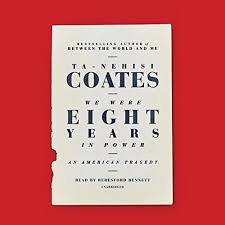
We Were Eight Years In Power: An American Tragedy.
Ta-Nehisi Coates.
One World Publishing.
367 pp. $28.
Why waste time knocking another writer’s immensely successful hustle when the target publicly decides to do it (somewhat) to himself? Ta-Nehisi Coates comes thisclose to admitting that he went a little bit Hollywood because Barack Obama’s 2018 campaign and presidency allowed the Howard University dropout to travel the Horatio Alger-Don King trail “from the unemployment office to the Oval Office.” One of his articles collected here, a select compilation of his Obama work for The Atlantic magazine, actually ends with his moving-on-up like George Jefferson and Weezie; that the scene ends a piece arguing that Malcolm X’s legacy lived in President Obama—the president who, in the beginning, apologized to a white police officer who arrested Harvard Africana Studies professor Henry Louis Gates for breaking into his own house, and, at the end, refused to pardon Marcus Garvey—makes it, in retrospect, even more puzzling and saddening. (Coates now admits his optimistic idea was “strained.” Really? You don’t say. :)) The honest-as-I-can-be new introductory essays are vitally important to understand the writer’s formulations as he was “swept away” by the Obamas while, not coincidentally, Michelle’s and Barack’s presence on the national stage “opened up” an elite white journalistic market to New Negroes who supposedly had new, innovative things to say. However, what makes this book and the superbly talented writer more than redeemable are its/his final two angry essays, “My President Was Black” and the epilogue, “The First White President.” Coates’ 2016 post-election night analysis of America contains immense socio-historical clarity. The pieces shake up the writer and the reader, allowing all to see the abandonment of Black America’s eight-year experiment with being adjective-less and to introduce in detail the insidious power of whiteness. (Taken together, the Trump-election duo pack a much better punch than his too-much-heralded 2015 single-essay work, “Between the World and Me.”) With The Donald now in charge whether people use his name or not, Coates’ years of literary sharecropping as forgotten as Friendster, and his white readers now fully understanding that they have never been, and are not now, innocent, the book’s end marks the beginning of a golden era of his writing.
My Atlanta Black Star Review of David Garrow’s LOOONG Biography of Barack Obama……..

……is here.
Here’s the block that got cut out, about the biographer and the his approach:

If there is ever to be a Hall of Fame for post-World War II American biographers, David Garrow has worked undeniably hard for his statue. The energy and sweat required of a great biographer are present. The book’s promotional material says Garrow does research worthy of Robert Caro, the man who has devoted half his life to writing about Lyndon Baines Johnson, and the hype is right. His thousands of resources include The Chicago Defender and several weekly newspapers, which allows him to use facts and statements others have forgotten. He had access to an incredible amount of detail, and decided to use (almost all of) it, to give the reader almost a month-by-month portrayal of 46 years.
Since the fable is so well-known, Garrow needed to perform a tragedy to give the reader a reason to re-visit this territory. He constantly prepared the reader for disappointment, showing that the potential compromises were there all along under the winning smile and Black Kennedy mystique: “[W]hile the crucible of self-creation had produced an ironclad will, the vessel was hollow at its core.”
The so-called hot news of the book—that Barack Obama, a young, over-educated, tall, handsome, single Black man, had a lot of sex before he got married and that he asked his serious live-in girlfriend, a half-white, half-Japanese woman named Shelia Miyoshi Jager, to marry him—is a complete yawner. The story that Garrow tells as he outs Jager is that Obama broke up with her because he needed a Black woman (World History, meet Michelle Robinson) to be a successful Black politician. So what that he asked another woman to marry him? Choosing a wife is a life-effecting process, not just a political one. It is possible that Obama made the decisions he did for purely Machiavellian reasons, but it is equally possible that Obama, a Half-rican, purposely chose a one-hundred-percent American Negress so he could have an authentic Black family. Just because he loved Jager doesn’t mean he was supposed to spend his life with her, and just because they wanted to marry doesn’t mean history was somehow thwarted by ambition.
Garrow is filled with critique—of Obama and of crush-ing Obama journalists and biographers. In his blistering epilogue, Garrow skips the most obvious reason his presidency was impotent: the intent of the Republican Party to oppose him on everything, from the administration’s first day. The epilogue is so intent on being critical—and it should, considering it’s about a man constantly compromised in ways he sees as pragmatic and necessary—it seems not to care where the criticisms originate. Meanwhile, Garrow ignores the most biting Leftist jabs. Strange choices for a left-of-center author. Garrow finds every disappointed friend, every Obama enemy, every teacher and influence he can, and includes them along with seemingly every colleague who at any point praised him. Jager accusing the president of political cowardice is the high-note of a critical symphony.
JUNE 7th UPDATE: Thanks to Jared Ball for this discussion!
My Reaction to Ta-Nehisi Coates’ “My President Was Black” In January/February 2017 Issue Of The Atlantic

Ta-Nehisi Coates does an outstanding job here as a post-Black Nationalist foil to President Obama, explaining the latter’s lifelong attempt to become Captain America. He really does a good job undressing the first Black President as a Black man who, because he grew up in Hawaii and Indonesia and completely loved and trusted his white family, he had the attitude/worldview that allowed White America to, in turn, completely trust him with the keys. (Coates correctly points out that Obama was in younger days an activist, not a protester; that says a lot when you think about it.) In many ways, I think that this is Coates’ breakthrough article, because now he can stop being an embedded journalist to Black Star Power. So enough of this I’m-trying-to-figure-all-this-stuff-out-without-offending-you-good-white-intellectuals role he has played to his loving white audience. Clearly, he has enough power, savings and fame by now. 🙂 Under President Trump’s naked, White Nationalist oppression, I hope Coates, a very talented writer who has played the game well, will now directly say what he really feels about white Americans, and White America, to a white readership who, interestingly enough, now trusts him enough that they will be ready to hear him. (I hope the lesson that will not be learned from all this is that white trust is essential for Black success and power, but that ship has probably already sale-d.) Coates will hopefully now tell truths undiluted by “dreams” (his or anyone else’s), or “Dreamers,” his annoyingly euphemistic name for whites in “Between The World and Me,” his award-winning update of James Baldwin’s “The Fire Next Time.” Well, that next time came about three weeks ago. It’s woke-ness for everybody. Time to share the pain. Time to stop dancing what my friend, the writer Ericka Blount Danois, calls “the soft shoe.” Or, as Baldwin himself says in “Blues For Mr. Charlie,” his play inspired by the lynching of Emmett Till:
Richard: You still determined to break your neck.
Juanita: Well, it’s a neck-breaking time. I wouldn’t like to appear to be above the battle.

