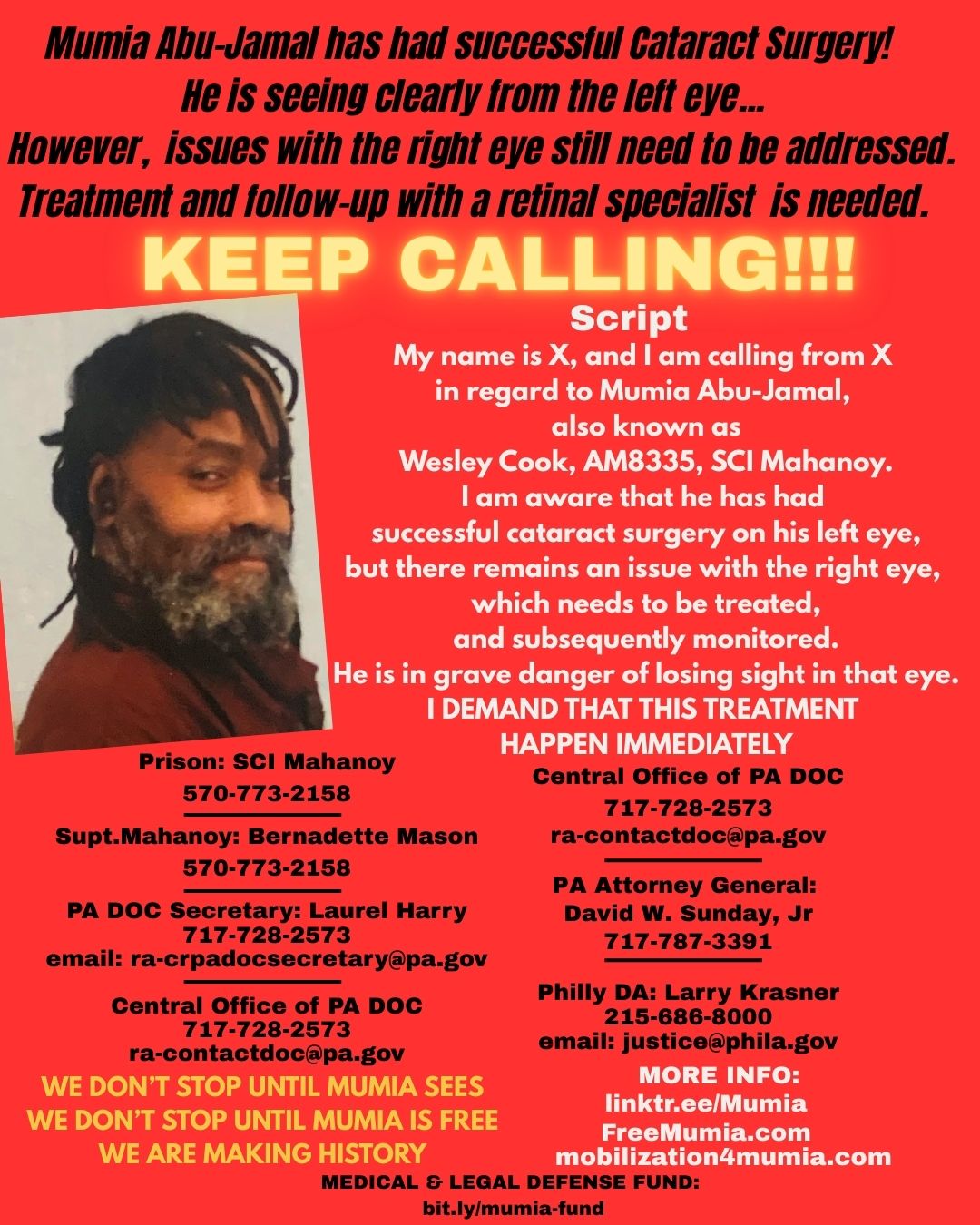
Asante Sana, #JohannaFernandez (1970-2026): That Time We Were On A Panel Together

Has the night lost its way to dawn?

– a poem for Johanna Fernandez

to sister comrade Johanna Fernandez RIP

you left us three nights ago
and
each time i awaken
to find it is still dark
i wonder
whether the night
has lost its way
to dawn

over and over
i check
the signless sky
over and over
it does not reply

over and over
i wish a trail of stars
would become
the crumbs leading
to the rewind day
i crave

over and over
struggle memories
reuniting us
tug at me
through dark dreams
lulling me
back into a broken sleep

over and over
after the disappearance
of another loved one
i wonder whether sunrise
will be in mourning

Caro
Cleo
Assata
Johanna

over and over
i fear i am lost
until the blessed rescue
of another daybreak
and Movement children knocking
at my door

(c) Julia Wright August 3 2026


From the Baruch College-CUNY Department of History, as posted on Facebook on August 1:

It is with great sadness that we share the news that Johanna Fernandez, a History Department professor at Baruch CollegeCUNY’s The Graduate Center of the Weissman School of Arts and Sciences, passed away on July 30, 2026.

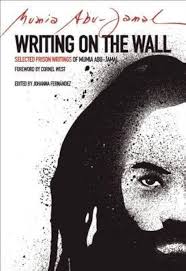
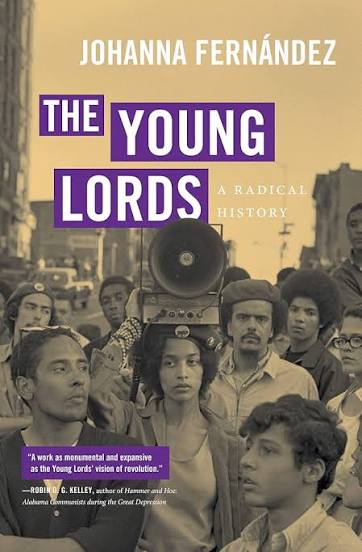
Professor Fernández was a dedicated educator to students at Baruch College and throughout CUNY, and a respected and pioneering historian. Her most notable publication, The Young Lords: A Radical History, was awarded multiple scholarly awards, including the prestigious Fredrick Jackson Turner Award from the Organization of American Historians in recognition of its excellence. She also authored Writing on the Wall: Selected Prison Writing of Mumia Abu-Jamal, as well as countless articles and book chapters on Latinx history, the history of the carceral state, and the history of modern US politics and society.

Professor Fernández embodied the mission of conducting history for the public good. She was a lead actor in the declassification and publication of previously inaccessible police archives, and helped establish a new archive on mass incarceration at Brown University. She organized countless marches and meetings to advance civil rights, and engaged people in the study of history through radio programs, editorials, and public events. In doing so, Professor Fernández never shied from holding power to account in pursuit of the truth. One of her last public history initiatives was the organization of Presente! – a major multi-site museum exhibition on Latinx history during the twentieth century. Professor Fernández did not tire in dedicating herself to these important efforts while valiantly battling cancer.

We mourn the loss of Professor Fernández, who has departed from much too early in life. Her work has, and will continue to have, an important legacy in the Baruch community, the field of history, and the fight for advancing justice and human rights.


*********************

I learned a lot about #MumiaAbuJamal from her. The #FreeMumiaMovement has lost one of its top leaders and #AfricanaStudies one of its top, award-winning scholars!

The aforementioned panel is here:

*********************
**********************

Two Ladies of the Young Lords—Denise Oliver-Velez and Joanna Fernandez

By Herb Boyd

The deaths of Denise Oliver-Velez (August 1, 1947-July 15, 2026) and Dr. Joanna Fernandez (December 2, 1970 -July 30, 2026) occurring fifteen days apart provides a double significance to the history of the Young Lords Party. Oliver-Velez was a founder of the Young Lords and Fernandez became one of its chief biographers. In a pamphlet on the Ideology of the Young Lords, Oliver-Velez, who was the party’s Minister of Economic Development, wrote “We are all fighting against an enemy, the Yankee and the Puerto Rican lombrices (earthworms). The major thing that holds us back in our fight to liberate Puerto Ricans and all oppressed people is a lack of unity. If we are not united, like a fist, we are weaker in our battle. In unity there is strength, and a nation divided is a weak nation.”

Fernandez touched on the same topic in her book The Young Lords: A Radical History (University of North Carolina Press, 2019) in her exposition of the party’s fight against imperialism. “Over the course of their brief yet productive life-span, the Young Lords won significant reforms and used local battles to expose the United States’ quiet imperial project in Puerto Rico, which became a colony of the United States in 1898. In just a few short years, the group grew from a little-known organization to the stuff of legend. In the process, their media-conscious urban guerrilla offensives, combined with the group’s multiethnic membership, redefined the character of protest, the color of politics, and the cadence of popular culture in the city” she wrote.

Among her comments about Denise, she notes that “Denise Oliver was one of several Young Lords who witnessed the fallout. In 1957, with the help of a white proxy, Oliver’s middle-class, black American parents purchased a home in Hollis, one of the predominantly white Queens neighborhoods to which children of color were bused in 1959. During her first day at Junior High School 59, Oliver remembers “getting off the bus, commotion going on, and a white kid with blood streaming down his face. There were fights going on in the yard. There were white students who had jumped on some black students, there were black students fighting back, there were [white] parents protesting the busing of kids into their neighborhood. The bus monitor rushed us into the building. You could feel the hostility immediately.”

Fernandez allocates considerable space for Denise’s stance against male chauvinism or “Machismo,” which is just one element of Denise’s determination to embrace “the revolution within the revolution.” This was, Fernandez further observes, “a deliberate part of her struggle to deconstruct and challenge the manifestations of power dynamics, racism, and sexism in everyday life among movement participants. The effort was also a trademark of the radical wing of the women’s movement, articulated in the slogan ‘The personal is political.’”

Both were dedicated writers and teachers, (Fernandez for many years a professor at Baruch College and Denise at SUNY New Paltz) and shortly before she joined the Young Lords, Denise “taught Black American and Puerto Rican history at East Harlem Prep, an East Harlem school launched by the RGS that offered an educational space to this new class of young people permanently expelled from the public school system. After having been expelled for her activism at Howard University, Oliver was startled by her success with what the school system perceived as “incorrigible students … a lot of kids in the community who weren’t in school at all. They were considered to be refuse, unteachable, unreachable; a lot of them were in gangs,” Fernandez wrote.

There isn’t time or space here to fully dissect the intersection of these two marvelously revolutionary activists, that will and should be done by comrades more informed of their lives. And it shouldn’t be ignored that both succumbed to cancer after relentlessly battling the disease. During appearances on “Dialolos” Intimedia.org, the two were separately interviewed last December. Dr. Fernandez expounded at length on the subject of fascism, and Denise, because of her illness, offered a brief discussion on the origins of the Young Lords that stemmed from the city’s reluctance to remove garbage.
https://www.johannafernandez.info/about

https://www.gc.cuny.edu/people/johanna-fernandez

https://en.wikipedia.org/wiki/Johanna_Fern%C3%A1ndez_(historian)

https://www.democracynow.org/2026/8/4/johanna_fernandez?utm_source=Democracy+Now%21&utm_campaign=4c08da9c08-Daily_Digest_COPY_01&utm_medium=email&utm_term=0_fa2346a853-4c08da9c08-191544869

https://www.democracynow.org/2016/6/17/nypd_surveillance_unveiled_city_claims_to
https://www.amazon.com/dp/0872866750?lv=shuf&channelId=500&plpRedirect=mhFallback

*******************

************************

From Julia Wright, in an email to the Free Mumia Listserv, August 2, 2026:

” solidarity is emotional “
Johanna Fernandez (1970-2026)

As the tributes pour in, we are slowly, soberly and somberly putting together the Johanna each one of us knew.
The collective Johanna that emerges is tall, fierce but loving, a burning passionaria with ice-cold determination. A woman warrior ready to pay the price.

The intrepid biographer of the Young Lords, Johanna had joined the Mumia Abu-Jamal campaign in the late nineties.

In 2023, I was honored to have collaborated with Johanna on bringing Mumia’s archives to Brown University and to have co-founded with her, Professor Mark Taylor and Michael and Annette Schiffmann: the UN Mumia Liaison group. The same year, Johanna was key in obtaining an amicus curiae for Mumia, which was presented to Judge Lucretia Clemons, although the latter dismissed both the United Nations human rights document and Mumia’s last appeal, founded on solid Brady and Batson evidence found in six boxes locked away for 36 years.

Johanna was not only Mumia’s PhD advisor, but she was also the political apple of his eye, his unfailing sister whose healing company had sustained him for decades. When he was informed two nights ago, Mumia was devastated.

Johanna had a strategic view of the struggle but she also knew tactically how to seize the time.

She had that see-through vision of Time that was both feline and analytic.

I remember, six years ago, when she was watching Amy Goodman interviewing Larry Krasner live on Democracy Now!, she seized her smartphone, called the studio, asked that a message be passed on to Amy requesting her to raise Mumia Abu-Jamal with Krasner in real time thus eliciting from the Philly DA the famous response that Mumia’s case remains “a microcosm” of all that was corrupt in the justice system that preceded him. That statement remains a testament to what Larry Krasner has yet to do while he is in the prosecutor’s seat.

Johanna had an uncanny way of holding up mirrors to double-talk.

I remember when Johanna was in remission from her last illness and the encampments of CUNY and Columbia were up and going for Gaza; frail as she was, she went in person to those campuses to air Mumia’s commentaries for a Free Palestine through a megaphone she held out for the students to hear.

Johanna had a sense of historical Time and knew how not to let it pass us by. And she was more than just the teacher of her students; she was a passer-on of revolutionary ideology and practice between the generations.

Johanna was a community healer.

In 2021, she organized a panel against sexual abuse targeting women in the struggle, which instead of being an academic panel of talking heads gave the mic to those among us who had been abused, and some of us for the first time found the words to say it.

I was able to bear testimony to my own abuse and to how I felt my body had become a piece of land up for grabs. I had been a human colony.

After the panel, for the first time in my life, although I was almost eighty years old, I was able to dance to my own ancestral music.

Johanna is to be thanked for many things – and many of us did not have the time to thank her.

Like Denise Oliver-Velez, the Economic Development Minister of the Young Lords and other revolutionary leadership, Johanna fought both the mass incarceration state on the outside and cancer within.

Since Amilcar Cabral’s Cancer of Betrayal speech on the death of Kwame Nkrumah ( 1972 ) , we understand that cancer can be the physical expression of the inner betrayal of the revolution. “The personal is political” is a Young Lords slogan.
Both Denise and Johanna were relentlessly tracking such betrayals or festering inner contradictions, for instance the paradoxical role of capitalism’s dollars in our movements.

More than ever, the losses of Denise Oliver-Velez and Johanna Fernandez leave us with the need for a Fanon who could write a psychopathology of everyday abolitionism showing us how in spite of the necessity of being in fight or flight mode day and night, in spite of the accumulation of cortisol and stored adrenaline, we can solve our contradictions before they go to our cells and we can address the root cause that prevents the unity of the new body politic we work to free our political prisoners into – from sub-dividing into rogue elements.

Yesterday my son, who never met Johanna, listened to her story and added: “Mum, just as oncologists have found that the sugar we are over-dependent on – like our dollars – is the poison that makes cancer grow in us.”

Johanna Presente!

Julia Wright

***************

Posted to the Listserv:

For Johanna Fernández— ¡Presente!

by Mark Lewis Taylor
Princeton Theological Seminary

August 3, 2026

I received word some days ago from Sophia Williams of the movement for Mumia, and also confirmation just yesterday from Johanna Fernández’s brother that Johanna passed this last Thursday night, July 30, 2026.

Words come hard now. The ache is acute, as I feel the loss of a friend, a scholar, colleague, and an activist who gave so much to the movement for Mumia and for justice and revolution in so many ways. One of the things she did was to rejuvenate Educators for Mumia Abu-Jamal (EMAJ), the group I founded in the mid-1990s. She went on to energize so much of the Mumia movement through the Campaign to Bring Mumia Home and by coordinating with Pam Africa and others in the International Concerned Family and Friends of Mumia Abu-Jamal (ICFFMAJ). And through all of these efforts—whether organizing, writing or teaching—she often mentioned the care she had for, and from, her most immediate family in the New York area.

I remember first meeting Johanna in the late 1990s or early 2000s. We first visited in phone meetings as we planned a panel of activist scholars presenting at Drexel University, the first of many more panels, press conferences and events. She drove into Philadelphia for the Drexel event, from Pittsburgh where she was then teaching at Carnegie Mellon University, before she took the teaching position at Baruch College, CUNY.

Meeting Johanna in a hallway at Drexel that day was like meeting a storm, or maybe a strong wind blowing in the right direction. She swept into the hall with several students in tow. We shook hands, but there was no time to stop and visit. We just kept striding, right to the Drexel U auditorium for start-up of the panel—to work!

How many press releases did I co-write with Johanna? How many times did we go to work over the phone, often pushing against and navigating between our teaching and publishing duties, to get those press releases or other movement essays, written just right and by deadline?

She had both a revolutionary impatience and a revolutionary patience. Both were gifts. I recall the impatience that she could express in the heat of a chaotic planning meeting—maybe in New York, in Philadelphia, in Princeton—“Guys, we gotta get focused now!” Her patience was expressed in the steady return to details that she showed when planning an event. Perhaps her patience was especially evident in the meticulous care she gave to her book, The Young Lords: A Radical History. For that volume she had to nurture a lawsuit over years against the NYPD, as well as draft and redraft chapters for what became a stellar, award-winning book, recognized for its brilliance and research by the best of historians nearly everywhere, but especially by the most radical ones among them. She also edited an invaluable collection of Mumia’s essays: Writing on the Wall: Selected Prison Writings of Mumia Abu-Jamal.

There are too many stories to tell, too many events to recall along the way of Johanna’s essential contribution to our struggle for Mumia. But consider these: (1) her contributions to EMAJ’s planning and hosting of the Constitution Center event of some 1800 attendees for Mumia in 2011, which occurred just before Mumia left death row; (2) the archiving of Mumia’s papers at Brown University library; (3) her efforts with Mumia to facilitate our movement’s self-critical analysis of potential abusive practices in our own activist communities; and especially (4) her constant presence to Mumia, mobilizing with others as Mumia battled for his health, his very life, against hepatitis B, his heart ailment, and the prison’s medical neglect that worsened all of these. Several times a week, for years, she was on the phone with Mumia, checking on him, visiting with him. I heard from Mumia so many times how important her phone and personal visits with him were.

Johanna’s smartphone also made possible Mumia’s call-ins to my classes. The last call-in she facilitated occurred while she was picking up her lunch at a NYC deli (!). As she told me later, she had received the call from Mumia at a cashier’s counter, then quickly patched Mumia through to my cell phone in Princeton, so that 40 students in my class on incarceration and police repression could have an insightful 15-minute question-and-answer session with Mumia. This call from Mumia via NYC occurred in the final course I taught before retiring from Princeton Theological Seminary, in Spring 2025.

One last word: Johanna was an internationalist. She wrote for Al-Jazeera and other world publications. Her organizing took her several times to France and Germany, where Mumia groups were active. She hosted French and German activists in her NYC apartment. She put hours into laboring with others for the UN and other international bodies seeking justice and freedom for Mumia. She also knew and cultivated the Caribbean radical traditions, which she knew viscerally from her own family’s roots in the Dominican Republic. She rigorously honed her socialist commitments and analyses in a world of imperialism, and also white and masculinist supremacy. We talked often about the importance of Latin America and its liberation theologies for the Mumia struggle. She traveled with a U.S. Prisoner, Labor and Academic Delegation to Palestine in 2016. That delegation, and the declaration it released later, aided reflection on my own travels there in 2007 and more recently in 2025.

Near the time of my retirement from teaching in 2025, I lost track of all that Johanna was doing. She was in the whirlwind of organizing ‘til nearly the end. And when her illness came, we could see how she battled to keep organizing, but also how she had to step back to tend to her health. Phone calls and texts became less frequent.

Back in January of this year, 2026, my text to her about an event being planned ended with my saying, “I hope you’re doing okay, warm regards.” She replied, “Aww, thanks. I am on the mend.” In May I wrote, “It’s been a while. I hope you are okay. Let me know if there’s a good time to call.” And just a few weeks ago, on July 18, I see my last message to her: “Sending you all revolutionary love, respect and power—wherever you are. All prayers and energies to you! -Mark”

There were no replies to these last two texts. In this hard time of loss, I am holding on, desperately, to my belief that Johanna, now with the ancestors, will not lose touch with our movement and with each of us. I know that I—along with so many others—will still be hearing her voice as it inspires us with her undying presence for all our struggles to come.

¡Presente! indeed, Johanna Fernández—comrade, professor, friend!
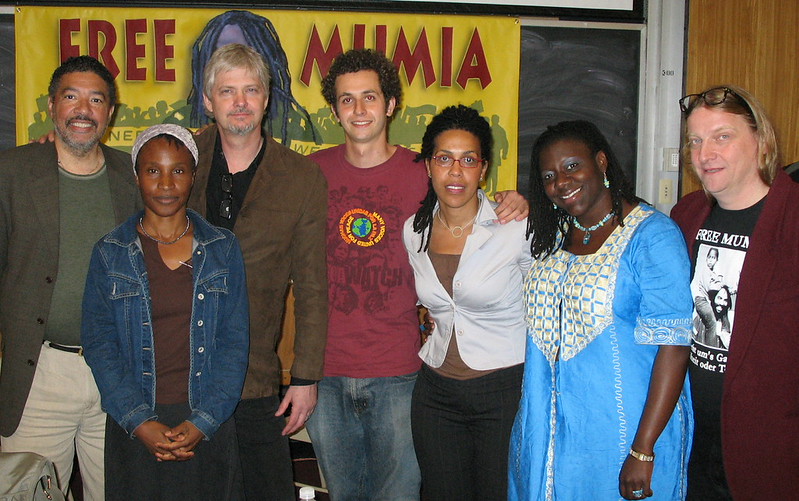
The Drexel University event, May 16, 2007. The author is background, second from right, obscuring #MumiaAbuJamal ‘s image. Photo by Joe Piette.

#MUMIAABUJAMAL’s testimony to the #UnitedNations #UNHumanRightsCommittee

On the initiative of the UN Human Rights Committee, an international call for written contributions has been launched concerning “the death penalty in relation to the prohibition of torture and other forms of ill-treatment, and also the protection of human dignity.” By clicking on the link below, you can learn more about the relevance and purpose of this initiative: https://www.ohchr.org/en/calls-for-input/2026/call-input-special-rapporteur-summary-extrajudicial-or-arbitrary-executions

This appeal has been relayed by the World Coalition Against the Death Penalty to its members; the French Collective has been a member of the coalition since its creation and was re-elected to its Steering Committee in 2025.

With the help of Prison Radio (USA), also a member of this Coalition, we requested a statement from Mumia (an iconic figure in the fight for the universal abolition of the death penalty), which we have just forwarded to the Special Rapporteur in charge of collecting contributions, on the basis of which he will present his report to the 62nd session of the United Nations. You can find Mumia’s AUDIO testimony in English by clicking on this link: https://mumiabujamal.com/v2/wp-content/uploads/2026/02/2-3-26-Mumia-UN-Submission.mp3 … and transcribed in the attachment.

Best regards,

Jacky & Steve
French Collective LIBERONS MUMIA

*****************************************************************************************************

In response to the Special Rapporteur’s call for contributions “on the death penalty in relation to the prohibition of torture and other forms of ill-treatment and the protection of human dignity,” we wish to bring to his attention the situation of Mr. Mumia ABU-JAMAL, who has spent 29 years of his life on death row in Pennsylvania (USA).

An African American journalist, now aged 71, he has his sentence commuted to life imprisonment without the possibility of parole.

Incarcerated for 45 years, below you will find his testimony on the conditions of survival in prison hell and the physical and mental consequences of his fellow inmates awaiting execution or the deterioration of their health exposing them to
death in the case of life sentences.

An iconic figure in the international fight for the universal abolition of the death penalty, Mr. ABU-JAMAL was convicted after a racist and expedited trial without being able to defend his innocence. Denounced by Amnesty International, the European Parliament, and the UN Human Rights Committee, he has still not obtained a review of his trial. Today, the deterioration of his health, like that of the oldest prisoners, would justify his release on humanitarian grounds.

Noelle Hanrahan (USA) nhanrahanlaw@gmail.com, Lawyer of Mumia Abu-Jamal and Director of Prison Radio (USA)

Member of the World Coalition Against the Death Penalty
Jacky Hortaut (FRANCE) contact@mumiabujamal.com
Let’s Free Co-organizer of the French Mumia Collective
bringing together around a hundred NGOs and the city of Paris
Member of the Steering Committee of the World Coalition against the Death Penalty

***************

Submission by Mr. Mumia ABU-JAMAL to the United Nations

When we think about death row I must remind you all who hear these words or read these
words it is not a movie. Don’t think of a movie. Instead imagine a reality where for years, for
many years, people are locked down in their cells for 23 hours a day. Which began as 24 hours
a day on the weekends and after years and years, became 22 hours a day.
Also imagine that for what may be the rest of your life you could not hug, nor kiss, nor caress
your children, your wife, your brothers, your sisters, your parents because non-contact was the
rule.
What did that mean in the real world ? And why was it established? What it means is the state
separating you from all people that you love and who love you. And what does it mean? It
meant that this physical isolation, this true solitary confinement, separated you from the people
who naturally care about you. And separated them from you. What is the purpose of that ? The
purpose is simple to dehumanize the accused, the death row person and to separate them from
humanity itself.
In some states, mostly the South, it has become custom that when a death-row prisoner is
escorted throughout the prison the guards usually shout: “ Dead man walking. Get out of the
way. Dead man walking ”. Now that will remind you of a movie, but that only reminds you of a
movie because it happened in real life.
To separate people from other people, it is to deprive people of what it means to be human. To
be social. And this is something that has become “expertise” in American prisons, North, South,
East or West. This tradition continues in much of this country and is designed to make people
lose hope, so that they can be more easily executed, or as the state says ”put to death “.
This too is not just a word or description or even a movie. I’ve known men who spent time on
death row with me who committed suicide, for a variety of reasons.
Sometimes, they were suffering health issues and could not bear to continue to suffer those
health issues. Sometimes they were depressed because they knew that they should have
gotten a new trial, but instead they got a resentencing hearing. I knew a guy who I had played
handball with, up SCI Greene, he was an excellent young handball player, because he’d played
it in the world. And we gave each other a good challenge, the old man and the young guy, and
he was in excellent health. Until his appeal got denied and he was given a life sentence instead
of the new trial that he knew, he knew, he deserved and by law should have gotten. Within a
week he tied himself to some bars in his cell and killed himself. For him, a life sentence, what
people call “ slow death row ” was too much like death row itself, for him to leave death row, it
was another kind of death row. A death row on life row.
I have met people who I have known on death-row who were executed by the government of the
Commonwealth of Pennsylvania. One guy was about two or three cells away from me when we
were at Graterford in Eastern Pennsylvania. He was an older guy, I sent him a note and said “
Listen man, fight your stuff ” And he called down and said “ Jamal, I am tired ; I got nothing
here, I got nothing to live for, I’m ready to go “. And so he did. He volunteered to be executed.
And the State of Pennsylvania took him up on his invitation.
When people are given no way out, given no hope, does it surprise you that men in such
conditions not committed suicide ?
If you think about it this guy commits suicide by the state. The other Puerto Rican brother I
talked about committed suicide because of his deep disappointment that the state could not
treat him according to the law as written in their books.

But what was killed, was hope. And that is what it was designed to do. That is what death row is
designed to be. And that is what death row and slow death row really is. Not just in this state
but in several states in a country called ‘the land of the Free’.
I wanted to give you an inside impression. I hope I have been successful.


Love not Phear,


Mumia ABU-JAMAL

#DEMOCRACYNOW: MARCH FOR #MUMIAABUJAMAL: 100+ mile march from Philly to SCI Mahanoy ends (and a #JuliaWright news poem)

https://www.facebook.com/keith.collins.7509/videos/1173368544986807/?fs=e&s=TIeQ9V&mibextid=wwXIfr&rdid=Osn99qFptqP4SMRq#

https://www.facebook.com/Mobilization4Mumia/videos/866732672464340

Supporters of Mumia Abu-Jamal are on a 103-mile, 12-day march ending Tuesday in Frackville, Pennsylvania, where he is imprisoned at the Mahanoy state prison. The march ends on the same day Abu-Jamal was arrested in 1981 for the murder of Philadelphia police officer Daniel Faulkner, for which he has always maintained his innocence. One of the best-known political prisoners in the world, Abu-Jamal was an award-winning journalist and co-founder of the Philadelphia chapter of the Black Panther Party before his incarceration, and has continued to write and speak from prison. Human rights groups say he was denied a fair trial, with evidence unearthed in 2019 showing judicial bias and police and prosecutorial misconduct. Abu-Jamal is now 71 years old, and advocates say he is being denied proper medical care in prison, permanently risking his eyesight.

“We’re marching today to demand freedom for Mumia and all political prisoners,” says activist Larry Hamm.

“We ration healthcare in this country, and in particular for prisoners,” says Noelle Hanrahan, part of Abu-Jamal’s legal team, who is demanding “that Mumia get specialist care … and that he is given the treatment that he deserves.”

***************************


AMY GOODMAN: This is Democracy Now!, democracynow.org. I’m Amy Goodman, with Juan González.

One of the world’s most well-known political prisoners, Mumia Abu-Jamal, was arrested on this day in 1981 for the murder of Philadelphia police officer Daniel Faulkner, for which Mumia Abu-Jamal has always claimed innocence. Amnesty International and human rights groups have found he was deprived of a fair trial. His lawyers say evidence shows his trial was tainted by judicial bias and police and prosecutorial misconduct, like withholding of evidence, bribing or coercing witnesses to lie. Evidence in boxes discovered in the Philadelphia District Attorney’s Office by DA Larry Krasner in 2019 includes notes from one of two key witnesses to prosecutors requesting, quote, “the money owed to me,” unquote.

Mumia Abu-Jamal was an award-winning journalist, member of the Philadelphia chapter of the Black Panther Party, ultimately sentenced to death, but went on to write 15 books and record a weekly column while a global movement built around his case. He spent 29 years in solitary confinement. In 2012, Mumia Abu-Jamal was moved from death row to the general prison population after a federal appeals court in 2011 upheld the overturning of his death sentence by a federal judge, citing improper jury instructions, and prosecutors agreed to a life sentence rather than a new sentencing hearing.

Mumia Abu-Jamal is now 71 years old, was recently blind for eight months until he had cataract surgery, but needs more medical care to prevent him from permanently losing his vision. Dozens of his supporters who hope to draw attention to his claims of medical neglect are on 103-mile, 12-day march that’s ending today in Frackville, Pennsylvania, where Mumia is imprisoned at SCI Mahanoy.

ZAYID MUHAMMAD: We’re taking that long walk, because the walk for freedom is a long walk. And we do it with an intense, extra motivated passion, because we just lost a bold freedom fighter in Imam Jamil Abdullah al-Amin in the clutches of the state, and that should not have happened. So, under no circumstances can we allow the state to take any more of our freedom fighters. It’s time to get Mumia all the healthcare he needs.

AMY GOODMAN: In a minute, we’ll speak with someone on the march and a member of Mumia Abu-Jamal’s legal team. But first, this is a Prison Radio commentary that he recorded in August, titled “Mumia’s Vision: A Message for the Movement.”

MUMIA ABU-JAMAL: I have been reluctant to talk about my eye problems. The reasons may have eluded some, but I explain that, you know, in the context of being in prison, any sign of weakness is to be avoided at all costs. These are, unlike many other institutions in society, heavily male, and therefore gender-conscious in a way that society is not. Weakness brings predation.

So, I kept it quiet. And I kept it quiet simply because I wrongly believed that once I got examined and once it was clear that this was a real visual contextual problem, that I would get a rather quick response. Boy, was I wrong. I was, as the saying goes, as wrong as two left feet. What I got was evaluation after evaluation after evaluation after evaluation, literally. It was only when I went outside and those prior evaluations were repeated by a noted ophthalmologist that the ball began to roll. And even then, the ball rolled exceedingly slowly.

I have been, for all intents and purposes, unable to read, unable to write, unable to see anything more than the masthead of a newspaper and not even its headlines, blurry television bursts of color. The television is my radio now.

AMY GOODMAN: Mumia Abu-Jamal, speaking from prison, SCI, State Correctional Institution, Mahanoy in Pennsylvania.

For more, we’re joined by Larry Hamm, chair of the People’s Organization for Progress, one of the elders on the March for Mumia. He is in Frackville, Pennsylvania, where the prison is. And here in New York, one of Mumia’s lawyers, Noelle Hanrahan, founder and producer of Prison Radio, which has been recording and distributing Mumia’s commentaries from prison since 1992.

Larry, let’s begin with you. You’re on this more than 100-[mile] march that’s ending today. Why did you march? What are you calling for?

LARRY HAMM: Good morning, Amy. Good morning, Juan. Good morning, Noelle.

We are marching to free Mumia and free all political prisoners. We are marching to draw attention to Mumia’s medical problems, but, more importantly, to demand that he get the surgery and medical treatment he needs. We are marching for humane treatment for all prisoners, especially our elders. I’m a witness to the fact that we have an aging prison population, and, like Mumia, many of them are not getting the medical care they need. So we’re marching today to demand freedom for Mumia and all political prisoners and to demand that Mumia get the urgent surgery and medical treatment he needs.

JUAN GONZÁLEZ: And, Noelle, I’d like to ask you: In terms of his battle for healthcare, Mumia’s battle for healthcare, why has it been so difficult for him to get that healthcare?

NOELLE HANRAHAN: [inaudible] healthcare in this country, and in particular for prisoners, there are contracts by Wellpath that specifically state that they limit ophthalmological care in prison to on-site monitoring. They do not send people routinely out for specialist care. We had to fight. The Abolitionist Law Center, the lawyers and the movement had to come together to demand that Mumia get care just for post-cataract surgery. When we got the specialists to look at Mumia, they discovered two other conditions that could mean that he loses his eyesight permanently if he is not treated. He has not been treated for these conditions since June.

AMY GOODMAN: So, what are you demanding right now?

NOELLE HANRAHAN: That Mumia get specialist care for his glaucoma and his diabetic retinopathy, and that he is given the treatment that he deserves. But we’re not just calling for Mumia, because there are many inmates. They know who’s blind in prison. They are refusing care to save money for Wellpath.

AMY GOODMAN: Why is ophthalmological care particularly limited?

NOELLE HANRAHAN: I don’t know if it’s particularly limited. It’s the one we’ve researched right now. I believe that they likely limit all care that might cost them money. Like our lawsuit for hep C care in 2017 that won care, the first preliminary injunction for hep C care, they did not treat Mumia with a fast-acting cure for two years, causing, likely, the diabetic retinopathy.

JUAN GONZÁLEZ: And, Noelle, Philadelphia has a supposedly progressive DA, District Attorney Krasner, who his own office found forgotten files on Mumia that showed bias in his trial. Why has there been no movement by the DA to reopen his case?

NOELLE HANRAHAN: I think the DA has been pressured to actively litigate this case by being impeached by the Pennsylvania Senate, also by being called up in a special — there was a King’s Bench petition that deposed Larry, that asked him specifically if he was going to prosecute Mumia. There are pressures. Mumia is the third rail in Philadelphia. He is like everyone else in prison, the 5,000 people that are serving life without possibility of parole just in Pennsylvania. He’s one of a class of many. And Krasner, he will do the right thing. He is elected by the people. He’s elected by the abolitionist ecosystem. We have an obligation to make it impossible for him to not support us. But there’s pressure.

AMY GOODMAN: And on what grounds are you asking for his case to be reopened now?

NOELLE HANRAHAN: There are three ways that any lifer can get out. It would be a post-conviction relief application, which we are developing, that he doesn’t have one in court right now. His last one was denied in March by a lower court that did not fairly review his case. He can also go through the pardon board, which is a five-member panel and also the governor, six — have to be unanimous — or compassionate release, which is extremely limited.

AMY GOODMAN: Finally, if you can comment, Larry Hamm, on what you’re doing today in front of the prison in Frackville, Pennsylvania, what this more than hundred-mile march has meant for you? You’re about the same age as Mumia Abu-Jamal.

LARRY HAMM: I am exactly the same age as Mumia, and our birthdays are in the same month.

Yesterday, we reached the hundred-mile mark, and today we will march the last three miles to Mahanoy prison, where Mumia is incarcerated. We will have a press conference and a rally there to once again make the call for Mumia to get the medical care that he needs, and for all prisoners, especially our elders, to get the medical care that they need.

AMY GOODMAN: And, Noelle Hanrahan, 10 seconds.

NOELLE HANRAHAN: It’s relief from the inside out. This was built by prisoners. It was built by prisoners’ families, the Abolitionist Law Center, Saleem Holbrook, Bret Grote, the lead attorney. We are going to win and create the world that we deserve.

AMY GOODMAN: Noelle Hanrahan is one of Mumia Abu-Jamal’s attorneys and founder and producer of Prison Radio. Larry Hamm is chair of the People’s Organization for Progress, on the March for Mumia, speaking to us from Frackville, Pennsylvania, where he is imprisoned. I’m Amy Goodman, with Juan González.

*******************

After the March for Mumia – a bluesy poem

Julia Wright

i so longed to march

with y’all

from the city of the absence of love

to SCI Mahanoy

that here across the pond

i lost balance and fell

twice in twelve days

as i walkedin a foreign town

with a Free Mumia banner

in my mind

yesterday

while y’all gathered

in front of Mumia’s prison

i was seeing a doctor

for this repeated loss of balance
after examining me

the doctor shook her head

and said :Madam

if you want to walk safe distances

you need a cane
this morning

i bought a cane

but

the real weathered walking stick

is

in your youthful hands

(c) Julia Wright. December 10th 2025. All Rights Reserved to the medical expenses of Mumia Abu-Jamal

#PEOPLESORGANIZATIONFORPROGRESS WILL PARTICIPATE IN 100-MILE MARCH FOR #MUMIAABUJAMAL

PEOPLE’S ORGANIZATION FOR PROGRESS (POP)
PO BOX 22505
NEWARK, NJ 07101
973 801-0001
CONTACT: LAWRENCE HAMM

NOVEMBER 26, 2025

FOR IMMEDIATE PRESS RELEASE

PEOPLE’S ORGANIZATION FOR PROGRESS WILL PARTICIPATE IN 100-MILE MARCH FOR MUMIA ABU-JAMAL

POP CHAIRMAN LAWRENCE HAMM WILL MARCH FOR MUMIA

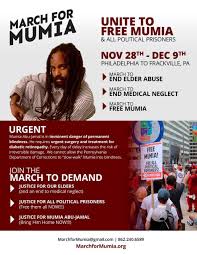
The People’s Organization for Progress (POP) will participate in a 103-mile march to draw attention to the worsening medical condition of political prisoner Mumia Abu-Jamal. It will begin Friday, Nov. 28, in Philadelphia, Pennsylvania.

The “March For Mumia” will start at 9 a.m. at Uncle Bobbie’s Cafe & Books, 5445 Germantown Avenue in Philadelphia. The event is sponsored by the March For Mumia coalition.

“We are marching to demand freedom for Mumia Abu-Jamal and all political prisoners,” Lawrence Hamm, Chairman, People’s Organization For Progress, stated.

“We are also marching to demand an end to the abuse that Mumia and other political prisoners experience, and that they receive the proper medical attention and care they need,” Hamm said.

The participants will walk 103 miles over twelve days until they reach the SCI Mahanoy Corrections Facility in Frackville on December 9th, where Abu-Jamal is incarcerated. Hamm said he will attempt to march to entire route.

Mumia Abu-Jamal is a renowned journalist and author who has written more than a dozen books. He is a revolutionary, political activist and former member of the Black Panther Party.

Abu-Jamal, 71 years old, has been incarcerated for 44 years. In 1981, he was convicted for the murder of Daniel Faulkner, a Philadelphia police officer.

His death sentence was subsequently commuted to life imprisonment. He has always maintained his innocence. His case, the issue of his innocence, and his fight for freedom have garnered international support over the decades.

Many well-known political activists, celebrities, and human rights organizations, such as Amnesty International, have demanded a new trial for Abu-Jamal. He has become a prominent personality in the fight to end racism, mass incarceration, inhumane treatment of prisoners, and the death penalty.

“We believe that Mumia is innocent and should be free. We demand freedom for all political prisoners. At a minimum Mumia should have a new trial,” Hamm said.

Over the years POP has held demonstrations rallies and programs to draw attention to Abu-Jamal’s struggle for freedom and his fight for medical care. More than a decade ago Hamm personally visited Abu-Jamal at the prison in Frackville.

“Mumia has been an elder for some years and has been experiencing very serious health challenges. He is in danger of going blind if he does not have surgery and treatment for diabetic retinopathy. We are marching to demand the Department of Corrections provide it,” he said.

The People’s Organization For Progress is part of the March For Mumia coalition. Besides Hamm other POP members will be marching including community organizer and poet Zayid Muhammad, and activist Steven Bernhaut.

“We invite everyone to join us for the march whether you can march one day or twelve days, or whether you can march one mile or 100 miles. Even if you can’t march come out and cheer us on. We need your support,” he said.

“When I march for Mumia I will also be marching for an end to mass incarceration, the death penalty, and slave labor in our prisons. I will be marching for all those treated unfairly and inhumanely by the criminal justice system,” Hamm said.

For more information contact March For Mumia at (862) 240-6589, or MarchforMumia@gmail.com. Visit the website at MarchforMumia.org. To contact Lawrence Hamm call the People’s Organization For Progress at (973) 801-0001.

-END-

FOR IMMEDIATE RELEASE

Contact: Steven Bernhaut, 201-960-9204; marchformumia@gmail.com

Website: http://www.marchformumia.org

MARCHERS TO KICK OFF 103-MILE WALK FROM PHILADELPHIA TO FRACKVILLE, PA TO HIGHLIGHT PRISON ABUSES AND TO FREE MUMIA 

“Many people say it is insane to resist the system, but actually, it’s insane not to.” — Mumia Abu- Jamal

Philadelphia, PA — Starting at 9 a.m., Friday, Nov. 28, activists, community leaders, and families of the incarcerated will gather next to Uncle Bobbie’s Bookstore at The Market Square Monument, 5447 Germantown Ave, Germantown, Philadelphia to embark on a March for Mumia, a 12-day mobilization demanding freedom for journalist and political prisoner Mumia Abu-Jamal, and calling attention to the systemic crisis of elder abuse, medical neglect, and politically targeted incarceration.

After libations and a few speakers, marchers carrying signs will  walk 7.1 miles up Germantown Ave. through Mt. Airy and Chestnut Hill and eventually to Miles Park in LaFayette Hill, where participants will share food and solidarity.

For 11 more days, marchers will walk for 3-6 hours daily for 7-12 miles until they reach SCI Mahanoy in Frackville, PA on Dec. 9. Once there, participants will present a list of demands to the facility’s Superintendent, Bernadette Mason. 

Abu-Jamal, 71 years old, suffers from chronic health conditions—including heart disease and vision loss—worsened by what his family and supporters describe as medical neglect by the Pennsylvania Department of Corrections. Jamil Abdullah Al-Amin (formerly known as Black Power activist H. Rap Brown), following complaints of elder abuse and medical neglect by his family and supporters, died Nov. 23 after 23 years in prison for a crime he did not commit. Al-Amin’s and Mumia’s conditions reflect the broader crisis of this country’s aging prison population amid decades of medical neglect, as our brothers and sisters behind bars are routinely denied adequate care and proper food.

The March seeks to highlight these abuses and demands an end to the systemic neglect of elderly and sick incarcerated people across the U.S. and the immediate release of Mumia Abu-Jamal and other political prisoners.

Born in 1954, Abu-Jamal grew up in Philadelphia amid racial segregation and police violence. As a teenager, he joined the Black Panther Party and later became an award-winning journalist known for exposing systemic racism and police abuse. His reporting challenged Philadelphia’s power structure, earning him recognition—and hostility—from local authorities.

In 1981, Abu-Jamal was arrested and convicted of the shooting death of a Philadelphia police officer. His 1982 conviction was tainted by racial bias, coerced testimony, and judicial misconduct. Although a federal court overturned his death sentence in 2001, he remains imprisoned for life without parole. Despite decades of appeals and evidence of prosecutorial misconduct and constitutional violations, the state has blocked every attempt to grant him a fair trial.

Prominent voices including Amnesty International, the United Nations Working Group of Experts on People of African Descent, Bishop Desmond Tutu, Maya Angelou, Nelson Mandela, Toni Morrison, the National Association of Criminal Defense Lawyers, the International Longshore and Warehouse Union (ILWU), the International Transport Workers Union and the Congressional Black Caucus, among others, have long called for justice for Mumia and for his release. 

March organizers and endorsers unite under a shared belief in the dignity of all human beings. It’s time to end a system that treats people as disposable.

Visit http://www.marchformumia.org for more details.

-30-

Who are the blind ones ? – a #poem #newspoem about #MumiaAbuJamal by #JuliaWright

Who are the blind ones ? – a poem by #JuliaWright

if we do not protest
Mumia will go physically blind
but who are those whose blindness
is beyond surgery ?

the corporate press
is paid to be blind
to Mumia’s upcoming blindness

the white terror-ists
are blind to the fact
that each time they attack us
they offer us a platform
to speak back

the corrupt police state
cannot see the house
they live in
is made of glass

Judge Lucretia Clemons
and the DA
threw away the spectacles
that would have enabled them
to read
the writing on Truth’s wall

so who are the blind ones ?

those whose dark spiritless vision
the diagnosis of History
has no further treatment for

(c) Julia Wright. September 8th 2025. All Rights Reserved.

[09-07-25 UPDATE] REGISTER NOW TO ATTEND URGENT #MUMIAABUJAMAL PRESS CONFERENCE, FRIDAY AUG. 29: Doctors Warn of Permanent Blindness Without Immediate Treatment

tinyurl.com/mumia-eyesight

SEPTEMBER 7th UPDATE: