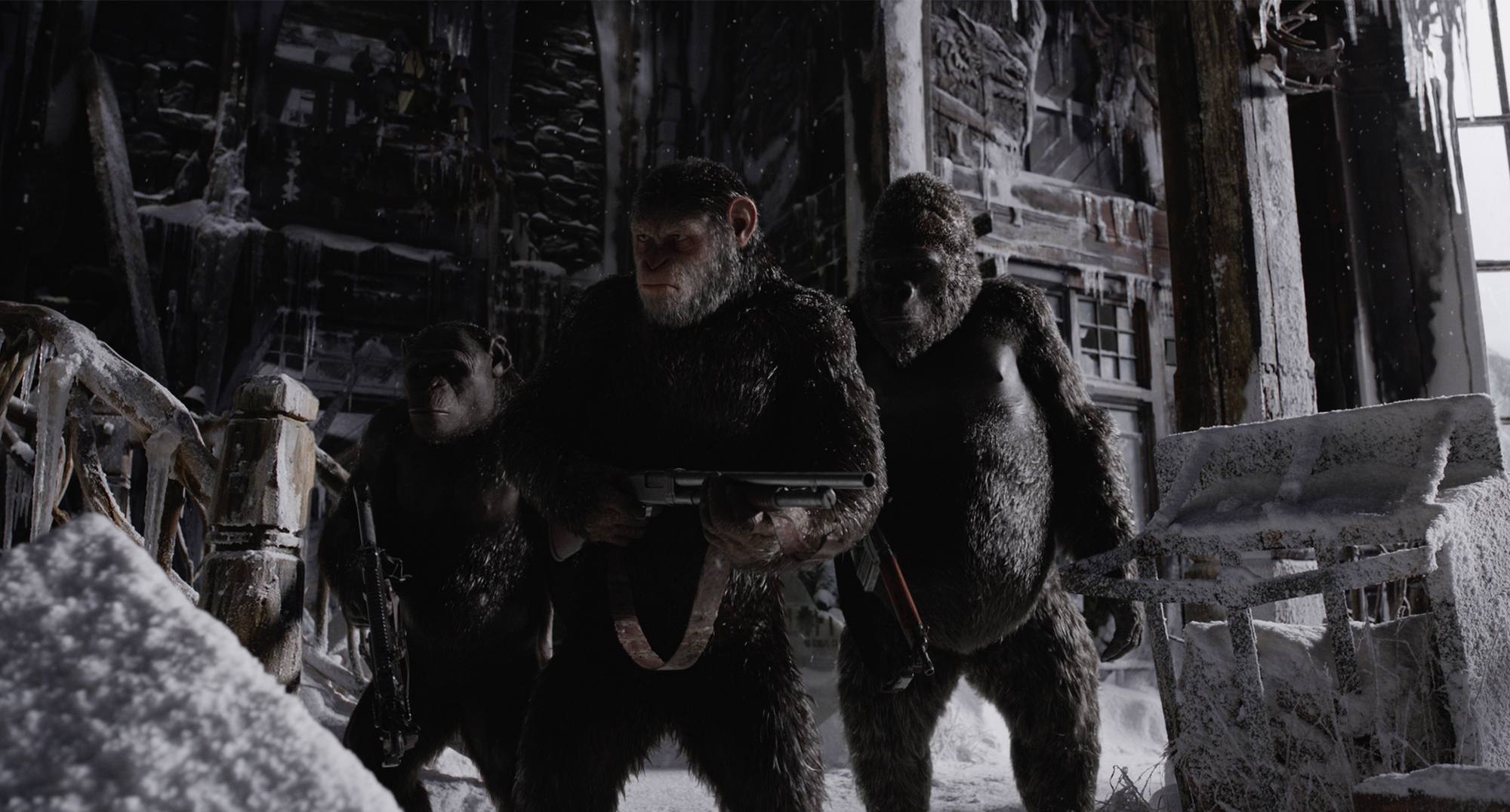
A film detailing why humanity deserved its fate. Blood, fire and snow purifies. And no, Moses does not make it to the Promised Land, but dies happy. Deserves to be in the pantheon of World War II-POW films, like “Stalag 17” and “The Great Escape.”
A film detailing why humanity deserved its fate. Blood, fire and snow purifies. And no, Moses does not make it to the Promised Land, but dies happy. Deserves to be in the pantheon of World War II-POW films, like “Stalag 17” and “The Great Escape.”

The Prey of Gods.
Nicky Drayden.
Harper Voyager.
377 pp., $15.99.
In the multicultural South Africa of 50 years from now, expertly carved out from the ether by Drayden, a Black American woman, the future belongs to those willing to grasp it with both hands and at least one foot, to feel the fear and evolve anyway. The fact that most of the identity struggles the main characters experience are (now considered) universal does not take anything away from Drayden’s superb skill in making them flesh (and metal, and….). Zulus and walking Ancestral trees mingle with demi-gods and sentient robots, while the pitfalls of both pop celebrity and drug abuse take new, fascinating societal forms. The novel, one that proudly wears its LGBTQIA gender orientation politics as a full body-length tattoo, takes waaayyy too long to get to a loooonng climax, but ultimately satisfies, its last-minute twists turning a well-established (hetero white male), sometimes-dense literary genre into post-modern, not-ashamed-to-be-accessible, post-feminist pop art. When the characters finally interact and transform, the reader happily devours the book’s pop-culture-inspired gumbo. Drayden has written a sci-fi novel that, for the most part, owes neither Isaac Asimov nor Octavia Butler; it’s a new product for the 21st century fan who wants and needs a fun, culture-based read.

……is here.
Here’s the block that got cut out, about the biographer and the his approach:

If there is ever to be a Hall of Fame for post-World War II American biographers, David Garrow has worked undeniably hard for his statue. The energy and sweat required of a great biographer are present. The book’s promotional material says Garrow does research worthy of Robert Caro, the man who has devoted half his life to writing about Lyndon Baines Johnson, and the hype is right. His thousands of resources include The Chicago Defender and several weekly newspapers, which allows him to use facts and statements others have forgotten. He had access to an incredible amount of detail, and decided to use (almost all of) it, to give the reader almost a month-by-month portrayal of 46 years.
Since the fable is so well-known, Garrow needed to perform a tragedy to give the reader a reason to re-visit this territory. He constantly prepared the reader for disappointment, showing that the potential compromises were there all along under the winning smile and Black Kennedy mystique: “[W]hile the crucible of self-creation had produced an ironclad will, the vessel was hollow at its core.”
The so-called hot news of the book—that Barack Obama, a young, over-educated, tall, handsome, single Black man, had a lot of sex before he got married and that he asked his serious live-in girlfriend, a half-white, half-Japanese woman named Shelia Miyoshi Jager, to marry him—is a complete yawner. The story that Garrow tells as he outs Jager is that Obama broke up with her because he needed a Black woman (World History, meet Michelle Robinson) to be a successful Black politician. So what that he asked another woman to marry him? Choosing a wife is a life-effecting process, not just a political one. It is possible that Obama made the decisions he did for purely Machiavellian reasons, but it is equally possible that Obama, a Half-rican, purposely chose a one-hundred-percent American Negress so he could have an authentic Black family. Just because he loved Jager doesn’t mean he was supposed to spend his life with her, and just because they wanted to marry doesn’t mean history was somehow thwarted by ambition.
Garrow is filled with critique—of Obama and of crush-ing Obama journalists and biographers. In his blistering epilogue, Garrow skips the most obvious reason his presidency was impotent: the intent of the Republican Party to oppose him on everything, from the administration’s first day. The epilogue is so intent on being critical—and it should, considering it’s about a man constantly compromised in ways he sees as pragmatic and necessary—it seems not to care where the criticisms originate. Meanwhile, Garrow ignores the most biting Leftist jabs. Strange choices for a left-of-center author. Garrow finds every disappointed friend, every Obama enemy, every teacher and influence he can, and includes them along with seemingly every colleague who at any point praised him. Jager accusing the president of political cowardice is the high-note of a critical symphony.
JUNE 7th UPDATE: Thanks to Jared Ball for this discussion!

…….is here.

Chris uses cotton to stop the brainwashing. This film is filled with interesting historical turn-around tidbits like that.
I like the idea of a horror version of “Guess Who’s Coming To Dinner.” Having white people take the next logical step in their Black fetish was frankly, refreshing to see on-screen, as was the Black hero not being afraid to take out the (white) monsters the way monsters need to be taken out.
Milton “Lil Rel” Howery not just stole every scene he was in, he took them hostage and killed them all after the ransom was delivered.
A psychological sci-fi/horror film, simply done but, contradictorily, with great thought behind the non-complexity.
![Panel discussion on ÒKnowledge from experience: Building the post-2015 development agenda with people living in extreme povertyÓ [organized by the International Movement ATD Fourth World, in collaboration with the Permanent Missions of France, Peru and the Philippines, the Organization International of la Francophonie (OIF), the Non-Governmental Liaison Service (NGLS), the Friedrich-Ebert-Stiftung, the Institute of Development Studies (IDS), the International Trade Union Confederation (ITUC) and Social Watch]](https://drumsintheglobalvillage.com/wp-content/uploads/2017/03/aminamohammed.jpg)

I had tried to avoid seeing BET’s “Madiba,” because I was afraid of it being really, really bad. I caught parts of it last night and was pleasantly surprised. Laurence Fishburne will die giving some great performance somewhere.
(Dear BET: I’m sure I’m in the minority here, but the little I saw last night made up for six hours of “New Edition” 🙂 Yes, I will relectantly admit it was a supergroup, but still….. SIX? LOL! I turned it off after the group sang “Can You Stand The Rain.”)
Anyway, the little I saw of “Madiba” last night was the Mandela that I had read about.
It made me think about how many times I’ve seen Madiba portrayed on screens big and little over the last 30.
Here are my five Mandela portrayals, from best to worst, with small commentary:
It’s a looooong wait until Feb. 21.