
PARIS—Let’s just make this point up front that kept being made all weekend: James Baldwin was not an expatriate, and he didn’t escape anything. Maxine Gordon, Dexter’s wife, told a story about the couple meeting Baldwin at a Harlem party (her first time), and the writer calling out to the jazz master: “Hey, Dex, I was reading in the paper that we were expatriates. I thought we just lived in Paris.”
Baldwin said repeatedly that he made France his (writing) home—first from 1948 to the early stages of the Civil Rights Movement in late 1950s, then from 1970 to his death in 1987 at the age of 63—because he was afraid that, as a Black man, he was going to either kill or be killed in America. During his first exile, he believed he would be murdered by Northern white racists; the second, by the Federal Bureau of Investigation or the Central Intelligence Agency. With two very different generations of Black male writers and artists—elders Ralph Waldo Ellison, Albert Murray and Romare Bearden on one end, and his younger, fiercer critics LeRoi Jones/Amiri Baraka and Ishmael Reed on the other—all determined to either bloody, or proudly survive being bloodied in, America, Baldwin, stuck in the middle of opposing generations and ideologies, received brickbats for becoming a long-term Trans-Atlantic commuter.
The writer’s relationship with France, Paris specifically, was the topic of no less than three panels at the James Baldwin International Conference, held last week at The American University of Paris. About 240 scholars, activists and writers from across the world came to a cautious nation –in a state of emergency until next month, implemented after last November’s terrorist attack—to honor their hero by gathering in his name and examining every facet of his life and work they could squeeze into the three days.
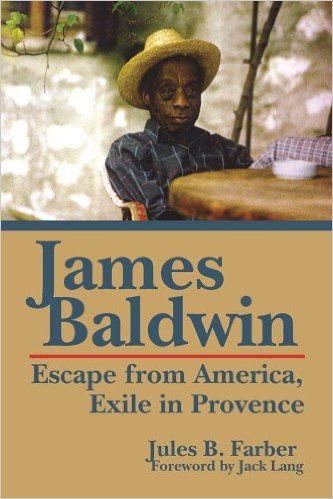
Before the conference opened, I read galleys of Jules B. Farber’s “James Baldwin: Escape From America, Exile in Provence” (Pelican), a new full-length book on Baldwin’s base of operations in the southeastern corner of France. Scheduled to be published next month, it revealed a very complicated negotiation on Baldwin’s part with the European version of white supremacy.
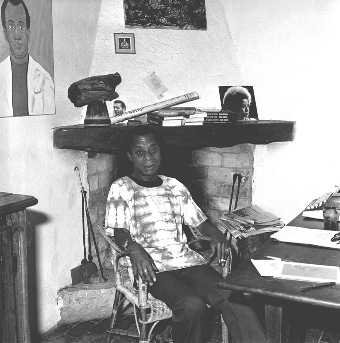
Provence, specifically the commune of Saint-Paul de Vence, allowed him to recover from the deep depression he felt from losing Malcolm and Martin—“Far from the Harlem tenements,” writes Farber, “this was paradise for Baldwin, who, with childlike glee, wandered barefooted in the groves, picking fruit and nuts”—but he would have to work hard at creating that permanent respite. The story of how with only sporadic rent payments and a stack of IOUs, he slowly charmed Ms. Jeanne Faure, his white racist landlady, to virtually give him the Saint-Paul house he would live and work in for 17 years, is worthy of a one-act play. It’s an extraordinary example of a former “boy preacher”’s ability to make a convert—provided the renter was the commune’s sole Black and, much more importantly, internationally famous.
That fame reverberated in ways that buoyed the spirits of the lonely writer. Baldwin transformed his house, and, therefore, his adopted community, into a must-stop, a welcome table, for traveling celebrities who sought refuge from congested Paris. It’s important to note that virtually all historical accounts show Jimmy as great company, whether entertaining American luminary friends at his home, or heavy drinking among locals in a bar in politically and socially conservative Saint-Paul. His survival instinct was always sharp, and he always made sure to surpass the needed mark.
That house, the subject of a long legal fight since Baldwin’s death and the site of at least two recent journalistic pilgrimages, is in a state of disrepair and may be destroyed. The novelist and essayist who died in that house is considered one of Paris’s many, many, national treasures, but as international travelers quickly learn, currency is constantly in flux, and the value of exotic trinkets relative.

When Baldwin wrote in his last book, “The Evidence of Things Not Seen,” that the Western World was “located somewhere between the Statue of Liberty and a pillar of salt,” he meant France, too. Lest we forget, the statue was an 1886 gift to America by France and created by Frédéric Auguste Bartholdi, a French sculptor, to celebrate, from the perspective of the formerly enslaved, their Jim Crowed, Reconstructed freedom offered by America.
“At the center of the European horror,” Baldwin continued, “is their religion: a religion by which it is intended one to be coerced, and in which no one believes, the proof being the Black/White conditions, or options, the horror into which the cowardly delusion of White supremacy seems to have transformed Africa, and the utterly intolerable nightmare of the American Dream.”
And France, as one of the members of the European axis of evil, did transform L’Afrique: it conquered lands now known as Senegal, Guinea, Niger, Chad…..the list can go on well into the next article. It was defeated by Africans who declared a free Black country called Haiti, but the price of that freedom ticket was to pay the French reparations! It’s such a beautiful country. But although it’s not hard to figure out why, it is hard sometimes to remember why when its splendor soaks into the soul. All throughout time, beauty seduces to hide away ugly truths for as long as it can, and France has beaucoup d’expertise.
(As the Baldwin conference closed, The Washington Post reported that French President Francois Hollande announced the nation would create a memorial and museum devoted to the country’s role in the slave trade. The Franco-Algerians, France’s long-suffering and abused immigrants, are still waiting for any such equivalent public acknowledgement and study of, say, the Algerian Massacre of 1962. And Gordon, explaining how the French love to spotlight American racism but remain in denial about their own, held up an issue of Liberation, a French tabloid that made that day’s cover story about Ferguson.)
Panel presenter Dorrie Wilson explained how in 2016, it’s not just the Franco-Algerians who are, as Baldwin famously called them, France’s niggers. Citizenship in Paris today, she explained, is determined by France’s arbitrary power, which creates a permanently unstable relationship for its residents who have settled into their new nation, including those recently arrived, and unwanted, Afghan, Syrian and other migrants. They are all eternal strangers in the village, she explained. And last November’s terrorism attack, she held, has made things worse, the xenophobia increased.

These ridiculous contradictory European (read: white) impulses are why “Meeting The Man: James Baldwin in Paris,” a 1971 documentary screened at one of the Baldwin/Paris conference panels, produced laughter and irritation from the assembled scholars. In the film, the novelist throws the European filmmaker’s plans for a combo travelogue-literature chat into the rubbish bin. He instead of being filmed associating with Franco-Algerians and standing in front of the Bastille, the prison that was torn down—stormed, actually—during the French revolution. Baldwin literally stood tall in front of it, mentioned that there were political prisoners in America and proclaimed: “I could be Bobby Seale. I could be Angela Davis. I could be Medgar Evers…I’m not interested in giving you ‘James Baldwin’s Paris.’”
Baldwin demands his own platform right then and there, and gets it. He exposed the double-standard of the Bastille being a symbol of liberation because the prisoners were white, when, if the imprisoned were Black, they’d be considered savages by Europe. He may have loved his enemies, but he proved he knew them well when he told the ignorant, exasperated European filmmaker that, “You [the white Western world], for me, is my prison. You are my warden.” That’s not the theatrics of a man ridiculed for decades as “Martin Luther Queen”: that’s a meaningful symbolic gesture in, and at the heart of, France. His stance is the equal of any such public act of Frederick Douglass or Ida B. Wells-Barnett in America.
As a “writer in a revolutionary situation,” as Baldwin describes himself later in the flick, he had to know, ever stuck in the middle—between Europe and America, and promising both rage and reconciliation (“I’m a Black man in the middle of this century”)—when and where to claim his historic space. He chose well, and it’s one of the reasons that what the conference organizers and participants referred to as “Baldwin Studies” is just beginning.
Baldwin_Poster








 Drums in the Global Village