This article was conceptualized, directed, and authored by Wautella Ibn Yusuf with digital composition and editorial assistance provided by #AI.
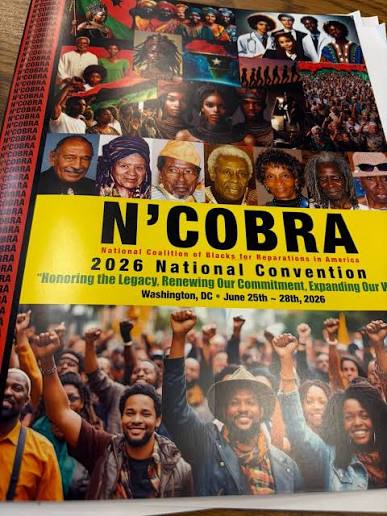
In June 2026, members and supporters of the National Coalition of Blacks for Reparations in America (N’COBRA) gathered in Washington, D.C., for a National Convention that became much more than a four-day gathering. Planned under a remarkably short timeline, the convention nevertheless brought people together for serious dialogue, powerful teaching, practical organizing and celebration. By the time participants left, the prevailing feeling was not simply that the convention had gone well. It was that N’COBRA had renewed its sense of purpose and had laid important groundwork for the year ahead.
The convention opened June 25 with one of its most consequential and courageous conversations: a discussion of reparations eligibility and the longstanding debate between a lineage-based approach focused on descendants of enslaved Africans in the United States and a comprehensive approach focused on Black people of African descent in the United States.
The session was designed to bring differing perspectives into the same room for substantive discussion rather than allow disagreement to remain a source of division outside the room.
Attorney Adjoa A. Aiyetoro, a founding member of N’COBRA and a longtime leader in the reparations movement, played a central role in bringing this difficult conversation to the forefront. The session demonstrated the value of creating space for disagreement while insisting on engagement, critique and a shared commitment to the larger reparations struggle. The discussion was not without tension, but its very existence was significant: a serious movement about achieving reparations must be capable of confronting hard questions openly and continuing to organize together.
The next two days moved from debate to education, analysis and action. Friday’s plenary, led by Dr. Cheryl Grills, offered a powerful examination of N’COBRA’s Five Injury Areas. Her presentation connected the historic injuries produced by enslavement and its legacies to the ways those injuries continue to affect Black people of African descent today. She also drew attention to newer and less visible forms of injury embedded in contemporary institutions, structures and technologies.
The Five Injury Areas framework gave the convention an important bridge between history and the present. It also connected directly to the work of N’COBRA’s commissions. The commission workshops were deliberately designed to be “work”shops: participants examined the scope of each injury area, reviewed work already undertaken and then developed plans for the coming year. Rather than simply listening to presentations, participants were expected to leave with concrete direction for July 2026 through June 2027. The response indicated that the approach worked.
Attorney Nkechi Taifa, another founding member of N’COBRA whose leadership in the reparations movement spans decades, moderated Dr. Grills’ plenary. Her role helped sustain the energy and engagement of the audience and contributed to the quality of the discussion. The presence and continuing leadership of both Aiyetoro and Taifa offered a visible reminder that N’COBRA’s nearly four decades of organizing history remain connected to its work today.
Saturday’s keynote plenary featured Dreisen Heath, a major voice in the movement’s federal legislative work. She focused on the importance of state and local reparations efforts in building toward federal reparations and described additional federal initiatives that could provide forms of reparative relief to Black people of African descent. Her presentation underscored the relationship among local, state and federal organizing and the importance of continuing the work around H.R. 40. Heath’s participation also reflected the significance of bringing leading movement strategists into direct conversation with N’COBRA members.
The convention’s program demonstrated that N’COBRA is not simply preserving a history of reparations organizing. It is continuing to develop the analysis and strategies necessary to move the struggle forward. The commission sessions, in particular, gave members an opportunity to translate knowledge into plans and to identify work that can be carried forward over the next year.
The convention also created opportunities to celebrate the movement and the people who sustain it. At the Gala Banquet, keynote speaker N’nanba (Robin Rue Simmons) brought the experience of Evanston, Illinois, into the room as evidence that reparations are achievable. She spoke of the progress made in Evanston and elsewhere and emphasized that legal challenges should not necessarily be understood as signs of failure. Instead, they can be evidence that reparations demands are being taken seriously and are helping to establish the legitimacy of the movement’s claims.
The Gala’s theme, “Yes, We Can,” captured the evening’s spirit. After the formal program, participants filled the floor with dancing, old line dances and newer ones alike. The celebration was more than entertainment. It was an expression of the joy, community and persistence that make long-term movement work sustainable.
The convention concluded June 28 with a journey to Great Falls, a site connected to the lives of enslaved Black people in Maryland and Virginia and to the post-emancipation period. The trip offered a fitting opportunity to honor ancestors and connect the present-day reparations movement with the people whose lives and labor created the history being confronted.
Brother Greg Carr’s libation at Great Falls provided a particularly powerful moment of remembrance. Participants described the ceremony as deeply moving, with a palpable sense of connection to ancestors, including those who lived at Great Falls and the founding and former leaders of N’COBRA who have passed on. Corey Shaw Jr., co-chair of the N’COBRA D.C. Chapter, provided an informative presentation on the history of Great Falls and the Black people who lived there.
Corey and fellow D.C. Chapter co-chair Kibibi Tyehimba deserve particular recognition for the chapter’s willingness to host the 2026 National Convention in Washington. Hosting a national convention places substantial demands on a local chapter, and their leadership helped make it possible for N’COBRA to gather in the nation’s capital. The convention’s success therefore belongs not only to the National Convention Planning Committee but also to the local leadership and members who assumed responsibility for welcoming the organization.
The Commemorative 2026 Convention Program Book is another lasting product of the gathering. Designed as more than a temporary event program, it preserves information about N’COBRA, the convention and the broader history and perspectives of the reparations movement. Wautella Ibn Yusuf was the driving force behind the publication, with longtime N’COBRA friend Zama Cook contributing to its printing and culturally grounded design. The book stands as a resource that can continue to inform members and others long after the convention itself has ended.
The convention took place just days before the July 4th celebration of the United States’ 250th anniversary, creating an important broader context for N’COBRA’s work. In its July 4 statement, N’COBRA challenged celebratory narratives that present the nation’s history primarily through claims of democracy, freedom and wealth while failing to confront the foundational role of enslavement and the continuing injuries produced by it. The convention’s discussions of injury, resistance, reparations and repair therefore occurred against a national backdrop in which competing versions of American history were very much in view.
That context reinforces the importance of the Five Injury Areas work and N’COBRA’s continuing educational mission. The organization’s developing website materials offer readers an opportunity to examine the injuries produced over centuries, the ways those injuries have changed and the continuing resistance of Black people of African descent. The convention did not stand apart from that work. It was one expression of it.
Most importantly, the convention produced momentum. It brought people together around difficult questions without allowing disagreement to erase the larger purpose. It deepened understanding of the injuries that reparations must address. It created concrete commission work plans. It connected federal, state and local strategies. It honored the ancestors. It celebrated the victories already achieved. And it sent participants home with work to do.
That may be the most fitting way to understand the 2026 N’COBRA National Convention. It was a celebration, but it was not simply a celebration. It was a place to learn, to argue, to plan, to remember, to laugh, to dance and to recommit. It demonstrated what can happen when people with a long history of struggle come together with the determination to keep building.
As N’COBRA turns toward 2027, the challenge is to build on that momentum. The recommendations coming out of the debriefing call for an earlier start to planning, a host chapter with a committed core membership and a national-local planning structure established well in advance. Those changes can help ensure that the next convention has the benefit of the lessons learned in 2026 while preserving the spirit that made this gathering so meaningful.
The final message of Washington was therefore a simple but powerful one: the work continues. The knowledge gained at the convention will inform the commissions. The plans developed there will guide the coming year. The history remembered at Great Falls will continue to ground the movement. And the spirit of “Yes, We Can” will carry forward—not as a slogan, but as a commitment to the continuing struggle for reparations, justice and repair.
************
FROM AI:
The National Coalition of Blacks for Reparations in America (N’COBRA) identified five major injury areas suffered by African descendants due to chattel slavery and its ongoing systemic legacies. These five areas are Peoplehood/Nationhood, Education, Health (including mental health), Criminal Punishment, and Wealth/Poverty (Economics).
The Five Injury Areas Defined
Peoplehood/Nationhood: The loss of the right to culture, language, family structure, and self-determination as a distinct group.
Education: The historic and ongoing denial of equal learning access, including laws that made teaching enslaved people to read a crime.
Health: Physical and mental health disparities stemming from centuries of trauma, stress, and unequal access to medical care.
Criminal Punishment: Disproportionate and discriminatory treatment within the legal and prison systems originating from slave codes and Black codes.
Wealth/Poverty: Severe economic disparities and wealth gaps caused by unpaid labor, systemic exclusion, and restricted financial resources.
For more context on how these categories shape repair strategies, you can review the outline provided by N’COBRA. Additional historical insights are also discussed by the National Conference of Black Lawyers.