…..is here.
…………I’ll have to be satisfied with this new, and fine, journal article by Christopher M. Tinson.
The biography, coming early next year, will be called “Ebony Magazine and Lerone Bennett, Jr: Black Popular History in Postwar America” by James West.
West tells me that I need to check out a forthcoming book on Hoyt Fuller by Jonathan Fenderson. It’s now on the list.

The official media material says:
Black Panther earns three Oscars. Since its inception Marvel Studios’ Black Panther has provoked and stoked a wide range of interest, and now that the blockbuster film is the recipient of three Oscars the film’s acclaim extends beyond the box office.
No, it didn’t get the top prize, but it was a barrier breaker as Ruth Carter was the first black woman to ever win in the Costume Design category; and another first for a black artist when Hannah Beachler took the trophy, which she shared with Set Decorator Jay Hart, in Production Design. Additional spice arrived when Ludwig Goransson earned an Oscar for the Best Score in a Motion Picture.
These awards and other nominations for Black Panther augurs well for populist cinema that is traditionally scorned when it comes to taking home the coveted awards, particularly an Oscar, which is Marvel’s first.
It’s a good bet the honors to Black Panther will not only boost the appreciation for populist cinema, it should also enhance the appeal of a number of products and projects such as Black Panther: A Paradigm Shift or Not? the forthcoming anthology at Third World Press, edited by Haki Madhubuti and Herb Boyd. “All of the celebration and awards for the film is nothing to thumb your nose at and we at Third World Press extend all our good wishes and hope we can do as well with our publication,” said Madhubuti, the press’s publisher and founder.
The anthology, which includes more than forty writers, film critics, scholars, and activists, has a timely appearance and should be able to reap some of the renewed media attention the film has sparked. Among the contributors are Nicole Mitchell Gantt, Jelani Cobb, Brent Staples, Abdul Alkalimat, Bobby Seale, Robyn Spencer, Diane Turner, Greg Tate, Maulana Karenga, Marita Golden, and Molefi Keta Asante, et al.
As may be discerned from the contributors the anthology is a compilation of mixed views and opinions―with both praise and a critique of the film. “The film has aroused a variety of conclusions, a wellspring of differences that we felt compelled to give them a forum,” said Boyd. “Like the film, the views expressed in the book are often very provocative.”
The above conversation was one of the many accomplishments of this television program. The trailer for the documentary film on the program can be found below.

This month not only marks the first anniversary of the release of “Black Panther,” a.k.a. The Film That Won’t Go Away. What will be little noted is that this February is also the 40th anniversary of another well-remembered African/African-American moment.
On the small screen in February 1979, James Earl Jones, fresh from his then-uncredited voice-over role as Darth Vader in the first “Star Wars,” was seen in a safari shirt and glasses on every ABC-tuned television in America, stabbing his pen into a pad, shouting the following into the then five-channel television universe: “You old African! I found you! I found you! Kunta Kinte, I found you!”
“Roots: The Next Generations,” the mammoth 1979 sequel to the groundbreaking 1977 original, ends with Haley’s (Jones’s) journey to the Gambia to search for the young ancestor who was captured when, as the Haley family legend goes, he went into the woods to make himself a drum.
The search for Haley’s fantasy-ish Juffure resonated with African-Americans (in fact, it’s partly how we eventually accepted that term for ourselves in the late 1980s), and with millions more who wanted to find out about themselves. It’s the core story, the central idea that, in 2019, spurs those Ancestry.com commercials and has given Henry Louis Gates, the Harvard Africana Studies professor, a new career in public television.
Haley’s historical novel and the vision of comicbook legends Stan Lee and Jack Kirby hold more similarities that one thinks. Aren’t both the imaginary product of 1960s magazine content producers? Isn’t Killmonger just a version of Kunta Kinte who finally makes it back home and reclaims his birthname and birthright? Isn’t the Juffure showed in “Roots: The Next Generations” a low-tech Wakanda of sorts—a (relatively) unspoiled, seemingly un-interrupted Africa?
Although “Roots” was created for television as an American family tale, it nevertheless brought home the central tenets of Black Power and Afrocentrism—that we are an African people. ABC broke through with a depiction of Africa that defied the “Tarzan” movies from the 1930s through the 1950s that were a staple of Saturday afternoon viewing on local television channels. For a people that had recently abandoned “Afro-American” for Black, the contrast was jarring. I was 9-years-old when the first “Roots” miniseries aired, and it shook me to the core. But not completely: I still loved those Tarzan films, watching them for years afterward, but I began to wonder why I couldn’t understand the Africans, and why they kept dying consistently.
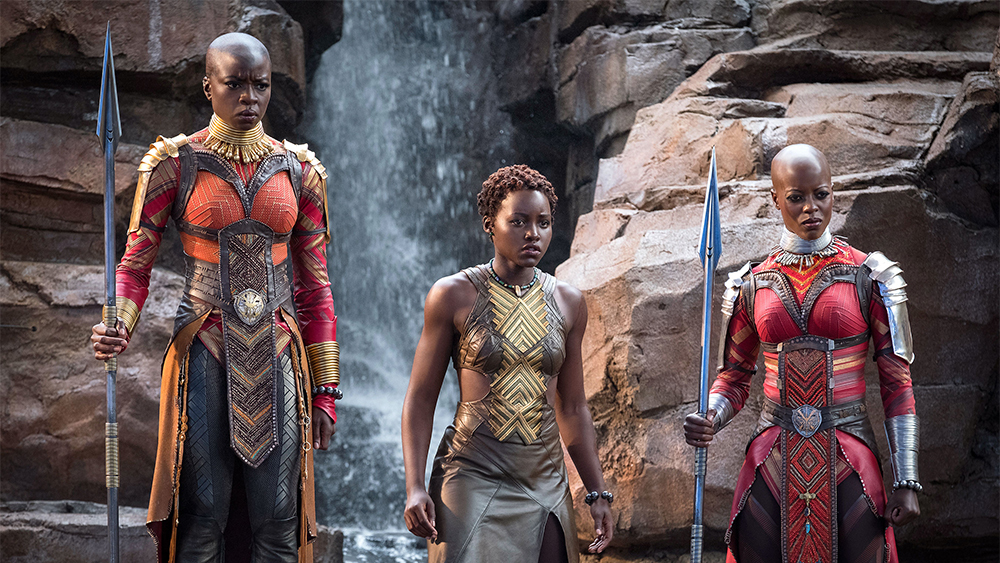
Marvel Studios’ BLACK PANTHER
L to R: Okoye (Danai Gurira), Nakia (Lupita Nyong’o) and Ayo (Florence Kasumba)
Credit: Matt Kennedy/©Marvel Studios 2018
What happened between “Roots” and “Black Panther?” More knowledge. Africana Studies—now in its 50th year, struggling to survive, but back then growing and expanding as a discipline. Sci-Fi-era technology that allows us to see Africa and converse with Africans every day. World travel not being a big deal anymore. A growing Afro-futurism movement that is including all people of African descent, regardless of geography, gender or gender orientation. So “Panther” came right on time, as a production of visual African/Black nationalism, a visual sense of Black/African victory, to counter the white nationalism of Trump and Brexit.
The very idea that the African Union has set out to create a Wakanda shows that even Africans are searching for the Africa they see in their own minds. Imagination serving its highest role—as inspiration. (I hope and pray that the AU, thus inspired, will turn down requests for the Chinese to build it.)
For better or worse, Black History Month now has an imaginary element. We have merged with Kunta Kinte, and have turbo-charged his drum with Vibranium. Using American mid-20th century fantasy, we have gone in our minds from victims of colonization to superheroes forging our own destiny. In 2019, we have checked our DNA, and know more fact than fiction about ourselves. Of course we are of African descent, we now say, confused how anyone could think otherwise.
Whether “Black Panther” wins any Oscars later this month is much less important than this truth that might double as fact: Ryan Coogler, T’Challa, Okoye and Shuri have killed Tarzan, for real this time.
I don’t remember what year this was, but I do recall how kind the Barakas were. Long had I promised to take Saswat to meet the Barakas, so when his father came to visit from India, the time was more than right. Saswat’s dad is a major poet and activist, and was very happy to meet them. Lez Edmond never missed a good time, and knew Mr. Baraka for decades. So, stars properly aligned, we all got together and Saswat, the creator of this blog, pulled out his camcorder.
In my new book on the Black Panther, I say this about Stan Lee and Marvel:
Growing up as a superhero-obsessed tyke in the 1970s, I saw the 1967 Spider-Man animated series (the one often called Spiderman, mistakenly without the hyphen between “Spider” and “Man”) and the Batman and Superman live-action series every weekday in second-run syndication and watched every version of The Superfriends every Saturday morning on ABC. I even devoured those gawd-awful Spider-Man live-action specials on CBS, as well as the two almost-as-bad Captain America and Dr. Strange movies that aired on that network. The fact that CBS aired quality live-action superhero shows like The Incredible Hulk and, in its second and third seasons, Wonder Woman (a refugee from ABC) almost made up for those terrible also-rans. And of course, I loved Superman: The Movie.
During that decade, I slowly discovered comicbooks. Marvel became my favorite. I think that was due to my all-time favorite characters, The Fantastic Four and the Silver Surfer, with Captain America as a runner-up. (I count the FF as one character.) My fifth-grade teacher had a copy of Bring On The Bad Guys, the third volume of the Simon and Schuster trade paperbacks that reprinted early Marvel stories with writer Stan Lee’s introductions. That’s where I discovered the FF, The Surfer and Cap in separate epic tales.
I still remember my shock when I found out that my favorites had been animated! Hanna-Barbera decided to syndicate, as a weekday “wheel,” all its 1960s Saturday morning superhero-action fare. Hanna-Barbera’s World of Super-Adventure, as the syndication wheel called itself, became my all-time favorite animated series, right next to Marvel Men, the second-run syndication of the 1966 Marvel Superheroes animated show (happily, Cap was a feature), and Superheroes!, the syndicated daily run of the Filmation 1960s DC animated cartoons of the same time. The H-B series, I quickly found out, had a Fantastic Four cartoon! I sat in front of the television every weekday, waiting to see if The Fantastic Four would come on. I was often disappointed, but I learned about great Hanna-Barbara superheroes like Space Ghost, Birdman and other characters. When I saw the FF and my other all-time favorite character, The Silver Surfer, fight some giant named Galactus, in front of another giant named The Watcher, I lost my mind and became a one-person [San Diego Comic-Con] Hall H, a certified Marvel Zombie. I never looked back.
*****
But there was more. A few years after that, into the ’80s, I enjoyed Stan’s narration of “Spider-Man and His Amazing Friends,” Marvel and NBC’s answer to DC and ABC’s “Superfriends.”
And then there was that time in 1990, when, now the ripe old age of 22, I wrote a Star-Ledger feature on the first Todd McFarlane Spider-Man issue. I interviewed The Man himself on the phone. Being new to the pressures of daily journalism, I actually asked him to slow down while he was talking! He said directly that if I couldn’t keep up he wouldn’t continue the interview. That was GREAT training for me, for at the end of that conversation, I learned how to take notes over the phone. He sent me a form letter after the article appeared that of course I cherished.
I really, really, really wish he had stopped being in denial about standing idly by, playing innocent, while his cousin-in-law, Martin Goodman, cheated and reneged on Jack Kirby. I really wished he would have asked Jack to use the Silver Surfer, instead of taking it from him. Although I think many people forget that Stan was Jack (and Steve Ditko’s) boss, I think these questions are more than fair, and should not be shunted out of politeness.
Stan, along with Jack and Steve, were responsible for three out of every five of my childhood smiles. That is how I will always remember all three of them.