Tag Archives: politics
Airwave Dijelis (Griots): Asante Sana, Bob Law #BobLaw #Nighttalk #NighttalkwithBobLaw
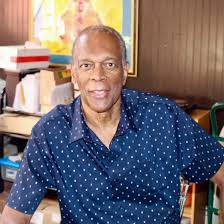
From my 2001 doctoral dissertation. The references have not been updated. Any mistakes–factual, grammatical or ideological–are mine, not the University of Maryland’s.
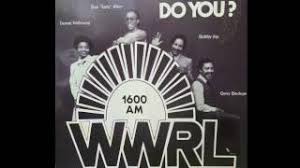
“He stood at the mic like a lighthouse, unblinking in the storm. A voice for the people, a spine for the truth. Fearless in witness, relentless in love for his community. An icon — not because he sought it, but because he earned it.”
– New York City radio broadcaster Rennie Bishop, from an email upon hearing about Law’s transition into the Realm of the Ancestors

BOB LAW, TO MY surprise, was not born with a radio microphone in or near his mouth; once upon an early-’70s raised fist, he was a hell-raising New York City civil rights activist. In the previous decade, he had worked with the radical Brooklyn branch of the Congress for Racial Equality, a national civil rights organization. He also worked in the 1960s with the Northern Student Movement and as an East Coast organizer for the Student Nonviolent Coordinating Committee. He had learned graphic design and communications arts at Pratt Institute, a New York City arts college. Law said one of his greatest influences in the 1960s was Malcolm X, whom he called “…the great educator. The great teacher. He raised questions about what we were doing in the movement. He raised questions about street life. And he was a primary influence in the lives of a great many people, particularly the group of young people that I was a part of.”
Law led a group called IMPAC–the Independent Movement for Political Action. Law appeared on Bernie McCain’s WWRL-AM Sunday afternoon show “Tell It Like It Is” to talk about his organization’s campaign against the use of the drug Ritalin, a drug that counteracts hyperactivity, in New York City’s public schools. Law and other activists believed the drug was disproportionately being used on Black schoolchildren. Law said McCain was a pioneer of “activist radio,” where a host would actually campaign–and get his listeners organized–against an injustice. When McCain became program director at KDIA-AM in Oakland, California, Law became WWRL’s public affairs director and host of a show called “Black Dialogue”–an interesting, and typical for Black radio, version of, as the expression went at the time, from the streets to the suites.
In 1981, the same year WLIB, a rival AM Black-formatted station, began Black news-talk programming, “Night Talk with Bob Law” premiered on the National Black Network, originating on WWRL. (The station’s all-night slot had been held by Law’s friend Gary Byrd, who soon moved his “Gary Byrd Experience” show down the dial to WLIB; more on his story here.) “Night Talk” with Bob Law was the first national Black radio call-in talk show. It ran weeknights, from midnight to 5 a.m., Monday through Friday mornings. It was a national forum for Black issues in the news and Black politics. One scholar said it “quickly became the most popular Black talk radio show in the country.”
Law said the value of the national show was that Blacks struggling for social justice in one area “learn that their situation is not isolated. And [they] are even encouraged by [other] people who struggle against that oppression.” Using his ’60s swagger, he used the forum not just to inform, but also to prepare his listeners to spring into action. Early in its history, civil rights leader Jesse Jackson Sr. was Law’s “Night Talk” Tuesday co-host, using his visibility to prepare for his 1984 Presidential campaign. Law regularly invited activists and scholars, such as John Henrik Clarke and Dr. Yosef ben-Jochannan, to discuss their specialties.
The wee-hours host used his late-night pulpit to run many campaigns and crusades. When I began listening to the show in 1987, a major focus was fundraising for the New York chapter of the Black United Fund, a self-help philanthropy group. Named New York Coordinator for 1995’s Million Man March, “Night Talk” pushed hard for a large national turnout. In his book, Law lists some of “Night Talk'” s crusades, with special emphasis on one campaign in particular:
And there are many examples of NIGHTTALK’s influence on a national level: We helped raise $100,000 for a Kansas City teenager, we financed a summer softball league for children on behalf of [Law’s] Respect Yourself Youth Foundation, and we helped [in 1982] to save the Lorraine Motel, the site of Martin Luther King· s assassination [from an auction] …[Local businessmen] wanted to convert the hotel into a Martin Luther King museum, which I agreed would be much more fitting than the stone marker and plastic flowers that had been placed at the door of Dr. King’s room. The plan was to prevent the auction by paying off the debt owed by the motel. and then raise the money to build the Martin Luther King Museum.
I agreed to make the appeal and organize various fundraising events in local communities around the country, in conjunction with my on-air activity. I wanted the museum to make one adjustment [,] however. I wanted the museum to be dedicated to the entire Civil Rights Movement, with Dr. King as its centerpiece. The group agreed, and we launched a national radio campaign on NIGHTTALK… The NIGHTTALK audience also responded by calling the Judge who was to rule on the auction, to assure him that they were donating to the memorial fund and that the money was indeed on the way. On the strength of those phone calls and the renewed and expanded enthusiasm for the project, the Judge delayed the auction, giving the Memorial Foundation a few more days to receive contributions from its new supporters throughout the country.
We were successful! The Martin Luther King Memphis Memorial Foundation was able to buy the motel and the time they needed to raise the additional funds to build the excellent museum of the Civil Rights Movement that currently exists at the site of the old Lorraine Motel. Strangely enough. there is no mention of the NIGHTTALK campaign in any of the museum· s literature, nor was a promised plaque installed in the museum’s entrance to acknowledge the donations of African Americans around the country. These donations did in fact make the Civil Rights Museum possible.
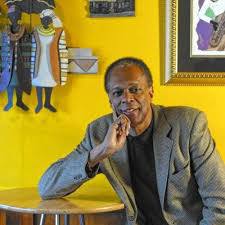
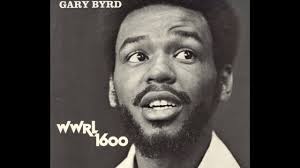

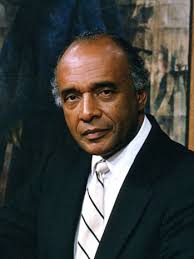
IN 1989, LAW’s FRIEND and former WWRL co-worker, now calling himself Imhotep Gary Byrd, was on a roll so he decided to openly celebrate a role. His “GBE” was now renamed–or, within the next two years, would be rechristened–the “Global Black Experience: Africentricity.” On WLIB, the self-styled call-in radio magazine grew so popular that it began broadcasting live from the Apollo Theater. So he took full advantage of that, devoting a week to big-upping his Black-oriented media peers. From Monday through Thursday during a late-August week, the soon-to-be-new, dashiked ”GBE” hosted a tribute to New York City’s “Pioneers in Broadcasting.” With a packed studio audience from the community, he honored the late Alma John, whose WWRL show was a ’60s Black radio staple and whose New York area community work was still remembered. Byrd also honored New York radio legend Hal Jackson, who was celebrating his 50th year in radio broadcasting. In addition, Byrd honored two of his peers: WABC-TV’s Gil Noble, producer and host of the award-winning Black public affairs television program “Like It Is,” and Law. (More on Noble and his show here.)
Onstage at the Apollo, which had basically become an African-centered Black community space during the hours of Byrd’s broadcast, Noble spoke with his friend about his career and professional philosophy (his professional journey began in the 1960s as a WLIB newscaster). Noble recalled how he learned from Pan-Africanist Queen Mother Moore that, as a displaced African in America, he didn’t even know his true [African] name. She “made me understand the severity of my condition … I didn’t even know my name.” That perspective, according to Noble, helped him to “ward off the intoxication” of becoming successful in a white-dominated industry. He said that he always remembers it was the Civil Rights Movement, particularly the 1967 Black insurrections in Newark and elsewhere, that got him his job at WABC-TV “..and that’s why I’ve spent my career trying to give back.” The program, he explained, was important for Blacks and whites because “white people need to learn the truth about themselves, too.” The predominantly Black audience laughed and applauded. Noble blamed America’s Eurocentric educational systems as the reason why Blacks who enter journalism all too often consider themselves journalists first and African-Americans second. He thanked Byrd for honoring him, noting that he was glad Byrd had such a public forum to be praised by callers and members of the studio audience, the latter of whom began moving to microphones near the Apollo stage to join the conversation. A Black woman, identifying herself as 83-year-old Beatrice Johnson from Queens, said she never missed “Like It Is” when it was broadcast on early Sunday afternoons. “I don’t miss it. That’s like church to me,” she said. One Black man asked Noble why he didn’t try to go after the lucrative and powerful WABC “Eyewitness News” weeknight anchor chair. “I am constantly reminded of the condition of our people,” responded Noble. “And that it is severe and grave. And that is my focus. And I don’t believe I can make a [similar] contribution anchoring the news as [I do with] ‘Like It Is,” since he said it was the only program on New York television controlled and conceptualized by people of African descent. “I think it is important for ‘Like It Is’ to stay alive because it allows people to see the world through the eyes of the majority of the people in the world instead of the minority.”
The next day on the “GBE,” Law was honored on the Apollo stage for his work on WWRL and on “Night Talk.” He talked to Byrd about his activist history in New York City prior to becoming a broadcaster–particularly the influence Malcolm had on him. He mentioned that Hal Jackson, whom Byrd had honored earlier that week, was the host of “Community Forum” on WLIB. where Law, as a young activist, would appear as a guest in the late 1960s. He said that the future of radio, especially AM radio, was talk and information, and that format was “…absolutely necessary in the African-American community,” since radio “is the only thing on in the Black community 24 hours a day.” A 65-year-old Black woman from the studio audience confirmed this. saying that she had gotten a thorough political and cultural education from her “daytime man” Byrd and her nighttime “husband” Law. The audience applauded and cheered, and both broadcasters quietly and humbly thanked her for her statement.
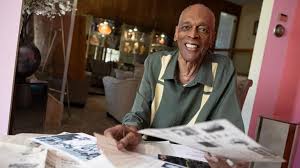
“LIKE IT IS,” WWRL-AM AND WLIB-AM are textbook examples of the multiple roles of Black media. The three forums have attempted to present an African-centered worldview using mass media. The hosts of these programs discussed here argue that their shows are antidotes to white mainstream media programming, which, due to its disproportionate control by whites, collectively present a white view of the world as mainstream. These forums allow African-Americans in the New York tri-state area and, in the case of WWRL’s “Night Talk” nationally, to see and hear themselves from the varied historical and cultural perspectives of Africans and African-Americans. They also allow a counter-narrative from the culturally white and politically right-wing views of white mainstream talk radio in New York City. Because the distinct roles they play are well within the concept of the Black media imperative. The mass communication products of Noble, Law and Byrd exemplify the Two-Pronged Black Critique of White Media Hegemony: l) the critique of white media supremacy and 2) the Black counter-narrative.
Noble, Law and Byrd share common professional and personal characteristics. All are tall, charismatic men who are more than 50 years old. The Civil Rights and Black Power movements forged all three ideologically, but as those movements developed in the North — specifically in New York City, the headquarters of the movements of Marcus Garvey and Malcolm X. They did not formally study journalism, although Law learned the basics of communications at Pratt. All started their careers in Black radio during turbulent years in American society. The three work as communicators who say they attempt to use their craft for the improvement of African-Americans. All three are artists: Noble, a piano player, led the Gil Noble Trio, a jazz band, in the 1950s; Byrd is a performance poet, songwriter and entertainer; Law is a graphics artist.
There are some slight differences. Law is the only one of the trio with a college degree. Noble was the only of the three not known to have been an athlete as a youth, unlike Byrd (football) and Law (baseball). Noble is the only one of the three working in white mainstream media. Law is the only one with a background in community organizing.
All three broadcasting forums are strongly focused from a Black worldview. For more than 15 years, the “Like It Is” title sequence has started with drums and a visual collage of the African-American experience, ranging from drawings of Africans being enslaved through pictures of the abolitionist period and the Civil Rights Movement to “Like It Is” interview clips from the 1970s to, finally, a still picture of a baby being born. After the collage, a red, black and green flag–the universally accepted symbol of Black Nationalism–is created onscreen, with the title of the show appearing in front of the flag shortly afterward. Law’s radio show started with an announcer saying “Night Talk” was “for people who live in the Black community and whose actions affect the Black community.” That description could easily apply to all three programs.
Not surprisingly, the shows sound different. Noble’s on-air demeanor, if not his line of questioning, is very calm and “objective;” he does not blatantly express his opinion on the air. Law and Byrd, on the other hand, have been open advocates on-air whose opinions on most topics are clearly known. Unlike Law and Byrd. Noble does not use music during the show; the show’s transitions to commercials and closing credits are done in silence. Noble is “Like It Is”s’ only interviewer, while Law and Byrd took calls from their audiences. Noble’s show is a weekly hour; the others had at least 16 hours of radio time to fill every week.
All three seem to be addressing the same audience–one seeking the Black media imperative as preferred programming. In my view, the audience Law, Byrd and Noble seem to target is composed of serious-minded African-American adults who want to l) learn about African-American politics, history and culture and 2) do something to improve the condition of African-Americans from a left-of-center, Nationalist-oriented point of view. The hosts seek to increase understanding of the African-American experience by creating programs that inspire African-Americans to become race-conscious citizens. By doing this, from my perspective, they serve the movements that created them and push a new generation to be exposed and, hopefully, become actively involved in social justice struggles.
The fact that Law, Byrd and Noble are part of a generation of Blacks influenced by the Civil Rights and Black Power movements does not make them at all unusual; millions of African-Americans were also shaped by “the Sixties,” the period between 1960 and 1979. What makes the story of these three men and their forums worthy of scholarly study is how, as media professionals, they consciously chose to make the mass media their own instead of being made by the mass media. As Black men who see their history, politics and culture as central to their identity as American citizens and human beings, they decided to make media from that experience during virtually the same time period–the late 1960s; they chose to make media that matched their beliefs, thoughts and opinions. They chose to use the media to present and discuss the African and African-American experiences from the often-controversial perspectives of their activist peers, not from the “objective” perspective taught in journalism school to Black and white journalists alike. In so doing, they became both proponents of the Black media imperative–”living mediums” standing on electronic stepladders–and ideological heirs of the movements they have championed.
https://americanarchive.org/catalog/cpb-aacip-529-ks6j09xd10
https://www.youtube.com/results?search_query=bob+law+night+talk

#MUMIAABUJAMAL’s testimony to the #UnitedNations #UNHumanRightsCommittee

On the initiative of the UN Human Rights Committee, an international call for written contributions has been launched concerning “the death penalty in relation to the prohibition of torture and other forms of ill-treatment, and also the protection of human dignity.” By clicking on the link below, you can learn more about the relevance and purpose of this initiative: https://www.ohchr.org/en/calls-for-input/2026/call-input-special-rapporteur-summary-extrajudicial-or-arbitrary-executions
This appeal has been relayed by the World Coalition Against the Death Penalty to its members; the French Collective has been a member of the coalition since its creation and was re-elected to its Steering Committee in 2025.
With the help of Prison Radio (USA), also a member of this Coalition, we requested a statement from Mumia (an iconic figure in the fight for the universal abolition of the death penalty), which we have just forwarded to the Special Rapporteur in charge of collecting contributions, on the basis of which he will present his report to the 62nd session of the United Nations. You can find Mumia’s AUDIO testimony in English by clicking on this link: https://mumiabujamal.com/v2/wp-content/uploads/2026/02/2-3-26-Mumia-UN-Submission.mp3 … and transcribed in the attachment.
Best regards,
Jacky & Steve
French Collective LIBERONS MUMIA
*****************************************************************************************************
In response to the Special Rapporteur’s call for contributions “on the death penalty in relation to the prohibition of torture and other forms of ill-treatment and the protection of human dignity,” we wish to bring to his attention the situation of Mr. Mumia ABU-JAMAL, who has spent 29 years of his life on death row in Pennsylvania (USA).
An African American journalist, now aged 71, he has his sentence commuted to life imprisonment without the possibility of parole.
Incarcerated for 45 years, below you will find his testimony on the conditions of survival in prison hell and the physical and mental consequences of his fellow inmates awaiting execution or the deterioration of their health exposing them to
death in the case of life sentences.
An iconic figure in the international fight for the universal abolition of the death penalty, Mr. ABU-JAMAL was convicted after a racist and expedited trial without being able to defend his innocence. Denounced by Amnesty International, the European Parliament, and the UN Human Rights Committee, he has still not obtained a review of his trial. Today, the deterioration of his health, like that of the oldest prisoners, would justify his release on humanitarian grounds.
Noelle Hanrahan (USA) nhanrahanlaw@gmail.com, Lawyer of Mumia Abu-Jamal and Director of Prison Radio (USA)
Member of the World Coalition Against the Death Penalty
Jacky Hortaut (FRANCE) contact@mumiabujamal.com
Let’s Free Co-organizer of the French Mumia Collective
bringing together around a hundred NGOs and the city of Paris
Member of the Steering Committee of the World Coalition against the Death Penalty
***************
Submission by Mr. Mumia ABU-JAMAL to the United Nations
When we think about death row I must remind you all who hear these words or read these
words it is not a movie. Don’t think of a movie. Instead imagine a reality where for years, for
many years, people are locked down in their cells for 23 hours a day. Which began as 24 hours
a day on the weekends and after years and years, became 22 hours a day.
Also imagine that for what may be the rest of your life you could not hug, nor kiss, nor caress
your children, your wife, your brothers, your sisters, your parents because non-contact was the
rule.
What did that mean in the real world ? And why was it established? What it means is the state
separating you from all people that you love and who love you. And what does it mean? It
meant that this physical isolation, this true solitary confinement, separated you from the people
who naturally care about you. And separated them from you. What is the purpose of that ? The
purpose is simple to dehumanize the accused, the death row person and to separate them from
humanity itself.
In some states, mostly the South, it has become custom that when a death-row prisoner is
escorted throughout the prison the guards usually shout: “ Dead man walking. Get out of the
way. Dead man walking ”. Now that will remind you of a movie, but that only reminds you of a
movie because it happened in real life.
To separate people from other people, it is to deprive people of what it means to be human. To
be social. And this is something that has become “expertise” in American prisons, North, South,
East or West. This tradition continues in much of this country and is designed to make people
lose hope, so that they can be more easily executed, or as the state says ”put to death “.
This too is not just a word or description or even a movie. I’ve known men who spent time on
death row with me who committed suicide, for a variety of reasons.
Sometimes, they were suffering health issues and could not bear to continue to suffer those
health issues. Sometimes they were depressed because they knew that they should have
gotten a new trial, but instead they got a resentencing hearing. I knew a guy who I had played
handball with, up SCI Greene, he was an excellent young handball player, because he’d played
it in the world. And we gave each other a good challenge, the old man and the young guy, and
he was in excellent health. Until his appeal got denied and he was given a life sentence instead
of the new trial that he knew, he knew, he deserved and by law should have gotten. Within a
week he tied himself to some bars in his cell and killed himself. For him, a life sentence, what
people call “ slow death row ” was too much like death row itself, for him to leave death row, it
was another kind of death row. A death row on life row.
I have met people who I have known on death-row who were executed by the government of the
Commonwealth of Pennsylvania. One guy was about two or three cells away from me when we
were at Graterford in Eastern Pennsylvania. He was an older guy, I sent him a note and said “
Listen man, fight your stuff ” And he called down and said “ Jamal, I am tired ; I got nothing
here, I got nothing to live for, I’m ready to go “. And so he did. He volunteered to be executed.
And the State of Pennsylvania took him up on his invitation.
When people are given no way out, given no hope, does it surprise you that men in such
conditions not committed suicide ?
If you think about it this guy commits suicide by the state. The other Puerto Rican brother I
talked about committed suicide because of his deep disappointment that the state could not
treat him according to the law as written in their books.
But what was killed, was hope. And that is what it was designed to do. That is what death row is
designed to be. And that is what death row and slow death row really is. Not just in this state
but in several states in a country called ‘the land of the Free’.
I wanted to give you an inside impression. I hope I have been successful.
Love not Phear,
Mumia ABU-JAMAL
#CounterSpin: #MumiaAbuJamal on Media and Power (Transcript)

‘There’s No Space in the American Landscape Where the Shadow of the Prison Doesn’t Fall’:
CounterSpin interview with Mumia Abu-Jamal on media and power
This week on CounterSpin: With some 2 million people in prison, jail or detention centers, the US is a world leader in incarceration. Ever more people disappear behind bars every day, many for highly contestable and contested reasons. But despite age-old rhetoric about prison as “rehabilitation,” US journalists say—through their work—that if any of the criminal legal systems in this country decide to punish you, that’s proof enough that you should never be heard from again. With some exceptions for celebrity, corporate journalists seem absolutely OK with silencing the huge numbers of disproportionately Black and brown people in prison. It’s a choice that impoverishes conversation about prison policy, about public safety, and about shared humanity.
There are reporters and outlets paying attention—and willing to navigate the serious barriers the prison system presents. One such outlet is Prison Radio, actually a multimedia production studio, that works to include the voices of incarcerated people in public debate.
It’s thanks to them that we have the opportunity to speak with journalist, author and activist Mumia Abu-Jamal, whose 1982 conviction for the killing of a Philadelphia police officer showcased failures in the legal system, yes, but also exposed flagrant flaws in corporate media’s storytelling around crime and punishment and race and power.
Janine Jackson: When our guest turned 71 in April, his organized advocates acknowledged the day with mobilizations around how US constitutional law is “weaponized to repress dissent and create political prisoners,” with public discussion about activism on campuses around Palestine, and about the importance of public protest and brave speech.
The 1982 conviction of Mumia Abu-Jamal for the killing of police officer Daniel Faulkner followed a trial marked by prosecutorial and police misconduct, purported witness testimony that was shifting and suborned, discriminatory jury selection, and irresponsible and frankly biased media coverage, which hasn’t changed much over years of court appeals and continued revelations. It was and continues to be clear that, for powers that be, including in the elite press, it is important not only to keep Mumia Abu-Jamal behind bars, but to keep him quiet.
It hasn’t worked. Despite more than four decades in prison, our guest has not ceased to speak up and speak out, on a range of concerns well beyond his own story, with the support of advocates around the world. He joins us now. Welcome to CounterSpin, Mumia Abu-Jamal.
Mumia Abu-Jamal: Thank you for inviting me.
JJ: Well, you never know what folks are learning for the first time. So I just wanted to start with noting that you are a journalist. Mumia, listeners should know, was a radio reporter at various Philly stations. He was head of the Philadelphia Association of Black Journalists.
I sometimes think, once you’re a witness and a storyteller, you can’t turn that off, even if you become the subject of the story. Certainly you have never really stopped doing what you started out to do, have you?
MAJ: I have not. I guess old habits die hard.
JJ: So you’ve continued to listen and report and to speak from whatever position you’re in, because a journalist is what you are, yeah?
MAJ: Yeah. But in a cultural sense, I think of myself as a griot, probably a progressive griot, but a griot nonetheless. In African culture, griots were the people who remembered the history of the tribe, and, really, they served the prince in power, but they served the tribe as well. And there’s an old tradition that’s talked about in Senegal that when a griot dies, you don’t lay him in the ground. You bury him vertically in a tree, so that he and his stories are remembered.
I think about telling the stories of a different kind of tribe here in America, a tribe of rebels, a tribe of people who struggle, a tribe of the poor and the oppressed, because those are the stories that rarely get heard and get reported in much of the world.
JJ: That leads me directly to what I just saw on Wikipedia, which said:
From 1979 to 1981, he worked at National Public Radio affiliate WHYY. The management asked him to resign, saying that he did not maintain a sufficiently objective approach in his presentation of news.
And, yeah, it gives me a giggle. And I think that while news media has, in important and life-altering ways, gotten much worse since then, there is, in some places, anyway, a growing recognition that objectivity is a myth, and a harmful one, and that we are all enriched by reporters who can bring their whole selves to the job.
MAJ: If you’re not bringing your whole self to the job, you’re not doing the job. And I think that this whole objectivity myth began when the art of journalism—I won’t call it a science—but the art of journalism was professionalized.
And before that, of course, the media was a very political entity. I remember reading in a history book, it might’ve been Howard Zinn or something like that, a New York newspaper called the New York Caucasian. I mean, think about that. Papers were printed by unions and churches and other kinds of groups, and it was reflective of the people who printed it, not the people who paid them, because journalism was more of a work that people loved doing than a quote unquote “profession.”
Howard Zinn warned us about the dangers of professional distance in many fields. As an historian, of course, Howard Zinn learned history, not when he earned his PhD at Columbia, but when he was teaching at a Black college during the civil rights years, and he was teaching pre-law, something like that, and he was telling people at the school about how the Constitution protected them, and they had certain rights. They said, “Excuse me, Professor Zinn, what are you talking about?” And he said, “Well, you have the right to do this and do that.” They said, “We don’t have the right to vote down here.” He said, “What are you talking about?” They said, “We go to the voting office, they will beat us up.” He said, “Who will beat you up?” They said, “The cops and everybody else.”
So Howard Zinn followed his students to the voting place, and he sat and he just looked, and he learned something that he had never learned in college—and this was Atlanta, of all places—that when people tried to register to vote, they were refused. They had these ridiculous tests they gave them, and if they did not walk away, they would be beaten and locked up.
And so Howard Zinn learned that which the profession did not teach him, that history isn’t always written in these documents or in books. They’re lived by people, and we have to pay attention to how people live in the real world to tell their stories.
JJ: What I get from that story is that an article can tell you the law says this, and that’s not the same thing as telling you how the law is lived out in various people’s lives.
And we have a journalist right now, there are many, but I will just say Mario Guevara, who apparently has an Emmy award, but it’s not enough to prevent his having been detained for over a hundred days now, for the work of live streaming law enforcement activity, including ICE raids. So we have a journalist doing what a lot of other journalists would say is what they’re supposed to do, and he’s been detained.
So when people hear generically about “journalism is under attack,” well, no, it isn’t all journalism that’s under attack. It’s a particular kind of witnessing.
MAJ: That’s actually true, but also think about, in this era, in this time, and I’m speaking right now about the, shall we call it the Kimmel affair, and how everybody is talking about First Amendment rights, the freedom of speech and the freedom of the press. The case you described is the unfreedom of the press, where a journalist is captured and caged for telling stories and streaming stories about government repression. Who do you think gives a damn about the Constitution, the government or the people?
JJ: Let me ask you, continuing with media, I think people read the data point, “Oh, 2 million people incarcerated in the US,” more and more every day being put in detention centers, and they’re shut away from families and friends, by procedure, by distance, but also shut out of public debate and conversation.
And I think there’s a feeling that this is a cost to those people who are imprisoned, but there’s less recognition that there’s a cost for everyone when we don’t get to hear from this ever-expanding and various group of voices. And I think journalists who buy into, wittingly or not, the idea of “out of sight, out of mind”—they’re serving someone, they’re serving something, by excluding the voices of the incarcerated in our public conversation.
MAJ: Well, yeah, they’re excluding not just the imprisoned, who, as you said, are in the millions in the United States, but also they’re excluded from thinking about what it means to be truly American, because this is part of that. There is no space in the American landscape where the shadow of the prison doesn’t fall.
And that’s because it is so huge. It is so vast that it impacts those within and without, because everybody in prison has someone on the outside of prison that loves them or they love: their children, their mates, their parents, you name it. And that shadow falls on all of those people. There are stories that can enrich our understanding of what it means to be human by allowing people in this condition to be heard as full human beings.
JJ: And I blame media a lot. I mean, I’m a media critic, but I also, as a media reader—media disappear people, as well as the state disappears them. Suddenly they move into another column, and are no longer worth hearing from. And I don’t know that people understand how much we lose when that happens, and how much media are feeding into this oppressive regime by underscoring the idea that once people go behind bars, we don’t even need to think about them at all anymore.
MAJ: We call the media the Fourth Estate, don’t we? But it’s an estate of what?
JJ: Right? For whom?
MAJ: The estate is part of the state. It’s not part of the people. And as long as people think in those terms, those elevated and false terms, then it’s difficult for them to relate in a human way to people who are in a distressed situation.
And you can’t talk about media without talking about power, because you know and I know that much media is about sucking up to power. I am reminded of, I think it was in the book Into the Buzzsaw that I read years ago; it was about forbidden stories that reporters got fired for, all around the spectrum. I mean, Fox News stations, all kinds of newspapers and whatnot. But the real key is that when people began telling stories that their editors and their bosses didn’t like, well, they got disappeared. By that I mean, of course, they got fired or threatened with firing.
But one of the things that really touched me in this context was that a reporter was talking about how journalists could never say that the president, for example, was lying. And they said, “Well, why not?” And people from the audience were like, “Why don’t you say that?” “Well, we are taught and we’re trained never to say that.” Well, then what if you hear him, and he’s lying, you just act like you don’t hear him? You’re just carrying his lies. That’s the relationship between the media and power. I think that began to crack around the time of the Bush years. But look where we’re at right now. We’re in a whole new world.
JJ: Just rocketing into the past, just rocketing backwards past so many gains that we thought we had made. And I remember that conversation well, and when the audience started saying, “What do you mean you can’t say the president’s lying?” the reporters said, “Well, we think it’s more powerful to say the president’s statements did not comport with information as we have it…” They had this kind of painful, tortured thing that they told themselves was somehow more impactful. So there’s a culture inside newsrooms that gives them, like, 12 degrees of difference between themselves and the truth.
But we know that other folks know what we know, are as irritated and disgusted and seeing through the emperor and his no clothes as we have. And so we have independent media growing up. And I just wonder, when you see the media landscape, do you see hope in these independent journalistic outfits that are coming up? Do you see Black-owned, some of them Black-centered, journalistic organizations sprouting up? Is that a source of hope?
MAJ: I think it can be. But the real question is, how will the sandwich taste once everything comes together? And when I think of a great journalist, I think of somebody like Chris Hedges, who was asked to join the New York Times. He didn’t go the regular route, where most reporters kind of prayed for an opportunity to write for a paper like the Times. He was in seminary, and he began hearing about El Salvador, and he went down there and he saw things and he began writing about it, and people were reading his stuff, and the Times came and said, “Boy, you’re a great writer. Can you write some articles for us?” And he was like, “OK, yeah, why not?”
Of course, all of that changed around the time of, I think it was 9/11 and the Iraq War. And Chris did a speech, and he got up and he talked with people and he was telling them, saying, “Listen, do not let these politicians use your fear to get you involved in a war.” And people began singing “God Bless America” and yelling at him, because they didn’t want to hear it. And it was almost like Chris was seeing which way the wind would blow.
And he got threatened by his editors, like, “Oh, that’s one strike against you, buddy.” I mean, he could care less. Again, he didn’t, like, run and get the job. They ran after him, because of the clarity and power of his writing.
JJ: But then that clarity and power was just what they didn’t want, actually, to hear.
MAJ: Exactly. Well, I think the scholar Olúfẹ́mi O. Táíwò hit the mark when he said it’s “elite capture.” He had been captured by the Times, and they had a tiger by the tail. And Chris really could care less because, in the new media world, he writes online, and probably is more read today than he was when he was at the Times.
JJ: Absolutely, and that’s kind of where we’re at, where folks who want to do reporting, who want to witness, but who are not willing to accept the constraints of corporate news media, we haven’t quite built the structures for those folks to have a platform, for those folks to be heard from. So we’re kind of in transition, in terms of media structures. But I do believe that, in terms of audience, more people are recognizing the failures and the flaws and the constraints of the major news media, and are at least looking for something else.
MAJ: I think they’re hungry for something else, because here’s the real deal: People who are young people, they don’t read newspapers, they don’t watch TV, because that media is alien to them. So, unfortunately, they might read news updates that someone has assembled, used media sources to assemble, but they don’t go to those original media sources, because they have no trust in those media sources. So they find out using other means.
But we’re, I think, on the cusp of creating citizen journalists, where, given the technology that now exists, everybody is a journalist. Because they have the potential to use their phones and broadcast to, really, uncounted numbers of people, to tell their stories and to get their word out, and to contact them and to give them insight into the world that they see, and not the world that the media want to project.
You remember George Floyd; it was a 17-year-old girl who was witnessing that, and when she livestreamed it, the world tuned in, and was transformed by that moment. So that’s just a taste of what journalism can do, when it’s at the right place at the right time.
JJ: And I thank you for that, and I think the corollary to the citizen journalism, and to people understanding that they can create their own news and witness and share, I think there is also an understanding that folks, when they’re watching the TV news, or they’re reading the paper, they also maybe are bringing more critical thinking to that, and recognizing that they don’t need to just swallow everything that’s in the New York Times. Am I being over-hopeful there?
MAJ: No, I think you’re absolutely correct. I think that’s part of that youthful vibration that turns kids off the newspaper or the local broadcast or even the national broadcast. I mean, I know quite a few young people who simply don’t watch TV. That’s an alien communications device to them.
JJ: Well, I could talk to you a lot, but I don’t want to take too much of your time. I want to ask you, certainly, before we close, to say anything that you want to say to a listenership of media critical folks. But I would ask—I read a quote from you recently that you said you’ve never felt alone. And I think that is gratifying, and probably surprising for people to hear, because many people, many people walking freely through the streets, are feeling very alone right now, really oppressively alone, for all kinds of reasons. And it might seem a weird question, but in September 2025, where are you finding hope? What are you looking to?
MAJ: I do find it in young people who are more open and more receptive, not just to stories, but to struggles. And I think that the gift of repression is that it wakes people up. I mean, people are seeing things that haven’t been seen in this country for years, and it’s waking people up. And so once you’re awake, it’s kind of hard to go back to sleep. And think about this: To the right wing, the worst thing you can be is woke. So that suggests that they want everybody to go to sleep. So wake up, be woke.
JJ: We’ve been speaking with Mumia Abu-Jamal, author of many titles, including Writing on the Wall, Faith of Our Fathers, Murder Incorporated and 1995’s Live from Death Row, translated now into at least seven languages. Mumia Abu-Jamal, thank you so much for joining us this week on CounterSpin.
MAJ: Thank you, and thank CounterSpin. It has been a pleasure.
FAIR’s work is sustained by our generous contributors, who allow us to remain independent. Donate today to be a part of this important mission.
********
Janine Jackson
Janine Jackson is FAIR’s program director and producer/host of FAIR’s syndicated weekly radio show CounterSpin. She contributes frequently to FAIR’s newsletter Extra!, and co-edited The FAIR Reader: An Extra! Review of Press and Politics in the ’90s (Westview Press). She has appeared on ABC‘s Nightline and CNN Headline News, among other outlets, and has testified to the Senate Communications Subcommittee on budget reauthorization for the Corporation for Public Broadcasting. Her articles have appeared in various publications, including In These Times and the UAW’s Solidarity, and in books including Civil Rights Since 1787 (New York University Press) and Stop the Next War Now: Effective Responses to Violence and Terrorism (New World Library). Jackson is a graduate of Sarah Lawrence College and has an M.A. in sociology from the New School for Social Research.
What’s FAIR?
FAIR is the national progressive media watchdog group, challenging corporate media bias, spin and misinformation. We work to invigorate the First Amendment by advocating for greater diversity in the press and by scrutinizing media practices that marginalize public interest, minority and dissenting viewpoints. We expose neglected news stories and defend working journalists when they are muzzled. As a progressive group, we believe that structural reform is ultimately needed to break up the dominant media conglomerates, establish independent public broadcasting and promote strong non-profit sources of information.
*************
Contact:
Fairness & Accuracy In Reporting
124 W. 30th Street, Suite 201
New York, NY 10001
Tel: 212-633-6700
#BreakingTheSoundBarrier Column: 20 Years Later, the Lessons of #HurricaneKatrina Go Unheeded

Weekly Column
August 28, 2025

By Amy Goodman & Denis Moynihan
It’s been 20 years since Hurricane Katrina made landfall on August 29th, 2005, breaching New Orleans’ protective levees, unleashing unprecedented destruction. It was one of the deadliest natural disasters in US history, killing over 1,800 people, mostly poor residents of New Orleans’ historic Black neighborhoods. Katrina was also the US’ costliest natural disaster, causing over $160 billion in damage. Katrina’s deadly waters long ago receded, but in their wake, with worsening climate change, the vital lessons of Katrina have gone unheeded. Indeed, President Donald Trump, by flaunting genuine risks, is aggressively courting disaster.
Take Trump’s attack on FEMA, the Federal Emergency Management Agency. In a statement released by the White House in May, FEMA was lumped with a slew of federal agencies that, the statement reads, represent “the weaponized rot in our Federal Government.” Targeted agencies included the EPA, the IRS, and the NIH. The document accuses FEMA of being “wasteful and woke,” engaged in “official training to indoctrinate ‘intersectionality’ and ‘investment in diversity and inclusion efforts’ over disaster prevention and response, culminating in aid workers being directed to skip the homes of President Trump’s supporters in the wake of a disaster.”
As with most of Trump’s pronouncements, these accusations are presented without any evidence.
The bulk of FEMA’s functions, according to Trump, would be delegated to the states. Of course, hurricanes and other natural disasters don’t recognize state lines, and no state could single-handedly respond to a disaster of the scale of Hurricane Katrina. Such a response requires collective action, marshalling resources from across the country to save lives in the impacted region, to recover the dead, and to rebuild.
Indicative of Trump’s contempt for FEMA was his appointment of David Richardson, a former Marine with no experience in disaster recovery, as acting head of the agency. Upon his arrival at FEMA, Richardson reportedly shocked staffers by saying he was unaware the US has a hurricane season.
A group of current and past FEMA workers published a letter, called The Katrina Declaration, that they sent to a Trump-appointed FEMA review council and to Congress.
The letter opens, “Since January 2025, FEMA has been under the leadership of individuals lacking legal qualifications, Senate approval, and the demonstrated background required of a FEMA Administrator. Decisions made by [David Richardson and Secretary of Homeland Security Kristi Noem] hinder the swift execution of our mission, and dismiss experienced staff whose institutional knowledge and relationships are vital to ensure effective emergency management.”
Close to 200 current and former FEMA workers signed the letter. Most of the current FEMA employees signed anonymously to avoid retaliation. At least 21 of those who did sign their names have been placed on administrative leave.
Jeremy Edwards, a former FEMA spokesperson under President Biden, explained why he signed the declaration, speaking on the Democracy Now! news hour:
“I would call this letter to Congress, unfortunately, a cry for help. The agency has been badly damaged by this administration. They’ve fired a third of the permanent workforce. They’ve cut trainings. They have installed a person at the top of the agency who has no experience.”
Edwards also criticized the White House’s reassignment of FEMA staff and funding to assist in Trump’s mass deportation program:
FEMA’s mission is very clear: to help people before, during and after disaster. Any single dollar that isn’t being spent to help people with that mission is a failure to the American people. That money should not be going to build immigration detention centers. They should not be sending FEMA personnel, which they are doing, to help on-board new ICE agents.”
From the denial of climate science, to the gutting of FEMA, to the militarization of American cities with Marines and the National Guard, it seems clear that those in control at the White House have chosen to ignore the devastating lessons of Hurricane Katrina.
One person who did learn hard lessons then is Malik Rahim, a longtime resident of the Algiers neighborhood in New Orleans. A co-founder of the New Orleans chapter of the Black Panthers, Rahim organized a grassroots mutual aid effort immediately after Katrina, called Common Ground Relief.
Democracy Now! recently caught up with him, inside the New Orleans Convention Center, which served as a shelter of last resort for as many as 30,000 desperate city residents during Katrina. When asked about those stranded there, the FEMA director at the time, Michael Brown, famously replied that he was unaware of the dire conditions there.
Those now running roughshod over FEMA should heed Malik Rahim’s wise words, as the US blunders through another hurricane season:
“The sad part about it, it could happen today. Déjà vu is alive and well here, because if a hurricane were to happen right now, we are ill-prepared for it, the same way we were ill-prepared 20 years ago.”
The original content of this program is licensed under a Creative Commons Attribution-Noncommercial-No Derivative Works 3.0 United States License. Please attribute legal copies of this work to democracynow.org. Some of the work(s) that this program incorporates, however, may be separately licensed. For further information or additional permissions, contact us.
#BreakingTheSoundBarrier Column: On The #Smithsonian and #Slavery: #PresidentTrump’s #DonaldTrump’s #POTUS’s Whitewashing of #USHistory #AmericanHistory #WorldHistory #BlackHistory

Weekly Column
Thursday, August 21, 2025
By Amy Goodman & Denis Moynihan
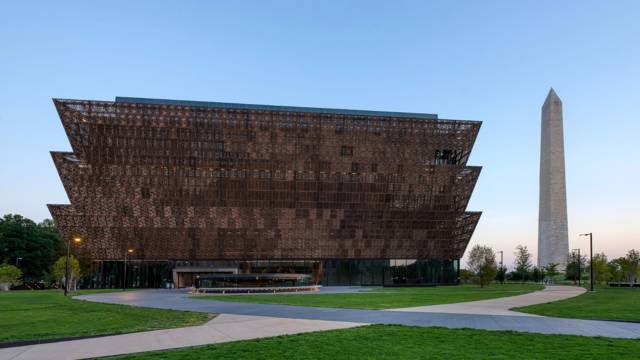
On Tuesday, President Trump attacked the narrative long taught in US schools and documented in museums, about the abhorrent, centuries-long practice of slavery. He focused on The Smithsonian Institution, the world-renowned center of learning and culture based in Washington, DC.
Trump wrote on his social media platform, “The Smithsonian is OUT OF CONTROL, where everything discussed is how horrible our Country is, how bad Slavery was.”
“How bad slavery was.” It is simply unbelievable that such a statement could be uttered by a president in 2025. Yes, slavery was bad, President Trump. It was evil and remains a stain on this country. We should never stop talking about it.
Lonnie G. Bunch III is the 14th Secretary of the Smithsonian, overseeing the entire institution. Prior to that, he was the co-founder of the Smithsonian’s internationally renowned National Museum of African American History and Culture.
Democracy Now! interviewed Bunch in February, 2020, just before the pandemic struck. Bunch described the importance of depicting slavery:
“One of the most important things for me was to talk about the slave trade…I felt that we had to find real remnants of a slave ship,” Bunch said.
“We found the São José. It was a ship that left Lisbon in 1794, went all the way to Mozambique and picked up 512 people from the Makua tribe, was on its way back to the New World when it sank off the coast of Cape Town. Half of the people were lost. The other half were rescued and sold the next day.”
Bunch recalled Trump’s visit to the African American Museum in 2017, at the beginning of his first term as president:
“The first place Donald Trump visited in an official capacity was the museum. I think he was stunned by the stories we told, and there was so much he didn’t know,” Bunch said. “What I realized is that if people who didn’t know but had political influence could come through the museum, I could help them understand, hopefully, something that would change the way they did it.”
Given Trump’s new assault on The Smithsonian, it seems his visit to the African-American Museum didn’t have Lonnie Bunch’s hoped-for uplifting impact.
In late March of this year, Trump issued an executive order targeting the museum conplex. The order alleges that “the Smithsonian Institution has, in recent years, come under the influence of a divisive, race-centered ideology.” The order further creates a committee to review the contents of exhibits for “improper ideology.”
Trump has set the tone, normalizing the rejection of history, of the indescribable horror of slavery in the United States. His loyalists follow suit.
In 2023, Florida Governor Ron DeSantis promoted a revision to the state’s school curriculum, to include instruction on “how slaves developed skills which, in some instances, could be applied for their own personal benefit.” DeSantis defended the offensive guidelines, saying “I think that they’re probably going to show some of the folks that eventually parlayed, you know, being a blacksmith, into doing things later in life.”
Trump’s Defense Secretary Pete Hegseth recently joined a growing Christian Nationalist congregation. The church’s co-founder, Doug Wilson, has written that slavery “produced in the South a genuine affection between the races.” Hegseth has ordered that previously removed statues of Confederate officers be put back, and is restoring Confederate names to military installations that had been recently removed.
The National Park Service has announced that the only outdoor statue in Washington, DC honoring a Confederate, Albert Pike, which was removed following the racial justice protests of 2020, will be restored. Pike was a Confederate general and alleged member of the Ku Klux Klan.
And as Trump has successfully defunded public broadcasting, some are advocating that PBS content be replaced with material from the rightwing media company PragerU. In one clip from Prager already being used in 10 states, an animated cartoon Christopher Columbus is shown downplaying slavery:
“Being taken as a slave is better than being killed, no?”
Annette Gordon-Reed, professor of history at Harvard University, president of the Organization of American Historians and Pulitzer award-winning author, said on Democracy Now!, “It’s an attempt to play down or downplay what happened in the United States with slavery…This is a whitewashing of history.”
With Trump’s all out assault on truth, learning, and the institutions that preserve and curate our collective history, places like The Smithsonian Institution are more important than ever.
“In the era of Donald Trump,” Bunch concluded in 2020, “the museum has become a pilgrimage site, a site of resistance, a site of remembering what America could be, and a site to engage new generations to recognize they have an obligation to make a country live up to its stated ideals.”
The original content of this program is licensed under a Creative Commons Attribution-Noncommercial-No Derivative Works 3.0 United States License. Please attribute legal copies of this work to democracynow.org. Some of the work(s) that this program incorporates, however, may be separately licensed. For further information or additional permissions, contact us.
#DemocracyNow! “Breaking The Sound Barrier” Weekly Column: The Ominous ICE Arrest of #NewarkMayorRasBaraka #RasBaraka


By Amy Goodman & Denis Moynihan
The march to authoritarianism in the US accelerated on May 9th with another arrest of an elected official by the Trump administration. Mayor Ras Baraka of Newark, the largest city in New Jersey, had accompanied a Congressional delegation to Delaney Hall, a private prison run by GEO Corporation under contract to ICE, Immigration and Customs Enforcement. The delegation included Congressmembers Bonnie Watson Coleman, LaMonica McIver and Rob Menendez, Jr., all Democrats representing districts that include or are near Newark. They went to the East coast’s largest migrant jail to conduct oversight as authorized by law.
They were allowed to pass through the gate, along with Mayor Baraka. There they waited for over an hour. Baraka was told to leave, which he did, moving outside the gate to public property. His subsequent unprovoked arrest was a shocking abuse of federal police power, another clear instance of President Donald Trump and his enablers trying to seize power and crush dissent.
Mayor Baraka was held by ICE for five hours then released, charged with trespass. He is no stranger at the gates of Delaney Hall, as he explained days after his arrest on the Democracy Now! news hour:
“I actually go there every day…I go at 7 a.m. with fire code officials, UCC [Uniform Construction Code] officials, health inspectors, to get in, as it is our right to inspect the facility for them to apply for a certificate of occupancy. We’re in court with GEO right now, because they’re defying city ordinances.”
GEO rapidly ramped up operations at the 1,000-bed jail in order to serve as a major hub for Trump’s mass deportations. Newark sued GEO on April 1st, alleging it “blatantly continues to violate City ordinances and regulations.”
Baraka recounted his arrest:
“When the special agent in charge, Patel [Ricky Patel, Special Agent in Charge of Homeland Security Investigations, Newark] showed up, he escalated the situation. The Congresspeople tried to reason with him, surrounded me inside, and finally got him to agree for me to leave. I left, on the other side of the fence…They arrested me, and the congresspeople and other bystanders tried to shield me from being arrested.”
Homeland Security later issued a press release falsely claiming that “a group of protestors, including two members of the U.S. House of Representatives, stormed the gate and broke into the detention facility. Representatives Robert Menendez, Jr. and Bonnie Watson Coleman and multiple protestors are holed up in a guard shack.” Acting US Attorney for New Jersey Alina Habba, one of Trump’s former personal lawyers, falsely claimed on X that Mayor Baraka “committed trespass and ignored multiple warnings from Homeland Security Investigations to remove himself from the ICE detention center in Newark…NO ONE IS ABOVE THE LAW.”
DHS spokesperson Tricia McLaughlin expanded on the lies, telling CNN Saturday, “There will likely be more arrests coming. We actually have body-camera footage of some of these members of Congress assaulting our ICE enforcement officers, including body-slamming a female ICE officer.”
Congressmember Bonnie Watson-Coleman, who is an 80-year-old cancer survivor, rejected the government’s allegations, saying on Democracy Now!,
“There was no body-slamming. The Department of Homeland Security or the representatives from the administration are doing what they do consistently, and that is to lie and to deflect and to try to create legitimacy for illegitimate things that they are doing.”
So, in addition to arresting an elected city mayor, the Trump administration is now threatening to arrest sitting members of Congress. This makes even more alarming a pronouncement by Trump’s Deputy Chief of Staff Stephen Miller, hours before Baraka’s arrest:
“The Constitution is clear…that the privilege of the writ of habeas corpus can be suspended in a time of invasion. It’s an option we’re actively looking at.”
Habeas corpus is the right of those detained to demand the government justify their imprisonment in court or be freed.
Mayor Baraka, who is running for governor and is campaigning for the June 10th Democratic primary, appeared in federal court on Thursday, pleading not guilty to trespass. Alina Habba demanded a full trial, despite the mountain of exculpatory evidence.
The prosecution of Mayor Ras Baraka, like the prosecution of Milwaukee County Judge Hannah Dugan in Wisconsin, accused of helping an immigrant avoid arrest by ICE agents, and the threatened arrest of members of Congress – all portend a frightening escalation in Trump’s drive to authoritarianism.
Several blocks from the Newark courthouse is Harriet Tubman Square, where in 2023 Mayor Baraka unveiled a memorial to the great Underground Railroad conductor and abolitionist, who escaped slavery and returned again and again to lead others to freedom. Newark has a long history of resistance to oppression, as President Trump and his enablers are about to find out.
The original content of this program is licensed under a Creative Commons Attribution-Noncommercial-No Derivative Works 3.0 United States License. Please attribute legal copies of this work to democracynow.org. Some of the work(s) that this program incorporates, however, may be separately licensed. For further information or additional permissions, contact us.
Book Mini-Review: A Clock Approaching Midnight Encourages An African Writer’s Memory Bombing

Decolonizing Language and Other Revolutionary Ideas.
Ngugi wa Thiong’o.
New York and London: The New Press. 209 p., $25.99.
Books are weird containers now because, formerly/formally, they were a way to combine things that would probably never be found on their own because they existed only in memory or microfilm/fiche; with the new century a quarter old, books are still necessary so people can listen to one container, at their own speed, instead of setting up a 10-hour #YouTube playlist. This mini-reader, kind of a ” #NgugiwaThiongo 101″ that would be perfect for an undergraduate class, is highly readable and approachable, with only a few notes at the end. It’s a compilation of some of the artistic activist’s presentations, essays, speeches, lectures and panel presentations, organized thematically. The shocking fact that there’s no introduction, no attempt to summarize such an amazing life of ideas and risk for them, makes sense when the reader realizes that wa Thiong’o, a literary legend still alive and thriving, is 87 and has been writing novels and his multi-volume memoir series from childhood up to his famous 1977 arrest, convicted of essentially strong playwrighting in his native Kenya. The first half of the essay collection summarizes his beliefs about how European colonial languages are incredibly effective in setting up an intellectual and psycho-social hierarchy so dominant that some African nations argue, or worse, don’t argue, about English being their official language. The second is his scattered memories of many of his continental artistic and activist contemporaries, written in essays so short and plain that it seemed he wanted to make sure to get them down as fast as possible. But when you are wa Thiong’o, even phoning it in is to walk boldly as an African through the 20th- and 21st-centuries, constantly measuring the meanings and contradictions of neo-colonialism and other difficult, incomplete freedoms.
Book Mini-Review: #BlackBoomers Teach #Movement101

A Protest History of the United States.
Gloria Browne-Marshall.
Boston: Beacon Press, 360 pp., $31.95.
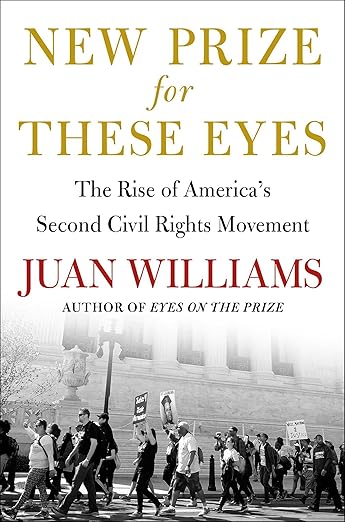
New Prize for These Eyes: The Rise of America’s Second Civil Rights Movement.
Juan Williams.
New York: Simon & Schuster, 288 pp., $28.99.
These books have never been more timely than today since they will probably be blocked from being adopted in school libraries and taught at universities across several states. Marshall, a modern-day, award-winning hyphenate in a way the late #MayaAngelou would be impressed with, and Williams, often known as a liberal (contrarian), both give context to the evening news’ #PresidentTrump executive orders. Both explain how the war is never-ending and that protest is constant and normal when you are up against oppression, whether historically naked or cloaked in the latest fashions. Williams attempts to B.C. and A.D. two different and consecutive #CivilRightsMovements, with #BarackObama on the cross. The first is the traditional, analog, PBS one (and Williams is an expert, having written the original #EyesonthePrize companion book) and the second is the one we have now–digital, fast and furious, with #BlackLivesMatter demanding the right to grow and make mistakes in public. (As we know and as Williams writes, the organized white-nationalist, right-wing response is equally digital but more deadly.) Marshall dissects protest to illustrate that it is, among other things, “primal” and an “investment,” the carbon dioxide exhaled within the racist/sexist/capitalist carbon-monoxide-filled American experiment; it is a visceral and always-correct response to the Dollar Eagle’s generations of Nos and Thou Shalt Nots. If #LeroneBennett and #HowardZinn adopted a child and raised her, it would be Marshall. And if Newark Mayor #RasBaraka #MayorRasBaraka #NewarkMayorRasBaraka is right in that perhaps the only legitimate thing about America is the struggles within it for democracy, then these Boomerooks 🙂 should only be read outside on campuses, in between demands for #Palestinian grad students–the new, respectable #politicalprisoners!–to return to a 2025 America the authors know all too well from the historic shadows and breaking-news currents they present and represent.
#RollingStone: 100 Actions That Define #PresidentDonaldTrump’s #DonaldTrump’s Horrifying #First100Days #PresidentTrumpFirst100Days in Office
The president and his administration have waged a corrupt, chaotic, and cruel assault on the United States and its people
April 29, 2025

Donald Trump’s first 100 days have been the most chaotic and consequential in modern political memory. He has wielded the presidency like a king, seeking to bend America (and, far less successfully, the world) to his will. The result has been about what you’d expect from the first convicted felon and twice-impeached insurrectionist to return to the White House: a reckless campaign of overreach and lawlessness that has strained the federal judiciary, the Constitution, and American democracy itself.
Trump has emerged with few legislative accomplishments — the fewest in a president’s first 100 days, in fact, since the 1950s. They include a short-term spending bill and a law named for murder victim Laken Riley that strips immigrants of due-process rights — both enabled by Democrats. But as he’s taken a hatchet to the government, empowering Elon Musk, the world’s richest man and Trump’s largest political benefactor, to decimate the federal bureaucracy, eliminating entire agencies, slashing and demoralizing others, while hoovering up Americans’ personal data for as yet unclear (but surely not benign) purposes.
Trump’s 100 days are consequential, but not politically successful. At the 100 day mark he’s the least popular president in some 80 years. His chaotic and nasty style of governance has sent his approvals into the toilet. He now finds himself under water even on his signature issue immigration. Trump has spent the days leading up to the milestone melting down over his polling.
It hasn’t been all bad, though. He did move to get rid of the penny.
Below we survey 100 of the most terrifying, corrupt, and otherwise absurd actions that Trump and his administration have taken since he was inaugurated on Jan. 20.
- Stages billionaire’s row at his inauguration — placing tech CEOs Elon Musk, Jeff Bezos, Mark Zuckerberg, Tim Cook, and other high-dollar donors in front of some of his Cabinet nominees.
- Demands an apology from the “Radical Left hard line Trump hater” bishop who implored him to “have mercy upon the people in our country who are scared now” during a sermon at the National Cathedral.
- Attempts to repeal birthright citizenship, which is enshrined in the Constitution, by executive order. The move inspires a wave of lawsuits and is blocked by several federal judges. The Supreme Court is set to take up the issue in May.
- Deports hundreds of immigrants to a notorious prison in El Salvador without due process, citing the Alien Enemies Act, a 1798 law infamously used to justify the internment of Japanese Americans during World War II. The move was made in defiance of a judge’s order.
- Calls for a judge’s impeachment in response to a judge’s order barring his deportations — earning a reprimand from Supreme Court Chief Justice John Roberts: “Impeachment is not an appropriate response to disagreement concerning a judicial decision.”
- Admits it wrongly deported Kilmar Abrego Garcia — a Maryland man without a criminal record — due to what it described as an “administrative error.” The Supreme Court unanimously orders the administration to “facilitate” his return. It is so far refusing to do so, claiming the high court didn’t say what it said.
- Mentions repeatedly how much he would “love” to illegally send American citizens to prison in El Salvador, even suggesting directly to the nation’s president, Nayib Bukele, that he’d like to rendition “homegrown” criminals during an Oval Office meeting.
- Deports U.S. citizen children. Those removed, along with undocumented parents, include a two-year-old, a four-year-old with metastatic cancer, and a 10-year-old with brain cancer who was stopped on the way to an emergency medical treatment.
- Says about the quest for mass deportations: “We cannot give everyone a trial.”
- Renames the Gulf of Mexico the “Gulf of America.” (Also revives “Mount McKinley” as the name for the great Alaskan mountain, Denali.)

- Ousts the Associated Press from White House briefings over its refusal to call the Gulf of Mexico the “Gulf of America.” (The move is later ruled unconstitutional.) The White House subsequently takes control of which reporters get access to press briefings, while the Justice Department revokes Biden-era protections for reporters.
- Spends Presidents’ Day weekend asserting he is allowed to break any law he wants. “He who saves his Country does not violate any law,” Trump made sure to post to both Truth Social and X, driving home the point.
- Says he wouldn’t “100 percent” agree that the U.S. should be governed by laws, not men.
- Pardons his supporters who stormed the U.S. Capitol on Jan. 6, including those who assaulted cops. Stewart Rhodes, the Oath Keepers honcho sentenced to 18 years for seditious conspiracy, and Enrique Tarrio, the Proud Boys leader sentenced to 22 years, were also let off the hook.
- Ed Martin, Trump’s loyalist prosecutor in D.C., fires the Justice Department lawyers who worked on Jan. 6 cases.
- Issues an executive order expanding police state to “unleash high-impact local police forces,” equipped with spare weapons from the military, and guaranteed legal representation if they abuse the citizenry.
- Drops federal corruption charges against Eric Adams, while attempting to hold the New York City mayor by the short hairs as “an ever present partner,” under threat of future prosecution.
- Burns through four IRS interim commissioners as the administration seeks to gain control over personal taxpayer records to aid its deportation efforts and threatens to revoke tax exempt status of nonprofits Trump opposes.
- Thumbs his nose at constitutional term limits by repeatedly discussing a potential 2028 presidential run, as his family business even starts selling “Trump 2028” merch.
- Blocks the State Department from issuing passports marked with X to Americans who don’t fall on the gender binary.
- Attempts to ban trans soldiers from the military, implying they are dishonorable. A judge later blocks the order, writing that it was “soaked in animus.”
- Arrests a sitting judge in Wisconsin, allegedly for helping a migrant avoid being detained by Immigration and Customs Enforcement (ICE).
- Captures and seeks deportation of Mahmoud Khalil, a green card holder who condemned Israel’s violence toward Gaza at student protests, on the pretext that his presence in the U.S. is harming American foreign policy objectives. (Khalil missed the birth of his child while in custody.)
- Threatens to arrest and imprison pro-Gaza participants of “illegal protests” at American universities, First Amendment be damned.
- Detains Rumeysa Ozturk, a student visa holder from Turkey studying at Tufts University, without charge, over her publication of a pro-Palestine op-ed.
- Shares an AI video on Truth Social imagining Gaza as a glitzy beach paradise with a lavish “Trump Gaza” hotel. (Trump previously pledged a U.S. takeover of Gaza, insisting: “We will own it.”)

- Imposes sweeping tariffs on America’s trading partners, dubbing the move “Liberation Day,” and insisting America “IS HEALING” as the markets crash before hitting the golf course.
- Trump’s nonsensical tariff plan calls for import levies on the Heard and McDonald Islands, an uninhabited Australian territory that’s home to penguins, but none for Vladimir Putin’s Russia.
- Promotes a video on Truth Social about how he is “purposely crashing the stock market.”
- Tells Americans that “THIS IS A GREAT TIME TO BUY!!!” hours before scaling back his tariffs, leading to accusations of market manipulation.
- Jacks up the tariff on Chinese goods to well over 100 percent, exacerbating a trade war that appears to have no end.

- Defense Secretary Pete Hegseth posts sensitive military attack plans in an unsecured Signal group chat that accidentally included a journalist.
- Hegseth messages the same attack plans to another unsecured Signal chat that included his wife.
- Fires multiple national security officials a day after right-wing extremist and conspiracy theorist Laura Loomer recommends their ouster in a meeting at the White House.
- Sides with Putin by calling Ukraine President Volodomyr Zelensky a “dictator” as he continues to fight Russia’s invasion.

- Berates Zelensky in the Oval Office, turning a meeting that was supposed to be about an economic agreement to help end the war into an intercontinental embarrassment (to the Kremlin’s delight).
- The Justice Department shuts down an anti-corruption task force that went after Russian oligarchs, including by seizing assets of those violating sanctions.
- Sells a “gold card” allowing a pathway to citizenship for just about anyone who can afford the $5 million price tag, including Russian oligarchs.
- Threatens to take Greenland with military force.
- Repeatedly pressures Canada to submit to becoming America’s “51st state,” subjecting the close ally to stiff tariffs and incessant bullying.
- Skips honoring the return of four American soldiers killed in a training exercise in Lithuania to attend a golf tournament at his Doral resort in Florida.
- Issues executive orders cracking down on some of the nation’s biggest law firms, as retaliation for representing his political enemies. He has since mocked how some of these firms have bowed to his demands in order to skirt retribution.
- Wages a pressure campaign against higher-learning institutions, threatening to withhold funding unless they satisfy the administration’s demands. Some, like Columbia University, cave, while others, like Harvard, fight back.
- Signs an executive order to “eliminate” the Department of Education.
- Opens a snitch line for parents to rat out pro-diversity efforts in public education. The federal initiative is introduced in coordination with the extremist group Moms for Liberty.
- Says he might get rid of the Federal Emergency Management Agency (FEMA), and later denies loyalist Arkansas Gov. Sarah Huckabee Sanders’ request for disaster relief as the state struggles to recover from a series of tornadoes.
- Uselessly drains billions of gallons from California reservoirs in the Central Valley for a photo op, while lying that the water will help put out (already fully contained) Los Angeles wildfires.
- Suggests withholding federal wildfire aid from California unless the state satisfies a series of demands.
- Issues executive orders directing the Justice Department to investigate former Trump officials Miles Taylor for writing anonymously about his first administration, and Chris Krebs, a former Homeland Security official, for telling the truth about the 2020 election.
- Ends Secret Service security detail for loyalists-turned-critics — including former National Security Adviser John Bolton and Secretary of State Mike Pompeo — who face foreign death threats over their involvement in Trump’s assasination of a top Iranian general.
- Purges top staff of the National Archives in apparent payback for its connection to the criminal charges brought against Trump for absconding to Mar-a-Lago with boxes of classified presidential records.
- Instructs Attorney General Pam Bondi to investigate ActBlue, the fundraising portal widely used by Democratic political campaigns. (WinRed, the GOP equivalent, is the subject of multiple consumer complaints and state-level investigations.)
- Fires a pardon attorney hours after she refused to sign off on restoring gun rights to Mel Gibson, the actor and friend of Trump who is subject to restrictions because of a domestic violence conviction.
- Shutters the White House Office of Gun Violence Prevention.
- Allows Musk and the so-called Department of Government Efficiency (DOGE) to gleefully fire tens of thousands of federal workers without any basis.
- Empowers DOGE to mine sensitive data the government holds on American citizens, from the Social Security Administration to the IRS, raising alarms about privacy and federal surveillance.
- Repeatedly attempts to shut down the Consumer Financial Protection Bureau.
- Musk and Vice President J.D. Vance team up to rehire a staffer who once wrote, “I was racist before it was cool.” The staffer is part of a stable of problematic, inexperienced Musk acolytes aiding DOGE in the reckless teardown of federal agencies.

- Pulls the plug on the U.S. Agency for International Development (USAID), leaving aid workers and recipients in the lurch. The cuts are threatening tens of millions of lives.
- Slashes jobs at the Department of Veterans Affairs, while laying out plans to cut 80,000 more from the already short-staffed agency responsible for veteran health care and other services.
- Fires over a dozen inspectors general, who offer oversight of executive agencies and actually prevent waste, fraud, and abuse.
- Musk admits DOGE “accidentally canceled” Ebola prevention, before supposedly reinstating it.
- Robert F. Kennedy Jr., Trump’s Health and Human Services secretary, fires thousands from the Centers for Disease Control, National Institute of Health, FDA, and other agencies responsible for the nation’s health and scientific research. The “bloodbath” pushes scientists to consider leaving America.
- RFK Jr. downplays the severity of a measles outbreak in Texas that led to the first death from the disease in a decade. “It’s not unusual to have measles outbreaks every year,” he insisted during a Cabinet meeting.
- RFK Jr. says he wants a “registry” of Americans living with autism. The administration said it’s ”not creating“ the database after intense backlash, but RFK Jr. still seems to be planning to determine what causes autism “by September.”
- The U.S. Department of Agriculture (USDA) slashes $1 billion that helped food banks and schools buy products from local farmers.
- The Food and Drug Administration (FDA) suspends milk inspections amid DOGE cuts, while the USDA pulls the plug on a program to monitor the nation’s raw chicken supply for salmonella.
- Announces a private dinner and White House tour for the largest investors in Trump’s personal cryptocurrency meme coin, which he launched just days before his inauguration.
- Pardons loyalist in Nevada who fraudulently used funds meant to honor a fallen police officer for plastic surgery.

- Turns the White House lawn into a Tesla showroom in order to pump up the stock price of Musk’s flagship company. Alleges that a boycott of Tesla is somehow “illegal,” while the Justice Department describes Tesla vandalism as “domestic terrorism.”
- Musk and DOGE slash the Federal Aviation Administration workforce. The cuts include air traffic control support staff.
- Baselessly blames a deadly mid-air collision of a military helicopter and a passenger jet on DEI, or diversity, equity, and inclusion initiatives.
- Pushes a series of absurd lies and distortions to justify DOGE tearing apart the government, from claiming the U.S. spent $50 million on condoms for Gaza to lamenting millions spent “making mice transgender.”
- Orders a sweeping freeze of trillions in federal grants and spending, affecting programs including Meals on Wheels and Medicaid. Mostly rescinds it after getting smacked down in court — but keeps it in place for green energy projects funded by the Inflation Reduction Act.
- Pulls the U.S. out of the Paris Agreement, placing America alongside pariah nations Iran, Libya, and Yemen as the only countries refusing to commit to coordinated reductions of greenhouse gases.
- Places 31 core environmental regulations on the chopping block — including the “endangerment finding” that made carbon pollution subject to the Clean Air Act. Environmental Protection Agency (EPA) Administrator Lee Zeldin brags of “driving a dagger straight into the heart of the climate change religion.”
- Dismisses the authors working on the National Climate Assessment, a congressionally mandated overview of the impact of global warming on the United States.
- Fires hundreds of staffers at the National Oceanic and Atmospheric Administration, the agency responsible for weather monitoring.
- Guts the National Environmental Policy Act, one of the nation’s bedrock public health and environmental protection laws that the fossil fuel industry had been targeting for decades.
- Stages a MAGA takeover of the Kennedy Center for Performing Arts, declaring himself chairman of the venerated institution.
- The White House X account becomes dark and trollish, posting an “ASMR” video of deportees being shackled before a flight, as well as other memes mocking migrants.
- Instructs the Department of Homeland Security to produce ads thanking him for closing the border. The DHS budgets up to $200 million for the campaign, exempting the money from DOGE review.

- DHS Secretary Kristi Noem poses for a ghoulish photo op inside of El Salvador’s infamous mega-prison, standing in front of a prison cell full of shirtless inmates with shaved heads.
- Rescinds Biden-era executive orders that would have dramatically lowered prescription drug prices.
- Backs legislation to abolish limits on bank overdraft fees, scrapping reforms that imposed a $5 cap.
- Issues an executive order banning collective bargaining at many federal agencies, insisting that union rights are a threat to national security.
- The Pentagon’s anti-diversity purge leads the Naval Academy to remove Maya Angelou from its library, while retaining Hitler’s Mein Kampf.

- The Pentagon briefly blocks web pages and training materials dedicated to the Tuskegee Airmen, the Navajo codebreakers, Jackie Robinson, and Women Airforce Service Pilots (a.k.a. WASPs). It even flags the Enola Gay, the plane that dropped the first atom bomb on Japan, as woke.
- Fires senior women military leaders from their posts at the Coast Guard, Navy, and Air Force, as well as the chairman of the Joint Chiefs of Staff, a Black man.
- Orders a crackdown on supposed “anti-American ideology” at the Smithsonian Institution, in particular at the National Museum of African American History and the Women’s History Museum.
- Rescinds a bedrock Civil Rights-era order from Lyndon B. Johnson barring discrimination among federal contractors. Trump later issues an executive order, dubbed “Restoring Equality of Opportunity and Meritocracy,” calling for the rescission of Civil Rights Act regulations.
- Spars with Maine’s governor at the White House over the state refusing to comply with an order barring trans athletes from participating in women’s sports. The Department of Education announces an investigation into Maine’s DOE later the same day.
- Tries to erase LGBTQ history by removing “T” and “Q” from the website for the Stonewall Inn National Monument, the site that birthed the modern LGBTQ movement, dismissing the leadership of trans icons like Marsha P. Johnson and Sylvia Rivera.
- Cuts thousands of jobs at the Forest Service and National Park Service, throwing the parks into chaos while elevating the risk for wildfires.
- Transportation Secretary Sean Duffy orders federal funding be prioritized to serve communities with high marriage and birth rates.
- Reclassifies millions of undocumented immigrants with Social Security numbers as dead, seeking to “terminate” their legal and financial lives.
- Issues an executive order demanding a registry of sanctuary cities and states, which would be targeted for the “suspension or termination” of federal funding.
- Yanks ReproductiveRights.gov off the internet, while removing every mention of “abortion” from the Department of Health and Human Services website.
- Pardons 23 anti-abortion activists convicted of crimes breaking into reproductive health centers, stealing fetal tissue, and accosting pregnant patients outside.
- Amid dismal polling preceding his 100th day in office, Trump calls pollsters “criminals” who should be “investigated.”
 Drums in the Global Village