Has the night lost its way to dawn?
– a poem for Johanna Fernandez
to sister comrade Johanna Fernandez RIP
you left us three nights ago
and
each time i awaken
to find it is still dark
i wonder
whether the night
has lost its way
to dawn
over and over
i check
the signless sky
over and over
it does not reply
over and over
i wish a trail of stars
would become
the crumbs leading
to the rewind day
i crave
over and over
struggle memories
reuniting us
tug at me
through dark dreams
lulling me
back into a broken sleep
over and over
after the disappearance
of another loved one
i wonder whether sunrise
will be in mourning
Caro
Cleo
Assata
Johanna
over and over
i fear i am lost
until the blessed rescue
of another daybreak
and Movement children knocking
at my door
(c) Julia Wright August 3 2026
From the Baruch College-CUNY Department of History, as posted on Facebook on August 1:
It is with great sadness that we share the news that Johanna Fernandez, a History Department professor at Baruch College–CUNY’s The Graduate Center of the Weissman School of Arts and Sciences, passed away on July 30, 2026.
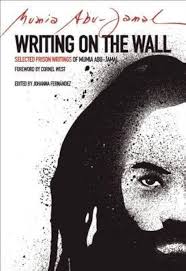
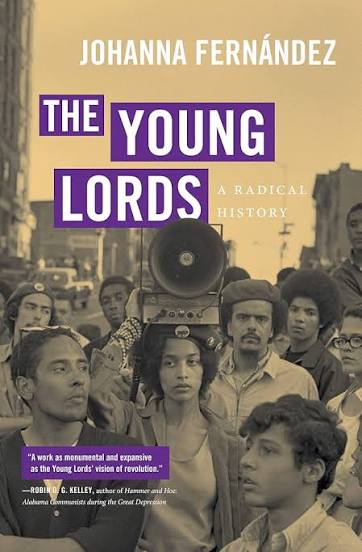
Professor Fernández was a dedicated educator to students at Baruch College and throughout CUNY, and a respected and pioneering historian. Her most notable publication, The Young Lords: A Radical History, was awarded multiple scholarly awards, including the prestigious Fredrick Jackson Turner Award from the Organization of American Historians in recognition of its excellence. She also authored Writing on the Wall: Selected Prison Writing of Mumia Abu-Jamal, as well as countless articles and book chapters on Latinx history, the history of the carceral state, and the history of modern US politics and society.
Professor Fernández embodied the mission of conducting history for the public good. She was a lead actor in the declassification and publication of previously inaccessible police archives, and helped establish a new archive on mass incarceration at Brown University. She organized countless marches and meetings to advance civil rights, and engaged people in the study of history through radio programs, editorials, and public events. In doing so, Professor Fernández never shied from holding power to account in pursuit of the truth. One of her last public history initiatives was the organization of Presente! – a major multi-site museum exhibition on Latinx history during the twentieth century. Professor Fernández did not tire in dedicating herself to these important efforts while valiantly battling cancer.
We mourn the loss of Professor Fernández, who has departed from much too early in life. Her work has, and will continue to have, an important legacy in the Baruch community, the field of history, and the fight for advancing justice and human rights.
*********************
I learned a lot about #MumiaAbuJamal from her. The #FreeMumiaMovement has lost one of its top leaders and #AfricanaStudies one of its top, award-winning scholars!
The aforementioned panel is here:
*********************
**********************
Two Ladies of the Young Lords—Denise Oliver-Velez and Joanna Fernandez
By Herb Boyd
The deaths of Denise Oliver-Velez (August 1, 1947-July 15, 2026) and Dr. Joanna Fernandez (December 2, 1970 -July 30, 2026) occurring fifteen days apart provides a double significance to the history of the Young Lords Party. Oliver-Velez was a founder of the Young Lords and Fernandez became one of its chief biographers. In a pamphlet on the Ideology of the Young Lords, Oliver-Velez, who was the party’s Minister of Economic Development, wrote “We are all fighting against an enemy, the Yankee and the Puerto Rican lombrices (earthworms). The major thing that holds us back in our fight to liberate Puerto Ricans and all oppressed people is a lack of unity. If we are not united, like a fist, we are weaker in our battle. In unity there is strength, and a nation divided is a weak nation.”
Fernandez touched on the same topic in her book The Young Lords: A Radical History (University of North Carolina Press, 2019) in her exposition of the party’s fight against imperialism. “Over the course of their brief yet productive life-span, the Young Lords won significant reforms and used local battles to expose the United States’ quiet imperial project in Puerto Rico, which became a colony of the United States in 1898. In just a few short years, the group grew from a little-known organization to the stuff of legend. In the process, their media-conscious urban guerrilla offensives, combined with the group’s multiethnic membership, redefined the character of protest, the color of politics, and the cadence of popular culture in the city” she wrote.
Among her comments about Denise, she notes that “Denise Oliver was one of several Young Lords who witnessed the fallout. In 1957, with the help of a white proxy, Oliver’s middle-class, black American parents purchased a home in Hollis, one of the predominantly white Queens neighborhoods to which children of color were bused in 1959. During her first day at Junior High School 59, Oliver remembers “getting off the bus, commotion going on, and a white kid with blood streaming down his face. There were fights going on in the yard. There were white students who had jumped on some black students, there were black students fighting back, there were [white] parents protesting the busing of kids into their neighborhood. The bus monitor rushed us into the building. You could feel the hostility immediately.”
Fernandez allocates considerable space for Denise’s stance against male chauvinism or “Machismo,” which is just one element of Denise’s determination to embrace “the revolution within the revolution.” This was, Fernandez further observes, “a deliberate part of her struggle to deconstruct and challenge the manifestations of power dynamics, racism, and sexism in everyday life among movement participants. The effort was also a trademark of the radical wing of the women’s movement, articulated in the slogan ‘The personal is political.’”
Both were dedicated writers and teachers, (Fernandez for many years a professor at Baruch College and Denise at SUNY New Paltz) and shortly before she joined the Young Lords, Denise “taught Black American and Puerto Rican history at East Harlem Prep, an East Harlem school launched by the RGS that offered an educational space to this new class of young people permanently expelled from the public school system. After having been expelled for her activism at Howard University, Oliver was startled by her success with what the school system perceived as “incorrigible students … a lot of kids in the community who weren’t in school at all. They were considered to be refuse, unteachable, unreachable; a lot of them were in gangs,” Fernandez wrote.
There isn’t time or space here to fully dissect the intersection of these two marvelously revolutionary activists, that will and should be done by comrades more informed of their lives. And it shouldn’t be ignored that both succumbed to cancer after relentlessly battling the disease. During appearances on “Dialolos” Intimedia.org, the two were separately interviewed last December. Dr. Fernandez expounded at length on the subject of fascism, and Denise, because of her illness, offered a brief discussion on the origins of the Young Lords that stemmed from the city’s reluctance to remove garbage.
https://www.johannafernandez.info/about
https://www.gc.cuny.edu/people/johanna-fernandez
https://en.wikipedia.org/wiki/Johanna_Fern%C3%A1ndez_(historian)
https://www.democracynow.org/2016/6/17/nypd_surveillance_unveiled_city_claims_to
https://www.amazon.com/dp/0872866750?lv=shuf&channelId=500&plpRedirect=mhFallback
*******************
************************
From Julia Wright, in an email to the Free Mumia Listserv, August 2, 2026:
” solidarity is emotional “
Johanna Fernandez (1970-2026)
As the tributes pour in, we are slowly, soberly and somberly putting together the Johanna each one of us knew.
The collective Johanna that emerges is tall, fierce but loving, a burning passionaria with ice-cold determination. A woman warrior ready to pay the price.
The intrepid biographer of the Young Lords, Johanna had joined the Mumia Abu-Jamal campaign in the late nineties.
In 2023, I was honored to have collaborated with Johanna on bringing Mumia’s archives to Brown University and to have co-founded with her, Professor Mark Taylor and Michael and Annette Schiffmann: the UN Mumia Liaison group. The same year, Johanna was key in obtaining an amicus curiae for Mumia, which was presented to Judge Lucretia Clemons, although the latter dismissed both the United Nations human rights document and Mumia’s last appeal, founded on solid Brady and Batson evidence found in six boxes locked away for 36 years.
Johanna was not only Mumia’s PhD advisor, but she was also the political apple of his eye, his unfailing sister whose healing company had sustained him for decades. When he was informed two nights ago, Mumia was devastated.
Johanna had a strategic view of the struggle but she also knew tactically how to seize the time.
She had that see-through vision of Time that was both feline and analytic.
I remember, six years ago, when she was watching Amy Goodman interviewing Larry Krasner live on Democracy Now!, she seized her smartphone, called the studio, asked that a message be passed on to Amy requesting her to raise Mumia Abu-Jamal with Krasner in real time thus eliciting from the Philly DA the famous response that Mumia’s case remains “a microcosm” of all that was corrupt in the justice system that preceded him. That statement remains a testament to what Larry Krasner has yet to do while he is in the prosecutor’s seat.
Johanna had an uncanny way of holding up mirrors to double-talk.
I remember when Johanna was in remission from her last illness and the encampments of CUNY and Columbia were up and going for Gaza; frail as she was, she went in person to those campuses to air Mumia’s commentaries for a Free Palestine through a megaphone she held out for the students to hear.
Johanna had a sense of historical Time and knew how not to let it pass us by. And she was more than just the teacher of her students; she was a passer-on of revolutionary ideology and practice between the generations.
Johanna was a community healer.
In 2021, she organized a panel against sexual abuse targeting women in the struggle, which instead of being an academic panel of talking heads gave the mic to those among us who had been abused, and some of us for the first time found the words to say it.
I was able to bear testimony to my own abuse and to how I felt my body had become a piece of land up for grabs. I had been a human colony.
After the panel, for the first time in my life, although I was almost eighty years old, I was able to dance to my own ancestral music.
Johanna is to be thanked for many things – and many of us did not have the time to thank her.
Like Denise Oliver-Velez, the Economic Development Minister of the Young Lords and other revolutionary leadership, Johanna fought both the mass incarceration state on the outside and cancer within.
Since Amilcar Cabral’s Cancer of Betrayal speech on the death of Kwame Nkrumah ( 1972 ) , we understand that cancer can be the physical expression of the inner betrayal of the revolution. “The personal is political” is a Young Lords slogan.
Both Denise and Johanna were relentlessly tracking such betrayals or festering inner contradictions, for instance the paradoxical role of capitalism’s dollars in our movements.
More than ever, the losses of Denise Oliver-Velez and Johanna Fernandez leave us with the need for a Fanon who could write a psychopathology of everyday abolitionism showing us how in spite of the necessity of being in fight or flight mode day and night, in spite of the accumulation of cortisol and stored adrenaline, we can solve our contradictions before they go to our cells and we can address the root cause that prevents the unity of the new body politic we work to free our political prisoners into – from sub-dividing into rogue elements.
Yesterday my son, who never met Johanna, listened to her story and added: “Mum, just as oncologists have found that the sugar we are over-dependent on – like our dollars – is the poison that makes cancer grow in us.”
Johanna Presente!
Julia Wright
***************
Posted to the Listserv:
For Johanna Fernández— ¡Presente!
by Mark Lewis Taylor
Princeton Theological Seminary
August 3, 2026
I received word some days ago from Sophia Williams of the movement for Mumia, and also confirmation just yesterday from Johanna Fernández’s brother that Johanna passed this last Thursday night, July 30, 2026.
Words come hard now. The ache is acute, as I feel the loss of a friend, a scholar, colleague, and an activist who gave so much to the movement for Mumia and for justice and revolution in so many ways. One of the things she did was to rejuvenate Educators for Mumia Abu-Jamal (EMAJ), the group I founded in the mid-1990s. She went on to energize so much of the Mumia movement through the Campaign to Bring Mumia Home and by coordinating with Pam Africa and others in the International Concerned Family and Friends of Mumia Abu-Jamal (ICFFMAJ). And through all of these efforts—whether organizing, writing or teaching—she often mentioned the care she had for, and from, her most immediate family in the New York area.
I remember first meeting Johanna in the late 1990s or early 2000s. We first visited in phone meetings as we planned a panel of activist scholars presenting at Drexel University, the first of many more panels, press conferences and events. She drove into Philadelphia for the Drexel event, from Pittsburgh where she was then teaching at Carnegie Mellon University, before she took the teaching position at Baruch College, CUNY.
Meeting Johanna in a hallway at Drexel that day was like meeting a storm, or maybe a strong wind blowing in the right direction. She swept into the hall with several students in tow. We shook hands, but there was no time to stop and visit. We just kept striding, right to the Drexel U auditorium for start-up of the panel—to work!
How many press releases did I co-write with Johanna? How many times did we go to work over the phone, often pushing against and navigating between our teaching and publishing duties, to get those press releases or other movement essays, written just right and by deadline?
She had both a revolutionary impatience and a revolutionary patience. Both were gifts. I recall the impatience that she could express in the heat of a chaotic planning meeting—maybe in New York, in Philadelphia, in Princeton—“Guys, we gotta get focused now!” Her patience was expressed in the steady return to details that she showed when planning an event. Perhaps her patience was especially evident in the meticulous care she gave to her book, The Young Lords: A Radical History. For that volume she had to nurture a lawsuit over years against the NYPD, as well as draft and redraft chapters for what became a stellar, award-winning book, recognized for its brilliance and research by the best of historians nearly everywhere, but especially by the most radical ones among them. She also edited an invaluable collection of Mumia’s essays: Writing on the Wall: Selected Prison Writings of Mumia Abu-Jamal.
There are too many stories to tell, too many events to recall along the way of Johanna’s essential contribution to our struggle for Mumia. But consider these: (1) her contributions to EMAJ’s planning and hosting of the Constitution Center event of some 1800 attendees for Mumia in 2011, which occurred just before Mumia left death row; (2) the archiving of Mumia’s papers at Brown University library; (3) her efforts with Mumia to facilitate our movement’s self-critical analysis of potential abusive practices in our own activist communities; and especially (4) her constant presence to Mumia, mobilizing with others as Mumia battled for his health, his very life, against hepatitis B, his heart ailment, and the prison’s medical neglect that worsened all of these. Several times a week, for years, she was on the phone with Mumia, checking on him, visiting with him. I heard from Mumia so many times how important her phone and personal visits with him were.
Johanna’s smartphone also made possible Mumia’s call-ins to my classes. The last call-in she facilitated occurred while she was picking up her lunch at a NYC deli (!). As she told me later, she had received the call from Mumia at a cashier’s counter, then quickly patched Mumia through to my cell phone in Princeton, so that 40 students in my class on incarceration and police repression could have an insightful 15-minute question-and-answer session with Mumia. This call from Mumia via NYC occurred in the final course I taught before retiring from Princeton Theological Seminary, in Spring 2025.
One last word: Johanna was an internationalist. She wrote for Al-Jazeera and other world publications. Her organizing took her several times to France and Germany, where Mumia groups were active. She hosted French and German activists in her NYC apartment. She put hours into laboring with others for the UN and other international bodies seeking justice and freedom for Mumia. She also knew and cultivated the Caribbean radical traditions, which she knew viscerally from her own family’s roots in the Dominican Republic. She rigorously honed her socialist commitments and analyses in a world of imperialism, and also white and masculinist supremacy. We talked often about the importance of Latin America and its liberation theologies for the Mumia struggle. She traveled with a U.S. Prisoner, Labor and Academic Delegation to Palestine in 2016. That delegation, and the declaration it released later, aided reflection on my own travels there in 2007 and more recently in 2025.
Near the time of my retirement from teaching in 2025, I lost track of all that Johanna was doing. She was in the whirlwind of organizing ‘til nearly the end. And when her illness came, we could see how she battled to keep organizing, but also how she had to step back to tend to her health. Phone calls and texts became less frequent.
Back in January of this year, 2026, my text to her about an event being planned ended with my saying, “I hope you’re doing okay, warm regards.” She replied, “Aww, thanks. I am on the mend.” In May I wrote, “It’s been a while. I hope you are okay. Let me know if there’s a good time to call.” And just a few weeks ago, on July 18, I see my last message to her: “Sending you all revolutionary love, respect and power—wherever you are. All prayers and energies to you! -Mark”
There were no replies to these last two texts. In this hard time of loss, I am holding on, desperately, to my belief that Johanna, now with the ancestors, will not lose touch with our movement and with each of us. I know that I—along with so many others—will still be hearing her voice as it inspires us with her undying presence for all our struggles to come.
¡Presente! indeed, Johanna Fernández—comrade, professor, friend!
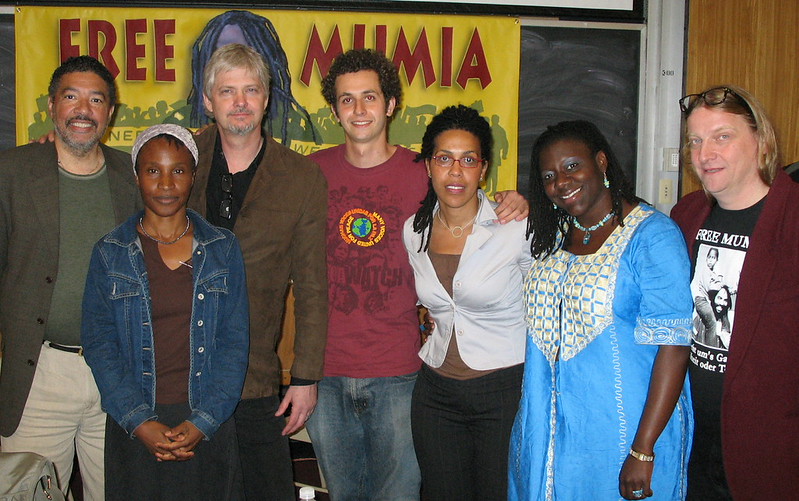
The Drexel University event, May 16, 2007. The author is background, second from right, obscuring #MumiaAbuJamal ‘s image. Photo by Joe Piette.