Tag Archives: Democracy Now!
#DEMOCRACYNOW: MARCH FOR #MUMIAABUJAMAL: 100+ mile march from Philly to SCI Mahanoy ends (and a #JuliaWright news poem)
https://www.facebook.com/Mobilization4Mumia/videos/866732672464340
Supporters of Mumia Abu-Jamal are on a 103-mile, 12-day march ending Tuesday in Frackville, Pennsylvania, where he is imprisoned at the Mahanoy state prison. The march ends on the same day Abu-Jamal was arrested in 1981 for the murder of Philadelphia police officer Daniel Faulkner, for which he has always maintained his innocence. One of the best-known political prisoners in the world, Abu-Jamal was an award-winning journalist and co-founder of the Philadelphia chapter of the Black Panther Party before his incarceration, and has continued to write and speak from prison. Human rights groups say he was denied a fair trial, with evidence unearthed in 2019 showing judicial bias and police and prosecutorial misconduct. Abu-Jamal is now 71 years old, and advocates say he is being denied proper medical care in prison, permanently risking his eyesight.
“We’re marching today to demand freedom for Mumia and all political prisoners,” says activist Larry Hamm.
“We ration healthcare in this country, and in particular for prisoners,” says Noelle Hanrahan, part of Abu-Jamal’s legal team, who is demanding “that Mumia get specialist care … and that he is given the treatment that he deserves.”
***************************
AMY GOODMAN: This is Democracy Now!, democracynow.org. I’m Amy Goodman, with Juan González.
One of the world’s most well-known political prisoners, Mumia Abu-Jamal, was arrested on this day in 1981 for the murder of Philadelphia police officer Daniel Faulkner, for which Mumia Abu-Jamal has always claimed innocence. Amnesty International and human rights groups have found he was deprived of a fair trial. His lawyers say evidence shows his trial was tainted by judicial bias and police and prosecutorial misconduct, like withholding of evidence, bribing or coercing witnesses to lie. Evidence in boxes discovered in the Philadelphia District Attorney’s Office by DA Larry Krasner in 2019 includes notes from one of two key witnesses to prosecutors requesting, quote, “the money owed to me,” unquote.
Mumia Abu-Jamal was an award-winning journalist, member of the Philadelphia chapter of the Black Panther Party, ultimately sentenced to death, but went on to write 15 books and record a weekly column while a global movement built around his case. He spent 29 years in solitary confinement. In 2012, Mumia Abu-Jamal was moved from death row to the general prison population after a federal appeals court in 2011 upheld the overturning of his death sentence by a federal judge, citing improper jury instructions, and prosecutors agreed to a life sentence rather than a new sentencing hearing.
Mumia Abu-Jamal is now 71 years old, was recently blind for eight months until he had cataract surgery, but needs more medical care to prevent him from permanently losing his vision. Dozens of his supporters who hope to draw attention to his claims of medical neglect are on 103-mile, 12-day march that’s ending today in Frackville, Pennsylvania, where Mumia is imprisoned at SCI Mahanoy.
ZAYID MUHAMMAD: We’re taking that long walk, because the walk for freedom is a long walk. And we do it with an intense, extra motivated passion, because we just lost a bold freedom fighter in Imam Jamil Abdullah al-Amin in the clutches of the state, and that should not have happened. So, under no circumstances can we allow the state to take any more of our freedom fighters. It’s time to get Mumia all the healthcare he needs.
AMY GOODMAN: In a minute, we’ll speak with someone on the march and a member of Mumia Abu-Jamal’s legal team. But first, this is a Prison Radio commentary that he recorded in August, titled “Mumia’s Vision: A Message for the Movement.”
MUMIA ABU-JAMAL: I have been reluctant to talk about my eye problems. The reasons may have eluded some, but I explain that, you know, in the context of being in prison, any sign of weakness is to be avoided at all costs. These are, unlike many other institutions in society, heavily male, and therefore gender-conscious in a way that society is not. Weakness brings predation.
So, I kept it quiet. And I kept it quiet simply because I wrongly believed that once I got examined and once it was clear that this was a real visual contextual problem, that I would get a rather quick response. Boy, was I wrong. I was, as the saying goes, as wrong as two left feet. What I got was evaluation after evaluation after evaluation after evaluation, literally. It was only when I went outside and those prior evaluations were repeated by a noted ophthalmologist that the ball began to roll. And even then, the ball rolled exceedingly slowly.
I have been, for all intents and purposes, unable to read, unable to write, unable to see anything more than the masthead of a newspaper and not even its headlines, blurry television bursts of color. The television is my radio now.
AMY GOODMAN: Mumia Abu-Jamal, speaking from prison, SCI, State Correctional Institution, Mahanoy in Pennsylvania.
For more, we’re joined by Larry Hamm, chair of the People’s Organization for Progress, one of the elders on the March for Mumia. He is in Frackville, Pennsylvania, where the prison is. And here in New York, one of Mumia’s lawyers, Noelle Hanrahan, founder and producer of Prison Radio, which has been recording and distributing Mumia’s commentaries from prison since 1992.
Larry, let’s begin with you. You’re on this more than 100-[mile] march that’s ending today. Why did you march? What are you calling for?
LARRY HAMM: Good morning, Amy. Good morning, Juan. Good morning, Noelle.
We are marching to free Mumia and free all political prisoners. We are marching to draw attention to Mumia’s medical problems, but, more importantly, to demand that he get the surgery and medical treatment he needs. We are marching for humane treatment for all prisoners, especially our elders. I’m a witness to the fact that we have an aging prison population, and, like Mumia, many of them are not getting the medical care they need. So we’re marching today to demand freedom for Mumia and all political prisoners and to demand that Mumia get the urgent surgery and medical treatment he needs.
JUAN GONZÁLEZ: And, Noelle, I’d like to ask you: In terms of his battle for healthcare, Mumia’s battle for healthcare, why has it been so difficult for him to get that healthcare?
NOELLE HANRAHAN: [inaudible] healthcare in this country, and in particular for prisoners, there are contracts by Wellpath that specifically state that they limit ophthalmological care in prison to on-site monitoring. They do not send people routinely out for specialist care. We had to fight. The Abolitionist Law Center, the lawyers and the movement had to come together to demand that Mumia get care just for post-cataract surgery. When we got the specialists to look at Mumia, they discovered two other conditions that could mean that he loses his eyesight permanently if he is not treated. He has not been treated for these conditions since June.
AMY GOODMAN: So, what are you demanding right now?
NOELLE HANRAHAN: That Mumia get specialist care for his glaucoma and his diabetic retinopathy, and that he is given the treatment that he deserves. But we’re not just calling for Mumia, because there are many inmates. They know who’s blind in prison. They are refusing care to save money for Wellpath.
AMY GOODMAN: Why is ophthalmological care particularly limited?
NOELLE HANRAHAN: I don’t know if it’s particularly limited. It’s the one we’ve researched right now. I believe that they likely limit all care that might cost them money. Like our lawsuit for hep C care in 2017 that won care, the first preliminary injunction for hep C care, they did not treat Mumia with a fast-acting cure for two years, causing, likely, the diabetic retinopathy.
JUAN GONZÁLEZ: And, Noelle, Philadelphia has a supposedly progressive DA, District Attorney Krasner, who his own office found forgotten files on Mumia that showed bias in his trial. Why has there been no movement by the DA to reopen his case?
NOELLE HANRAHAN: I think the DA has been pressured to actively litigate this case by being impeached by the Pennsylvania Senate, also by being called up in a special — there was a King’s Bench petition that deposed Larry, that asked him specifically if he was going to prosecute Mumia. There are pressures. Mumia is the third rail in Philadelphia. He is like everyone else in prison, the 5,000 people that are serving life without possibility of parole just in Pennsylvania. He’s one of a class of many. And Krasner, he will do the right thing. He is elected by the people. He’s elected by the abolitionist ecosystem. We have an obligation to make it impossible for him to not support us. But there’s pressure.
AMY GOODMAN: And on what grounds are you asking for his case to be reopened now?
NOELLE HANRAHAN: There are three ways that any lifer can get out. It would be a post-conviction relief application, which we are developing, that he doesn’t have one in court right now. His last one was denied in March by a lower court that did not fairly review his case. He can also go through the pardon board, which is a five-member panel and also the governor, six — have to be unanimous — or compassionate release, which is extremely limited.
AMY GOODMAN: Finally, if you can comment, Larry Hamm, on what you’re doing today in front of the prison in Frackville, Pennsylvania, what this more than hundred-mile march has meant for you? You’re about the same age as Mumia Abu-Jamal.
LARRY HAMM: I am exactly the same age as Mumia, and our birthdays are in the same month.
Yesterday, we reached the hundred-mile mark, and today we will march the last three miles to Mahanoy prison, where Mumia is incarcerated. We will have a press conference and a rally there to once again make the call for Mumia to get the medical care that he needs, and for all prisoners, especially our elders, to get the medical care that they need.
AMY GOODMAN: And, Noelle Hanrahan, 10 seconds.
NOELLE HANRAHAN: It’s relief from the inside out. This was built by prisoners. It was built by prisoners’ families, the Abolitionist Law Center, Saleem Holbrook, Bret Grote, the lead attorney. We are going to win and create the world that we deserve.
AMY GOODMAN: Noelle Hanrahan is one of Mumia Abu-Jamal’s attorneys and founder and producer of Prison Radio. Larry Hamm is chair of the People’s Organization for Progress, on the March for Mumia, speaking to us from Frackville, Pennsylvania, where he is imprisoned. I’m Amy Goodman, with Juan González.
*******************
After the March for Mumia – a bluesy poem
Julia Wright
i so longed to march
with y’all
from the city of the absence of love
to SCI Mahanoy
that here across the pond
i lost balance and fell
twice in twelve days
as i walkedin a foreign town
with a Free Mumia banner
in my mind
yesterday
while y’all gathered
in front of Mumia’s prison
i was seeing a doctor
for this repeated loss of balance
after examining me
the doctor shook her head
and said :Madam
if you want to walk safe distances
you need a cane
this morning
i bought a cane
but
the real weathered walking stick
is
in your youthful hands
(c) Julia Wright. December 10th 2025. All Rights Reserved to the medical expenses of Mumia Abu-Jamal
#BlackPowerMedia: #LeonardPeltier’s First Birthday Celebration Following his Release!
*******
#BreakingTheSoundBarrier Column: 20 Years Later, the Lessons of #HurricaneKatrina Go Unheeded

Weekly Column
August 28, 2025

By Amy Goodman & Denis Moynihan
It’s been 20 years since Hurricane Katrina made landfall on August 29th, 2005, breaching New Orleans’ protective levees, unleashing unprecedented destruction. It was one of the deadliest natural disasters in US history, killing over 1,800 people, mostly poor residents of New Orleans’ historic Black neighborhoods. Katrina was also the US’ costliest natural disaster, causing over $160 billion in damage. Katrina’s deadly waters long ago receded, but in their wake, with worsening climate change, the vital lessons of Katrina have gone unheeded. Indeed, President Donald Trump, by flaunting genuine risks, is aggressively courting disaster.
Take Trump’s attack on FEMA, the Federal Emergency Management Agency. In a statement released by the White House in May, FEMA was lumped with a slew of federal agencies that, the statement reads, represent “the weaponized rot in our Federal Government.” Targeted agencies included the EPA, the IRS, and the NIH. The document accuses FEMA of being “wasteful and woke,” engaged in “official training to indoctrinate ‘intersectionality’ and ‘investment in diversity and inclusion efforts’ over disaster prevention and response, culminating in aid workers being directed to skip the homes of President Trump’s supporters in the wake of a disaster.”
As with most of Trump’s pronouncements, these accusations are presented without any evidence.
The bulk of FEMA’s functions, according to Trump, would be delegated to the states. Of course, hurricanes and other natural disasters don’t recognize state lines, and no state could single-handedly respond to a disaster of the scale of Hurricane Katrina. Such a response requires collective action, marshalling resources from across the country to save lives in the impacted region, to recover the dead, and to rebuild.
Indicative of Trump’s contempt for FEMA was his appointment of David Richardson, a former Marine with no experience in disaster recovery, as acting head of the agency. Upon his arrival at FEMA, Richardson reportedly shocked staffers by saying he was unaware the US has a hurricane season.
A group of current and past FEMA workers published a letter, called The Katrina Declaration, that they sent to a Trump-appointed FEMA review council and to Congress.
The letter opens, “Since January 2025, FEMA has been under the leadership of individuals lacking legal qualifications, Senate approval, and the demonstrated background required of a FEMA Administrator. Decisions made by [David Richardson and Secretary of Homeland Security Kristi Noem] hinder the swift execution of our mission, and dismiss experienced staff whose institutional knowledge and relationships are vital to ensure effective emergency management.”
Close to 200 current and former FEMA workers signed the letter. Most of the current FEMA employees signed anonymously to avoid retaliation. At least 21 of those who did sign their names have been placed on administrative leave.
Jeremy Edwards, a former FEMA spokesperson under President Biden, explained why he signed the declaration, speaking on the Democracy Now! news hour:
“I would call this letter to Congress, unfortunately, a cry for help. The agency has been badly damaged by this administration. They’ve fired a third of the permanent workforce. They’ve cut trainings. They have installed a person at the top of the agency who has no experience.”
Edwards also criticized the White House’s reassignment of FEMA staff and funding to assist in Trump’s mass deportation program:
FEMA’s mission is very clear: to help people before, during and after disaster. Any single dollar that isn’t being spent to help people with that mission is a failure to the American people. That money should not be going to build immigration detention centers. They should not be sending FEMA personnel, which they are doing, to help on-board new ICE agents.”
From the denial of climate science, to the gutting of FEMA, to the militarization of American cities with Marines and the National Guard, it seems clear that those in control at the White House have chosen to ignore the devastating lessons of Hurricane Katrina.
One person who did learn hard lessons then is Malik Rahim, a longtime resident of the Algiers neighborhood in New Orleans. A co-founder of the New Orleans chapter of the Black Panthers, Rahim organized a grassroots mutual aid effort immediately after Katrina, called Common Ground Relief.
Democracy Now! recently caught up with him, inside the New Orleans Convention Center, which served as a shelter of last resort for as many as 30,000 desperate city residents during Katrina. When asked about those stranded there, the FEMA director at the time, Michael Brown, famously replied that he was unaware of the dire conditions there.
Those now running roughshod over FEMA should heed Malik Rahim’s wise words, as the US blunders through another hurricane season:
“The sad part about it, it could happen today. Déjà vu is alive and well here, because if a hurricane were to happen right now, we are ill-prepared for it, the same way we were ill-prepared 20 years ago.”
The original content of this program is licensed under a Creative Commons Attribution-Noncommercial-No Derivative Works 3.0 United States License. Please attribute legal copies of this work to democracynow.org. Some of the work(s) that this program incorporates, however, may be separately licensed. For further information or additional permissions, contact us.
#BreakingTheSoundBarrier Column: On The #Smithsonian and #Slavery: #PresidentTrump’s #DonaldTrump’s #POTUS’s Whitewashing of #USHistory #AmericanHistory #WorldHistory #BlackHistory

Weekly Column
Thursday, August 21, 2025
By Amy Goodman & Denis Moynihan
On Tuesday, President Trump attacked the narrative long taught in US schools and documented in museums, about the abhorrent, centuries-long practice of slavery. He focused on The Smithsonian Institution, the world-renowned center of learning and culture based in Washington, DC.
Trump wrote on his social media platform, “The Smithsonian is OUT OF CONTROL, where everything discussed is how horrible our Country is, how bad Slavery was.”
“How bad slavery was.” It is simply unbelievable that such a statement could be uttered by a president in 2025. Yes, slavery was bad, President Trump. It was evil and remains a stain on this country. We should never stop talking about it.
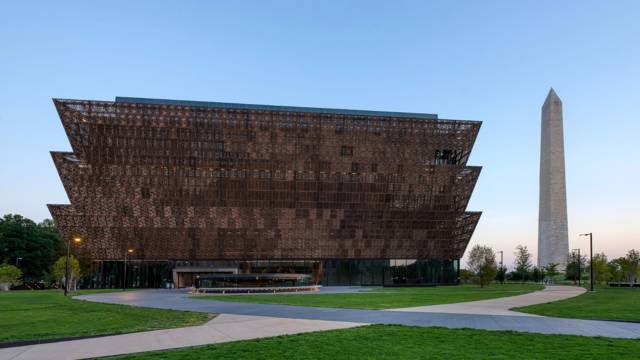
Lonnie G. Bunch III is the 14th Secretary of the Smithsonian, overseeing the entire institution. Prior to that, he was the co-founder of the Smithsonian’s internationally renowned National Museum of African American History and Culture.
Democracy Now! interviewed Bunch in February, 2020, just before the pandemic struck. Bunch described the importance of depicting slavery:
“One of the most important things for me was to talk about the slave trade…I felt that we had to find real remnants of a slave ship,” Bunch said.
“We found the São José. It was a ship that left Lisbon in 1794, went all the way to Mozambique and picked up 512 people from the Makua tribe, was on its way back to the New World when it sank off the coast of Cape Town. Half of the people were lost. The other half were rescued and sold the next day.”
Bunch recalled Trump’s visit to the African American Museum in 2017, at the beginning of his first term as president:
“The first place Donald Trump visited in an official capacity was the museum. I think he was stunned by the stories we told, and there was so much he didn’t know,” Bunch said. “What I realized is that if people who didn’t know but had political influence could come through the museum, I could help them understand, hopefully, something that would change the way they did it.”
Given Trump’s new assault on The Smithsonian, it seems his visit to the African-American Museum didn’t have Lonnie Bunch’s hoped-for uplifting impact.
In late March of this year, Trump issued an executive order targeting the museum conplex. The order alleges that “the Smithsonian Institution has, in recent years, come under the influence of a divisive, race-centered ideology.” The order further creates a committee to review the contents of exhibits for “improper ideology.”
Trump has set the tone, normalizing the rejection of history, of the indescribable horror of slavery in the United States. His loyalists follow suit.
In 2023, Florida Governor Ron DeSantis promoted a revision to the state’s school curriculum, to include instruction on “how slaves developed skills which, in some instances, could be applied for their own personal benefit.” DeSantis defended the offensive guidelines, saying “I think that they’re probably going to show some of the folks that eventually parlayed, you know, being a blacksmith, into doing things later in life.”
Trump’s Defense Secretary Pete Hegseth recently joined a growing Christian Nationalist congregation. The church’s co-founder, Doug Wilson, has written that slavery “produced in the South a genuine affection between the races.” Hegseth has ordered that previously removed statues of Confederate officers be put back, and is restoring Confederate names to military installations that had been recently removed.
The National Park Service has announced that the only outdoor statue in Washington, DC honoring a Confederate, Albert Pike, which was removed following the racial justice protests of 2020, will be restored. Pike was a Confederate general and alleged member of the Ku Klux Klan.
And as Trump has successfully defunded public broadcasting, some are advocating that PBS content be replaced with material from the rightwing media company PragerU. In one clip from Prager already being used in 10 states, an animated cartoon Christopher Columbus is shown downplaying slavery:
“Being taken as a slave is better than being killed, no?”
Annette Gordon-Reed, professor of history at Harvard University, president of the Organization of American Historians and Pulitzer award-winning author, said on Democracy Now!, “It’s an attempt to play down or downplay what happened in the United States with slavery…This is a whitewashing of history.”
With Trump’s all out assault on truth, learning, and the institutions that preserve and curate our collective history, places like The Smithsonian Institution are more important than ever.
“In the era of Donald Trump,” Bunch concluded in 2020, “the museum has become a pilgrimage site, a site of resistance, a site of remembering what America could be, and a site to engage new generations to recognize they have an obligation to make a country live up to its stated ideals.”
The original content of this program is licensed under a Creative Commons Attribution-Noncommercial-No Derivative Works 3.0 United States License. Please attribute legal copies of this work to democracynow.org. Some of the work(s) that this program incorporates, however, may be separately licensed. For further information or additional permissions, contact us.
#DemocracyNow! “Breaking The Sound Barrier” Weekly Column: The Ominous ICE Arrest of #NewarkMayorRasBaraka #RasBaraka


By Amy Goodman & Denis Moynihan
The march to authoritarianism in the US accelerated on May 9th with another arrest of an elected official by the Trump administration. Mayor Ras Baraka of Newark, the largest city in New Jersey, had accompanied a Congressional delegation to Delaney Hall, a private prison run by GEO Corporation under contract to ICE, Immigration and Customs Enforcement. The delegation included Congressmembers Bonnie Watson Coleman, LaMonica McIver and Rob Menendez, Jr., all Democrats representing districts that include or are near Newark. They went to the East coast’s largest migrant jail to conduct oversight as authorized by law.
They were allowed to pass through the gate, along with Mayor Baraka. There they waited for over an hour. Baraka was told to leave, which he did, moving outside the gate to public property. His subsequent unprovoked arrest was a shocking abuse of federal police power, another clear instance of President Donald Trump and his enablers trying to seize power and crush dissent.
Mayor Baraka was held by ICE for five hours then released, charged with trespass. He is no stranger at the gates of Delaney Hall, as he explained days after his arrest on the Democracy Now! news hour:
“I actually go there every day…I go at 7 a.m. with fire code officials, UCC [Uniform Construction Code] officials, health inspectors, to get in, as it is our right to inspect the facility for them to apply for a certificate of occupancy. We’re in court with GEO right now, because they’re defying city ordinances.”
GEO rapidly ramped up operations at the 1,000-bed jail in order to serve as a major hub for Trump’s mass deportations. Newark sued GEO on April 1st, alleging it “blatantly continues to violate City ordinances and regulations.”
Baraka recounted his arrest:
“When the special agent in charge, Patel [Ricky Patel, Special Agent in Charge of Homeland Security Investigations, Newark] showed up, he escalated the situation. The Congresspeople tried to reason with him, surrounded me inside, and finally got him to agree for me to leave. I left, on the other side of the fence…They arrested me, and the congresspeople and other bystanders tried to shield me from being arrested.”
Homeland Security later issued a press release falsely claiming that “a group of protestors, including two members of the U.S. House of Representatives, stormed the gate and broke into the detention facility. Representatives Robert Menendez, Jr. and Bonnie Watson Coleman and multiple protestors are holed up in a guard shack.” Acting US Attorney for New Jersey Alina Habba, one of Trump’s former personal lawyers, falsely claimed on X that Mayor Baraka “committed trespass and ignored multiple warnings from Homeland Security Investigations to remove himself from the ICE detention center in Newark…NO ONE IS ABOVE THE LAW.”
DHS spokesperson Tricia McLaughlin expanded on the lies, telling CNN Saturday, “There will likely be more arrests coming. We actually have body-camera footage of some of these members of Congress assaulting our ICE enforcement officers, including body-slamming a female ICE officer.”
Congressmember Bonnie Watson-Coleman, who is an 80-year-old cancer survivor, rejected the government’s allegations, saying on Democracy Now!,
“There was no body-slamming. The Department of Homeland Security or the representatives from the administration are doing what they do consistently, and that is to lie and to deflect and to try to create legitimacy for illegitimate things that they are doing.”
So, in addition to arresting an elected city mayor, the Trump administration is now threatening to arrest sitting members of Congress. This makes even more alarming a pronouncement by Trump’s Deputy Chief of Staff Stephen Miller, hours before Baraka’s arrest:
“The Constitution is clear…that the privilege of the writ of habeas corpus can be suspended in a time of invasion. It’s an option we’re actively looking at.”
Habeas corpus is the right of those detained to demand the government justify their imprisonment in court or be freed.
Mayor Baraka, who is running for governor and is campaigning for the June 10th Democratic primary, appeared in federal court on Thursday, pleading not guilty to trespass. Alina Habba demanded a full trial, despite the mountain of exculpatory evidence.
The prosecution of Mayor Ras Baraka, like the prosecution of Milwaukee County Judge Hannah Dugan in Wisconsin, accused of helping an immigrant avoid arrest by ICE agents, and the threatened arrest of members of Congress – all portend a frightening escalation in Trump’s drive to authoritarianism.
Several blocks from the Newark courthouse is Harriet Tubman Square, where in 2023 Mayor Baraka unveiled a memorial to the great Underground Railroad conductor and abolitionist, who escaped slavery and returned again and again to lead others to freedom. Newark has a long history of resistance to oppression, as President Trump and his enablers are about to find out.
The original content of this program is licensed under a Creative Commons Attribution-Noncommercial-No Derivative Works 3.0 United States License. Please attribute legal copies of this work to democracynow.org. Some of the work(s) that this program incorporates, however, may be separately licensed. For further information or additional permissions, contact us.
#Forbes Breaking News: HAPPENING NOW: Supporters Of #MahmoudKhalil Hold A Rally Outside Of Court In Newark, New Jersey
*******
Meanwhile, in Washington, D.C.:
******
https://en.wikipedia.org/wiki/Detention_of_Mahmoud_Khalil#
https://apnews.com/article/immigration-detention-students-louisiana-bd46789bb7b295fa31b5d564673b9c2d
#DemocracyNow!: “I Am Finally Free!”: Indigenous Leader #LeonardPeltier Released After Nearly 50 Years Imprisoned
Column: This #Thanksgiving, #PresidentBiden Should Grant Clemency to #LeonardPeltier
As posted from here: https://www.democracynow.org/2024/11/27/this_thanksgiving_biden_should_grant_clemency
November 27, 2024
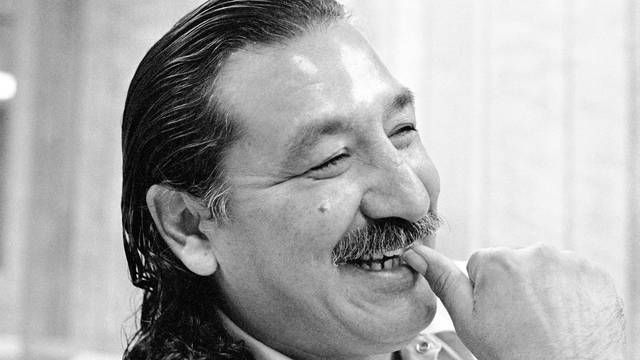
Political prisoner Leonard Peltier is the author of the memoir Prison Writings: My Life Is My Sun Dance.
By Amy Goodman & Denis Moynihan
While many brace for the return of Donald Trump to the White House, let’s remember that until Monday, January 20th, #JoeBiden is still president, with all the power that confers. The Constitution grants the president the “Power to grant Reprieves and Pardons for Offences against the United States,” to remedy a criminal justice system riddled with faults. One strong candidate for presidential clemency, as recently called for by Amnesty International USA, is 80-year-old Anishinabe-Lakota elder #LeonardPeltier, who has been incarcerated for close to half a century for a crime he maintains he did not commit. This Thanksgiving weekend, when people across the US enjoy a holiday based on the myth of a shared meal between native people of Massachusetts and the English settler-colonists who would later violently displace them, #PresidentBiden should free Leonard Peltier.
The case of Leonard Peltier encapsulates the modern era of indigenous resistance. After centuries of #genocide launched by #ChristopherColumbus and expanded by successive waves of European settlers, by the 1950s most of the surviving indigenous nations in North America had been contained in isolated and impoverished reservations. Hollywood appropriated, caricatured and monetized the vibrant mosaic of indigenous cultures. Many Native people moved to cities seeking economic opportunity but still faced racism and discrimination. Out of this, and amidst the civil rights and other social movements of the 1960s, the #AmericanIndianMovement, or #AIM, was born.
In 1973, AIM went to the #PineRidgeReservation in South Dakota, where a corrupt tribal government was working in league with federal and local authorities to violently suppress a growing movement to restore traditional practices – and to block extractive industries from exploiting traditional lands. More than 50 Lakota people and their allies were murdered there over a three-year period.
On June 26, 1975, Leonard Peltier was present at an AIM camp on the property of a targeted family. The camp was fired upon by unknown assailants, and the AIM members returned fire. In the ensuing minutes, two FBI agents and one young AIM activist were killed.
Two AIM members were later arrested for killing the agents. At trial, the jury agreed that they had fired in self-defense and acquitted them. Leonard Peltier, arrested later, was tried separately and convicted. Peltier’s trial was marked by gross FBI and federal prosecutorial misconduct, with the coercion of witnesses, fabricated testimony, and suppressed exculpatory evidence.
When Peltier was on trial in 1976, Joe Biden, then a young US Senator, was a founding member of the Senate Select Committee on Intelligence. The committee was created after the explosive Church Committee hearings that investigated the unconstitutional and criminal conduct of the FBI and its “ #COINTELPRO ” operations against civil rights leaders and organizations, including AIM.
A global movement grew, demanding justice for Leonard Peltier. Human rights icons like South African #PresidentNelsonMandela and #ArchbishopDesmondTutu called for his release, as did one of the federal judges involved, and, years later, one of the prosecutors who tried the case.
#AmnestyInternational has campaigned for Peltier’s release for decades. The group recently sent a letter to President Biden, reiterating their demand.
“Over the decades at Amnesty, we have been calling on administration after administration to do the right thing by Leonard. He was in hospital in June, he was in hospital again in October. It’s time to give him a chance to spend his last days with his family and with his community,” Paul O’Brien, Executive Director of #AmnestyInternationalUSA, said on the Democracy Now! news hour.
In late October, President Biden traveled to the Gila River Indian Community in Arizona to formally apologize for the US government’s treatment of Indigenous children forced into boarding schools.
“All told, hundreds and hundreds of Federal Indian Boarding Schools across the country. Tens of thousands of Native children entered the system. Nearly 1,000 documented Native child deaths, though the real number is likely to be much, much higher; lost generations, culture, and language; lost trust. It’s horribly, horribly wrong. It’s a sin on our soul,” Biden said.
Nick Tilsen, executive director of the Indigenous-led NDN Collective, responded on #DemocracyNow!, saying,
“What this means for Indian Country is that we hope that this is the beginning of an era of repair between the United States government and the Indigenous people, the First People of this land…He [Peltier] was in the Sisseton Wahpeton boarding school, in South Dakota. Leonard Peltier and many people who became leaders in the American Indian Movement were boarding school survivors. They came out of that era, and then they resisted.”
If President Biden’s apology at Gila River was genuine, he could demonstrate it by commuting the sentence of Leonard Peltier. It would be a long-overdue gesture to Indigenous people across the US, for which we could all give thanks.
The original content of this program is licensed under a Creative Commons Attribution-Noncommercial-No Derivative Works 3.0 United States License. Please attribute legal copies of this work to democracynow.org. Some of the work(s) that this program incorporates, however, may be separately licensed. For further information or additional permissions, contact us.
Four Black Male Radical Views Of The 2024 Presidential Election
From this morning’s #DemocracyNow! :
We speak with historian Robin D. G. Kelley about the roots of Donald Trump’s election victory and the decline of Democratic support among many of the party’s traditional constituencies. Kelley says he agrees with Vermont Senator Bernie Sanders, who said Democrats have “abandoned” working-class people. “There was really no program to focus on the actual suffering of working people across the board,” Kelley says of the Harris campaign. He says the highly individualistic, neoliberal culture of the United States makes it difficult to organize along class lines and reject the appeal of authoritarians like Trump. “Solidarity is what’s missing — the sense that we, as a class, have to protect each other.”
NERMEEN SHAIKH: Kamala Harris has conceded to Donald Trump after the former president pulled off an overwhelming victory Tuesday to send him back to the White House. On Wednesday, Harris spoke at Howard University.
VICE PRESIDENT KAMALA HARRIS: I will never give up the fight for a future where Americans can pursue their dreams, ambitions and aspirations, where the women of America have the freedom to make decisions about their own body and not have their government telling them what to do. We will never give up the fight to protect our schools and our streets from gun violence. And, America, we will never give up the fight for our democracy, for the rule of law, for equal justice and for the sacred idea that every one of us, no matter who we are or where we start out, has certain fundamental rights and freedoms that must be respected and upheld.
NERMEEN SHAIKH: That was Kamala Harris giving her concession speech on Wednesday.
The Democratic Party is in a state of crisis after Trump expanded his support across the country and Republicans also regained control of the Senate. Republicans may also keep control of the House.
AMY GOODMAN: On Wednesday, independent Senator Bernie Sanders blasted the Democratic Party. In a statement, Sanders said, quote, “It should come as no great surprise that a Democratic Party which has abandoned working class people would find that the working class has abandoned them. While the Democratic leadership defends the status quo, the American people are angry and want change. And they’re right,” Sanders said.
To talk more about Tuesday’s election, we’re joined by Robin D. G. Kelley, professor of history at UCLA, who studies social movements. He’s author of many books, including Freedom Dreams: The Black Radical Imagination.
Professor Kelley, it’s great to have you back with us. If you can start off by talking about Donald Trump’s major victory, I mean, sweeping the country, actually winning the popular vote, as well as what looks like the Electoral College vote, Harris winning far fewer millions of votes than President Biden did in 2020? Though some Democrats, for example, Elissa Slotkin in Michigan, polled much higher and won, she did not get those same votes. And end by talking about what Democratic Senator Sanders is saying, that the Democratic Party has abandoned the working class.
ROBIN D. G. KELLEY: Right. Let’s begin with Senator Sanders. He’s absolutely right. The Democratic Party abandoned the working class. Kamala Harris ran on a ticket of moving toward the right, you know, shifting, pivoting toward the right, bragging that Liz Cheney is endorsing her. And so, there was really no program to focus on the actual suffering of working people across the board. That’s true.
Now, when we think about 2024 compared to 2020, I’m not sure that Trump’s victory is so historic. Trump would have won in 2020 had it not been for the uprisings that emerged out of the George Floyd murder. The wind was behind the Democratic Party, even though the Democratic Party didn’t earn that wind. And so, I think that’s a factor.
The other factor is that the country is moving toward the right, and the working class, or working classes, feel really disaffected and abandoned. They feel abandoned, I believe, for a couple of reasons. One, because whatever the numbers said about the shifting economy, the fact of the matter is that people are still dealing with inflation, with joblessness, with insecurity. But the second thing — and this goes back to an article I published back in 2016 — we also have, you know, a deeply racist, Islamophobic, xenophobic nation. And that runs through. I mean, when you look at the demographics, white men consistently vote for Trump. White women, of course, it was a slight shift, but the shift wasn’t that radical. I mean, I don’t trust exit polls, but it’s amazing how many white women supported Trump. It’s amazing how much of the message of fascism actually did tap into a deep insecurity, a deep fear, and the fact that deportation is the dominant message that has drawn working people.
So I really want to talk about the question of class, which I think is most important. We have a class that’s suffering, but we don’t have a class that thinks of itself as a class. If we had a class that thought of itself as a class, then working people would say, “We refuse deportation. We refuse racism. We refuse transphobia,” because that’s what the class does. Solidarity is what’s missing — the sense that we, as a class, you know, have to protect each other. Trump is seen as the person who can fix things, the person who represents the CEO who could step in and solve problems in a culture in which the only solidarity we’re seeing, the primary solidarity, is coming from the capitalist class, you know? So, I’m not sure that there’s such a radical shift from 2016 to 2020 to 2024. It’s a failure of the Democratic Party. And even under Biden, the Democratic Party actually pivoted a little bit toward labor, in a way that the Harris campaign did not.
NERMEEN SHAIKH: Well, I’d like to go to former Ohio state Senator Nina Turner, who we spoke to last week. She served as co-chair of independent Senator Bernie Sanders’ 2020 presidential campaign.
NINA TURNER: I think, over time, the Democratic Party lost its way in terms of just talking to working-class voters. And I mean from all identities, because sometimes when we say “working class,” people assume we’re just talking about white men. I’m talking about working-class people from all walks of life. And my state, you know, CAFTA, NAFTA, this happened over time. It didn’t just happen in one fell swoop. It happened over decade after decade after decade. But those trade deals definitely decimated Midwestern states like mine and really hurt a lot of workers.
And then working-class people from all backgrounds do not necessarily see themselves. They feel like elitism has taken over for both parties, but especially in the Democratic Party. And so, when you don’t see yourself in a party, you decide that you want to go another way.
And then, more recently — when I say “recently,” certainly over the almost four years — as people were suffering the effects of COVID, trying to — we were all trying to break out of it, inflation very high, the cost of groceries high, the cost of gas high, all of those material condition elements. The Democratic Party denied that, and they trotted out Bidenomics, and they turned their backs on people and made it seem as though the pain points that the big mamas and big papas were feeling were not necessarily real. You cannot do that.
NERMEEN SHAIKH: So, Robin Kelley, that was Ohio state Senator Nina Turner. If you could respond to what she said and put it in the context of what you mentioned earlier, namely the absence of working-class cohesion, and what that meant for this election? And why, in fact, why do you think there is an absence of cohesion among the working class in the U.S.?
ROBIN D. G. KELLEY: Right. No, I think — I totally agree with what Nina Turner said. This is where we are right now.
The absence of cohesion has to do with the general — two things, I think. One, the general absence of solidarity in a long-standing kind of neoliberal culture where people are taught to solve their own problems, a kind of deep individualism, and that corporate interests are the only ones — in other words, private interests are the ones that can solve your problem. Government is a problem. Government gets in the way. This is the kind of discourse that we’ve been seeing for at least three, four decades.
And so, even though we see amazing developments in the labor movement with the UAW, we see discussions and talk of solidarity — the Boeing strike, for example — but in terms of those who are either unorganized or at the sort of edges of a concierge economy that is no longer based in high-wage manufacturing, what ends up happening, it’s almost impossible to organize people and to think as a class. You know, the Amazon strike in Bessemer is a really good example of what could have been, but how the combination of fear, insecurity and the failure to really think of solidarity — in other words, the care for our neighbor, the care for those who are not us but maybe we share the same class, that sense of solidarity, that Audre Lorde talks about at the beginning of my piece, that’s missing. And we haven’t done the work, the political education work, to build that sense of cohesion.
But the other thing that I think is really important is this belief that if we — that we can one day become Trump. In other words, wealth, entrepreneurship, the striving for success, the fact that a lot of these Senate campaigns where seats were overturned, they were won by billionaires and millionaires, you know? I mean, that’s significant.
And one other thing I should add is that, you know, we could look at this at the presidential level; we could also look at it at the local level. I’m here in L.A. in what’s supposed to be the Left Coast, California, where we just had propositions that failed, a proposition to end forced prison labor, a proposition to raise the minimum wage, a proposition for rent control, you know, a proposition that actually — the one proposition that did win was one that will deeply criminalize and expand sentences for petty crimes. This is in L.A., you see? This is California.
So we’re moving toward the right. And somehow the right, for many people, is attractive. And we have to figure out why it’s attractive. And if we don’t think of ourselves as a class, a class with power, a class in which the state could be the lever of equality rather than deep inequality, then we’re going to be stuck supporting Trumps for the rest — for generations.
AMY GOODMAN: Yeah, it’s very interesting on the issue of prison labor and a ballot initiative there. When we were out in California interviewing prisoner firefighters who got a pittance a day, they were pushing for earlier release, but they didn’t get it often because it provided a prisoner labor force for the wildfires that plague California. But I wanted to ask you about the extremism of Trump, when he was talking about — or, you know, at the Madison Square Garden rally, of course, that Puerto Rico is an “island of garbage.” He would later called that whole rally a “lovefest,” you know, referring to women as the B-word, and, of course, how he deals with immigrants. But there’s a very interesting comment of writer Meg Indurti, who tweeted, “if you are someone who was able to overlook the genocide and cast a vote for kamala harris, then you already understand how a conservative was able to overlook Trump’s extremism to vote for him.” Can you comment on this? Robin Kelley, you talk a lot about the working class and the working poor. You also have written extensively about Gaza.
ROBIN D. G. KELLEY: Right, right. Yeah, I mean, one of the questions that came up, my students were posing this question to me the other day: What would have happened had the U.S. actually stopped supporting Israel, like in November or December of last year? What would have happened? I think the Democrats could have won. You know, we overestimate the power of the Israeli lobby, because in some ways Democrats are looking for dollars, not necessarily votes. And so, imagine what would have happened had there been this refusal to send arms to Israel. There would be no — the war would have ended. There wouldn’t be an escalation of the war. And part of the attraction of Trump, ironically, is this belief, this kind of — it’s kind of a myth, but still this belief that under Trump there were no wars. And so, here we have possibly three different wars going on at once under the Democrats. And you could see how that would generate some fear.
But to go back to the question of the extremism and elites, you know, toxic masculinity is a huge factor. The buildup coming from right-wing state legislatures to attack the curriculum, to attack DEI, to attack trans people at every single level, here we are dealing with an extremism that is actually palpable and that I could see how elites, some elites on the right, those who actually have drafted Project 2025, would support these policies. So, in some ways, what we keep calling fascism, which I agree is fascism, is pretty mainstream among the Project 2025 people, pretty mainstream among the MAGA Republicans. And the Republican Party is a MAGA party. Whatever the old bourgeoisie of the kind of older neoliberal order, whatever they think, they’re either going to go with the program or they’re going to do what they did, support Harris and Walz. And that didn’t work out for them.
So, I mean, I’m actually terrified by a future in which the kind of violence of the settler-colonial mentality, which was always there, has escalated and become normalized in a way. And let’s remember that the history of fascism is filled with supporters who themselves are targets of fascism. We have examples of that, you know, historically. So, you know, it’s hard — so we can’t just assume that because there’s an uptick in, say, the Latino vote in support for Trump, that somehow that’s an example of Trumpism’s multiculturalism, because it’s still white supremacy and patriarchy.
NERMEEN SHAIKH: So, Robin Kelley, I just want to go back for a second to the point that you made earlier about those ballot measures. Why do you think those ballot measures were rejected? How did they get on the ballot to begin with? And then, is that related at all to the fact that, you know, the Democrats have come under massive criticism for, after 2016, after the Clinton election, basically finding ways to blame everybody but themselves? Is there a risk that that’s going to happen again?
ROBIN D. G. KELLEY: Yes, I think there is a risk.
As far as the propositions, California is a conservative state. You know, it has been. It has produced some of the most conservative governors. It is the home of the origins of the John Birch Society. You know, this is a conservative state. So, it didn’t surprise me too much, although California is also a state that has, you know, had basically the biggest, for a long time, or at least second-largest prison population in the country. And so, some of these initiatives came from imprisoned people themselves, came from abolitionists. The struggle for a minimum wage came from an organized labor movement. But there’s still deep anti-immigrant sentiment here in California, deep anti-labor sentiment. And keep in mind that rent control has been consistently beat down since 1995. And why? Because some of the same elites who gave money to the Harris campaign are also absentee or venture capitalists who own a lot of property, and they’re trying to profit off of them.
The Democrats, I mean, you know, I don’t have an answer to that, except for the fact that we can’t keep relying on the Democratic Party. I mean, it’s been — it’s so bankrupt. I think what Ralph Nader said yesterday is absolutely true. We need something else. You know, if not a real third party, I think Reverend William Barber has an answer, and that is to build from the bottom up, to build from low-wage workers, because that’s the vast majority of the people. But we can’t do this until we actually think of ourselves as a community, a beloved community, as a class that struggles with each other against corporate interests.
AMY GOODMAN: And we will be speaking with Reverend Barber tomorrow, so people should tune in. And Ralph Nader’s comments on Democracy Now! just exploded yesterday, so people can check them out at democracynow.org. Robin D. G. Kelley, thank you so much for being with us, professor of history at UCLA who studies social movements, author of many books, including Freedom Dreams: The Black Radical Imagination.
 Drums in the Global Village