I’ll be announcing my new book soon. Until then:
Category Archives: books
Ta-Nehisi Coates, The Obama Embedded Journalist, Wokes :) (Or, How Trump’s Big White Lifesaver Pulled Him Out From Drowning In Kool-Aid)
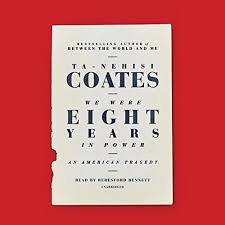
We Were Eight Years In Power: An American Tragedy.
Ta-Nehisi Coates.
One World Publishing.
367 pp. $28.
Why waste time knocking another writer’s immensely successful hustle when the target publicly decides to do it (somewhat) to himself? Ta-Nehisi Coates comes thisclose to admitting that he went a little bit Hollywood because Barack Obama’s 2018 campaign and presidency allowed the Howard University dropout to travel the Horatio Alger-Don King trail “from the unemployment office to the Oval Office.” One of his articles collected here, a select compilation of his Obama work for The Atlantic magazine, actually ends with his moving-on-up like George Jefferson and Weezie; that the scene ends a piece arguing that Malcolm X’s legacy lived in President Obama—the president who, in the beginning, apologized to a white police officer who arrested Harvard Africana Studies professor Henry Louis Gates for breaking into his own house, and, at the end, refused to pardon Marcus Garvey—makes it, in retrospect, even more puzzling and saddening. (Coates now admits his optimistic idea was “strained.” Really? You don’t say. :)) The honest-as-I-can-be new introductory essays are vitally important to understand the writer’s formulations as he was “swept away” by the Obamas while, not coincidentally, Michelle’s and Barack’s presence on the national stage “opened up” an elite white journalistic market to New Negroes who supposedly had new, innovative things to say. However, what makes this book and the superbly talented writer more than redeemable are its/his final two angry essays, “My President Was Black” and the epilogue, “The First White President.” Coates’ 2016 post-election night analysis of America contains immense socio-historical clarity. The pieces shake up the writer and the reader, allowing all to see the abandonment of Black America’s eight-year experiment with being adjective-less and to introduce in detail the insidious power of whiteness. (Taken together, the Trump-election duo pack a much better punch than his too-much-heralded 2015 single-essay work, “Between the World and Me.”) With The Donald now in charge whether people use his name or not, Coates’ years of literary sharecropping as forgotten as Friendster, and his white readers now fully understanding that they have never been, and are not now, innocent, the book’s end marks the beginning of a golden era of his writing.
Thank You, Hugh Hefner…….

……for jump-starting Alex Haley’s career and indirectly being responsible for “The Autobiography of Malcolm X.”
“Reparations And The Legacy Of Marcus Mosiah Garvey,” A Speech By Don Rojas

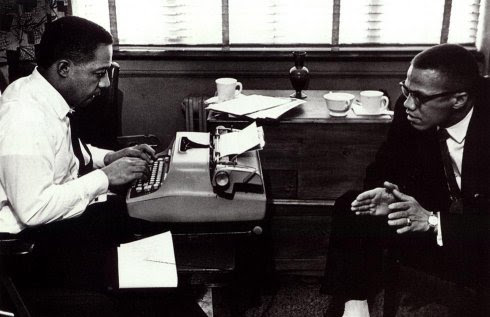
My friend and mentor Don Rojas (right) sent a group of us this email on Aug. 21:
Dear Colleagues,
I thought I’d share with you all a copy of a presentation I gave last Thursday evening at Detroit’s Charles Wright Museum of African American History which celebrated Marcus Garvey’s 130th birthday. My talk was entitled, “Reparations and the Legacy of Marcus Garvey.” I was introduced by Rev. JoAnn Watson, one of Detroit’s finest products, who wrote the preface to Herb’s seminal book.
Thanks to Herb and a few quotes from “Black Detroit,” I was able to make the historical connections between Garvey, the Caribbean and Detroit and then on Friday morning who should I run into at the Museum’s entrance but our Dear Comrade Ollie Johnson….an unplanned and thoroughly delightful rendezvous. (See attached photo along with speech.)
Peace,
Don
*******************************************************
“Reparations and the Legacy of Marcus Mosiah Garvey”
By Don Rojas
(A speech Delivered at the Charles H. Wright Museum of African-American History in Detroit, Michigan on the occasion of the 130th Anniversary of the birth of Marcus Mosiah Garvey—August 17, 2017)Madame Chair,
Sis. Hazel Ross-Robinson,
Distinguished Guests,
Sisters and Brothers,
Good evening.I wish to begin by thanking Bro. Charles Ferrell, vice president for programs at this venerable museum, for the kind invitation to speak here this evening and commend him for his vision and his exemplary Pan-Africanism in action. For me, this is a singular privilege and honor to address you in the magnificent Charles Wright Museum of African-American History, one of America’s great cultural institutions.
In many respects, this museum is a living embodiment of the reparations movement in that the extraordinary collection of paintings, sculptures, photographs, videos and mixed media that reside here and that reflect the multi-dimensional history of the global black experience serves to repair our collective souls, nurture our minds and heal our psyches that have been so badly damaged by the ravages of chattel slavery in the Americas. Walking through the halls of this museum is a positively cathartic experience.
Tonight, I bring you greetings from Prof. Sir Hilary Beckles, Chairman of the CARICOM Reparations Commission and Vice Chancellor of the University of the West Indies who was originally scheduled to speak tonight but who had to be in London on urgent university business.
I also bring greetings this evening from the National African American Reparations Commission and from the Institute of the Black World, and its President Dr. Ron Daniels, convenor of that commission.
Allow me a moment of personal privilege to send shout outs to Rev. Dr. JoAnn Watson and Rev. Wendell Anthony, two proud products of Detroit. Back in the early 1990s I enjoyed the opportunity of working with these stalwarts when I was the Director of Communications at the NAACP, at the time under the leadership of Rev. Dr. Benjamin Chavis. And today, I once again have the pleasure of working with Rev. Watson who is one of the commissioners serving on the National African American Commission.
On this occasion, I honor the memory of those brave souls who died in the Detroit Rebellion 50 years ago and I salute this city’s legendary role in progressive and revolutionary activism over many decades. Your city is revered not just for its extraordinary contributions to African-American music and culture, but also as a crucible in the fight for black self-determination in the USA. For many years, Detroit has been an oasis of Afro-centricity, an epicenter for revolutionary black nationalism.
The city that gave the world musical giants like Aretha Franklin, Stevie Wonder, the Supremes, Marvin Gaye, Berry Gordy and many more, is also the city of Joe Lewis and Fannie Richards and Coleman Young, John Conyers and Chokwe Lumumba, and for the second half of her life, Rosa Parks; the city that birthed the League of Revolutionary Black Workers…the place where CLR James, the great socialist and Pan-Africanist from the Caribbean spent time organizing and writing in the 1930s, the city that is known and respected globally as the “arsenal of democracy.”
Though he seldom receives credit for it, the Hon. Marcus Mosiah Garvey, Jamaica’s first national hero, the towering Black giant we are remembering today on the 130th anniversary of his birth, was the man who had organized the largest mass movement of Black people in the world. At its zenith, Garvey’s Universal Negro Improvement Association (UNIA) had over 3 million dues-paying members, with chapters all across the United States, Canada, the Caribbean and Central America.
As a journalist myself, former editor of The New York Amsterdam News and former Director of Communications at the NAACP, I am amazed that the UNIA’s newspaper, The Negro World which Garvey launched in 1918, achieved a weekly circulation of over a half million copies at its peak, a number higher that the NAACP’s The Crisis magazine, The Messenger, The Chicago Defender and other important black newspapers of the time combined. No existing African-American weekly newspaper can boast a circulation even close to that of The Negro World 100 years ago. British and French colonial rulers banned its sales and even prohibited the possession of The Negro World in their territories. Distribution in foreign countries was conducted through black seamen who would smuggle the paper into European colonies in Africa, the Caribbean and Latin America. For a nickel, readers received a front-page editorial by Garvey, along with poetry and articles of international interest to people of African ancestry. Under the editorship of Amy Jacques Garvey the paper featured a full page called “Our Women and What They Think.” The Negro World also played an important part in the Harlem Renaissance of the 1920s. The paper was a focal point for publication on the arts and African-American culture, including poetry commentary on theatre and music, and regular book reviews. The Negro World ceased publication in 1933.
One hundred years later, no other black leader or organization in the African diaspora has been able to match Marcus Garvey’s extraordinary feats of mass organization and mass mobilization. During a trip to Jamaica, Martin Luther King and his wife Coretta Scott King visited Garvey’s shrine on 20 June 1965 and laid a wreath. In a speech at the University of the West Indies he told the audience that Garvey “was the first man of color to lead and develop a mass movement. He was the first man on a mass scale and level to give millions of Negroes a sense of dignity and destiny. And make the Negro feel he was somebody.”
King was a posthumous recipient of the first Marcus Garvey Prize for Human Rights on 10 December 1968, issued by the Jamaican Government and presented to King’s widow.
As we gather here in Detroit and in cities all across the world to celebrate Garvey’s 130th birthday, this is the perfect time to remind everyone of Garvey’s accomplishments, primarily because there is a significant opportunity once again in 2017 and in the coming years for Black people in America, the Caribbean and in Africa to unite around issues concerning reparations, economic development and self-sufficiency. Garvey’s legacy endures long after his death in 1940 and it lives today in the reparations movement.
The strategic international emergence in recent years of a movement for reparatory justice in the Caribbean, the USA, Latin America, Europe and Africa is a manifestation of Garvey’s Pan-Africanist legacy, a living legacy that had impacted the anti-colonial and independence movements in Africa and the Caribbean and continues to influence the anti-racist resistance struggles of the Black Lives Matter movement in the USA and in Afro-descendant communities across the globe.
Before coming to Detroit yesterday, I called my dear friend and colleague, Herb Boyd, a proud son of this city and author of the seminal book, “Black Detroit: A People’s History of Self-Determination,” to consult with him on the history of Marcus Garvey’s historical connections with Detroit.
Herb told me that Garvey visited Detroit on at least two occasions, in 1919 and again in 1922 and the first branch of the Universal Negro Improvement Association was established in this city in 1920. It later became one of the strongest UNIA chapters in the world. Huge crowds turned out to hear Garvey’s spell-binding oratory whenever he visited the city.
Many prominent Black Detroiters were drawn to Garvey’s messages of racial pride and economic self-sufficiency for Black people in America and across the world and some became national leaders of the UNIA.
The brothers John and Ulysses Poston, who were publishers of the Detroit Contender newspaper at the time, were enthralled by the charismatic Garvey who made John an assistant secretary general of the UNIA and Ulysses rose in the ranks to become an editor of The Negro World.
Boyd says further in his book that the presence of Detroiters J.A. Craigen, F. Levi Ford and John Charles Zampty, who often traveled with Garvey as his adjunct general, greatly enhanced the UNIA in Detroit and across the country.” Zampty, like many other West Indians at the time, who had migrated to Detroit from the islands to work in the auto industry and later became a permanent resident of this city.
Among the other prominent Detroiters who were drawn to Marcus Garvey in the 1920s were Charles Diggs Sr., the first African-American state senator in the country, father of Charles Jr., the first African-American from the State of Michigan to be elected to the US Congress and Elijah Poole who later became Elijah Muhammad, founder of the Nation of Islam. The parents of Malcolm X, were both staunch Garveyites. Malcolm’s father headed up the UNIA chapter in Omaha Nebraska and his mother, who was born in Grenada, West Indies, was a regular correspondent for The Negro World.
So many fine residents of this great city have, and continue to make, stellar contributions to the reparations movement in the USA….outstanding brothers and sisters like Reparations Ray Jenkins, Imari Obadele, the late Chokwe Lumumba, Rev. Dr Joann Watson and, of course, the indomitable Hon. John James Conyers Jr, Dean of the House of Representatives, longest serving member of the US Congress and the author of HR40, the landmark bill calling for the Federal Government to study and act on the need for reparations for crimes inflicted on enslaved Africans in America.
Close to 100 years ago, Marcus Garvey argued the case for reparations for the crimes of slavery and colonialism when he said back in 1919, “They said we were heathens, we were pagans, we were savages and did not know how to take care of ourselves; that we did not have any religion; we did not have any culture; we did not have any civilisation for all those centuries, and that is why they had to be our guardians. But, thank God, we have them all now, and as such we are asking that you hand back to us ‘our own civilisation’. Hand back to us that which you have robbed and exploited us of in the name of God and Christianity for the last 500 years.”
Today, the still-active chapter of the UNIA in Garvey’s homeland of Jamaica is a staunch advocate for reparations and an active member of the national Jamaica Reparations committee.
The Movement for Reparations in the USA has a long and distinguished history with a number of important milestones along the journey, going back to Callie House who was born a slave in 1861 in Nashville, Tenn and who in the middle of the 19th Century was a leader of the National Ex-Slave Mutual Relief, Bounty and Pension Association, one of the first organizations to campaign for reparations for slavery in the United States to Queen Mother Moore’s championing of reparations for decades in the 20th Century, to the reparations campaign mounted by James Forman in the 1960s, to the publication of “The Debt” by Randall Robinson, (which is on sale here this evening and I encourage you all to purchase a copy) to the establishment of The National Coalition of Blacks for Reparations in America (N’COBRA) in 1987.
The reparations movement ebbed and flowed in the 1990s and in the early 2000ths and then it found a new momentum in the second decade of the 21st Century. A brief chronological review of this decade could begin in July, 2013 with the historic launch of the CARICOM Reparations Commission at a summit of Caribbean heads of government in Trinidad & Tobago.
This marked the first time that a group of independent, sovereign states had agreed to make a united demand to the governments of former slave holding nations for reparations for the historic crimes of native genocide and African enslavement in the Caribbean.
This breakthrough development inspired and excited reparations activists and advocates around the world. It galvanized the establishment of the National African American Reparations Commission in March 2015 followed a month later in April, 2015 by the national/international reparations conference organized by the Institute of the Black World in New York. This major conference attracted hundreds of reparations advocates from across the USA and Canada and well as from 18 countries in the Caribbean, Latin America, Europe and Africa.
In April 2014, journalist and author Ta-Nehisi Coates published his landmark article “The Case for Reparations” in The Atlantic magazine, which broke the magazine’s record for readership of any edition in the 120-year history of The Atlantic.
In May 2016, the Movement for Black Lives released its platform with reparations listed among its top 5 demands—“reparations for the wealth extracted from our communities through environmental racism, slavery, food apartheid, housing discrimination and racialized capitalism in the form of corporate and government reparations focused on healing ongoing physical and mental trauma, and ensuring our access and control of food sources, housing and land”.
Inspired by the activism of the Movement for Black Lives, two candidates running for public office in Florida this year have included reparations in their platforms.
Two years ago, Bro. Danny Glover, the extraordinary actor and activist addressed the General Assembly of the Organization of American States at its headquarters in Washington DC he called on all the nations in the Americas to support the just claim for reparations during this UN Decade for People of African Descent.
In January 2016, a United Nations Group of Experts led by Mirielle Fanon Mendes-France, daughter of the great Martiniquan revolutionary doctor and freedom-fighter Franz Fanon, released a report following a number of fact-finding visits to urban centers across the USA. The report concluded, “The legacy of slavery, post-Reconstruction ‘Jim Crow’ laws and racial subordination in the United States remains a serious challenge as there has been no real commitment to recognition and reparations for people of African descent in America.”
One month later, the Community of Latin American and Caribbean States (CELAC) passed a unanimous resolution at a summit of Presidents and Prime Ministers supporting CARICOM’s 10-Point Action Plan for reparatory justice.
The call for reparations is today resonating far beyond the United States and the Caribbean. Last year, the Prime Minister of India speaking in that country’s Parliament said that his government was considering a number of reparations demands to the British Government for crimes committed against the Indian people during the long years of British colonial rule in that South Asian country.
In Africa, civil society organizations in Tanzania and Namibia, with support from their governments, are now demanding that Germany pay reparations for acts of genocide committed against the peoples of those countries during the period of German colonization in the late 19th and early 20th Centuries. And, we hope that very soon the African Union (the AU) will see fit to join the CARICOM and CELAC nations in support of the call for reparations for people of African descent in the diaspora as well as on the continent of Africa.
In March 2017, a group of Afro-Colombian civil rights activists convened a reparations conference in Cali, Colombia, South America to examine the need for reparations for crimes committed against black Colombians during that country’s recent civil war and a reparations movement is picking up steam in far-away Australia that addresses compensation and restitution for past crimes against the Aboriginal peoples of that country.
As you can see from this brief chronology, there is, indeed, a global reparations movement in the making.
Sisters and Brothers, the moral and political imperatives for reparations are compelling in and of themselves but, more so, in this age of an American President who sympathizes with white supremacists, Nazis and neo-fascists, all of whom want to make today’s multicultural America “white again.” Some of Trump’s white supremacist friends even claim that slavery was a cherished part of their “heritage” and that black people were better off as enslaved humans.
Now is the right time for more frank and honest dialogue on the living legacy of slavery in the socio-economic realities of black communities in the USA today, the legacy of persistent poverty in the black inner cities, the legacy of gross economic inequalities in both income and wealth between black and white Americans, the systematic criminalization of black males in the so-called “War on Drugs” which has fueled mass incarceration of close to 2 million young African-Americans, black unemployment rates that are twice the average national rate, health care in black urban communities that’s sub-par etc, etc……the root cause of all of these social and economic indices can be traced back to slavery.
It is a matter of utmost importance in this time of resurgent white supremacy to infuse an understanding and analysis of the history and legacy of slavery, a condition that was justified by the proponents of white supremacist terror. The current public discourse on the root causes of virulent and violent racism must pay more attention to the nature of chattel slavery and its living legacy passed on from generation to generation.
White supremacy is in the very DNA of America or as Bro. Rap Brown used to say back in the ‘70s racism and racist violence is as American as apple pie. The inconvenient truth is that American history is replete with atrocities committed in the name of democracy but motivated fundamentally by white supremacists.
The living legacies of slavery still permeate all of American society’s major institutions–from politics to law and criminal justice, to economics and business, to labor, to religious faiths, to culture and entertainment, to education. No sector of contemporary American society has been spared the lingering stench of slavery.
For days now, I, and I’m sure many of you in this audience have been riveted by the media reports of hordes of heavily-armed thugs invaded Charlottesville, the charming little college town in central Virginia, and unleashed a torrent of racist hatred and terror.
There was one key story, however, that the mainstream media overlooked or ignored but which has been circulating in alternative and progressive media thanks to some fine reporting by the TV program “Democracy Now!”
That story centers around Wes Bellamy, vice-mayor of Charlottesville, and the youngest person ever to be elected to the Charlottesville City Council. He is also the only African-American City councilor and has been leading the opposition to the Robert E. Lee statue in the city.
In an interview with “Democracy Now!,” Bellamy not only spoke about taking down the Robert E. Lee statue but also about a multi-million dollar reparations fund that would target marginalized communities to help bridge the economic gap between black and white residents of that town in order to create some equity.
“All of this is about equity. We need equity, and not equality,” Bellamy told Democracy Now. “Those are two different things. Equity is giving everyone what they need in order to have the same level playing field. Equality is just giving everyone the same thing. I don’t want equality. I want us to have equity. And we’re going to push for equity in every space, whether that’s public parks, whether that’s in our city budget, no matter where it is, as long as I’m on the City Council. And I’m going to push for it until the day I die.”
Now, there are scores of Robert E. Lee statues in cities and towns across the US South so one can wonder if reparations pushed by an African-American elected official, had any influence on the white terrorists targeting Charlottesville…..just saying.
In any event this courageous young brother, who has received countless death threats, is a political star on the rise and I predict that we will hear more from him and about him in the future.
Opposing white supremacist mobilizations is important in the defense of marginalized people and civil society as a whole. But focusing mainly on the violent acts of racist individuals or on ugly emotions like “hate” and “bigotry” too often obscures the role of structural racism in white supremacist violence. While condemning these personal attitudes of bigotry and prejudice we should also critique the laws and the public policies that negatively influence the lives of blacks and other people of color. This mix of ignorance, arrogance and intolerance makes for a toxic stew.
At its conference on racism, bigotry, xenophobia and racial intolerance in Durban, South Africa in 2001, the United Nations declared slavery and the Transatlantic slave trade to be crimes against humanity, crimes that have never been punished. Monstrous, historic crimes such as slavery have no statute of limitations…..and so a legal case can be brought against the former slave-holding countries, which is what the CARICOM nations intend to do.
It was the enormous profits produced by the free, super-exploited labor of enslaved Africans toiling in the plantations of the American South and in the islands of the Caribbean in the 17th,18th and 19th centuries that financed the industrial revolutions in Europe and America which later gave rise to the growth of capitalism and the expansion of imperialism in the 20th and 21st Centuries. The historical evidence is abundant and clear—slavery gave rise to capitalism, both in Europe and in the United States.
In carrying out the systematic economic rape of enslaved black bodies, unspeakable terror and plunder was visited on millions of black people in the Western Hemisphere over a period of 300 years.
And just as the courageous young black men and women in the Movement for Black Lives are today resisting and fighting back against police brutality and the daily ravages of systemic and institutional racism, our enslaved ancestors fought back and resisted the terror of chattel slavery time and time again.
Countless revolts rose up in the US South as well as in the Caribbean and Latin America during the slavery period, the most successful of which was the victory of the Haitian Revolution in 1804, defeating the mighty imperial armies of France, Spain and England and which led to the establishment of the first independent and sovereign black Republic in the world.
The victory of the Haitian Revolution had an enormous impact on enslaved Africans throughout the Americas in the 19th Century. The Haitian Revolution inspired Simon Bolivar, the great liberator of Latin America and 100 years later the example of a free Haiti enlightened and inspired Marcus Garvey and other Pan-Africanists of the day.
Any enslaved African across the entire Americas who would have escaped captivity and made their way to Haiti by boat, would immediately be treated as a free person and would enjoy all the rights of the newly freed Haitians. And, for its “crime” of liberating itself from French slavery, France, the USA and several countries in Europe militarily and diplomatically forced the young nation of Haiti to pay reparations to France beginning in 1825.
France, with warships at the ready, demanded Haiti compensate it for its loss of slaves and its slave colony. In exchange for French and US recognition of Haiti as a sovereign republic, France demanded payment of 150 million francs. In 1838, France agreed to reduce the debt to 90 million francs to be paid over a period of 30 years to compensate former plantation owners who had lost their property. The modern equivalent of $21 billion was paid from Haiti to France over a period spanning six decades
It took until 1947 for Haiti to finally pay off all the associated interest on this imposed debt. Is it any wonder, then, that the first black republic in the world is today the poorest country in the Western Hemisphere and one of the poorest countries in the world? I am pleased to report, however, that today, Haiti is a proud member state in the Caribbean community of nations (CARICOM) and is supporting the work of the CARICOM Reparations Commission.
Just like in Garvey’s era, every consequential movement needs a program and a working agenda. The Caribbean wing of this movement has a 10-point Action Plan. and a preliminary 10-Point Program has been issued by the National African American Reparations Commission (NAARC).
In a recent summit meeting in Grenada all the heads of government in the 14-nation Caribbean Community (CARICOM) re-committed their governments to the pursuit of reparatory justice from the former slave-holding powers of Europe.
Time does not permit me to outline the full details of these two programs. These details can be found on the Website of the Institute of the Black World in its unique Reparations Resource Center, the most comprehensive resource for the reparations movement on the World Wide Web and social media platforms (www.ibw21.org).
However, I wish to highlight a few of the items in both plans and focus more on the moral, philosophical and historical contexts encompassing them.
For the CARICOM nations, the question of reparations is not about individual hand outs of checks to the descendants of African slaves but more so a question of regional integration and national development. Reparations is widely viewed in the Caribbean as the last stage of de-colonization and the next stage of development and sovereignty.
As mentioned earlier, in July, 2013 Caribbean Heads of Governments established the Caricom Reparations Commission [CRC] with a mandate to prepare the case for reparatory justice for the region’s indigenous and African descendant communities who are the victims of Crimes against Humanity [CAH] in the forms of genocide, slavery, slave trading, and racial apartheid.
Today, the CARICOM Commission asserts that victims and descendants of these crimes against humanity have a legal right to reparatory justice, and that those who committed these crimes, and who have been enriched by the proceeds of these crimes, have a reparatory case to answer.
The Commission argues that European governments were the legal bodies that instituted the framework for developing and sustaining these crimes. These governments, furthermore, served as the primary agencies through which slave-based enrichment took place, and as national custodians of criminally accumulated wealth. It asserts that European Governments:
• Were owners and traders of enslaved Africans,
• Instructed genocidal actions upon indigenous communities
• Created the legal, financial and fiscal policies necessary for the enslavement of Africans
• Defined and enforced African enslavement and native genocide as in their ‘national interests’
• Refused compensation to the enslaved with the ending of their enslavement
• Compensated slave owners at emancipation for the loss of legal property rights in enslaved Africans
• Imposed a further one hundred years of racial apartheid upon the emancipated
• Imposed for another one hundred years policies designed to perpetuate suffering upon the emancipated and survivors of genocide
• And have refused to acknowledge such crimes or to compensate victims and their descendants.
The Commission views the persistent racial victimization of the descendants of slavery and genocide as the root cause of their suffering today. Furthermore, it recognizes that the persistent harm and suffering experienced today by these victims constitute the primary causes of under-development in the Caribbean.
In its 10-Point Action Plan, the CARICOM Reparations Commission calls for a full, formal apology from the governments of Britain, France, Spain, Holland, Portugal, Norway and Sweden for the historical crimes committed during the time of slavery.
The Commission argues that the healing process for victims and the descendants of the enslaved and enslavers requires, as a precondition, the offer of a sincere formal apology by the governments of Europe. Some governments in refusing to offer an apology have issued in place “Statements of Regrets.”
Such statements do not acknowledge that crimes have been committed and represent a refusal to take responsibility for such crimes. Statements of regrets represent, furthermore, a reprehensible response to the call for apology in that they suggest that victims and their descendants are not worthy of an apology. Only an explicit formal apology will suffice.
Other elements of CARICOM’s 10-Point Action Agenda call for:
European nations to set up cultural institutions such as museums and research centers in order to prepare their citizens for an understanding of these Crimes Against Humanity. These facilities serve to reinforce within the consciousness of their citizens an understanding of their role in history as rulers and change agents.
There are no such institutions in the Caribbean where the crimes against humanity were committed. Caribbean schoolteachers and researchers do not have the same opportunity. Descendants of these victims continue to suffer the disdain of having no relevant institutional systems through which their experience can be scientifically told.
The African descended population in the Caribbean has the highest incidence in the world of chronic diseases in the forms of hypertension and type two diabetes.
This pandemic is the direct result of the nutritional experience, physical and emotional brutality, and overall stress profiles associated with slavery, genocide, and apartheid. Over 10 million Africans were imported into the Caribbean during the 400 years of slavery.
At the end of slavery in the late 19th century less than 2 million remained. The chronic health condition of Caribbean blacks now constitutes the greatest financial risk to sustainability in the region. Arresting this pandemic requires the injection of science, technology, and capital beyond the capacity of the region.
The CARICOM Commission states that Europe has a responsibility to participate in the alleviation of this heath disaster. The CARICOM reparatory justice program addresses this issue and calls upon the governments of Europe to take responsibility for this tragic human legacy of slavery and colonization.
For over 400 years Africans and their descendants were classified in law as non-human, chattel, property, and real estate. They were denied recognition as members of the human family by laws derived from the parliaments and palaces of Europe.
This history has inflicted massive psychological trauma upon African descendant populations. This much is evident daily in the Caribbean.
Only a reparatory justice approach to truth and educational exposure can begin the process of healing and repair. Such an engagement will call into being, for example, the need for greater Caribbean integration designed to enable the coming together of the fragmented community.
Caribbean governments that emerged from slavery and colonialism have inherited the massive crisis of community poverty and institutional unpreparedness for development. These governments still daily engage in the business of cleaning up the colonial mess in order to prepare for development.
The pressure of development has driven governments to carry the burden of public employment and social policies designed to confront colonial legacies. This process has resulted in states accumulating unsustainable levels of public debt that now constitute their fiscal entrapment.
This debt cycle properly belongs to the imperial governments who have made no sustained attempt to deal with debilitating colonial legacies. Support for the payment of domestic debt and cancellation of international debt are necessary reparatory actions.
To date, only Sweden, among the former European slave-holding states, have declared publicly a willingness to come to the negotiating table to begin discussing reparations with the CARICOM nations.
The National African American Reparations Commission (NAARC), which was launched in May 2015, is comprised of distinguished African-American leaders in law, academia, religion, civil and human rights, medicine, organized labor, community organizing and the media. Our Dear Sis. JoAnn Watson is one of those commissioners.
The NAARC is dedicated to the legacy of Audley Moore, better known as Queen Mother Moore, one of Marcus Garvey’s key lieutenants in the 1920s and 30s. She was the founder and president of the Universal Association of Ethiopian Women as well as the founder of the Committee for Reparations for Descendants of U.S. Slaves.
She was also a founding member of the Republic of New Africa whose platform was to fight for self-determination, land, and reparations. For most of the 1950s and 1960s, Moore was the best-known advocate of African-American reparations. Operating out of Harlem and her organization, the Universal Association of Ethiopian Women, Moore actively promoted reparations from 1950 until her death in 1996.
The NAARC demands that the government of this nation acknowledge the unspeakable crimes committed against African people through enslavement, the institution of chattel slavery, systems of de jure and de facto segregation and other processes of discrimination, denial and exclusion which have severely damaged Black people across generations.
In the preamble of its founding document, the Commission declares its intention to “relentlessly pursue local and state governments and private institutions directly engaged with or complicit in these crimes.”
It calls for the establishment of a National Reparations Trust Authority to be the repository, custodian and administrative body to receive monetary and material resources, allocated by offending parties as restitution to repair the damages inflicted on the sons and daughters of Africans in America during centuries of oppression and exploitation.
The National Reparations Trust Authority will be comprised of a cross-section of credible representatives of reparations, civil rights, human rights, labor, faith, educational, civic and fraternal organizations and institutions. It will be empowered to establish subsidiary Trust Funds to administer projects and initiatives in the areas of culture, economic development, education, health and other fields as deemed appropriate based on the demands in this Reparations Program.
While the National Reparations Trust Fund is envisioned as a consensus mechanism for the repository of various forms of restitution, NAARC recognizes and respects the right of other Black organizations or agencies to pursue such compensation at the local, state and national level as well.
In its 10-Point Program, the NAARC calls for:
• A Formal Apology for the crimes of slavery by the US President speaking on behalf of all Americans and for the establishment of a African Holocaust Institute
• The Right of Repatriation and Creation of an African Knowledge Program
• The Right to Land for Social and Economic Development
• Funds for Cooperative Enterprises and Socially Responsible Entrepreneurial Development
• Resources for the Health, Wellness and Healing of Black Families and Communities
• Education for Community Development and Empowerment
• Affordable Housing for Healthy Black Communities and Wealth Generation
• Strengthening Black America’s Information and Communications Infrastructure
• Preserving Black Sacred Sites and Monuments
• Repairing the Damages of the “ Criminal Injustice System”
Sisters and Brothers, in conclusion, as we seek a path forward for the global reparations movement we recognize that while there is no blueprint or official roadmap, efforts are underway to strengthen the links between the various elements of this emerging global movement and to begin a process of regular and active solidarity and dialogue aimed at achieving cohesion and coordination among the various geographical centers of the movement.
There is talk of convening a major international reparations conference in 2018, possibly in the Caribbean; a large gathering that will bring together state and government representatives from Africa, the Caribbean, North America and Europe along with representatives of civil society organizations working on reparations issues. The main objective will be to plan and strategize for the next phase of the global reparations movement. A strategic goal of this global conference will be to come up with an overarching set of principles that will drive an integrated action program with an implementation timeline.
Meanwhile, in the coming weeks, several key initiatives will unfold both here in the USA and in the Caribbean. In the last week of September at the Annual conference of the Congressional Black Caucus there will be two reparations forums, one hosted by Cong. John Conyers and organized by the National African American Reparations Commission and the other panel will be part of the Black Lives Global Summit and will examine the why and how of emotional reparations.
In mid-October, the Centre for Reparations Research will be launched at the University of the West Indies in Jamaica and later at the end of November, the NAARC will convene a reparations town hall meeting in New Orleans.
On the international front, we expect that before the end of 2017, we will witness the formal establishment of reparations commissions in Colombia and Brazil in Latin America, as well as in Canada and Europe. The establishment of the Reparations Research Center will provide “think tank” support for the work of the CARICOM Reparations Commission.Here in the USA, we need to step up our efforts to get more members of Congress to sign on to Cong. Conyers’s new version of his HR40 bill which he introduced in January this year and we need to support the NAARC and its 10-Point Action Program. In this time of rising white terrorist violence in America, the work of the reparations movement becomes ever more critical and urgent.
For regular updates on these future initiatives, I urge you to check out the online Reparations Resource Center at the Website of the Institute of the Black World (ibw21.org).
Finally, as we march forward into the future with determination and resolve to advance the struggle for reparatory justice for black people around the world, we should take some time to cast our attention back to the 1920s and 30s, back to the era when the man we honor today, Marcus Mosiah Garvey, had built the largest mass movement of black people in the modern epoch, a movement that spanned black communities in North and South America, the Caribbean, Africa and Europe.
We need to critically examine Garvey’s principles and practices in organizing and mobilizing and be inspired and reassured that a similar global mass movement of African-descended peoples is possible in the 21st Century and, to be sure, this new movement will build upon the foundations and traditions of Garvey’s movement and will be guided by his Pan-Africanist ideas. Collectively, reparations activists and advocates across the world are now taking those first crucial steps and I would like to invite you all here tonight, residents of this city with a long and rich history of activism, to join the ranks of the new reparations movement that’s now on the march.
As we would often say at the end of a speech during the time of the Grenada Revolution under the leadership of Comrade Maurice Bishop, we would sayFORWARD EVER, BACKWARD NEVER
A LUTA CONTINUA—THE STRUGGLE CONTINUES.
REPARATIONS NOW!!!
My Neworldreview Review of Herb Boyd’s New Book, “Black Detroit: A People’s History Of Self-Determination”………

……..is here.
My AtlantaBlackStar Article On My Take On The 1990s And Black Violence…….

…..is here.
My AtlantaBlackStar Article On The 50th Anniversary Of The Newark Rebellion…..

…….is here.
121-Word Review Of “Spider-Man: Homecoming” [MAJOR SPOILERS]

There are now six “Spider-Man” films, and this fresh, lighthearted ’80s-teen-films-inspired romp is better than 1, 3, 4 and 5. (But not combined. And no “Spider-Man” film may ever be better than Tobey Maguire’s “Spider-Man 2,” and Marvel Films has seemingly made peace with that reality.) And don’t be surprised that your opinion of Spidey’s high-tech, 2017 costume might be determined by how old you are. As the villain, superhero movie veteran Michael Keaton brings the amount of gravitas this film sometimes wants and needs. After the identity-discovering shocks of “Homecoming”‘s final scenes, it’s clear Zendaya is not the only one who is no longer undercover. And be sure to stay to the very end of the credits like the well-trained Pavlovian Marvel Films dogs we now are…..(heehee 🙂 ).