“The Message”: Ta-Nehisi Coates on the Power of Writing & Visiting Senegal, South Carolina, Palestine
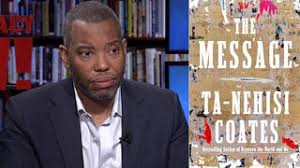
We spend the hour with the acclaimed writer Ta-Nehisi Coates, whose new book The Message features three essays tackling the Israeli-Palestinian conflict, book bans and academic freedom, and the legacy of the transatlantic slave trade. The Message is written as a letter to Coates’s students at Howard University, where he is the Sterling Brown Endowed Chair in the English department. As part of the research for the book, Coates traveled to Senegal and visited the island of Gorée, often the last stop for captured Africans before they were shipped to the Americas as enslaved people. Coates also visited a schoolteacher in South Carolina who faced censorship for teaching Coates’s previous book, Between the World and Me, an experience he says showed him the power of organizing. “That, too, is about the power of stories. That, too, is about the power of narratives, the questions we ask and the questions we don’t,” Coates says of the community’s response.
________________________________________________________________________________________________________________
AMY GOODMAN: Vigils and memorials were held across the globe Monday and this weekend on the first anniversary of October 7th to mourn Israelis and Palestinians who have been killed over the past year. The anniversary comes as Israel is widening its assault on Gaza and sending more troops into Lebanon.
Today, we spend the hour with the acclaimed writer, the journalist Ta-Nehisi Coates, author of the new book The Message, based in part on a trip he took last year to the occupied West Bank and Israel. Ta-Nehisi compares Israel’s apartheid system to that of Jim Crow here in the United States. He writes, “It occurred to me that there was still one place on the planet — under American patronage — that resembled the world that my parents were born into.”
In his book, Ta-Nehisi Coates also writes about traveling to Senegal, where he visited the slave trade memorial at Gorée Island, and going to South Carolina, where school officials tried to ban his book Between the World and Me, which won the National Book Award in 2015.
The Message is written as a letter to his students at Howard University, where Ta-Nehisi Coates is the Sterling Brown Endowed Chair in the English department. The Message is Ta-Nehisi’s first collection of nonfiction work since his 2017 book, We Were Eight Years in Power: An American Tragedy.
Ta-Nehisi, welcome back to Democracy Now! Last time, during the pandemic, you were in another studio, so it’s great to be with you in our New York studio.
I wanted to read one of your quotes: “We are plagued by dead language and dead stories that serve people whose aim is nothing short of a dead world. It is not enough to stand against these dissemblers. There has to be something in you, something that hungers for clarity. And you will need that hunger, because if you follow that path, soon enough you will find yourself confronting not just their myths, not just their stories, but your own.” Ta-Nehisi Coates in The Message.
We’re going to talk a lot about what’s happening in the Occupied Territories, in Gaza, in the West Bank. But I wanted to start where you go in The Message first, and that is to Senegal.
TA-NEHISI COATES: Right.
AMY GOODMAN: Talk about this journey that you actually took with great trepidation.
TA-NEHISI COATES: I did. I did. As you said, you know, we’ll spend a lot of time talking about the Occupied Territories and Israel and the West Bank, but it’s good to start here because the two parts are kind of paired to each other.
African Americans are a group of people who have lived under the weight of an artifice or creation, a kind of mythology of what Africa is in our minds. All of the myths of racism, all the justifications for enslavement, all the justifications for Jim Crow, at the end of the day, they have their origins in these constructions of Africa as this savage place, the idea that, you know, having been brought here, we’re better off — very, very typical of, you know, colonizing and conquering a movement. And one of the things we’ve done to push back is create our own narratives, our own journeys, our own ideas of what Africa is. My very name comes out of that, which I’m very uncomfortable with, as I talk about in the book. And —
AMY GOODMAN: Talk about it.
TA-NEHISI COATES: Oh boy. Oh Lord. I wrote it. I should be very comfortable talking about it. You know, I was born in 1975, and that was a period in time coming out of Black Power, coming out of “Black is beautiful,” like really discovering this idea that our sense of beauty, our nose, our lips, our names, our heritage, we had the right to take control over that, including our history.
And so, my name is an ancient Egyptian name that refers to the ancient kingdom of Nubia. The notion was that, put very, very crudely, that if the West had its kings and queens, if it had its great monuments, if it had its great ideas, so did we. And part of growing older, part of, you know — and I actually talk about this in Between the World and Me — part of becoming a writer, actually, is, like, our job is to be skeptical of clean stories. And I learned that very, very early on. And The Message is kind of a continuation of that.
Of course, the ultimate, I would say, I guess, climax in that journey is going to see the continent itself and moving past myth, moving past the idea of constructed narratives, even when they’re liberatory, even when they’re emancipationist, to see the people themselves. And that is what took me to Dakar. And that is what I think took so long for me to go to Dakar.
JUAN GONZÁLEZ: And in terms of what most surprised you in the trip, could you talk about that?
TA-NEHISI COATES: Yeah. What most surprised me is a thing that will not surprise any African American watching this interview. It was my deep sorrow. It was my deep, deep, deep sorrow. And I think, like, much of what I just said in answer to Amy’s question, I had already intellectualized before I went, and so I was already thinking about this. But thinking about something and being confronted with it is a totally, totally different thing. As the great Mike Tyson said, everybody’s got a plan until they got punched. And as soon as that plane started descending out of the clouds over Dakar and I saw the buildings rising up, I was being punched. It is one thing to think about the Middle Passage, to think about your ancestors theoretically. It is quite another to literally sit on the edge of the Atlantic Ocean and look out and understand that this was, if even only symbolically, last stop.
JUAN GONZÁLEZ: And when you went to Gorée, you decided that you did not want to have any of the tour guides —
TA-NEHISI COATES: No.
JUAN GONZÁLEZ: — that you wanted to wander around on your own.
TA-NEHISI COATES: No, but it —
JUAN GONZÁLEZ: Talk about that experience.
TA-NEHISI COATES: Juan, by then, it was like day three. And so, I understood that as much as I thought I was going to see the continent, I was actually going to see some sort of departed version of myself, you know, from hundreds of years ago. I was walking with ghosts the whole time. And I just — I didn’t want to be talked to.
My family is from the Eastern Shore of Maryland, not too far from Ocean City, for anybody who knows that geography. It’s like right on the Atlantic Ocean. And so, to get back to Senegal, to get to Dakar, which is itself right on the tip of the continent, you know, I would look out, and I would have these moments, and I would say, “My god!” You know what I mean? “There’s part of me all the way on the other side, and then there’s part of me that’s here.”
And so, again, Gorée is a place that has a lot of story and a lot of myth around it. And I had read about that. I thought I was fully prepared. But I’m going to tell you, brother, you get on that boat, and that boat pulls off, and you think about all your ancestors. And it was 7 a.m. in the morning, and I was alone on that boat. And it is a very, very different experience.
AMY GOODMAN: And back to your name, Ta-Nehisi?
TA-NEHISI COATES: Yes.
AMY GOODMAN: And also, which goes to your parents, as well —
TA-NEHISI COATES: Yes.
AMY GOODMAN: — and their influence on you. Your dad, a former Black Panther, ran a publishing — a publishing press right in your house.
TA-NEHISI COATES: Yeah, yeah, no. And I think, like, what they were really trying to do — and this actually goes to the core of what the book is about. How do you tell your own story? How do you free yourself from a history, from novels, from film, from television, an entire architecture that is designed to tell you that you are exactly where you belong because of who you are, because of what you are, either because of your genes, because God said, you know, you belong there? How do you construct something different?
And one of the things I’m trying to confront in the book is, I think perhaps step one is almost to make a mirror image of the people that have put you in that situation: “Well, you say we’re this. We’re actually that.” But I think one of the most difficult things is to free yourself entirely of that structure and to construct your own morality, your own stories, your own ideas, that don’t necessarily depend on those who have put you in the situation to begin with.
JUAN GONZÁLEZ: And the structure of your book is addressed to your students at Howard. The decision to choose that form for your book?
TA-NEHISI COATES: You know, I was, to be honest with you — I have not said this anywhere — I was very worried about that, because I had done that. Like, I had written this letter in Between the World and Me, and I thought people were going to say, “Oh my god, he’s going to do this again. What? Between the World and Me again?”
But the fact of the matter is, I am always trying to achieve intimacy with the reader. That’s the primary job. You know, I would tell my students all the time, “Look, you are dealing with readers who could be doing anything else. They could be on their smartphones. They could be playing video games. They could be watching movies. They could be watching TV, be somewhere making love. They could be doing anything but reading you. And so, you have a responsibility to make them feel a sense of intimacy and immediacy.” And I was lucky in the sense that, you know, these were very, very real conversations that I had had with my students, so I had something to pull from, and also the fact of just the letter form allowed me to do that and allows me to get a kind of intimacy with my reader.
AMY GOODMAN: Talk about George Orwell, “Why I Write,” and —
TA-NEHISI COATES: That’s a great essay.
AMY GOODMAN: — connecting politics and language in the promise you made to your students at Howard. Between the World and Me was written to your son Samori.
TA-NEHISI COATES: Yeah.
AMY GOODMAN: This, to the students.
TA-NEHISI COATES: Yeah. So, we usually start, actually, with “Politics and the English Language.” That’s the first essay that I have them read, you know, just to think about language as a political thing. You know, we live in this world where I feel that oftentimes we are taught — not that everybody subscribes to this — that art lives over here and politics lives over here, and that politics itself is actually very, very limited, that it happens every two or four years — it’s in the voting booth, it’s who you decide to vote for, it’s what issues you decide to activate on. But one of the arguments that I make in The Message is that there’s an entire architecture outside of the world of mean politics that determines how politicians actually talk, the choices they give, you know, etc. Why does Kamala Harris feel the need, for instance, to say that she has a gun? What is that actually based on? And I would say it is based on archetypes of femininity. I would say it’s based on archetypes of race, archetypes of the cowboy. And where do those archetypes come from? They come from our art. They come from our literature. They come from our film, our TVs, our commercials. And at their base, they ultimately come from writing, because somebody has to write those ultimately. And in that world, things that seem separated from politics never really are. And so, I wanted to start that book — or, this book, The Message, with that Orwell quote, because that’s like one of the things he kind of is obsessing with in that essay.
And at the same time, there’s this beautiful tension that I often feel, which is, in a different world, you know, he would just write beautiful stories. He would just play with language for the hell of playing with language. But he doesn’t live in that world. And I don’t feel that my students live in that world. They live in a world of, as we’ll talk about, genocide, apartheid, segregation, global warming, you know, Category 5 hurricanes, flood on one coast, fire on the other. These are immediate issues. And I don’t believe that they, as writers, we, as writers, have the luxury of sort of sitting back in our salons and in our living rooms simply constructing beautiful language for the hell of constructing beautiful language. It has to be engaged with something.
JUAN GONZÁLEZ: And, Ta-Nehisi, from Senegal, you take us to Columbia, South Carolina. Why that choice?
TA-NEHISI COATES: Well, I was writing this in a time where this wave of book bannings was happening. And I always wanted to write about that, but I felt that — I was worried about making the writer the center of the book banning, because even though the work is directed at the writer, the writer is actually not the person that suffers under the book ban. The teachers suffer under the book ban. It’s the teachers who are under threat for losing their job. It’s the teachers who get harassed. It’s the librarians who are under threat of losing their jobs, the librarians who get harassed. It’s the students who lose the ability to have access to different worlds and different ways of thinking. And I was trying to figure out how I could write this in such a way so that I would not be the center of it.
Luckily, you know, I ended up in conversation with a teacher by the name of Mary Wood from Chapin, South Carolina, went to Chapin High School, where she teaches and where she was trying to teach Between the World and Me and got into some amount of trouble for that. And she invited me down, you know, just to go to a hearing. And that’s what I did. And it was quite eventful. It was not the world that I expected. It was not the audience I expected. It was interesting to see how much support actually was rallied behind her, even though she’s in a deep red area in a deep red state. And so, that, too, is about the power of stories. That, too, is about the power of narratives, the questions we ask and the questions we don’t.
AMY GOODMAN: You write, in The Message, about this experience in South Carolina, “I see politicians in Colorado, in Tennessee, in South Carolina moving against my own work, tossing books I’ve authored out of libraries, banning them from classes, and I feel snatched out of the present and dropped into an age of pitchforks and bookburning bonfires. My first instinct is to laugh, but then I remember that American history is filled with men and women who were as lethal as they were ridiculous.”
TA-NEHISI COATES: That’s right.
AMY GOODMAN: Now, if —
TA-NEHISI COATES: We got one running for president right now, you know? Lethal and ridiculous.
AMY GOODMAN: Well, you talk about the area you were in, 70-30 split, 70% for Trump. And yet — and this is what you were just talking about — this 30%, how surprised you were by the minority, the power of it when it’s mobilized.
TA-NEHISI COATES: Yeah. You know, it’s like one of these things. Like, again, like, this goes back to how we construct language. It’s either a blue or red district, right? Even purple doesn’t quite, like, carry the quite — you know, like the real context. They think it’s red. OK, battle’s over. Why am I here? You know? But 30% — if 30% activated around an actual issue, it’s actually a lot of people. You know what I mean?
And it was like — like, I could not have known that without seeing it. Like, you have to — and this is, like, one of the messages I have for my students in the book. You have to walk the land. You can’t sit on your butt reading reports — you know what I mean? — and even reading books like this one, and say, “Hey, I’m going to be a writer.” You have to have actual experiences. And so, I have to walk in that room and meet this white woman in her seventies, you know, who tells me, in the wake of George Floyd, “We organized a reading group at our church for Black authors, and I love Colson Whitehead. Oh my god! Have you read him?” You know, like, I have to have that experience with somebody. You know, I have to have that shock, you know? And so, I just feel like it was, like, really, really important in The Message to actually model the work that I was articulating or model the lessons that I was actually articulating for my students.
AMY GOODMAN: When you just referred to President Trump, can you elaborate further?
TA-NEHISI COATES: He looks ridiculous, but he is in fact quite lethal. You know? And I think, certainly in 2016, there was great, great temptation to laugh. You know what I mean? You hear these things, you know, you hear him say certain things, you see him in certain places, and there’s a kind of dismissiveness. But what we actually are dismissing is a kind of darkness that I think lurks deep, deep within all of us and can actually be appealed to. It’s not comfortable to say that you can win through hate. It’s not comfortable to say that you can win through anger. It’s not comfortable to say, historically, it actually has been very effective, electorally, to pick out weak people or people who are not in the most advantaged political space and to demonize them and use them as a tool, that that actually has been quite effective for people in pursuit of power. We would rather think that good wins all the time, that people see the best in each other. It reifies our notions of what America is, our stories that we tell ourselves of what America is, but it doesn’t correspond with the actual history and the truth.
Ta-Nehisi Coates: I Was Told Palestine Was Complicated. Visiting Revealed a Simple, Brutal Truth
As the war on Gaza enters its second year and Israel expands its attacks on Lebanon, we continue our conversation with the acclaimed writer Ta-Nehisi Coates. His new book, The Message, is based in part on his visit last year to Israel and the occupied West Bank, where he says he saw a system of segregation and oppression reminiscent of Jim Crow in the United States. “It was revelatory,” says Coates. “I don’t think the average American has a real sense of what we’re doing over there — and I emphasize ‘what we’re doing’ because it’s not possible without American support.”
AMY GOODMAN: This is Democracy Now!, democracynow.org, The War and Peace Report. I’m Amy Goodman, with Juan González.
Last night here in New York, hundreds of activists — Jewish and Jewish allies and Palestinians — rallied in Union Square for a vigil on the first anniversary of October 7th to mourn Israelis and Palestinians who have been killed and to call for an end to the Israeli massacre in Gaza and beyond. People performed prayers. There were rabbis there. And they read out the names of those who have lost their lives. One of those who spoke, I talked to afterwards, Eva Borgwardt. She is a spokesperson for the group IfNotNow.
AMY GOODMAN: Right now people are wearing signs that say “No U.S. money for bombs.” And talk about the motto of this October 7th vigil.
EVA BORGWARDT: So, the motto is “every life a universe,” and it’s from ”pikuach nefesh,” which says that to destroy a life is to destroy an entire world, and to save a life is to save an entire world. And our government is not treating every single life as a universe. They’re treating Palestinian lives as less sacred.
AMY GOODMAN: How did you get so involved with this issue?
EVA BORGWARDT: I got involved through the Ferguson uprising. And I was watching Black and Palestinian activists trading tips on Twitter about how to deal with tear gas, and it became clear that Palestinians in the West Bank are facing a military charged with policing, and Black Americans are facing a militarized police force. And that was my entry point, where I said, “I need to organize my community,” which was unable — or, which was limited in being able to show up for the civil rights fight of our time, for the Black Lives Matter movement, because they were upset about the messaging for a free Palestine in those protests. And so, I’ve spent the last 10 years of my life working on building the movement of Jewish Americans who are calling for equality, justice and a thriving future for all, no matter where people live.
AMY GOODMAN: That’s Eva Borgwardt of the group IfNotNow, one of hundreds of people here in New York City in Union Square for two large rallies on the anniversary of October 7th. Our guest today is Ta-Nehisi Coates, the prize-winning journalist and author of the new book, The Message, in part about a visit he took last year, organized by the Palestine Festival of Literature, PalFest, to the West Bank and Israel. Talk about this whole journey you took. You were part of the PalFest, and then you also stayed.
TA-NEHISI COATES: Yeah. And I guess, to be honest, my journey began 10 years ago, when I published “The Case for Reparations.” And there was a section — again, as a writer, as a journalist, you’re always trying to make people feel things, make things real. And there was a section where I offered an analog for reparations, for how it could possibly look. And it was from West Germany to the state of Israel — and I need to be very specific about that — not to Holocaust survivors, but to the state of Israel itself. And that part of that essay came under quite a bit of critique — and what became clear to me was, deservedly so. It took 10 years for me to get it fixed, because writing takes a long time, you know? But I knew I had to — like, that I was going to have to go at some point. You know, I knew it wouldn’t be enough for me to, you know, appear at a rally, do a slogan, whatever.
And long story short, I began talking to PalFest in 2016, finally got there in 2023, just in time for The Message. I spent five days with them, mostly traveling through the Occupied Territories and through East Jerusalem as a Palestinian would, getting a sense of what their daily life was. And then, the next five days I spent mostly in the company of a group called Breaking the Silence, former IDF veterans who are against the occupation, and I saw the country largely through the views of an Israeli, how they move through the world, how they move through Jerusalem, how they move through the roads. But I also, again, spent a lot of time actually talking more to Palestinians.
It was revelatory. It was — I don’t think the average American has a real sense of what we’re doing over there — and I emphasize “what we’re doing” because it’s not possible without American support. I have heard people say over and over again, “There are great evils happening the world, states across the world perpetrating evils against whole groups of people. Why pick on Israel?” And the thing I say is, “I’m an American. This is the thing that we have our fingerprints on.” Those bombs over Gaza, the planes that drop bombs on Gaza, the plaques that I saw, for instance, in Jerusalem, all of that is America. And we are going around the world propping ourselves up as the font of democracy. We are going around the world propping Israel up as the only democracy in the Middle East. This is a deep, deep fiction, a very, very dangerous fiction that must be addressed. And that’s what I tried to do in the book.
JUAN GONZÁLEZ: You write in the book, quote, “It occurred to me that there was still one place on the planet — under American patronage — that resembled the world that my parents were born into.” Can you elaborate?
TA-NEHISI COATES: Yes. And I think I talked about it the last time I was here, actually. These are the words I have even now, and they are probably insufficient to what a Palestinian would offer who experiences this, but the words that come to me are “segregation.” When you are on the West Bank, there are separate roads. There are roads for Israeli settlers and citizens of Israel, and there are roads for Palestinians. These roads are not separate and equal; these roads tend to be separate and unequal. It tends to take longer to get where you want to go if you’re a Palestinian. If you enter a city like Hebron, for instance, Hebron is quite literally segregated. There are streets that Palestinians cannot walk down. There are streets that Israeli settlers are given complete and free movement of. Moving throughout the West Bank in general, there are checkpoints everywhere for Palestinians. These checkpoints are sometimes normal checkpoints that they know are there. Sometimes checkpoints appear out of the blue, what they call flying checkpoints. Your basic movement is constantly in peril.
The justice system, which is deeply familiar for African Americans today, is quite literally segregated. There is a civil justice system that the minority of Israeli settlers, as Israeli citizens, enjoy, and then there is an entirely separate justice system that Palestinians on the West Bank are subject to. You can be arrested, for instance, as an Israeli citizen, and you are, you know, due all the due rights that we are familiar with. You have to be told what the charges are, etc. If you are arrested as a Palestinian, you can just be taken. In another political context, we would call those hostages, because nobody has to say why you’re taken, nobody has to say what you were taken for, nobody has to inform your family. You are under the jurisdiction of the military.
It has been this way since 1967. And the word we use for that is “occupation,” which is a kind of a deeply vanilla word that does not actually describe what is going on. How a country that maintains this separate and unequal system, how a country that does not even allow the, quote-unquote, “Palestinian citizens” of the state full equality with its Jewish Israeli citizens is allowed to refer to itself as a democracy is a mystery to me. And the closest analog I can think of is the time in which the United States of America referred to itself as a democracy even as it was disenfranchising whole swaths of Black people in the Southern states. And so, when I say Jim Crow, when I say segregation, that is because that is the period that immediately comes to mind for me.
AMY GOODMAN: Talk about being stopped by an Israeli soldier, Ta-Nehisi.
TA-NEHISI COATES: Oh, well, we were stopped all the time, to be clear, you know, because we were on the roads. We were constantly stopped. You know, I was — you know, you just kind of got used to it after a while, which was also weirdly familiar. But I think the instance you’re referring to is when I was in Hebron, which is a flashpoint for anybody that’s been over there.
I was walking down a street attempting to patronize a Palestinian vendor, and a guard, IDF guard or IDF soldier, stopped out — he was young enough to be my son — stopped out and asked me what was my religion. It was clear that I had to state my religion in order to pass. When I told him that I was not religious, he asked what my mother’s religion was. When I told him my mother wasn’t particularly religious, he asked what my grandmother’s religion was. And this is a very, very important thing, because when you start asking what my mother and grandmother’s religion is, you are referring to something beyond do I accept Christ as my personal savior or what god I pray to. You are asking a deeper question about my ancestry. And it became clear that if I did not give the right answer to that question, I would not be allowed to pass.
I highlight this because when you hear Palestinian and Palestinian American activists make the charge of racism, this is what they’re talking about. Why does who my grandmother or my mother worshiped matter, if we’re strictly talking about a god? Not that it would be right even in that sense. But when you hear the charge of racism, this is what people are referring to.
AMY GOODMAN: Ta-Nehisi, this is a powerful book, and you went on CBS This Morning recently to talk about the publication of it. And I want to go to that interview —
TA-NEHISI COATES: Oh, that will be fun.
AMY GOODMAN: — on CBS This Morning. The New York Times is now reporting CBS News has rebuked one of the morning anchors, Tony Dokoupil, over what he did in that interview to you, and, maybe you could also say, to his fellow anchors as he dominated this. CBS executives said the interview fell short of the network’s editorial standards. This is an excerpt of that interview.
TONY DOKOUPIL: Ta-Nehisi, I want to dive into the Israel-Palestine section of the book. It’s the largest section of the book. And I have to say, when I read the book, I imagine if I took your name out of it, took away the awards and the acclaim, took the cover off the book, the publishing house goes away, the content of that section would not be out of place in the backpack of an extremist. And so, then I found myself wondering, “Why does Ta-Nehisi Coates, who I’ve known for a long time, read his work for a long time, very talented, smart guy, leave out so much?” Why leave out that Israel is surrounded by countries that want to eliminate it? Why leave out that Israel deals with terror groups that want to eliminate it? Why not detail anything of the First and the Second Intifada, the cafe bombings, the bus bombings, the little kids blown to bits? And is it because you just don’t believe that Israel, in any condition, has a right to exist?
TA-NEHISI COATES: Well, I would say the perspective that you just outlined, there is no shortage of that perspective in American media. That’s the first thing I would say. I am most concerned always with those who don’t have a voice, with those who don’t have the ability to talk. I have asked repeatedly in my interviews whether there is a single network, mainstream organization in America with a Palestinian American bureau chief or correspondent who actually has a voice to articulate their part of the world. I’ve been a reporter for 20 years. The reporters of those who believe more sympathetically about Israel and its right to exist don’t have a problem getting their voice out. But what I saw in Palestine, what I saw on the West Bank, what I saw in Haifa, in Israel, what I saw in the South Hebron Hills, those were the stories that I have not heard.
AMY GOODMAN: So, Ta-Nehisi, you sitting on the set of CBS This Morning with the former football player, now anchor, Nate Burleson, Gayle King, very well known, both African American anchors, and Tony Dokoupil. He dominated the discussion, talking about your book belonged, could be found in an extremist’s backpack. Talk about the backlash on this, the aftermath of this, and also who you felt was most wronged in this.
TA-NEHISI COATES: Well, it wasn’t me. I mean, at that point, let me tell you, it was not me, you know? It certainly — and I don’t know that it was anybody on that set. Look, I think there is a meta-conversation that happens here, where we end up — because we’re media, where we end up talking about media and media politics. But I do think it’s really important to broaden the frame from the few people that were there, and talk about what was actually excluded and who was actually excluded from that conversation by the very structure itself. I just don’t want to lose sight of that.
I don’t really have a problem with a tough interview. You know, I knew what I wrote. You know, I knew I’d be confronted. You know, was he rude? Was he aggressive? You know, like, I can’t really get into that. Like, it’s not really something that I think too much about.
The question I would ask, though, is: How often on CBS, on NBC, on ABC, or on any major news organization, do you see someone who is a defender of the Israeli state project get confronted in that kind of way, given a tough interview in that kind of way? When was the last time you saw, for instance, a defender of Israel, a defender of Zionism confronted with the fact that major human rights organizations say that Israel is practicing apartheid? How do you defend that? When is the last time you’ve seen an interviewer, how often do you see interviewers — because I don’t want say it never happens — how often do you see interviewers say, “Listen, we have the former head of Human Rights Watch that says you are practicing genocide right now in Gaza. How do you respond to that?” How often do you — how often do you see that? How often do you see, “How do you define yourself as a democracy when fully half the people under your rule are not equal?”
There is no problem with confronting me. You know, I would like to see some other people confronted. And the second part of that is: Who gets to do the confronting in the first place? I have said, and I will continue to say, I am a little uncomfortable with this role and a little uncomfortable with the publicity, not because I feel like I do not know, but because I feel like there are people who are going through this experience and who have gone through this experience, who know so much more, who are completely out of the frame. And those are Palestinians and Palestinian Americans. So, it’s not just the issues that are raised in the confrontation. The question I would ask is, you have to imagine a world where a Palestinian American journalist could be on a mainstream show like CBS This Morning and confront someone who wrote a book that, say, defended Israel or defended Zionism with that kind of aggression. It’s fine if I get it, but I want to live in that world, too, you know?
And that really is, you know, like, one of the things I was really, really trying to get at in the book, in The Message, you know? It’s the questions we ask. It’s the stories we get to tell and the stories that we don’t tell. And perhaps most importantly, it’s who gets to tell them and who doesn’t. And I just — I really feel this passionately. This is not about me. This is not about Tony. This is not about Gayle. This is not about Nate. We’re going to be fine. It’s the people who are invisible. It’s the people who were not in that set — you know, on that set to begin with, who were not part of that conversation.
JUAN GONZÁLEZ: And, Ta-Nehisi, this criticism that you weren’t sufficiently taking into account the history, when the reality is here we are on the anniversary of the October 7th attacks, and very little discussion occurs about what was Gaza like before October 7th of last year and how were the residents of Gaza being treated, essentially, in an open-air prison.
TA-NEHISI COATES: Yes, no, I completely agree. Look, I love the young lady who was saying earlier in the lede in, “Every life is a universe.” I truly, truly believe that. And so, you know, as I’ve said before, like, there really is no part of my politics that has the ability to look at October 7th and not mourn the death, the massacre, the atrocities perpetrated. I just wish that some of my countrymen — especially my countrymen, especially Americans who are responsible for this, who are propping this up — had that same sort of compassion and that same sort of energy for October 6th, October 5th, etc.
You know, this kind of abstracting events outside of their historical context is really necessary to the political order, because it allows us to justify ourselves and not have to think harder or not have to ask much deeper questions. You really have to be able to hold both. And I know that that sounds a bit cliché, but I truly do believe that you have to, you know, believe in this idea that I actually just heard today, that every life is a universe. You know, I think that’s a really, really beautiful articulation, you know? And that has to be true for all life. That has to be true on October 7th, you know, and loudly said, but it has to be true on 6, 5, 4, 3, 2, 1 also.
JUAN GONZÁLEZ: And also, I wanted to go back for a second, because we are running out of time, and ask you about —
TA-NEHISI COATES: I’m sorry my answers are so long.
JUAN GONZÁLEZ: Yeah — about President Trump and the upcoming election. The great surprise to me, all these years now, is the enormous support that Donald Trump still has among huge swaths of the American public. To what do you attribute this?
TA-NEHISI COATES: Darkness. There’s a darkness in all of us. I mean, this is — this is not new. You know? And if you just took American history from the perspective of an African American, and I suspect from the perspective of the Indigenous people of this continent, what they would tell you is there is nothing new in people using power, in people using the worst tropes in the world to win and to dominate. For any Black person that grew up in the South from — I don’t know — 1876 to 1964 and probably beyond — I’m being very conservative by saying that — this is what politics was. Like, this is just what we grew up under.
And so, I think maybe we thought, or we allowed ourselves to believe, that somehow we had escaped the gravity of history. But no people, no country escapes the gravity of history. We live within it. We are part of it. And so, I think it’s a very, very dangerous thing that our leaders led us to believe in 2016 that this was like a thing that could not happen in America, you know, whereas had we looked at history from another perspective, we would know that this actually is very American. You know, that doesn’t make us inhuman or somehow demonically evil; on the contrary, it just makes us human. It means that we’re subject to, you know, the darkness in our souls like any other group of people would be.
AMY GOODMAN: Ta-Nehisi, I wanted to go to that point you say of who gets heard. We were at the Democratic convention. Everywhere we were interviewing people —
TA-NEHISI COATES: I saw you out there.
AMY GOODMAN: We saw you in the background.
TA-NEHISI COATES: Yes, yes, yes.
AMY GOODMAN: We were interviewing the delegate from, what, Michigan, from Florida and from Connecticut —
TA-NEHISI COATES: Yeah.
AMY GOODMAN: — who unfurled a banner in the Florida delegation that said “Stop arming Israel.”
TA-NEHISI COATES: Yeah.
AMY GOODMAN: You were there as we were interviewing them in the hallway. When we were outside, when they were about to begin the sleep-in overnight, demanding that Kamala Harris allow a Palestinian American to speak, you were there. And then, the next day, you wrote a piece in Vanity Fair about your experience, “A Palestinian American’s Place Under the Democrats’ Big Tent?” the piece looking at the “uncommitted” movement and their unsuccessful efforts to have such a speaker. This is Ruwa Romman of the uncommitted movement. She’s a Palestinian American Georgia state representative. This is part of what she would have said if she was chosen.
RUWA ROMMAN: For 320 days, we’ve stood together demanding to enforce our laws on friend and foe alike, to reach a ceasefire, end the killing of Palestinians, free all the Israeli and Palestinian hostages, and to begin the difficult work of building a path to collective peace and safety. That’s why we are here, members of this Democratic Party committed to equal rights and dignity for all. What we do here echoes around the world. They’ll say this is how it’s always been, that nothing can change. But remember Fannie Lou Hamer, shunned for her courage, yet she paved the way for an integrated Democratic Party. Her legacy lives on, and it’s her example we follow.
AMY GOODMAN: So, that’s the Georgia state Representative Ruwa Romman. And needless to say, there was not a Palestinian American voice on the stage. Last night, Kamala Harris did an interview with 60 Minutes — at least they played it last night. This is what she had to say about Israel-Palestine.
VICE PRESIDENT KAMALA HARRIS: When we think about the threat that Hamas, Hezbollah presents, Iran, I think that it is, without any question, our imperative to do what we can to allow Israel to defend itself against those kinds of attacks. Now, the work that we do diplomatically with the leadership of Israel is an ongoing pursuit around making clear our principles, which include the need for humanitarian aid, the need for this war to end, the need for a deal to be done which would release the hostages and create a ceasefire. And we’re not going to stop in terms of putting that pressure on Israel and in the region, including Arab leaders.
AMY GOODMAN: That’s Democratic presidential nominee Kamala Harris speaking on 60 Minutes last night. As we wrap up, you were just talking about Trump. Talk about what the position of the Biden-Harris administration is right now. They did hold two separate commemorations yesterday. President Biden was at the White House, and he lit a candle and also, I also, crossed himself right after. And Kamala Harris, the vice president, in the Naval Observatory, planted a tree, a pomegranate tree.
TA-NEHISI COATES: Well, you know, that’s good and appropriate, you know. Like I said, we don’t want to have a politic that does not take life serious and does not take loss of life serious. On the larger question, and maybe even as an extent of that, but we have to take all life seriously. I don’t think we’re doing that. This is morally untenable.
What I saw was — and this is the first time I’ve ever said this or put this in this frame, and maybe the uncommitted delegates understood this — there was as much a moral gap between what I saw in Chicago, that is to say, to go on stage and promote these values of diversity, humanity, big tent, and to exclude the peoples whose families are being bombed right now, as it was in the early 1960s and before, when the Democratic Party claimed to be for the working man and the working person while millions of workers all through the South were effectively in a system of indentured servitude, and they refused to give those people political representation. It is a gigantic moral gulf, that is troubling, disappointing, heartbreaking and deeply, deeply personally upsetting.
AMY GOODMAN: Ta-Nehisi Coates, award-winning journalist, author, professor. His new book is The Message. That does it for our show. I’m Amy Goodman in New York, with Juan González in Chicago.