Tag Archives: Mumia Abu-Jamal
Coming Soon…An Interview w/ #MumiaAbuJamal
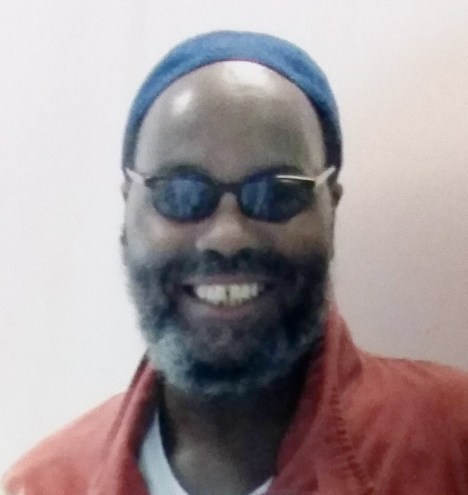
#MUMIAABUJAMAL’s testimony to the #UnitedNations #UNHumanRightsCommittee

On the initiative of the UN Human Rights Committee, an international call for written contributions has been launched concerning “the death penalty in relation to the prohibition of torture and other forms of ill-treatment, and also the protection of human dignity.” By clicking on the link below, you can learn more about the relevance and purpose of this initiative: https://www.ohchr.org/en/calls-for-input/2026/call-input-special-rapporteur-summary-extrajudicial-or-arbitrary-executions
This appeal has been relayed by the World Coalition Against the Death Penalty to its members; the French Collective has been a member of the coalition since its creation and was re-elected to its Steering Committee in 2025.
With the help of Prison Radio (USA), also a member of this Coalition, we requested a statement from Mumia (an iconic figure in the fight for the universal abolition of the death penalty), which we have just forwarded to the Special Rapporteur in charge of collecting contributions, on the basis of which he will present his report to the 62nd session of the United Nations. You can find Mumia’s AUDIO testimony in English by clicking on this link: https://mumiabujamal.com/v2/wp-content/uploads/2026/02/2-3-26-Mumia-UN-Submission.mp3 … and transcribed in the attachment.
Best regards,
Jacky & Steve
French Collective LIBERONS MUMIA
*****************************************************************************************************
In response to the Special Rapporteur’s call for contributions “on the death penalty in relation to the prohibition of torture and other forms of ill-treatment and the protection of human dignity,” we wish to bring to his attention the situation of Mr. Mumia ABU-JAMAL, who has spent 29 years of his life on death row in Pennsylvania (USA).
An African American journalist, now aged 71, he has his sentence commuted to life imprisonment without the possibility of parole.
Incarcerated for 45 years, below you will find his testimony on the conditions of survival in prison hell and the physical and mental consequences of his fellow inmates awaiting execution or the deterioration of their health exposing them to
death in the case of life sentences.
An iconic figure in the international fight for the universal abolition of the death penalty, Mr. ABU-JAMAL was convicted after a racist and expedited trial without being able to defend his innocence. Denounced by Amnesty International, the European Parliament, and the UN Human Rights Committee, he has still not obtained a review of his trial. Today, the deterioration of his health, like that of the oldest prisoners, would justify his release on humanitarian grounds.
Noelle Hanrahan (USA) nhanrahanlaw@gmail.com, Lawyer of Mumia Abu-Jamal and Director of Prison Radio (USA)
Member of the World Coalition Against the Death Penalty
Jacky Hortaut (FRANCE) contact@mumiabujamal.com
Let’s Free Co-organizer of the French Mumia Collective
bringing together around a hundred NGOs and the city of Paris
Member of the Steering Committee of the World Coalition against the Death Penalty
***************
Submission by Mr. Mumia ABU-JAMAL to the United Nations
When we think about death row I must remind you all who hear these words or read these
words it is not a movie. Don’t think of a movie. Instead imagine a reality where for years, for
many years, people are locked down in their cells for 23 hours a day. Which began as 24 hours
a day on the weekends and after years and years, became 22 hours a day.
Also imagine that for what may be the rest of your life you could not hug, nor kiss, nor caress
your children, your wife, your brothers, your sisters, your parents because non-contact was the
rule.
What did that mean in the real world ? And why was it established? What it means is the state
separating you from all people that you love and who love you. And what does it mean? It
meant that this physical isolation, this true solitary confinement, separated you from the people
who naturally care about you. And separated them from you. What is the purpose of that ? The
purpose is simple to dehumanize the accused, the death row person and to separate them from
humanity itself.
In some states, mostly the South, it has become custom that when a death-row prisoner is
escorted throughout the prison the guards usually shout: “ Dead man walking. Get out of the
way. Dead man walking ”. Now that will remind you of a movie, but that only reminds you of a
movie because it happened in real life.
To separate people from other people, it is to deprive people of what it means to be human. To
be social. And this is something that has become “expertise” in American prisons, North, South,
East or West. This tradition continues in much of this country and is designed to make people
lose hope, so that they can be more easily executed, or as the state says ”put to death “.
This too is not just a word or description or even a movie. I’ve known men who spent time on
death row with me who committed suicide, for a variety of reasons.
Sometimes, they were suffering health issues and could not bear to continue to suffer those
health issues. Sometimes they were depressed because they knew that they should have
gotten a new trial, but instead they got a resentencing hearing. I knew a guy who I had played
handball with, up SCI Greene, he was an excellent young handball player, because he’d played
it in the world. And we gave each other a good challenge, the old man and the young guy, and
he was in excellent health. Until his appeal got denied and he was given a life sentence instead
of the new trial that he knew, he knew, he deserved and by law should have gotten. Within a
week he tied himself to some bars in his cell and killed himself. For him, a life sentence, what
people call “ slow death row ” was too much like death row itself, for him to leave death row, it
was another kind of death row. A death row on life row.
I have met people who I have known on death-row who were executed by the government of the
Commonwealth of Pennsylvania. One guy was about two or three cells away from me when we
were at Graterford in Eastern Pennsylvania. He was an older guy, I sent him a note and said “
Listen man, fight your stuff ” And he called down and said “ Jamal, I am tired ; I got nothing
here, I got nothing to live for, I’m ready to go “. And so he did. He volunteered to be executed.
And the State of Pennsylvania took him up on his invitation.
When people are given no way out, given no hope, does it surprise you that men in such
conditions not committed suicide ?
If you think about it this guy commits suicide by the state. The other Puerto Rican brother I
talked about committed suicide because of his deep disappointment that the state could not
treat him according to the law as written in their books.
But what was killed, was hope. And that is what it was designed to do. That is what death row is
designed to be. And that is what death row and slow death row really is. Not just in this state
but in several states in a country called ‘the land of the Free’.
I wanted to give you an inside impression. I hope I have been successful.
Love not Phear,
Mumia ABU-JAMAL
Black Power Media: #MumiaAbuJamal on the Arrests of #GeorgiaFort & #DonLemon: The War on #BlackJournalism / Roots of Resistance (And #MAJ Answers Viewer Questions)
#PEOPLESORGANIZATIONFORPROGRESS WILL PARTICIPATE IN 100-MILE MARCH FOR #MUMIAABUJAMAL
PEOPLE’S ORGANIZATION FOR PROGRESS (POP)
PO BOX 22505
NEWARK, NJ 07101
973 801-0001
CONTACT: LAWRENCE HAMM
NOVEMBER 26, 2025
FOR IMMEDIATE PRESS RELEASE
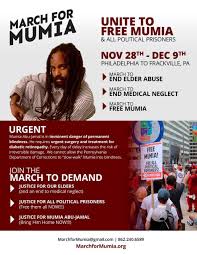
PEOPLE’S ORGANIZATION FOR PROGRESS WILL PARTICIPATE IN 100-MILE MARCH FOR MUMIA ABU-JAMAL
POP CHAIRMAN LAWRENCE HAMM WILL MARCH FOR MUMIA
The People’s Organization for Progress (POP) will participate in a 103-mile march to draw attention to the worsening medical condition of political prisoner Mumia Abu-Jamal. It will begin Friday, Nov. 28, in Philadelphia, Pennsylvania.
The “March For Mumia” will start at 9 a.m. at Uncle Bobbie’s Cafe & Books, 5445 Germantown Avenue in Philadelphia. The event is sponsored by the March For Mumia coalition.
“We are marching to demand freedom for Mumia Abu-Jamal and all political prisoners,” Lawrence Hamm, Chairman, People’s Organization For Progress, stated.
“We are also marching to demand an end to the abuse that Mumia and other political prisoners experience, and that they receive the proper medical attention and care they need,” Hamm said.
The participants will walk 103 miles over twelve days until they reach the SCI Mahanoy Corrections Facility in Frackville on December 9th, where Abu-Jamal is incarcerated. Hamm said he will attempt to march to entire route.
Mumia Abu-Jamal is a renowned journalist and author who has written more than a dozen books. He is a revolutionary, political activist and former member of the Black Panther Party.
Abu-Jamal, 71 years old, has been incarcerated for 44 years. In 1981, he was convicted for the murder of Daniel Faulkner, a Philadelphia police officer.
His death sentence was subsequently commuted to life imprisonment. He has always maintained his innocence. His case, the issue of his innocence, and his fight for freedom have garnered international support over the decades.
Many well-known political activists, celebrities, and human rights organizations, such as Amnesty International, have demanded a new trial for Abu-Jamal. He has become a prominent personality in the fight to end racism, mass incarceration, inhumane treatment of prisoners, and the death penalty.
“We believe that Mumia is innocent and should be free. We demand freedom for all political prisoners. At a minimum Mumia should have a new trial,” Hamm said.
Over the years POP has held demonstrations rallies and programs to draw attention to Abu-Jamal’s struggle for freedom and his fight for medical care. More than a decade ago Hamm personally visited Abu-Jamal at the prison in Frackville.
“Mumia has been an elder for some years and has been experiencing very serious health challenges. He is in danger of going blind if he does not have surgery and treatment for diabetic retinopathy. We are marching to demand the Department of Corrections provide it,” he said.
The People’s Organization For Progress is part of the March For Mumia coalition. Besides Hamm other POP members will be marching including community organizer and poet Zayid Muhammad, and activist Steven Bernhaut.
“We invite everyone to join us for the march whether you can march one day or twelve days, or whether you can march one mile or 100 miles. Even if you can’t march come out and cheer us on. We need your support,” he said.
“When I march for Mumia I will also be marching for an end to mass incarceration, the death penalty, and slave labor in our prisons. I will be marching for all those treated unfairly and inhumanely by the criminal justice system,” Hamm said.
For more information contact March For Mumia at (862) 240-6589, or MarchforMumia@gmail.com. Visit the website at MarchforMumia.org. To contact Lawrence Hamm call the People’s Organization For Progress at (973) 801-0001.
-END-
FOR IMMEDIATE RELEASE
Contact: Steven Bernhaut, 201-960-9204; marchformumia@gmail.com
Website: http://www.marchformumia.org
MARCHERS TO KICK OFF 103-MILE WALK FROM PHILADELPHIA TO FRACKVILLE, PA TO HIGHLIGHT PRISON ABUSES AND TO FREE MUMIA
“Many people say it is insane to resist the system, but actually, it’s insane not to.” — Mumia Abu- Jamal
Philadelphia, PA — Starting at 9 a.m., Friday, Nov. 28, activists, community leaders, and families of the incarcerated will gather next to Uncle Bobbie’s Bookstore at The Market Square Monument, 5447 Germantown Ave, Germantown, Philadelphia to embark on a March for Mumia, a 12-day mobilization demanding freedom for journalist and political prisoner Mumia Abu-Jamal, and calling attention to the systemic crisis of elder abuse, medical neglect, and politically targeted incarceration.
After libations and a few speakers, marchers carrying signs will walk 7.1 miles up Germantown Ave. through Mt. Airy and Chestnut Hill and eventually to Miles Park in LaFayette Hill, where participants will share food and solidarity.
For 11 more days, marchers will walk for 3-6 hours daily for 7-12 miles until they reach SCI Mahanoy in Frackville, PA on Dec. 9. Once there, participants will present a list of demands to the facility’s Superintendent, Bernadette Mason.
Abu-Jamal, 71 years old, suffers from chronic health conditions—including heart disease and vision loss—worsened by what his family and supporters describe as medical neglect by the Pennsylvania Department of Corrections. Jamil Abdullah Al-Amin (formerly known as Black Power activist H. Rap Brown), following complaints of elder abuse and medical neglect by his family and supporters, died Nov. 23 after 23 years in prison for a crime he did not commit. Al-Amin’s and Mumia’s conditions reflect the broader crisis of this country’s aging prison population amid decades of medical neglect, as our brothers and sisters behind bars are routinely denied adequate care and proper food.
The March seeks to highlight these abuses and demands an end to the systemic neglect of elderly and sick incarcerated people across the U.S. and the immediate release of Mumia Abu-Jamal and other political prisoners.
Born in 1954, Abu-Jamal grew up in Philadelphia amid racial segregation and police violence. As a teenager, he joined the Black Panther Party and later became an award-winning journalist known for exposing systemic racism and police abuse. His reporting challenged Philadelphia’s power structure, earning him recognition—and hostility—from local authorities.
In 1981, Abu-Jamal was arrested and convicted of the shooting death of a Philadelphia police officer. His 1982 conviction was tainted by racial bias, coerced testimony, and judicial misconduct. Although a federal court overturned his death sentence in 2001, he remains imprisoned for life without parole. Despite decades of appeals and evidence of prosecutorial misconduct and constitutional violations, the state has blocked every attempt to grant him a fair trial.
Prominent voices including Amnesty International, the United Nations Working Group of Experts on People of African Descent, Bishop Desmond Tutu, Maya Angelou, Nelson Mandela, Toni Morrison, the National Association of Criminal Defense Lawyers, the International Longshore and Warehouse Union (ILWU), the International Transport Workers Union and the Congressional Black Caucus, among others, have long called for justice for Mumia and for his release.
March organizers and endorsers unite under a shared belief in the dignity of all human beings. It’s time to end a system that treats people as disposable.
Visit http://www.marchformumia.org for more details.
-30-
March For #MumiaAbuJamal #MarchforMumia


#TheNation #TheNationMagazine: #MumiaAbuJamal Speaks With the Clear Voice of a Free Man

#CounterSpin: #MumiaAbuJamal on Media and Power (Transcript)

‘There’s No Space in the American Landscape Where the Shadow of the Prison Doesn’t Fall’:
CounterSpin interview with Mumia Abu-Jamal on media and power
This week on CounterSpin: With some 2 million people in prison, jail or detention centers, the US is a world leader in incarceration. Ever more people disappear behind bars every day, many for highly contestable and contested reasons. But despite age-old rhetoric about prison as “rehabilitation,” US journalists say—through their work—that if any of the criminal legal systems in this country decide to punish you, that’s proof enough that you should never be heard from again. With some exceptions for celebrity, corporate journalists seem absolutely OK with silencing the huge numbers of disproportionately Black and brown people in prison. It’s a choice that impoverishes conversation about prison policy, about public safety, and about shared humanity.
There are reporters and outlets paying attention—and willing to navigate the serious barriers the prison system presents. One such outlet is Prison Radio, actually a multimedia production studio, that works to include the voices of incarcerated people in public debate.
It’s thanks to them that we have the opportunity to speak with journalist, author and activist Mumia Abu-Jamal, whose 1982 conviction for the killing of a Philadelphia police officer showcased failures in the legal system, yes, but also exposed flagrant flaws in corporate media’s storytelling around crime and punishment and race and power.
Janine Jackson: When our guest turned 71 in April, his organized advocates acknowledged the day with mobilizations around how US constitutional law is “weaponized to repress dissent and create political prisoners,” with public discussion about activism on campuses around Palestine, and about the importance of public protest and brave speech.
The 1982 conviction of Mumia Abu-Jamal for the killing of police officer Daniel Faulkner followed a trial marked by prosecutorial and police misconduct, purported witness testimony that was shifting and suborned, discriminatory jury selection, and irresponsible and frankly biased media coverage, which hasn’t changed much over years of court appeals and continued revelations. It was and continues to be clear that, for powers that be, including in the elite press, it is important not only to keep Mumia Abu-Jamal behind bars, but to keep him quiet.
It hasn’t worked. Despite more than four decades in prison, our guest has not ceased to speak up and speak out, on a range of concerns well beyond his own story, with the support of advocates around the world. He joins us now. Welcome to CounterSpin, Mumia Abu-Jamal.
Mumia Abu-Jamal: Thank you for inviting me.
JJ: Well, you never know what folks are learning for the first time. So I just wanted to start with noting that you are a journalist. Mumia, listeners should know, was a radio reporter at various Philly stations. He was head of the Philadelphia Association of Black Journalists.
I sometimes think, once you’re a witness and a storyteller, you can’t turn that off, even if you become the subject of the story. Certainly you have never really stopped doing what you started out to do, have you?
MAJ: I have not. I guess old habits die hard.
JJ: So you’ve continued to listen and report and to speak from whatever position you’re in, because a journalist is what you are, yeah?
MAJ: Yeah. But in a cultural sense, I think of myself as a griot, probably a progressive griot, but a griot nonetheless. In African culture, griots were the people who remembered the history of the tribe, and, really, they served the prince in power, but they served the tribe as well. And there’s an old tradition that’s talked about in Senegal that when a griot dies, you don’t lay him in the ground. You bury him vertically in a tree, so that he and his stories are remembered.
I think about telling the stories of a different kind of tribe here in America, a tribe of rebels, a tribe of people who struggle, a tribe of the poor and the oppressed, because those are the stories that rarely get heard and get reported in much of the world.
JJ: That leads me directly to what I just saw on Wikipedia, which said:
From 1979 to 1981, he worked at National Public Radio affiliate WHYY. The management asked him to resign, saying that he did not maintain a sufficiently objective approach in his presentation of news.
And, yeah, it gives me a giggle. And I think that while news media has, in important and life-altering ways, gotten much worse since then, there is, in some places, anyway, a growing recognition that objectivity is a myth, and a harmful one, and that we are all enriched by reporters who can bring their whole selves to the job.
MAJ: If you’re not bringing your whole self to the job, you’re not doing the job. And I think that this whole objectivity myth began when the art of journalism—I won’t call it a science—but the art of journalism was professionalized.
And before that, of course, the media was a very political entity. I remember reading in a history book, it might’ve been Howard Zinn or something like that, a New York newspaper called the New York Caucasian. I mean, think about that. Papers were printed by unions and churches and other kinds of groups, and it was reflective of the people who printed it, not the people who paid them, because journalism was more of a work that people loved doing than a quote unquote “profession.”
Howard Zinn warned us about the dangers of professional distance in many fields. As an historian, of course, Howard Zinn learned history, not when he earned his PhD at Columbia, but when he was teaching at a Black college during the civil rights years, and he was teaching pre-law, something like that, and he was telling people at the school about how the Constitution protected them, and they had certain rights. They said, “Excuse me, Professor Zinn, what are you talking about?” And he said, “Well, you have the right to do this and do that.” They said, “We don’t have the right to vote down here.” He said, “What are you talking about?” They said, “We go to the voting office, they will beat us up.” He said, “Who will beat you up?” They said, “The cops and everybody else.”
So Howard Zinn followed his students to the voting place, and he sat and he just looked, and he learned something that he had never learned in college—and this was Atlanta, of all places—that when people tried to register to vote, they were refused. They had these ridiculous tests they gave them, and if they did not walk away, they would be beaten and locked up.
And so Howard Zinn learned that which the profession did not teach him, that history isn’t always written in these documents or in books. They’re lived by people, and we have to pay attention to how people live in the real world to tell their stories.
JJ: What I get from that story is that an article can tell you the law says this, and that’s not the same thing as telling you how the law is lived out in various people’s lives.
And we have a journalist right now, there are many, but I will just say Mario Guevara, who apparently has an Emmy award, but it’s not enough to prevent his having been detained for over a hundred days now, for the work of live streaming law enforcement activity, including ICE raids. So we have a journalist doing what a lot of other journalists would say is what they’re supposed to do, and he’s been detained.
So when people hear generically about “journalism is under attack,” well, no, it isn’t all journalism that’s under attack. It’s a particular kind of witnessing.
MAJ: That’s actually true, but also think about, in this era, in this time, and I’m speaking right now about the, shall we call it the Kimmel affair, and how everybody is talking about First Amendment rights, the freedom of speech and the freedom of the press. The case you described is the unfreedom of the press, where a journalist is captured and caged for telling stories and streaming stories about government repression. Who do you think gives a damn about the Constitution, the government or the people?
JJ: Let me ask you, continuing with media, I think people read the data point, “Oh, 2 million people incarcerated in the US,” more and more every day being put in detention centers, and they’re shut away from families and friends, by procedure, by distance, but also shut out of public debate and conversation.
And I think there’s a feeling that this is a cost to those people who are imprisoned, but there’s less recognition that there’s a cost for everyone when we don’t get to hear from this ever-expanding and various group of voices. And I think journalists who buy into, wittingly or not, the idea of “out of sight, out of mind”—they’re serving someone, they’re serving something, by excluding the voices of the incarcerated in our public conversation.
MAJ: Well, yeah, they’re excluding not just the imprisoned, who, as you said, are in the millions in the United States, but also they’re excluded from thinking about what it means to be truly American, because this is part of that. There is no space in the American landscape where the shadow of the prison doesn’t fall.
And that’s because it is so huge. It is so vast that it impacts those within and without, because everybody in prison has someone on the outside of prison that loves them or they love: their children, their mates, their parents, you name it. And that shadow falls on all of those people. There are stories that can enrich our understanding of what it means to be human by allowing people in this condition to be heard as full human beings.
JJ: And I blame media a lot. I mean, I’m a media critic, but I also, as a media reader—media disappear people, as well as the state disappears them. Suddenly they move into another column, and are no longer worth hearing from. And I don’t know that people understand how much we lose when that happens, and how much media are feeding into this oppressive regime by underscoring the idea that once people go behind bars, we don’t even need to think about them at all anymore.
MAJ: We call the media the Fourth Estate, don’t we? But it’s an estate of what?
JJ: Right? For whom?
MAJ: The estate is part of the state. It’s not part of the people. And as long as people think in those terms, those elevated and false terms, then it’s difficult for them to relate in a human way to people who are in a distressed situation.
And you can’t talk about media without talking about power, because you know and I know that much media is about sucking up to power. I am reminded of, I think it was in the book Into the Buzzsaw that I read years ago; it was about forbidden stories that reporters got fired for, all around the spectrum. I mean, Fox News stations, all kinds of newspapers and whatnot. But the real key is that when people began telling stories that their editors and their bosses didn’t like, well, they got disappeared. By that I mean, of course, they got fired or threatened with firing.
But one of the things that really touched me in this context was that a reporter was talking about how journalists could never say that the president, for example, was lying. And they said, “Well, why not?” And people from the audience were like, “Why don’t you say that?” “Well, we are taught and we’re trained never to say that.” Well, then what if you hear him, and he’s lying, you just act like you don’t hear him? You’re just carrying his lies. That’s the relationship between the media and power. I think that began to crack around the time of the Bush years. But look where we’re at right now. We’re in a whole new world.
JJ: Just rocketing into the past, just rocketing backwards past so many gains that we thought we had made. And I remember that conversation well, and when the audience started saying, “What do you mean you can’t say the president’s lying?” the reporters said, “Well, we think it’s more powerful to say the president’s statements did not comport with information as we have it…” They had this kind of painful, tortured thing that they told themselves was somehow more impactful. So there’s a culture inside newsrooms that gives them, like, 12 degrees of difference between themselves and the truth.
But we know that other folks know what we know, are as irritated and disgusted and seeing through the emperor and his no clothes as we have. And so we have independent media growing up. And I just wonder, when you see the media landscape, do you see hope in these independent journalistic outfits that are coming up? Do you see Black-owned, some of them Black-centered, journalistic organizations sprouting up? Is that a source of hope?
MAJ: I think it can be. But the real question is, how will the sandwich taste once everything comes together? And when I think of a great journalist, I think of somebody like Chris Hedges, who was asked to join the New York Times. He didn’t go the regular route, where most reporters kind of prayed for an opportunity to write for a paper like the Times. He was in seminary, and he began hearing about El Salvador, and he went down there and he saw things and he began writing about it, and people were reading his stuff, and the Times came and said, “Boy, you’re a great writer. Can you write some articles for us?” And he was like, “OK, yeah, why not?”
Of course, all of that changed around the time of, I think it was 9/11 and the Iraq War. And Chris did a speech, and he got up and he talked with people and he was telling them, saying, “Listen, do not let these politicians use your fear to get you involved in a war.” And people began singing “God Bless America” and yelling at him, because they didn’t want to hear it. And it was almost like Chris was seeing which way the wind would blow.
And he got threatened by his editors, like, “Oh, that’s one strike against you, buddy.” I mean, he could care less. Again, he didn’t, like, run and get the job. They ran after him, because of the clarity and power of his writing.
JJ: But then that clarity and power was just what they didn’t want, actually, to hear.
MAJ: Exactly. Well, I think the scholar Olúfẹ́mi O. Táíwò hit the mark when he said it’s “elite capture.” He had been captured by the Times, and they had a tiger by the tail. And Chris really could care less because, in the new media world, he writes online, and probably is more read today than he was when he was at the Times.
JJ: Absolutely, and that’s kind of where we’re at, where folks who want to do reporting, who want to witness, but who are not willing to accept the constraints of corporate news media, we haven’t quite built the structures for those folks to have a platform, for those folks to be heard from. So we’re kind of in transition, in terms of media structures. But I do believe that, in terms of audience, more people are recognizing the failures and the flaws and the constraints of the major news media, and are at least looking for something else.
MAJ: I think they’re hungry for something else, because here’s the real deal: People who are young people, they don’t read newspapers, they don’t watch TV, because that media is alien to them. So, unfortunately, they might read news updates that someone has assembled, used media sources to assemble, but they don’t go to those original media sources, because they have no trust in those media sources. So they find out using other means.
But we’re, I think, on the cusp of creating citizen journalists, where, given the technology that now exists, everybody is a journalist. Because they have the potential to use their phones and broadcast to, really, uncounted numbers of people, to tell their stories and to get their word out, and to contact them and to give them insight into the world that they see, and not the world that the media want to project.
You remember George Floyd; it was a 17-year-old girl who was witnessing that, and when she livestreamed it, the world tuned in, and was transformed by that moment. So that’s just a taste of what journalism can do, when it’s at the right place at the right time.
JJ: And I thank you for that, and I think the corollary to the citizen journalism, and to people understanding that they can create their own news and witness and share, I think there is also an understanding that folks, when they’re watching the TV news, or they’re reading the paper, they also maybe are bringing more critical thinking to that, and recognizing that they don’t need to just swallow everything that’s in the New York Times. Am I being over-hopeful there?
MAJ: No, I think you’re absolutely correct. I think that’s part of that youthful vibration that turns kids off the newspaper or the local broadcast or even the national broadcast. I mean, I know quite a few young people who simply don’t watch TV. That’s an alien communications device to them.
JJ: Well, I could talk to you a lot, but I don’t want to take too much of your time. I want to ask you, certainly, before we close, to say anything that you want to say to a listenership of media critical folks. But I would ask—I read a quote from you recently that you said you’ve never felt alone. And I think that is gratifying, and probably surprising for people to hear, because many people, many people walking freely through the streets, are feeling very alone right now, really oppressively alone, for all kinds of reasons. And it might seem a weird question, but in September 2025, where are you finding hope? What are you looking to?
MAJ: I do find it in young people who are more open and more receptive, not just to stories, but to struggles. And I think that the gift of repression is that it wakes people up. I mean, people are seeing things that haven’t been seen in this country for years, and it’s waking people up. And so once you’re awake, it’s kind of hard to go back to sleep. And think about this: To the right wing, the worst thing you can be is woke. So that suggests that they want everybody to go to sleep. So wake up, be woke.
JJ: We’ve been speaking with Mumia Abu-Jamal, author of many titles, including Writing on the Wall, Faith of Our Fathers, Murder Incorporated and 1995’s Live from Death Row, translated now into at least seven languages. Mumia Abu-Jamal, thank you so much for joining us this week on CounterSpin.
MAJ: Thank you, and thank CounterSpin. It has been a pleasure.
FAIR’s work is sustained by our generous contributors, who allow us to remain independent. Donate today to be a part of this important mission.
********
Janine Jackson
Janine Jackson is FAIR’s program director and producer/host of FAIR’s syndicated weekly radio show CounterSpin. She contributes frequently to FAIR’s newsletter Extra!, and co-edited The FAIR Reader: An Extra! Review of Press and Politics in the ’90s (Westview Press). She has appeared on ABC‘s Nightline and CNN Headline News, among other outlets, and has testified to the Senate Communications Subcommittee on budget reauthorization for the Corporation for Public Broadcasting. Her articles have appeared in various publications, including In These Times and the UAW’s Solidarity, and in books including Civil Rights Since 1787 (New York University Press) and Stop the Next War Now: Effective Responses to Violence and Terrorism (New World Library). Jackson is a graduate of Sarah Lawrence College and has an M.A. in sociology from the New School for Social Research.
What’s FAIR?
FAIR is the national progressive media watchdog group, challenging corporate media bias, spin and misinformation. We work to invigorate the First Amendment by advocating for greater diversity in the press and by scrutinizing media practices that marginalize public interest, minority and dissenting viewpoints. We expose neglected news stories and defend working journalists when they are muzzled. As a progressive group, we believe that structural reform is ultimately needed to break up the dominant media conglomerates, establish independent public broadcasting and promote strong non-profit sources of information.
*************
Contact:
Fairness & Accuracy In Reporting
124 W. 30th Street, Suite 201
New York, NY 10001
Tel: 212-633-6700
“Keep Calling!!”: Updated #MumiaAbuJamal Flyer
re: #MumiaAbuJamal: Brother2Brother

 Drums in the Global Village