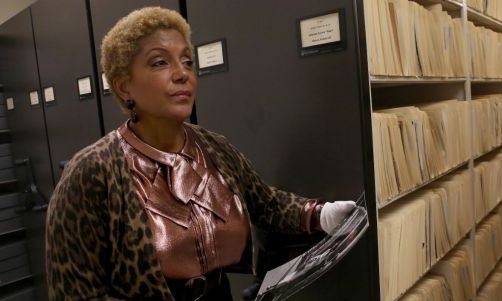
My Root article is here.
MARCH 25th UPDATE: The Black press version of the obit is here and here.


The whole interview.
NAME: Katea Denise Stitt
TITLE: Interim Program Director, WPFW Pacifica Radio in Washington, D.C.
How did you find out about this letter? What was your reaction to it?
My good friend and Jazz historian, William Brower, forwarded the letter to me.
How does it feel to know that Malcolm X knew your father (“they all know me well,” he said in the letter), and that he was one of his favorite artists?
My immediate, visceral reaction was the smile, a huge smile, followed by a bit of melancholy in wishing I could have had discussion about Malcolm X with my father. I was thrilled to read it, not only because he speaks so warmly of my father, but his thoughts on the significant role of music, and that of the musician, were immensely moving. And, of course, the intimacy of a hand-written letter!
Did your father ever tell you that he knew “Detroit Red” and/or Malcolm X? Was it unusual or usual for him to talk about who he knew? And if he did, what did he say about Red/X? Did he tell you about his reaction to Malcolm X’s assassination, 50 years ago this month?
He never told me about knowing Malcolm X, although he did mention The Nation, and Elijah Muhammad, in terms of proper diet, living, etc. He would reference the book “How to Eat to Live” when discussing health with us. He often talked about his friends and contemporaries. Folks like Miles Davis, Dizzy Gillespie, of course, Dexter, Sonny Rollins, Don Patterson, Nancy Wilson, Amina Myers, Milt Jackson, Stan Getz – they were all great friends. Some would come to the house when they were playing town, or sometimes he’d take us to see them perform. While he never spoke of Malcolm’s assassination, my father was progressive and kept abreast of political happenings, especially as it pertained to African Americans, so I’d assume that he was saddened and deeply troubled.
What did you tell your children about this letter, their grandfather and Detroit Red/Malcolm X?
Well, I have a 13 year old daughter, Johanna, and we talk about her grandfather all the time. She is pretty open and receptive, thankfully. I asked her to read it, and share her thoughts with me. She had questions about the other musicians referenced, and who Malcolm was, etc. At the end of our discussion, her words were, “That’s really cool, Mom!”
Did you bid for the letter?
No. I was not aware it was being auctioned. That said, I would hope that whomever possesses it would gift or loan it to a museum where the public could see the actual document.
What is your opinion of what Malcolm X said about music (and your father) in the letter? “Music, Brother, is ours—it is us—and like us it is always here—surrounding us—like the infinite particles that make up Life, it cannot be seen— but can only be felt—Like Life!!! No, it is not created—but like the never-dying Soul—eternally permeates the atmosphere with its Presence—ever-waiting for its Master—the Lordly Musician—the Wielder of Souls—to come and give it a Temple—mould it into a Song. Music without the Musician is like Life without Allah…both being in need of the house—a home—The Temple — the Complete Song and its Creator Sonny & Milt Jackson played together up in Flint, Mich.”
Again, it was so profound, and so deeply personal. It felt a bit like eavesdropping to read it. Music is Life to me, a very sacred experience – I feel this way about all good music, regardless of genre. I completely empathized with this sentiment. To have him refer to my father, and Jazz, no less, in that way is mindblowing to me!!
This month marks the 50th anniversary of the assassination of Malcolm X and this fall marks the 50th anniversary of the publication of the Autobiography. You’re an interim program director at a Pacifica station that plays jazz, so this kind of thing must be very important to you. From your view as a manager of an on-air art forum, what should we remember about Malcolm X AND the artistic vision exemplified by your father, that he praised so well?
Malcolm X is one of my heroes, particularly after his pilgrimage to Mecca, but really, all of Malcolm. To show how you can change your life, and how your transformation to help and uplift others – a constant lesson and challenge for humanity. Through the letter, we get a different glimpse of Malcolm as a cultural icon and thinker, in addition to a political one. His comparison of the Creators of The Music to Life and Allah really speaks volumes as to what Jazz, Great Black Music, if you will, means to us as a people, as a society – national and globally. Simply put, Jazz is sustenance for the soul – beautiful! All of the creators of Jazz, and all music of a higher vibration, empower us to expand our minds, and access a higher spiritual experience or sensibility. This is indeed what we try to do with Music at WPFW. By the way, on February 20th, WPFW will present Malcolm and the Music, based, in part on this letter. I hope folks will listen and certainly offer feedback.
Did you know about this Ahmadiyya movement Malcolm is talking about? If so, what do you know about it? Was your father part of it? Did you know any jazz artists that were a part of it? What did he think of it, and what did/do you think of it? (And is Malcolm referring to something specific to your father when he talks about a “temple” and a “complete song?”)
Unfortunately, I only know the little I’ve read about it, and I don’t know if my father or other musicians were a part of it. I don’t think his words there are specific to my father, but speaking more to The Musician as a key to Life and Liberation – or as he says “…the Wielder of Souls.”
Now, feel free to add or say anything you want below–to answer something I didn’t ask! Someone you want me to try to fit in the article.
It was just wonderful to experience a part of Malcolm X that is not heralded enough in my opinion – his deep love for, and commitment to all humanity. HIs understanding of an interconnectedness, not on this plain, but as a spiritual experience, through music. Certainly, it gave me a new and wonderful perspective on how deep and far-reaching my father’s contributions to music were, and still are.

Selected Letters of Langston Hughes.
Edited by Arnold Rampersad and David Roessel with Christa Fratantoro.
New York: Knopf.
423 pp., $35 (hardcover).
If he were alive today, Langston Hughes would have tried to write this book review as quickly as possible. He had bills to pay (and loans from friends to pay back), so he leapt into the plays, novels and short stories he had to write. Meanwhile, an ever-mounting pile of correspondence awaited him to sort and answer—which he did, often into the late night and early morning.
Luckily for Hughes aficionados, that lifetime’s worth of letters were regularly shipped, from 1940 until his 1967 death at the age of 65, to Yale University’s James Weldon Johnson Memorial Collection of American Negro Arts and Letters. (The idea for the collection was Carl Van Vechten’s, the man history identifies as the white champion of the Harlem Renaissance.) It’s from that massive Hughes output—thousands of letters that date back to 1921, letters that eventually filled 671 boxes—that the reader can see the artist at work.
And it’s almost mostly just his work schedule—with a smattering of self-opining and sometimes-frank opinions of his fellow artists thrown in—that’s absorbed from this comprehensive survey. Hughes’s definitive biographer Arnold Rampersad and literature scholar David Roessel, with help from independent scholar Christa Fratantoro, chose the letters that give as much insight as the often-intangible Hughes chooses to reveal. His most frequent communications, according to this assemblage, were to his literary agent, Maxim Lieber, his publisher Blanche Knopf (the matron of the publishing house that is celebrating its centennial with this book and a re-issue of Hughes’ first-and-still-classic 1926 poetry collection The Weary Blues), his friend and quasi-patron Noel Sullivan, and his best pal and writing partner, Arna Bontemps.
In this book, which mightily struggles to be more than a work ledger, Hughes is almost constantly at work, writing anything from quickie children’s books to newspaper columns to his two autobiographies, 1940’s The Big Sea: An Autobiography and 1956’s I Wonder as I Wander: An Autobiographical Journey. Sadly for the general reader but semi-happily for Hughes, the master poet had a near-obsession with writing a successful stage musical, which would have given him the financial security that eluded him his entire struggling-against-being-a-vagabond life. His attempts to fight being fleeced by racist white producers and playwrights are as tedious as they are outrageous.
Hughes kept everything that interested him. He followed Black newspapers and magazines with great care, and kept track what those periodicals were saying about Black artists, especially him. Periodicals were Hughes’ lifeblood: he sold many short stories, poems and essays to Black magazines such as The Crisis and Phylon and white magazines such as Esquire. Irony abounds in Negro life: Hughes’ Chicago Defender Op-Ed column hit book and stage musical paydirt for with his creation of the character Jesse B. Semple (“Simple”), but The Defender, now having access to cheaper, white columnists, wanted to cut the little he made from it.
With the exception of the musical producers and, not insignificantly, the McCarthy witch-hunters who tried to destroy him in the 1950s, these collective letters display a man’s need to be loved and needed by everyone. He is always attempting anthologies (especially for African writers) and is ceaselessly encouraging his fellow scribes, especially younger ones that he proudly claims as his discoveries, like Margaret Walker (Alexander) and, later, a young Alice Walker (“She is really ‘cute as a button’ and real bright…Mine is her first important publication [and her first story in print], so I can claim her discovery, too, I reckon,” he writes to Bontemps in 1966). For the most part, he holds back his anger and his hurt, and tries to put a positive spin on almost everyone, even the younger, angrier writers—James Baldwin and LeRoi Jones—who criticize him in his later years. The personal outlook matches the professional persona well, since Hughes had to depend on the largesse and kindness of many, many friends and associates in order to survive. The letters are his day-to-day-reality-as-performance, but his romantic life, his sexuality, his personal needs are permanently off-stage, not for even semi-public consumption.
Rampersad’s high biographical standard continues to hold. The annotations alone—of people, places end events that populate Hughes’ almost-countless adventures and misadventures around the world and around New York City—make it worth the time it takes to go through his life, one thought and one year at a time. The introductions to the chronological sections show the trio of writers at their concise, detailed best.
This book can be read on its own, but it is the perfect companion to either of Hughes’ autobiographies, Rampersad’s two-volume biographical magnum opus, or even just a collection of the artist’s poetry. It’s not too obvious to say it is a fantastic addition to the bookcases filled with Hughes’ writing and Hughes scholarship. It is a must for those who want a peek behind the curtain of a Black artist, but don’t need to see too much.
*******
APRIL 11th UPDATE: An earlier version of this review was printed inside here.

……is here.

Okay! Ready!
…..I thought it was time to get out of mothballs the 1978 “King” miniseries, produced and aired on NBC (as a counter to ABC’s “Roots” the year before?).
Very accurate in some aspects concerning King’s life, but LOTS of composite Movement characters, substituting for Jesse Jackson, Bayard Rustin, A. Philip Randolph, C.T. Vivian, Selma, Alabama Sheriff Jim Clark and others. (Ramsey Clark, Julian Bond and Tony Bennett [!] portray themselves. Maynard Jackson, the mayor of Atlanta, played a subsitute of Whitney Young, and Yolanda King played Rosa Parks.) And Malcolm X makes a cameo in 1966 (!) as a substitute for Stokely Carmichael. Between this and “Selma,” filmmakers seem to have a problem with Stokely (Kwame)–so much so that even Malcolm X is preferable.

These three articles were supposed to be posted on a nonprofit’s website sometime last year. The group paid me (and well), but never used them.
So Martin Luther King’s 86th birthday is as good a day as any to post them.
****************************
Part One: Why Race Is A Biological Illusion
With race being such a dominant factor in American life, it is almost confusing to know it doesn’t really exist.
Race is a made-up social category that allows for groups to see and view each other differently, say a group of experts interviewed for this series. There are very few biological differences between blacks, whites, Asians, Latinos, and indigenous peoples, but once the social differences and power relations developed, there was no turning back.
Jonathan Marks, a professor of the Department of Anthropology at the University of North Carolina-Charlotte and a current Templeton Fellow at the Notre Dame Institute for Advanced Study, explains that the idea of race comes from natural historians of the 18th century.
“Given that there are many natural kinds of animals, vegetables, and minerals, what natural kinds of people are there? People were seen in ancient times as varying locally: the people over here look like this, talk like this, act like this, dress like this, eat these kinds of foods; the people over there are different,” he said.
‘There had always been group hatreds—and friendships,” explained Marks. “But it’s not until around 1700 – with the conjunction of the age of exploration, colonialism, and science – that we begin to see the idea that the human species is naturally composed of a relatively small number of relatively discrete kinds of people.
Alan Goodman, a professor of Biological Anthropology at Hampshire College in Amherst, Mass., said that race started as “a European folk idea that took on increased formality, with appeal to the so-called ‘great chain of being’—the idea that everything has its place in nature from lowly animals to angles.”
In the development of Western civilization, European groups fought among themselves for supremacy. The Irish and the Scots, for example, were subjugated by the English. There were different classes within and among European groups.
When Europeans start leaving Europe, this “folk idea” begins to turn ugly, then deadly for Africans and other groups.
For example, the colonists who were the landowners in Colonial America understood that they needed a buffer class against Native Americans and African and other non-white immigrants, according to historian Theodore W. Allen, the author of the two-volume book series “The Invention of The White Race.” So the immigrant European whites—Scots-Irish, Normans, Flemings, to name a few groups—became independent farmers in the New World, he explained.
“The immigrant to whom this opportunity was opened were counted .upon to provide a barrier against external dangers from French and hostile Indian attacks, and against the establishment of maroon centers of freedom and resistance by African-American bond-laborers in the Allegheny Mountains,” Allen writes. “By that time, by a historical transformation…the bourgeoisie had drawn the color line between freedom and slavery and established white supremacy as article one of the Anglo-American constitution. Only European-Americans, as ‘whites,’ were thereafter to be entitled to the full rights of the free citizen, Indians being by definition not ‘white!’” he continued.
This make-shift racial definition also appeared during the Middle Passage, according to Marcus Rediker’s book, “The Slave Ship; A Human History.”
“In producing workers for the plantation, the ship-factory also produced ‘race,’” he wrote. “At the beginning of the voyage, captains hired a motley crew of sailors, who would, on the coast of Africa, become ‘white men.’ At the beginning of the Middle Passage, captains loaded on board the vessel a multiethnic collection of Africans, who would, in the American port, become ‘black people’ or a ‘negro race.’
“The voyage thus transformed those who made it,” wrote Rediker.
So only white groups were allowed to fight for full citizenship in the founding days of America. And sociology and science were abused to keep it that way.
“Interestingly, the most virulent racial science occurs in the U.S. around the mid-1800s and even right after the end of slavery,” Goodman said. “I think because there was such a strong need on the parts of Southern elites (and many others) to ‘prove’ that slavery was not the unjust institution it was.”
Marks explained that it’s understandable that the “illusion” of race is hard to accept because of the visual differences between groups.
“That’s what we mean by race – that we can collapse broad diversity into homogeneity, and that the boundaries of the groups are the products of nature,” he explained. “By the 1730s, Linnaeus, the great Swedish naturalist, is presenting humans as naturally composed of four continental subspecies, color-coded for your convenience as red, white, yellow, and black. It’s not really until the mid-20th century that science—anthropology—seriously starts to question those basic assumptions. And then, like Copernican astronomy, we realized that our predecessors were laboring under an optical illusion.”
“Race is a social concept because it is strongly culturally and historically situated. But a lot of people have trouble grappling with that because, after all, complexion is a biological feature,” he explained.
“I prefer to say that race is a bio-cultural construct,” he argued.
“Race is both about the observation of difference, and the cultural decision about what difference and how much difference it takes to decide that two people belong in different categories, rather than being variants within a single category,” said Marks. “So it’s the conjunction of nature and the cultural process of classification, or biology and meaning. The illusion of race is that it is a set of natural facts, when it is really a set of natural and cultural facts.”
“Consider the things that differentiate us, genetically: for example hair texture, foot size, sexual differences, skin color, blood type, and a propensity for certain heritable diseases, said Freund. “None of them correspond, consistently, with the conventional things that we associate with race, even though some of those are used by people to claim racial distinction, such as using skin color.”
Marks said that more and more people are learning the truth about the limits of racial difference, but too much of Western science is stuck in the past.
“We are getting there, but right now, the cultural prestige of science is a big impediment, because some of it – especially in psychology and genomics – is essentially 21st century technology in the service of 19th century theory. And of course, the politics of racism is still there, and loves it.”
“I’ve just started writing a book called ‘Why is Science Racist?’ that begins with the question, ‘Why is it not acceptable in science to be a Creationist, but acceptable to be a racist?’ Race is very real as a lived experience in a society of inequalities, but is an illusion as a discrete natural category of the human species.”
Marks also explained how American society co-opts race and ethnicity in very interesting ways, especially in the popular culture.
“We see President Obama as a black man with a white mother, rather than as a white man with a black father. Why? Because in American society we have come to accept a cultural rule that anthropologists call ‘hypodescent’ – where two groups coexist with unequal power and status, someone partaking of both ancestries is generally assigned the identity of the lower status group,” he said.
“There are other factors operating, such as that since the 1960s, it has been cool to be ethnic. People who would never have identified themselves as having any Indian ancestry in the melting-pot 1950s, now proudly proclaim themselves as 1/64th Cherokee, or some such. Barbra Streisand made it beautiful to ‘look Jewish,’” Marks added.
Marks also said the decision of the 2000 Census to separate the race question from the one on being Hispanic has resulted in the “racialization of the term ‘Hispanic,’ as a category of language becomes perceived as a category of nature.”
So the terms are shifting because the ideas and the racial demographics are shifting, and what is new is the both a beginning of an acceptance of racial difference and the refusal of it defining day-to-day humanity.
Said Goodman: “What is interesting historically is that we’ve never been a pure country. Indeed, as Cole Porter said, we’ve had ‘the urge to merge’ and have always been crossing racial borders. Now, the speed has picked up.”
****************
Part Two: Why Race Is Not A Social Illusion
The idea that race is a biological fiction is very comforting, at first glance. But how race is interpreted in America in 2014—namely, how the illusion of race become the reality of racism—shows that the fiction has turned into disturbing differences between America’s racial groups.
Examples of how people of color are viewed and perceived individually and collectively, and what resources they get or do not get because of these different perceptions, are littered throughout articles published daily.
Some examples in the last six months [OF LATE 2013 AND EARLY 2014] include:
Late last year [AS IN, 2013], two University of Massachusetts professors published a paper called “Jim Crow 2.0? Why States Consider and Adopt Restrictive Voter Access Policies.” That paper argued that the Republican-led effort in several states to restrict voting by passing laws demanding IDs and proof of citizenship, for example, were almost completely racial in context. The study, which spanned six years, found that the higher population of people of color in a given state, the more bills were passed.
Why do these studies continue to prove that America is a racist nation, when a majority of Americans can accept people of color as their work friends, favorite leading television personalities, heading Wall Street companies, serving as Secretary of State, and even president?
Perhaps social science can help. Because of the way America is constructed—as a multi-racial, multi-ethnic society, filled with different groups and classes—the mind develops subconscious stereotypes that affect how people perceive, and therefore, deal with one another.
The article “Our Unconscious Mind” was published in the January 2014 issue of Scientific American. The author, John A. Bargh, a professor of psychology at Yale University, explains how the mind creates stereotypes in order to function on a day-to-day level.
“Snap judgements—relatively automatic thought processes—abound in our daily life—and for good reason. Outside of the relatively small number of individuals any one of us knows really well, most people we interact with are strangers we might never see again—while standing in line at the bank, say—or others we come across in the course of their jobs—cashiers, taxi drivers, waiters, insurance agents, teachers, and so on,” Bargh’s article’s introduction reads. “The default unconscious perception generates expectations about behavior and personalities based on minimal information. We expect waitresses to act a certain way, which is different from what we expect of librarians or truck drivers. These expectations come to us immediately and without our thinking about them, based only on a person’s social place.
“The unconscious way we perceive people during the course of the day is a reflexive reaction. We must exert willful, conscious effort to put aside the unexplained and sometimes unwarranted negative feelings that we may harbor toward others,” Bargh writes. “The stronger the unconscious influence, the harder we have to work consciously to overcome it. In particular, this holds true for habitual behaviors. An alcoholic might come home in the evening and pour a drink; a person with a weight problem might reach for the potato chips—both easily casting aside the countervailing urge toward restraint.
“Understanding the tug the unconscious exerts on us is essential so that we do not become overwhelmed by impulses that are hard to understand and control,” he continued. “The ability to regulate our own behavior—whether making friends, getting up to speed at a new job or overcoming a drinking problem—depends on more than genes, temperament and social support networks. It also hinges, in no small measure, on our capacity to identify and try to overcome the automatic impulses and emotions that influence every aspect of our waking life. To make our way in the world, we need to learn to come to terms with our unconscious self.”
So, is race a visual way for a person’s subconscious to categorize the world—meaning, the practical, narrow world of the average individual?
If applied to the history and development of race relations in America, that idea in the affirmative makes racial problems permanent if the racially dominant group continues to control all American institutions, keeping “the other” at bay until the dominant group can consciously “see” them in a comfortable, non-stereotypical way.
“One can say race is only a social construct or only an illusion. But this misses the power of that illusion,” explained Alan Goodman, professor professor of biological anthropology at Hampshire College in Amherst, Mass.
“If a society and its powerful institutions believe in something, and, of course, acts on the belief, then the results are real. Race, as lived experience, is very, very real.”
So real, in fact, that racism can become biologically manifest.
A study published in the American Journal of Preventive Medicine states that racism can accelerate aging in African-American men, the University of Maryland recently announced.
“We examined a biomarker of systemic aging, known as leukocyte telomere length,” Dr. David H. Chae, assistant professor of epidemiology at UMD’s School of Public Health and the study’s lead researcher, said in a University of Maryland press release. A shorter Shorter telomere length of the telomere is associated with increased risk of disease and premature death—especially those diseases African-American men disporportionally die from, such as heart disease, stroke and diabetes.
“We found that the African American men who experienced greater racial discrimination and who displayed a stronger bias against their own racial group had the shortest telomeres of those studied,” Chae explained in the press release.
Goodman gave an example that even shows the beginning of Black life as precarious: the black infant mortality rate being twice the amount of whites. “That is deadly real.”
He also pointed out the estimated 10 times average wealth white families have in comparison to their black and Hispanic counterparts. “That is pure institutional racism in action,” he declared.
“Race might be an illusion in that it isn’t biologically real,” argued Goodman, “but race is real until we do not have racial differences in education, employment, and wealth and health.”
****************
Part Three: Activism for Image, Language Part of Solutions
Although America’s systemic racism has not changed, national symbols have. Just ask General Mills.
The company produced an television ad, titled “Just Checking,” that aired in June of last year [as in 2013] that showed an interracial family in a very matter-of-fact way. The commercial wasn’t about race; it was a humorous look at a child’s understanding of how oats are good to eat. The ad shows a bi-racial child dumping Cheerios on her sleeping Dad’s chest after being told by her mother the cereal was heart healthy. The mom is white, and the dad is black.
General Mills had to disable the “comments” section of the ad on youtube because of the racist comments it received.
During much of the 20th century, such a “controversial” ad would be pulled by a conglomerate afraid of racial controversy. General Mills, however, not only refused to pull the ad, but produced a new commercial starring the same family for Super Bowl Sunday, the nation’s major television commercial showcase. The new ad, called “Gracie,” is about a new addition to the family.
Why would the company do this itself, spending at least $4 million to promote intimate interracial relations without being publicly pressured by, say, black activists from ColorofChange.org, the National Association of the Advancement of Colored People or Jesse Jackson’s Rainbow-PUSH Coalition?
“General Mills can see which way the [demographic and political] wind is blowing,” said Jonathan Marks, a professor of the Department of Anthropology at the University of North Carolina-Charlotte and a current Templeton Fellow at the Notre Dame Institute for Advanced Study.
Then again, maybe things have not changed as fast for all people of color. For example, the producers of the CBS sitcom “How I Met Your Mother” had to apologize this year [in 2014] after airing an Kung-Fu movie homage episode that showed some of its main characters in “yellowface.” What makes 2014 so different, however, is that people of color on Twitter immediately respond to this kind of controversy, creating an immediate groundswell of protest.
A major sticking point is public language about racial difference and conflict. For example, affirmative action is referred to as “racial preferences” in the news media, giving the implication that people of color are getting preferential treatment in the nation’s universities and jobs instead of assuring they are considered. And on Capitol Hill “immigration reform” is viewed by Republican congressional representatives and their red-state constituents as giving an unfair and unearned amnesty to undeserving Mexican lawbreakers who are, in the view of the Republicans, stealing into America, stealing American jobs and driving up the costs of social services, such as emergency room care.
(Even the public, mainstream media-generated discussion of “race in America” is hijacked and dominated by whites and blacks, consistently leaving out or marginalizing non-white Hispanics, Asian-Americans, and America’s indigenous peoples. Historically, Latinos are discussed within the context of “immigration,” and Asian-Americans and American’s indigenous peoples are rarely brought up at all.)
In his 2002 book “The Rhetoric of Racism Revisited: Reparations or Separation?” Mark Lawrence McPhail, dean of the College of Arts and Communication at the University of Wisconsin-Whitewater, writes about “the politics of innocence” whites and blacks use when creating purposely neutral, or history-denying, or guilt-creating, terms about race.
This allows a public racial discourse that is clouded by racist ideology in which the identity of victim and the victimizer shifts, depending on which race is doing the arguing and what terms are used, he argued.
What McPhail called for in the book is an end to language that is coded with protests of innocence and historical and cultural denial.
Noel Ignatiev, the author of the book “How The Irish Became White,” argues in his afterword that the word “racism” is useless because it automatically assumes racial superiority and inferiority, including the idea that a race must be “held down” because it is, indeed, the superior one. He prefers the term “racial oppression.”
“I consider the term [racism] useless….The sooner the term is retired, the better it will be for clear thinking all around,” he writes.
But Ignatiev, a major scholar in the field of Whiteness Studies—the study of white racial formation in the world—has also been quoted as saying that the inbred concept of white privilege is the central problem, one that needs to be dealt with for whites to properly relate to non-whites.
“The key to solving the social problems of our age is to abolish the white race—in other words, to abolish the privileges of the white skin.”
His words echo the writer James Baldwin’s, who said and wrote approximately a half-century ago: “As long as you think you are white, there is no hope for you. Because as long as you think you’re white, I’m forced to think I’m black.” This line could be applied to all non-whites.
Marks said that the 21st century has new, distinct battles that are fought over gender and gender orientation, but the frameworks are familiar.
“Eighteen-year olds today have to be told that in 1962 the issue wasn’t, ‘can two people with penises marry one another?’ but ‘can black children and white children even be allowed to go to the same schools?’ It was a different and unfamiliar universe,” he explained.
In 2014, America’s social landscape is complex, and new behaviors will be learned and old ones tested. In February of this year, Michael Sam, a NFL draft pick from the University of Missouri and an African-American, publicly announced he was gay, making him the first prospective professional player of any American sports league to say so. Several sportswriters and commentators have said this makes Sam, in effect, a new type of Jackie Robinson figure.
Marks argued that Americans are still dealing with past definitions, and interpretations, of scientific ideas.
“Ethnicity and gender were two of the major scientific inventions of the 20th century, emphasizing the learned, behavioral expectations associated with race and sex,” Marks explained. “We now recognize the dichotomy as oversimplified, but it’s an important distinction.
“Sadly, though, we live in a society where race is evil and sex is dirty, so it’s common today to have people ask your gender when they want to know your sex, and synonymize race with ethnicity, thus burying the importance of distinguishing the concepts from one another.”