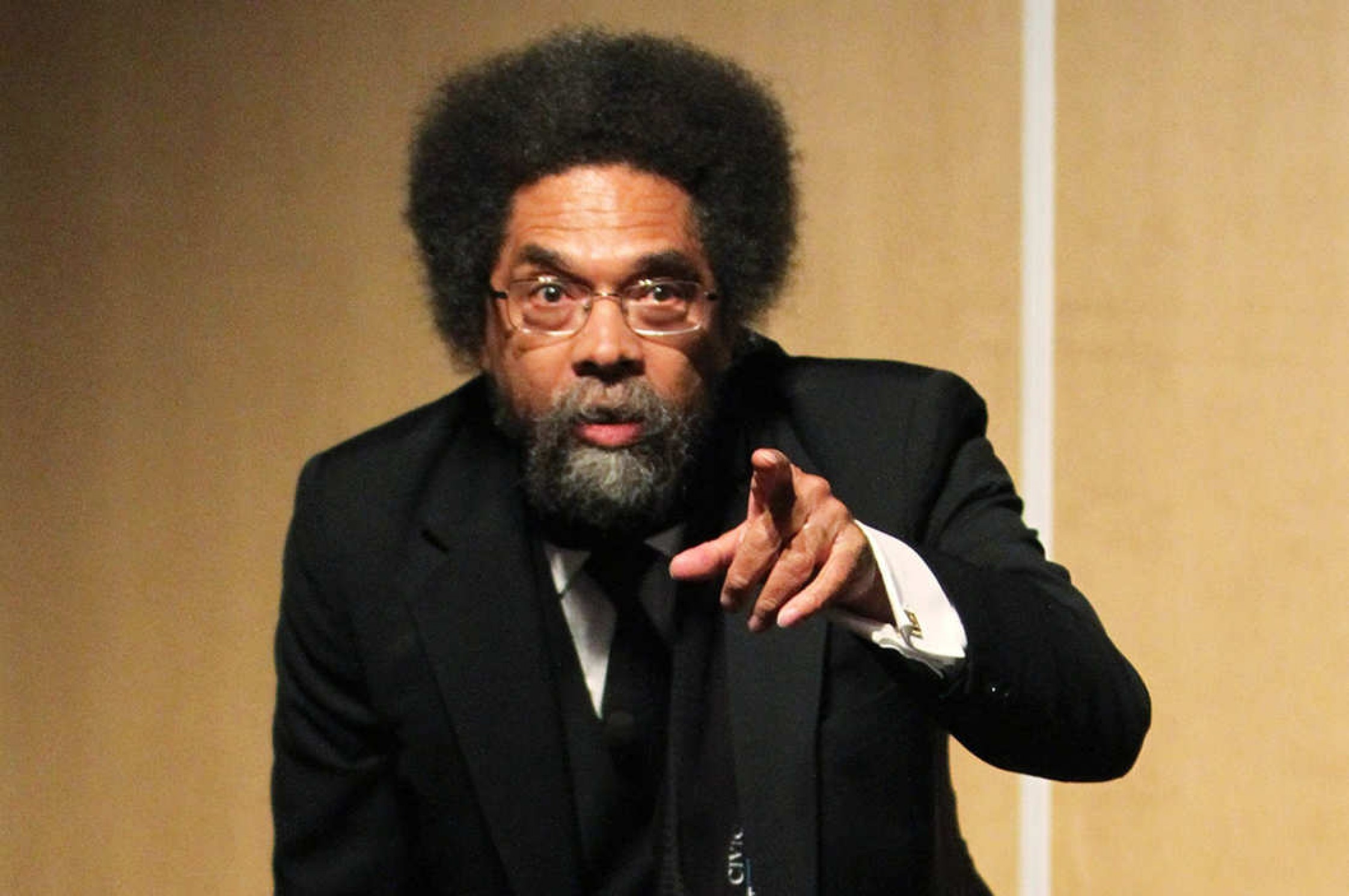
Nothing. But read him, argue with him, think about what he is saying. Accept him. Dismiss him. Say he’s lost it. Think him a hater. Miss him when he becomes an Ancestor, because he stands up and talks loud when others are silent (like when Mumia Abu-Jamal was dying), and gets cuffed with others just talk.
Category Archives: books
Book Review: “Soul!” On Ice: New Book On Pioneering PBS Black TV Show Takes Pale Route To Find Africanized American Culture
It’s Been Beautiful: Soul! and Black Power Television.
By Gayle Wald (with photographs by Chester Higgins).
Durham, N.C.: Duke University Press.
288 pp. $25.95 (trade paperback).
This book understands the right story to tell—one of, in author Gayle Wald’s words, “a fragile alliance of liberal and radical interests, both public and private”–and, thankfully, arrives at the right places. “Soul!” (1968-1973), a nationally distributed public television program that could loosely be described as the radical sister of the more commercial “Soul Train,” fired the imagination and reflected the multi-faceted sensibilities of its Black community of viewers. Using largely untapped wells of research about the early days of American public television vis-à-vis Black America, Wald relates a nuanced story of how the condescension of white American public television officials seeking to provide an outlet for the angry Black community in the late 1960s led to a (largely) Black-controlled showcase of the Black Arts Movement on (largely) Black aesthetic terms. It is the restrained approach, however, of choosing as this book’s scholarship basis intellectual sources outside the “soul” of Black/African folks that makes this book strangely appealing and more than a little irritating.
“Soul!” (episodes of which can be found online) was first a product of Black insurrection. Reacting to that outpouring of anger and violence, white funders, somewhat accidentally, allowed a Black producer, Ellis Haizlip, to have his way. WNET-Channel 13 (now known as Thirteen), then and now the New York-based flagship station of the PBS collective, wanted a companion show to “Black Journal,” its Black newsmagazine. The initial and white idea of a “Black Tonight Show” developed under Haizlip into a Black Arts salon that was cooler than the “The Flip Wilson Show” and Don Cornelius’ large Afro. Wald wisely includes as much of Haizlip’s life story into this book as she can fit. (A documentary film on the “Soul!” producer, done by his niece Melissa Haizlip, is struggling to get funding.) The letters of support “Soul!” received are well used in Wald’s book; they show the involvement of the Black community instead of just describing the appreciation of an audience.
“It’s Been Beautiful” builds somewhat on Devorah Heitner’s “Black Power TV,” a pioneering 2013 intellectual narrative on the early days of East Coast Black public affairs television, and does so with great intellectual gusto. Wald, a professor of English and American Studies at George Washington University, rightly uses the New York-based “Soul!”—a program that would feature, for example, Nikki Giovanni interviewing James Baldwin or a studio performance of The Last Poets, or Earth, Wind and Fire—to find “a key TV text of the era or as a cultural project joined by common cause to 1960s and 1970s political struggles.” The show’s arc matches its era: Martin Luther King, Jr. was killed two weeks before the grant to create the show was submitted, and it was cancelled because PBS’ funders, facing the onslaught of the Nixon era and the fading of the Black Power movement, wanted to create programming that would have Blacks and whites interacting.
Chapters Three and Four—which dissect “Soul!” as a program, along with its performers and producers—are worth the price of the book alone. Wald does not shy away from explaining Black American culture in all its glory and anger. But she doesn’t seem to want to dig into the African, non-Western roots of what she is seeing and describing. She correctly emphasizes the ideological and cultural diversity of the performances, and explores the unity-without-uniformity cultural and political ideology present at the time, but doesn’t want to go in-depth into how Africans in America came to create those products and their ideas in a world drenched in white supremacy and anti-African-ness. Instead, Wald chooses to emphasize the gender and sexual orientation undercurrents of the visual text: “’Soul!’ created a television space where Black people—imagined to include Latinos of various hues who were seeking alternatives to whiteness, Black women marginalized by nationalist conceptions of both the public and private spheres, and Black gays and lesbians rendered as ‘unnatural’ and ‘freakish’—could see, hear and almost feel each other.” For example, she seems more interested in Haizlip’s negotiation of his public gayness than the undiluted African thought processes that produced him and his approach to Black art and the Black community. Wald is not ignorant of African-centered thought; she doesn’t think it’s intellectually relevant enough to examine when quotes from Black Arts Movement stalwarts will do.
The 21st century public television landscape is deeply complicated in ways that this book’s bell-bottom era forecasts. The fact that, for example, on “The PBS NewsHour,” one will find in 2015 occasional in-depth discussions of African and African-American artists and their work is the realization of public broadcasting’s assimilation goals. (After reading Wald, the cross-cultural appeal of PBS’ “Tavis Smiley” could been seen as a page out of a memorandum written by the 1970s PBS executives.) And the 2015 decision by the Sesame Workshop to sell first-run rights of “Sesame Street” to premium cable outlet Home Box Office shows that funding and producing these non-commercial programs are still challenging, even for PBS’ signature programs. So Wald accomplishes with her detail the goal of all scholars: to be both historical and current.
Wald’s and Heitner’s approach to analyzing Black media—focusing on the televisual performance and its socio-political and socio-cultural implications, grounded in European-approved disciplines of American (film) studies, (Black) feminism, queer studies, et. al.—provides both a fascinating read and important scholarship. (Anyone interested in continuing their newly-established tradition should seriously consider studying PBS’ “With Ossie and Ruby,” an almost-forgotten treasure of a Black cultural container similar to “Soul!” in important ways. A study from those perspectives would be fascinating, and perhaps a scholar will one day attempt it.) Ultimately though, Black people need scholarly narratives of these Black cultural television programs from the unapologetic point-of-view of African-centered thought and philosophy.
The End of the FF? Not-So-Fantastic Fourth Try
As you get older, acceptance becomes easier. So, after accepting the tragedy of “Fantastic Four,” this No. 1 FF fan (owned hundreds of comics, cartoons, toys, etc.) has accepted that there will never be a good Fantastic Four movie in his lifetime.
The above is the never-released 1994 first FF film. (Of course, I owned a copy in the VHS days.) The theme music is good, at least!
Book Review: Mumia–Still, Not Stilled
Writing on the Wall: Selected Prison Writings of Mumia Abu-Jamal. Edited by Johanna Fernandez. Foreword by Cornel West.
San Francisco: City Lights.
370 pp., $17.95 (paperback).
If the fight earlier this year for the right of imprisoned writer Mumia Abu-Jamal to get correct care for his diabetes had failed, this book, his eighth, would have been possibly the last he would get to approve under his name. The diabetes complication was not just a shock to his system. There is an insane sense of normality that has now developed around the idea of Abu-Jamal’s work—the assumptions that he is writing, and will be writing frequently, that his commentaries will get emailed around the world, that his recorded voice will be on YouTube. Frankly, Abu-Jamal’s rat-a-tat journalistic contribution would be almost taken for granted if he hadn’t almost died. The ubiquitousness of the author and product shows how much he has succeeded in creating a foothold in Black radical thought in the last 20 years.
And that Panther-inspired bootprint continues here. Following in the steps of Noelle Hanrahan’s 2000 Abu-Jamal column collection “All Things Censored,” Fernandez, an assistant professor of history and Black and Puerto Rican Studies at Baruch College/City University of New York, creates a second unofficial “Mumia Reader” of 107 columns and speeches that span from the former Black Panther Party member’s 1981 arrest for the killing of a white Philadelphia police officer to 2014. The editor takes significant time to explain the how, when, what and why of Abu-Jamal’s essays. She shows that the intellectual scope and depth of Abu-Jamal’s writings precede Hanrahan’s mid-1990s recordings—the ones that, along with a 1995 death warrant and a ready-to-go international anti-death penalty movement, jump-started the “Free Mumia” movement and pushed it straight to the international Leftist stage.
The “new” gems discovered here are, ironically, among his oldest. “Christmas In a Cage,” his rarely read 1981 account of his own arrest and treatment by the police (“Where are the witnesses to the [police] beating that left me with a four-inch scar on my forehead? A swollen jaw? Chipped teeth?”) is worth the price of the book alone.
The editor situates the first few columns in a way that explains him, not just his opinions. Upfront, his love for the MOVE Organization and its founder, John Africa, is clearly articulated, using the 1982 trial and conviction statements he made as an understandably angry young man. (“John Africa is not a slave to this foul, messed up system—he is not bought and sold.”) An example of what he told the court after it decided it wanted his death: “On December 9, 1981, the police attempted to execute me in the street; this trial is just a result of their failure to do so.”
And as the wall writing progresses with a combination of memories, obits and news riffs that, policy-wise, string Reagan to Obama, the reader feels the air from the older Abu-Jamal’s steady, intellectual darts thrown at, for example, the post-911 legalization of COINTEL-PRO under George W. Bush, the devastation that followed Katrina, et. al. Abu-Jamal’s commentaries, taken together, target the contradictions of the established order, pointing to its corrupt nature versus the natural power of people-fueled resistance. (“The objective of all politics is power,” he writes in a 2000 column about the police killing of Amadou Diallo, a Black man shot in his building’s vestibule in New York City. “No major political party in America can even begin to promise Black folks in America the power to stand on their own doorstep[s], or ride their own car[s], or walk the streets of the urban center, without the very real threat of being ‘accidently’ blasted into eternity.”) The book, therefore, is a half-lifetime of well-researched, historically radical Black print rage, from waxing nostalgia about his brief political brush with Huey Newton in and the Black Panther Party circa 1970 to predicting in advance the acquittal of George Zimmerman of the 2012 shooting of Trayvon Martin.
It is now assured that, whatever his future health in prison, Abu-Jamal’s body of work will outlast his actual one. The writer, as Cornel West discusses in the preface, belongs in “that cultural continuum of struggle that shaped urban Black people between 1950 and 1980.” It remains to be seen in a 2015 world of social media if the masses of “Black Lives Matter” Tweeters will develop the skill, discipline and commitment of their now- elder statesman Abu-Jamal, who wrote in the margins of the society decades before it became cool.
Wakanda Is Movie-Designed!
Will The FF Hit Gold This Time?
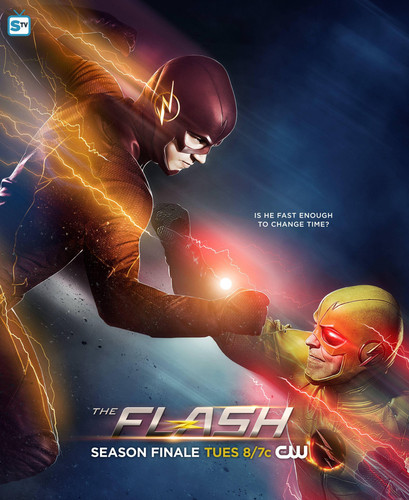
“The Flash” Finale……
………was quite extraordinary. And shocking and sad!
Sorry for the new cliche, but: this show is everything a superhero TV show should be. Twenty-three episodes and its potential is fulfilled. Now it has to stay there for nine more seasons.
The above is more evidence that geeks have won!
(Now onto Season 3 of “Beauty and the Beast.”)
Ava DuVernay To Direct “Black Panther” Or “Captain Marvel?”
Ava + Marvel? Okay, I can see this!
Wow! “Flash”/”Arrow” Universe Spinoff And New One! Wow! (CW’s “Legends of Tomorrow” and CBS’ “Supergirl”)
LOL! Lookit Arthur Darvill (“Rory”) doing HIS Doctor, with long David Tennant-like coat and stuff! LOL! 🙂 Long time to January!
Hmm…..a Black Jimmy Olsen and the return of Calista Flockhart to network television? Not too bad. It’ll move to the CW when CBS screws with it. 🙂
(Everything I liked got renewed: “Marvel’s Agents of SHIELD,” “Agent Carter,” “Arrow,” “Flash,” “Gotham,” and now the above stuff added! That’s a LOT of comicbook network TV!)
Book Review: Within The Cage
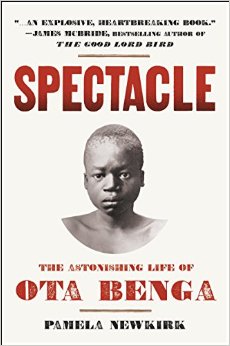
Spectacle: The Astonishing Life of Ota Benga.
Pamela Newkirk.
New York: Amistad/HarperCollins.
304 pp.; $25.99 (hardcover).
It’s the ingredients for a powerful devil’s brew: take white supremacy, slavery and colonialism and mix thoroughly with late 19th and early 20th century zoology, ethnology, wildlife conservation and taxidermy. Sprinkle with Darwin’s theory of evolution and simmer in Greater New York, the precursor to New York City. Simmer. Then pull back the curtain and pour, showing the African—the so-called “pygmy”—on public display in the monkey cage at the Bronx Zoo, all for the sake of greed disgustingly disguised as science.
Written by New York University journalism professor Pamela Newkirk in as dispassionate a tone as can be attempted, “Spectacle” shakes all the way to the reader’s core. The tale of Ota Benga, the Congolese forest dweller—exhibited with other captured people in the 1904 World’s Fair, the symbol of white world progress, and then, two years later, solo at the zoo—crackles with 21st century disbelief, even after taking into account an elementary historical understanding that many Europeans and white Americans for centuries publicly declared Blacks sub-human.
“For the general public [of the World’s Fair], the sight of barely clad, presumably primitive people assembled across the fairgrounds was evidence enough of Caucasian superiority,” writes Newkirk. “The beings whom scientists had described as semi-human, cannibalistic dwarfs were no longer regulated to mythology or to anthropological field notes. The reality—that the delegation comprised captured African children—if considered at all, was understood as merely a means to a scientific end.”
The painful, and painstakingly researched, work of social history goes beyond the surface level of “Whites Only” signs into the bleached hearts of an insecure, psychologically disturbed people who, in the early part of the 20th century, argued over the level of humanity of an African they had caged, failing to see the obvious irony. The efforts of a group of Black preachers to free Benga from his Bronx Zoo cage is prominently noted (as is the intellectual combativeness of the voice of true scientific reason, the anthropologist Franz Boas), but their limited, and relative, access to their own freedom and power dangles in the background.
Because Newkirk had no historical access to Benga, the public sensation via personal violation, she had the challenging task of writing around the man at the center of the monkey cage—the “prey for a merciless hunter.” That hunter’s name is Samuel Phillips Verner, and he is the central subject of this merciless defilement. He proves the old adage that some people in life pose as a friend in order to get into position as a more effective enemy.
Verner is, in many ways, the quintessential unapologetic white man for this type of unapologetically harsh story, fitting the perfect casting call for the benevolent white American liberal who interrupts African life for gold, status and power. He is a liar and thief who camouflages his character through the chronological guises of missionary, then adventurer, and finally an amateur “scientist” and “African expert” in this white world of European and American pseudo-science. In the histories and academic studies written and embedded by white men, he is the man who did well by doing good. Newkirk exposes his decades of shameless, opportunistic motives and behavior in what should be called visionist history.
Belgian King Leopold II’s shadow, and especially the mass graveyards of his uncounted African victims, loom over this work. Benga’s “rescue” by Verner, while the “hero” cuts business deals almost every waking hour, is symbolic of the American complicity in the raping of the continent by Europe. (As Newkirk shows, Belgium’s public relations campaign to get greedy American imperialists on its side—with Verner as one of many leaders—was quite successful, while it lasted.) The public shaming of white supremacy in the Congo by true heroes Mark Twain, George Washington Williams and Booker T. Washington are mentioned, but it is Verner’s ruthless ambitions that solidify the book’s central vortex.
Meanwhile, Benga—who a New York Times editorial charitably described as “a human being, of a sort”—resisted his captors as best he could, being a stranger in an absurd land surrounded by paternalistic friends. One day, he defies the zookeepers by physically fighting them. When he was physically prodded by the rowdy throngs that crowded the park to see him, he struck back. When he was allowed to roam the park, and another horde decided to track him, he fired an arrow at one of the rabble. He pulled a knife against a handler. Later, when he was moved to a museum, he attempted to escape. And finally, now years separated from his village, refusing to ask his former captors for help getting back to the Congo, he does what he must to ease his deepening depression. The author allows Benga’s actions to speak above the crushing waves of this psychologically tortuous history.
The Bronx Zoo, the Smithsonian Institution, the Museum of Natural History, the National Geographic Society and their institutional fellow travelers in quantitative academia—all historic bastions of elite, white male privilege—will have a lot of questions asked by Newkirk’s readers to answer. Complicity in the crimes against African humanity connects like amber waves of grain. “Me no like America,” Benga said from his cage.
Frederick Douglass said in a famous 1852 speech that the United States of America was guilty of “crimes that would disgrace a nation of savages.” This superb book proves that postulate again, right in time for recent, post-modern generations of Americans who seriously need to come to terms with that consistent, historical truth.