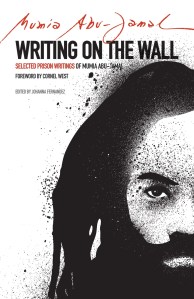
Writing on the Wall: Selected Prison Writings of Mumia Abu-Jamal. Edited by Johanna Fernandez. Foreword by Cornel West.
San Francisco: City Lights.
370 pp., $17.95 (paperback).
If the fight earlier this year for the right of imprisoned writer Mumia Abu-Jamal to get correct care for his diabetes had failed, this book, his eighth, would have been possibly the last he would get to approve under his name. The diabetes complication was not just a shock to his system. There is an insane sense of normality that has now developed around the idea of Abu-Jamal’s work—the assumptions that he is writing, and will be writing frequently, that his commentaries will get emailed around the world, that his recorded voice will be on YouTube. Frankly, Abu-Jamal’s rat-a-tat journalistic contribution would be almost taken for granted if he hadn’t almost died. The ubiquitousness of the author and product shows how much he has succeeded in creating a foothold in Black radical thought in the last 20 years.
And that Panther-inspired bootprint continues here. Following in the steps of Noelle Hanrahan’s 2000 Abu-Jamal column collection “All Things Censored,” Fernandez, an assistant professor of history and Black and Puerto Rican Studies at Baruch College/City University of New York, creates a second unofficial “Mumia Reader” of 107 columns and speeches that span from the former Black Panther Party member’s 1981 arrest for the killing of a white Philadelphia police officer to 2014. The editor takes significant time to explain the how, when, what and why of Abu-Jamal’s essays. She shows that the intellectual scope and depth of Abu-Jamal’s writings precede Hanrahan’s mid-1990s recordings—the ones that, along with a 1995 death warrant and a ready-to-go international anti-death penalty movement, jump-started the “Free Mumia” movement and pushed it straight to the international Leftist stage.
The “new” gems discovered here are, ironically, among his oldest. “Christmas In a Cage,” his rarely read 1981 account of his own arrest and treatment by the police (“Where are the witnesses to the [police] beating that left me with a four-inch scar on my forehead? A swollen jaw? Chipped teeth?”) is worth the price of the book alone.
The editor situates the first few columns in a way that explains him, not just his opinions. Upfront, his love for the MOVE Organization and its founder, John Africa, is clearly articulated, using the 1982 trial and conviction statements he made as an understandably angry young man. (“John Africa is not a slave to this foul, messed up system—he is not bought and sold.”) An example of what he told the court after it decided it wanted his death: “On December 9, 1981, the police attempted to execute me in the street; this trial is just a result of their failure to do so.”
And as the wall writing progresses with a combination of memories, obits and news riffs that, policy-wise, string Reagan to Obama, the reader feels the air from the older Abu-Jamal’s steady, intellectual darts thrown at, for example, the post-911 legalization of COINTEL-PRO under George W. Bush, the devastation that followed Katrina, et. al. Abu-Jamal’s commentaries, taken together, target the contradictions of the established order, pointing to its corrupt nature versus the natural power of people-fueled resistance. (“The objective of all politics is power,” he writes in a 2000 column about the police killing of Amadou Diallo, a Black man shot in his building’s vestibule in New York City. “No major political party in America can even begin to promise Black folks in America the power to stand on their own doorstep[s], or ride their own car[s], or walk the streets of the urban center, without the very real threat of being ‘accidently’ blasted into eternity.”) The book, therefore, is a half-lifetime of well-researched, historically radical Black print rage, from waxing nostalgia about his brief political brush with Huey Newton in and the Black Panther Party circa 1970 to predicting in advance the acquittal of George Zimmerman of the 2012 shooting of Trayvon Martin.
It is now assured that, whatever his future health in prison, Abu-Jamal’s body of work will outlast his actual one. The writer, as Cornel West discusses in the preface, belongs in “that cultural continuum of struggle that shaped urban Black people between 1950 and 1980.” It remains to be seen in a 2015 world of social media if the masses of “Black Lives Matter” Tweeters will develop the skill, discipline and commitment of their now- elder statesman Abu-Jamal, who wrote in the margins of the society decades before it became cool.


 Drums in the Global Village