Mini-Book Review: For Coretta Scott King, A Time To Break Silence

coretta

My Life, My Love, My Legacy.
Coretta Scott King, as told to the Rev. Dr. Barbara Reynolds.
Henry Holt and Company.
368 pp., $30.

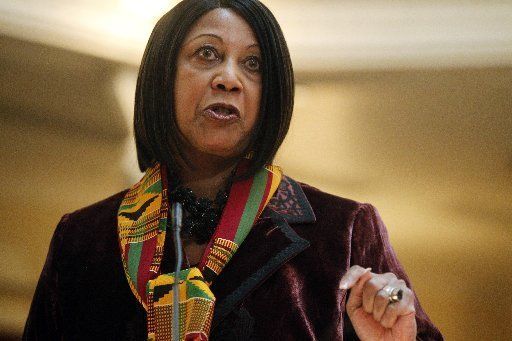
The first First Lady of Black America has a lot to say, particularly since her first memoir, from 1969, was revised, not updated, about 25 years ago. Veteran Black journalist Barbara Reynolds, no stranger to chronicling the Civil Rights Movement, lets Coretta, who died in 2006, be Coretta, and the widow decided that meant turning her life into a Christian fable, a generation-filled testimony of faith and courage. The first half of the book re-hashes her time with MLK, but it’s the second half that awakens the reader from a black-and-white documentary slumber. That second act is where King details her struggles to create the Martin Luther King Center for Nonviolent Social Change in Atlanta, and makes sure to, in a gentle Christian fashion, settle old scores against her husband’s former comrades-in-arms.  So Jesse Jackson, Ralph Abernathy, Hosea Williams and, later, the Black American apartheid activist Randall Robinson, are briefly portrayed as Black men who attempted to deny King the Black leadership mantle she said she inherited from God and Martin. King wanted this book to make clear to history that she was an important part of a dangerous movement for Black liberation (“We forged a rough and blood-drenched road, but Martin never looked for easy victories”). She convinces the reader that she was a well-respected national and international human rights leader in her own right–a Blackish heir to Eleanor Roosevelt, who was dubbed “The First Lady of the World,” and, to a lesser extent, singer-activist Paul Robeson. (Her story is sometimes candid, but other times exactly that, a story: for example, ignoring reams of documented history to the contrary, she claims her husband never cheated on her.) As Black America moves to permanently claim a younger, hipper, actual First Lady, it might be important to remember when thinking about both women that maintaining a public display of dignity–something they both mastered–was not enough; that it was direct, dangerous action against the forces of war, capitalism and white supremacy, accepting a life of risk that Coretta knew all too well, that made real, lasting history.

Un-Hidden Figures, Slightly Broken Fences

hensen

I was bombarded with Black images today, both subtle and powerful. Did a double-feature this afternoon—“Hidden Figures” and “Fences.” The former, part of a new trend of “Black History Month Movies” (I am old enough to remember when these kinds of films were only on HBO) made me choke up, while the latter had me in that August Wilson hypnotic state, where his never-ending flow of working-class words arraigned in profound ways continue to fill the mind until you can’t take any more.

“Hidden Figures” did a good job turning a not-so-routine job transfer from a smaller office into a bigger one into a Civil Rights march. It was a very patriotic movie; I guess it helps greatly if your movie on Black excellence is also about John Glenn and NASA. So this is the Henson Black moviegoers have known about for two decades and white people have not been able to stop talking about for the past two years! For the first time, really, I was attracted to her, and yes, it had everything to do with those glasses and the idea that this film was the closest Black America ever had to having its own version of “A Beautiful Mind” without the mental illness. She and her co-sisters displayed with great power their controlled rage of a unprivileged class. I was interested in how much that film was about their discrimination being gender-based. I kept wondering if that emphasis was part of the story, or was it Hollywood’s way of making everyone (reading: white) comfortable. Comfort and humor were sprinkled throughout this film, and both work.

fences

As for “Fences,” I have only wanted to see this play for 30 years; I am quite grateful for this movietelling. I couldn’t stop thinking as Denzel did his best, How did James Earl Jones did it? I bet he sounded louder, angrier. Viola Davis to me is that Black actress who nails down the “Black woman holler” thing, but she is a rainbow of feeling. Denzel had real challenges, the biggest one being making this play—where the camera almost never leaves the house and backyard—as a movie, a moving picture. He keeps the camera on the words, and hopes that you feel enough to compensate for the lack of visual narrative.

What is great about 2017 is that the dam holding back all of the positive images seems to be more cracked than ever. Yes, only the acceptable images are out. No, the more radical parts of the African-American experience are nowhere to be seen. No, we can’t have one of these “Black History Month” movies without a major white actor headlining (the camera seems to find Kevin Costner whenever it can, like it did when Indiana Jones was in the Jackie Robinson flick). But I must admit it was an absolute joy to be able to finally watch Taraji Penda Henson, Viola Davis (who now needs no more, ah, “Help” to get some more statues 🙂 ) and Octavia Spencer without having to flinch. And Janelle Monáe owns the screen like she’s been acting her whole life. More, please. And I hope Denzel follows through on his goal of producing the remaining un-filmed plays of the Black American Shakespeare (yep, I said it!).

10:59 P.M. EST UPDATE: Congrats to Viola Davis!

46-Word Review of “Star Wars: Rogue One”

untitled

“Magic Negro” in “Star Wars?!?”Booo…… And what about all those people of color on the suicide mission to help the white girl?!? WTF?!?

Other than that, it was very good (not being sarcastic), and I was fascinated by the digital Peter Cushing and Carrie Fisher.

(Here’s Peter Cushing from “A New Hope”:)

My Response To Wei Tchou’s Nation Magazine-Sanctioned, Not-So-Subtle, Attack On Three Black Opinion Journalists at MTV

the-nation

My friend Angel V. Shannon showed me this and this. She gets my public thanks.

My cent-and-a-half:

1) The first thing to remember is that journalism is a TRADE. Anyone has done it, anyone can do it, and now everyone is now doing it. So there are no real “credentials” to being a journalist. Ta-Nehisi Coates is a Howard University drop-out. So, I may add, was Amiri Baraka, one of the greatest writers on Black culture that Black America produced in the 20th century. In his introduction to “The Price of The Ticket: Collected Essays,” James Baldwin talked about how he didn’t even bother going to The New York Amsterdam News because those Negro college boys would have laughed him out the office. Tchou, interestingly, ignores the two-generations-old pipeline that connected Ivy League grads to jobs like hers. (By the way, Farai Chideya is one of those people; Harvard to Newsweek by 25 by 1994.) I guess in Ivy League Land, The Harvard Crimson is “experience,” huh?

Journalism schools were created because the industry was too lazy to train anyone, but needed bodies. I have three journalism degrees, and what I’ve learned from them professionally (from the first two) I could teach in 40 hours or less. As an American journalism historian, I can tell you with some authority (ulp, there’s that word :)) that almost half of the greatest (white, male) journalists of three-quarters of the 20th century had NO degree, never less a “pedigree” (although, some, like George Plimpton and Tom Wolfe, did).

Journalism became a profession in the 20th century because of the MASSIVE need to fill space between advertising. Mass advertising had taken off because of the transfer of people from individual farms to collective cities. The mass audience/market had been born, and content was needed to draw eyeballs (later ears, then, with Tee Vee, the whole thing) to ADS. It was the same reason that

2) “Objectivity” was created. It was created after the Civil War. It was created after 100 years of American viewspapers. Why? For advertising purposes! Creating an “objective,” mainstream media allowed most people to be comfortable with buying the paper to read the advertisements. So both the newspapers owners and advertisers made a pile of money, ,and a WHOLE bunch of people got GREAT careers, travelling the nation and world for decades, with just a bachelor’s degree, decent typing skills and curisoity. They became “prestigious.” This is the real reason why “objectivity” was so cherished.

But what’s really happening here now, right?

3) The walls between mainstream journalism and opinion/literary/cultural/”alternative”/race journalism have been permanently destroyed by the Web 2.0.  The segregated world of the Black press, white press, LGBTQIA press, etc. is, now that we are well into the 21st century, getting both merged and, paradoxically, re-segregated. Dude at MTV wants his version of the old Village Voice, right? Well, the VV had both investigative reporting and identity politics writing. The Nation is crapping on the idea because it is representing all of the white male writers who now can’t get jobs–not because their jobs have been eaten by 2.0., but by these “unqualified” Black people. There ain’t enough room anymore for all of dem anymore (and their core audience is dying off): ergo, the old “unqualified” sting. It was different in the mass media era because there were enough jobs for everyone; not everyone wanted to be Norman Mailer or I.F. Stone when they could be the next Edward R. Murrow or David Halberstam. Whites had real choices, based on their priorities and proclivities. But now things that used to be done just in the “alternative” media have now become fulltime, prestigious jobs. Now, these elite white boys have to go teach English and #$%&–you know, the stuff we, as Black people, had to do all our lives, and still do (Rachel Kaadazi Ghansah, one of the greatest writers on Black American culture in the United States,  is a public schoolteacher; she’s not on welfare, begging The New York Times Magazine, where she contributes, to hire her.

I never forget that Albert Murray had to retire from TWO jobs (the U.S. Air Force and Tuskegee) before he was “discovered” in the late 1960s. It was the same time a 50-something historian and writer who worked, at various times, as a floor manager (read: janitor) for NBC and the operator of a sandwich stand, John Henrik Clarke, finally got a decent professor job at Hunter College.

So it was amusing to read this article, and to find out that Ana Marie Cox, for instance, is now “prestigious,” when I remember her as a 2004 blogger who supposedly upset the political journalism establishment! LOL! (Here’s the image from The New York Times Magazine cover, which showed her as The Next Big Thing. See, she’s white, so that means she can play a new game to get into the old game.) I remember her saying in that 2004 cover story that her goal was to be at MTV. How wonderful when white girls’ dreams come true! I’m sure Lena Dunham is proud! LOL!

In the end, then, this article is about how elite whites are pissed that they can’t get or keep anything for themselves without some “other” coming in and spoiling their frat party. So, no white boys: most of you will not be David Remnick, Thomas Friedman or the white male Gwen Ifill. Boo-hoo-hoo. And having an Asian female writer buffer your racism with an attempt as sophistication doesn’t take away this new truth.