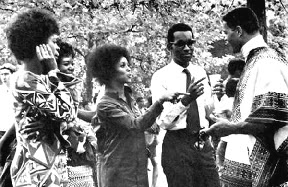
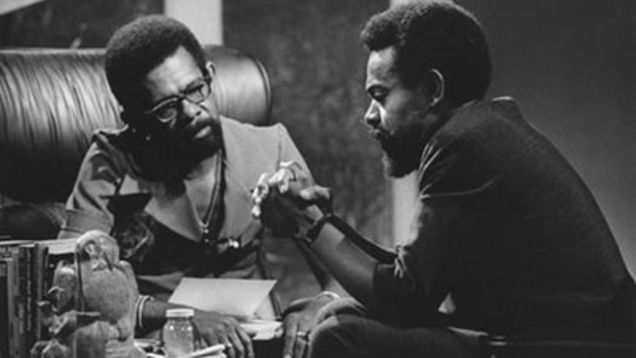
Asante Sana, #TonyBrown of #TonyBrownsJournal

FROM MY 2001 DISSERTATION:

….William Greaves, who was the sole host of the show [Black Journal] by 1970, left that year to focus on his film company. Black Journal did a nationwide search for a new producer/host. It focused on a colleague of Greaves, a Detroit civil rights activist named Tony Brown. A native of Charleston, West Virginia, Brown earned a bachelor· s degree in sociology and psychology and a master’s degree in psychiatric social work at Wayne State University in Detroit. As a local civil rights activist, Brown had featured Martin Luther King in one of his marches. He began his journalistic career writing for The Detroit Courier, a Black weekly newspaper. He hosted a local public-affairs show for WTVS, a public television station. The show, sponsored by the Detroit Junior League, was called C.P.T. (C.P.T. stood for “Colored People’s Time,” a humorous, intra-racial term among many Blacks used to chide chronic Black lateness.) It was the first Black-oriented show on the station. Brown also remained involved in print journalism, publishing The Detroit Sun, a Black magazine.

In 1970, according to Brown, Greaves held a conference of Black public-affairs program producers in Wisconsin. Out of that meeting came the National Association of Black Media Producers, of which Brown, the founding dean of the Howard University School of Communications, was elected president. Brown says as president, he began challenging the licenses to broadcast stations that practiced racial exclusion in 1970, the year that he was appointed as Black Journal host. With major white commercial corporate sponsorship. Brown moved the show to commercial syndication in 1977. where it was renamed Tony Brown’s Journal. Brown’s own Tony Brown Productions produced it, and continues to do so today [in 2001]. Tony Brown’s Journal aired in commercial markets until 1981, when it returned to public television, where the show, hosted, produced and owned by Brown, airs in 2001.

The half-hour program has had several formats and identities in its long history. During the 1970s, dashikis turned into business suits. In the 1980s, the show had a studio audience. In the 1990s — the decade Brown. a longtime neo-conservative, publicly declared himself to be a member of the Republican Party—it adopted a one-on-one talk format. Favorite topics have included Black history and culture, Black economic empowerment in the 1980s and early 1990s and, in the late 1990s, Black empowerment through computers and non-racialized subjects such as the Y2K computer compliance crisis. and alternative medicine. Over the years. major white corporations. including Texaco and Pepsi Cola, have sponsored the program. There have been no studies yet conducted on Brown, his show or his audience. Tony Brown’s Journal has produced–and still updates in 2000–documentaries on subjects such as slavery as well as the life and death of Malcolm X and Martin Luther King. During the mid- to the late-l990s. Brown hosted a talk show on New York radio station 1190 WLIB-AM. Brown remains a community activist with a public involvement in building economic opportunities for Blacks.

He is the only known Black public affairs show television host on commercial or public television to both produce and own his own program. In a 1990 article profiling Brown, Greaves said Tony Brown’s Journal has survived when other Black public affairs shows didn’t because the producers of those shows …would not fight for their survival… If you are a producer and you fight for your show, you are seen as a troublemaker in the mainstream media, thus endangering any future you might have had at the networks.”

*************

I learned a lot about Brown from Roberto Santiago’s “The Outspoken Tony Brown,” published in Emerge magazine, February 1990, pp. 38, and from WABC-TV’s Like It Is, Show No. 762, “The Long-Distance Runners,” March 11, 1990. Like It Is producer-host Gil Noble did a program on Black public-affairs shows. His guests were Brown, Greaves, Gustav Heningburg, the longtime host of WNBC-TV’ s Positively Black and Bill McCreary, executive producer and host of WNEW-TV’s (now WNYW’s) The McCreary Report. In 2026, a new (academic) book about Positively Black was published.

PRESS RELEASE: He Was A Black Power Icon On “Sesame Street.” Then He Was Evicted. A New, Free Online Novel On Medium.com Tells The Full Story Of America’s First Black Muppet.

Forgotten Black-Power-TV icon Roosevelt Franklin, teaching his fellow inner-city Muppets on PBS’ “Sesame Street,” circa early 1970s

February 1, 2024

FOR IMMEDIATE RELEASE

CONTACT: Todd Steven Burroughs (toddpanther@gmail.com/@ToddStevenBurr1)

NEW, FREE ONLINE NOVEL ON MEDIUM.COM TELLS THE STORY OF HOW AMERICA’S FIRST BLACK MUPPET, A SYMBOL OF THE BLACK POWER MOVEMENT, WAS EVICTED FROM “SESAME STREET”

A PEOPLE’S NOVEL: At The Dark End of Sesame Street: The Autobiography of Roosevelt Franklin
(OR
Coup Tube: The Prose Ballad of Roosevelt Franklin)

Roosevelt Franklin, one of the first breakout stars of Sesame Street, has been called “The Black Elmo” but he’s really a Black Power pioneer. It’s why author Todd Steven Burroughs decided to take the plunge and further fictionalize the life of a network TV puppet.

“The more I read about Roosevelt, the more I realize that a puppet actually went through the Black Power experience,” said Burroughs, who, at 56, was part of the first generation of American toddlers to watch the then-brand-new “Sesame Street” on PBS. So it was clear to him that Roosevelt’s “life” had to be explored in-depth.

“Originally I was going to write an article, but that had been done to death already,” said Burroughs, a freelance writer and public historian. “I was going to make it a little different by doing one of those long magazine pieces that would have allowed Roosevelt his first-person segment—a mini-platform to tell his own story—and that idea expanded into this attempt at fan fiction.”

Roosevelt Franklin was created by Matt Robinson, the show’s first “Gordon” (pictured, along with Loretta Long, still the show’s “Susan” in 2024). Decades before “Elmo’s World,” he was the first character to get his own “Sesame Street” segment named after him, “Roosevelt Franklin Elementary School,” a series of skits that had Franklin work as a student teacher at a vibrant, noisy, inner-city school.

Another pioneering power-move: he was the first Sesame Street character to get an album. It was released in 1971 and re-released in 1974.

A mainstay from 1970, the year after Sesame Street began, to 1975, he was even one of the show’s first toys.

 So what happened?

“Roosevelt was a victim, ultimately, of middle-class Black respectability politics,” said Burroughs. “Once I saw his arc and how it intersected, and even mirrored, the Black Power Movement and the problems and paradoxes of racial integration and cultural nationalism, I knew I had to do something a little different, to tell the story I began to see in my own mind—basically write the last Black Power memoir about someone who, pun intended,  wasn’t going to be The Man’s puppet.”

Published in full and for free on Medium.com, At The Dark End of Sesame Street fills in significant gaps in Roosevelt’s story, giving him friends and mentors—some of whom are very well-known in New York’s Black communities in the early 1970s—and, by doing that, tells fun and interesting tales about television, music, and finding a sense of purpose. Along the way, it exposes the internal tensions that are inevitable when a young Black man tries to balance the demands of white liberalism and Black radicalism during the Black Power era.

“The weirdest part for me was writing a story that mentioned both pioneering New York Congresswoman Shirley Chisolm and Big Bird,” said Burroughs, a lifetime student of New York’s Black public affairs television programming and Black radio history. “TV has always created strange bedfellows, and this novel is no different.”

############

Roosevelt and the class, keeping the beat

DISCLAIMER: A PEOPLE’S NOVEL: At The Dark End of Sesame Street: The Autobiography of Roosevelt Franklin (OR Coup Tube: The Prose Ballad of Roosevelt Franklin) is a nonprofit work of fanfiction written and posted for free online consumption, and hopefully enjoyment, under Fair Use. Roosevelt Franklin is a fantasy puppet character created by a real Black man, Matt Robinson, for use by the Children’s Television Workshop (CTW), now known as the Sesame Workshop. Sesame Street is a creation of the Children’s Television Workshop for the Public Broadcasting Service and HBO and is trademarked by Sesame Workshop. The Muppets were created by Jim Henson and the CTW. All Sesame Street Muppet characters are trademarked and copyrighted by the Sesame Workshop. All images, names and likenesses of Sesame Street characters, puppets and PBS actors used in this promotional material and in the novel are done under Fair Use. No copyright nor trademark infringement is intended.

The Abstract For My New Journal Article, Published In The Howard (University) Journal of Communications,…….

…..can be found here.