Tag Archives: Smithsonian Institution
#BreakingTheSoundBarrier Column: On The #Smithsonian and #Slavery: #PresidentTrump’s #DonaldTrump’s #POTUS’s Whitewashing of #USHistory #AmericanHistory #WorldHistory #BlackHistory

Weekly Column
Thursday, August 21, 2025
By Amy Goodman & Denis Moynihan
On Tuesday, President Trump attacked the narrative long taught in US schools and documented in museums, about the abhorrent, centuries-long practice of slavery. He focused on The Smithsonian Institution, the world-renowned center of learning and culture based in Washington, DC.
Trump wrote on his social media platform, “The Smithsonian is OUT OF CONTROL, where everything discussed is how horrible our Country is, how bad Slavery was.”
“How bad slavery was.” It is simply unbelievable that such a statement could be uttered by a president in 2025. Yes, slavery was bad, President Trump. It was evil and remains a stain on this country. We should never stop talking about it.
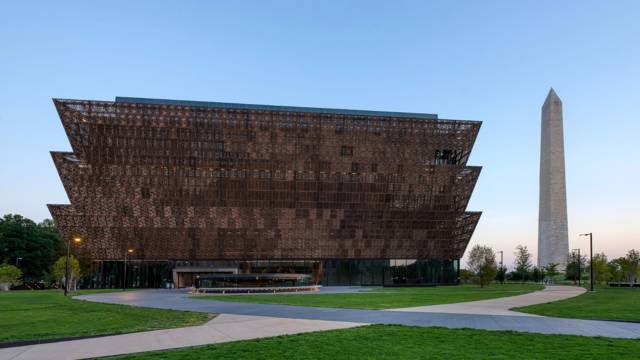
Lonnie G. Bunch III is the 14th Secretary of the Smithsonian, overseeing the entire institution. Prior to that, he was the co-founder of the Smithsonian’s internationally renowned National Museum of African American History and Culture.
Democracy Now! interviewed Bunch in February, 2020, just before the pandemic struck. Bunch described the importance of depicting slavery:
“One of the most important things for me was to talk about the slave trade…I felt that we had to find real remnants of a slave ship,” Bunch said.
“We found the São José. It was a ship that left Lisbon in 1794, went all the way to Mozambique and picked up 512 people from the Makua tribe, was on its way back to the New World when it sank off the coast of Cape Town. Half of the people were lost. The other half were rescued and sold the next day.”
Bunch recalled Trump’s visit to the African American Museum in 2017, at the beginning of his first term as president:
“The first place Donald Trump visited in an official capacity was the museum. I think he was stunned by the stories we told, and there was so much he didn’t know,” Bunch said. “What I realized is that if people who didn’t know but had political influence could come through the museum, I could help them understand, hopefully, something that would change the way they did it.”
Given Trump’s new assault on The Smithsonian, it seems his visit to the African-American Museum didn’t have Lonnie Bunch’s hoped-for uplifting impact.
In late March of this year, Trump issued an executive order targeting the museum conplex. The order alleges that “the Smithsonian Institution has, in recent years, come under the influence of a divisive, race-centered ideology.” The order further creates a committee to review the contents of exhibits for “improper ideology.”
Trump has set the tone, normalizing the rejection of history, of the indescribable horror of slavery in the United States. His loyalists follow suit.
In 2023, Florida Governor Ron DeSantis promoted a revision to the state’s school curriculum, to include instruction on “how slaves developed skills which, in some instances, could be applied for their own personal benefit.” DeSantis defended the offensive guidelines, saying “I think that they’re probably going to show some of the folks that eventually parlayed, you know, being a blacksmith, into doing things later in life.”
Trump’s Defense Secretary Pete Hegseth recently joined a growing Christian Nationalist congregation. The church’s co-founder, Doug Wilson, has written that slavery “produced in the South a genuine affection between the races.” Hegseth has ordered that previously removed statues of Confederate officers be put back, and is restoring Confederate names to military installations that had been recently removed.
The National Park Service has announced that the only outdoor statue in Washington, DC honoring a Confederate, Albert Pike, which was removed following the racial justice protests of 2020, will be restored. Pike was a Confederate general and alleged member of the Ku Klux Klan.
And as Trump has successfully defunded public broadcasting, some are advocating that PBS content be replaced with material from the rightwing media company PragerU. In one clip from Prager already being used in 10 states, an animated cartoon Christopher Columbus is shown downplaying slavery:
“Being taken as a slave is better than being killed, no?”
Annette Gordon-Reed, professor of history at Harvard University, president of the Organization of American Historians and Pulitzer award-winning author, said on Democracy Now!, “It’s an attempt to play down or downplay what happened in the United States with slavery…This is a whitewashing of history.”
With Trump’s all out assault on truth, learning, and the institutions that preserve and curate our collective history, places like The Smithsonian Institution are more important than ever.
“In the era of Donald Trump,” Bunch concluded in 2020, “the museum has become a pilgrimage site, a site of resistance, a site of remembering what America could be, and a site to engage new generations to recognize they have an obligation to make a country live up to its stated ideals.”
The original content of this program is licensed under a Creative Commons Attribution-Noncommercial-No Derivative Works 3.0 United States License. Please attribute legal copies of this work to democracynow.org. Some of the work(s) that this program incorporates, however, may be separately licensed. For further information or additional permissions, contact us.
#DonaldTrump #POTUS47 says #Smithsonian should portray America’s ‘Brightness,’ not ‘how bad Slavery was’
The fact that we still have to explain this in 2025 is disturbing. What we should be “over,” using the conservative panelist’s words, is having to still debate about this.
For Zayid: Some Brief Impressions From My “Blacksonian” Visit
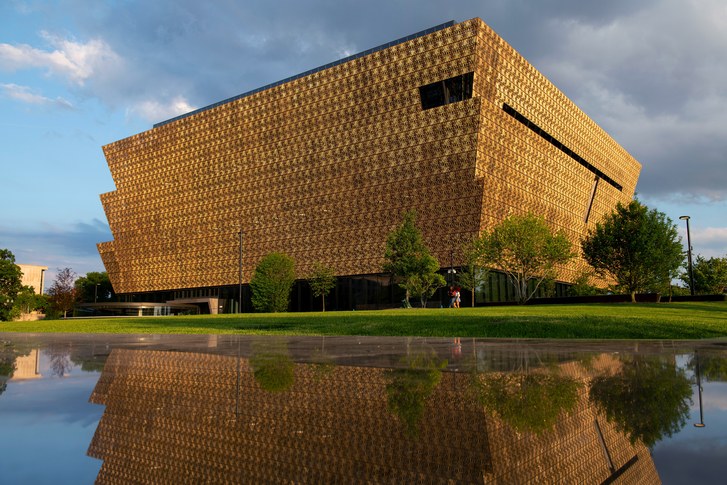
My friend Annette Alston, who signed and sold 40 of her Harriet Tubman books there Sunday, told me Zayid Muhammad–an activist and poet who is a member of the People’s Organization for Progress (as is Annette)–wanted me to write a few words about my impressions of the “Blacksonian.” So, Brother Zayid, this very poor Amiri Baraka imitation/homage is dedicated to you:
*****
This is as much truth as white people can take and give in 2019; of that, there is no doubt. It turned out at least some of them had listened to Baldwin, and perhaps now Coates, and began to at least take the first step toward understanding. Not that I cared about that at first; I had read not one but two highly critical pieces about the NMAAHC in The New Yorker magazine, not exactly a known journalistic forum for Black radicalism. What’s so bad to merit such a harsh Black critique from a white liberal bastion? I came to Dee Cee like a Black Johnny Storm: Hate On!
What I found was eye candy for the Race Man and Woman, a serious feast for all five senses. (The food in the caf… ) The Smithsonian has used all it has learned and has created by all accounts an extraordinarily powerful experience.
So, Sankofa. We go down to the bottom of the historical well in an elevator that makes me, a certifiable geek, think of an African-American TARDIS, and as we move upwards from Africa to Africa-America (hmm!) we are bombarded by photos, documentaries and exhibits. Harriet’s shawl. A slave cabin. Funder-approved themes such as “The Paradox of Liberty” greet us. (Us was in paradox?) “Life and Work.” (Wait, slavery is equivalent to work?) Ulp, no time to think, because now we’ve been emancipated and still we rise.
The Jim Crow era had all you could expect: the coolest segregated lunch counter you will ever see, with interactive video Tony Stark would love. I was all, blah-blah-blah, yeah-yeah, saw-the-movie….and then I went into a corner with a guard out in front of it, should we forget that what lay in state ahead of us was not for cameras. So I disappeared into the corner, cynical as hell, and then it confronted me.
Emmett Till’s casket. The actual one.
My critic’s haughtiness fell off of me like a jacket quickly yanked off. I stared. One minute. Two. Then I had to walk away. I couldn’t look at it. Like a good American, I immediately tried to bury the memory and move forward. But the casket followed me for a long time.
Movin’ on up, I was bombarded by Barack Obama’s voice and face on the big screen. (Of course; reminds me when I heard in 2009 that nonfiction book publishers on Black topics made an edict that every Black nonfiction book had to end with Daddy-O painting the White House Black.) Wait, there’s an Oprah Winfrey Theater in here? Not even stoppin’ to check the part about my birth year, 1968, I refused to be present; I didn’t want to be told that I had overcome because Spike Lee and Queen Latifah have had long careers.
The reason that (two Black writers at) The New Yorker was pissed was that it saw what I saw: a muted historical voice. I walked up to the small but nice Black press exhibit, and it said the same thing I have read millions of times. Malcolm X’s exhibit had nothing about his Pan-Africanism–his trip to 13 African nations as an unofficial Black American head-of-state, his attempt at World African Revolution. I looked in vain for any discussion of Black Marxism. Yes, Kwame Ture was there, permanently frozen as Stokely Carmichael before he split (the American from his mind). A friend of mine who walked around told me he didn’t see anything about the Million Man March. The what? Minister who? There is a high level of sophistication in the air: in the 21st century, Oreos are out and smoothies are in, didn’t you know that?
Ironically, museums and exhibits are not in stone. So let’s grat the Newark brother who built it (’cause this ain’t no con!) but follow The New Yorker’s lead and be as critical as possible. The more criticism, the more the Blacksonian will evolve, the more the white psychic rubber band will be forced to stretch.
FEBRUARY 19th, 2020 UPDATE: Okay, imitating me now–I did go back, and I did go to the top floor this time. Good section on Black radio and impressive collection of Black culture treasures (Wow! The Mothership! :)).
Book Review: Within The Cage
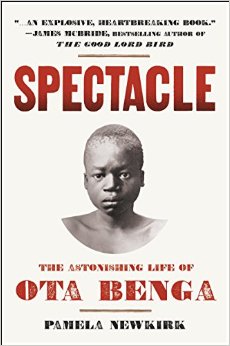
Spectacle: The Astonishing Life of Ota Benga.
Pamela Newkirk.
New York: Amistad/HarperCollins.
304 pp.; $25.99 (hardcover).
It’s the ingredients for a powerful devil’s brew: take white supremacy, slavery and colonialism and mix thoroughly with late 19th and early 20th century zoology, ethnology, wildlife conservation and taxidermy. Sprinkle with Darwin’s theory of evolution and simmer in Greater New York, the precursor to New York City. Simmer. Then pull back the curtain and pour, showing the African—the so-called “pygmy”—on public display in the monkey cage at the Bronx Zoo, all for the sake of greed disgustingly disguised as science.
Written by New York University journalism professor Pamela Newkirk in as dispassionate a tone as can be attempted, “Spectacle” shakes all the way to the reader’s core. The tale of Ota Benga, the Congolese forest dweller—exhibited with other captured people in the 1904 World’s Fair, the symbol of white world progress, and then, two years later, solo at the zoo—crackles with 21st century disbelief, even after taking into account an elementary historical understanding that many Europeans and white Americans for centuries publicly declared Blacks sub-human.
“For the general public [of the World’s Fair], the sight of barely clad, presumably primitive people assembled across the fairgrounds was evidence enough of Caucasian superiority,” writes Newkirk. “The beings whom scientists had described as semi-human, cannibalistic dwarfs were no longer regulated to mythology or to anthropological field notes. The reality—that the delegation comprised captured African children—if considered at all, was understood as merely a means to a scientific end.”
The painful, and painstakingly researched, work of social history goes beyond the surface level of “Whites Only” signs into the bleached hearts of an insecure, psychologically disturbed people who, in the early part of the 20th century, argued over the level of humanity of an African they had caged, failing to see the obvious irony. The efforts of a group of Black preachers to free Benga from his Bronx Zoo cage is prominently noted (as is the intellectual combativeness of the voice of true scientific reason, the anthropologist Franz Boas), but their limited, and relative, access to their own freedom and power dangles in the background.
Because Newkirk had no historical access to Benga, the public sensation via personal violation, she had the challenging task of writing around the man at the center of the monkey cage—the “prey for a merciless hunter.” That hunter’s name is Samuel Phillips Verner, and he is the central subject of this merciless defilement. He proves the old adage that some people in life pose as a friend in order to get into position as a more effective enemy.
Verner is, in many ways, the quintessential unapologetic white man for this type of unapologetically harsh story, fitting the perfect casting call for the benevolent white American liberal who interrupts African life for gold, status and power. He is a liar and thief who camouflages his character through the chronological guises of missionary, then adventurer, and finally an amateur “scientist” and “African expert” in this white world of European and American pseudo-science. In the histories and academic studies written and embedded by white men, he is the man who did well by doing good. Newkirk exposes his decades of shameless, opportunistic motives and behavior in what should be called visionist history.
Belgian King Leopold II’s shadow, and especially the mass graveyards of his uncounted African victims, loom over this work. Benga’s “rescue” by Verner, while the “hero” cuts business deals almost every waking hour, is symbolic of the American complicity in the raping of the continent by Europe. (As Newkirk shows, Belgium’s public relations campaign to get greedy American imperialists on its side—with Verner as one of many leaders—was quite successful, while it lasted.) The public shaming of white supremacy in the Congo by true heroes Mark Twain, George Washington Williams and Booker T. Washington are mentioned, but it is Verner’s ruthless ambitions that solidify the book’s central vortex.
Meanwhile, Benga—who a New York Times editorial charitably described as “a human being, of a sort”—resisted his captors as best he could, being a stranger in an absurd land surrounded by paternalistic friends. One day, he defies the zookeepers by physically fighting them. When he was physically prodded by the rowdy throngs that crowded the park to see him, he struck back. When he was allowed to roam the park, and another horde decided to track him, he fired an arrow at one of the rabble. He pulled a knife against a handler. Later, when he was moved to a museum, he attempted to escape. And finally, now years separated from his village, refusing to ask his former captors for help getting back to the Congo, he does what he must to ease his deepening depression. The author allows Benga’s actions to speak above the crushing waves of this psychologically tortuous history.
The Bronx Zoo, the Smithsonian Institution, the Museum of Natural History, the National Geographic Society and their institutional fellow travelers in quantitative academia—all historic bastions of elite, white male privilege—will have a lot of questions asked by Newkirk’s readers to answer. Complicity in the crimes against African humanity connects like amber waves of grain. “Me no like America,” Benga said from his cage.
Frederick Douglass said in a famous 1852 speech that the United States of America was guilty of “crimes that would disgrace a nation of savages.” This superb book proves that postulate again, right in time for recent, post-modern generations of Americans who seriously need to come to terms with that consistent, historical truth.
 Drums in the Global Village