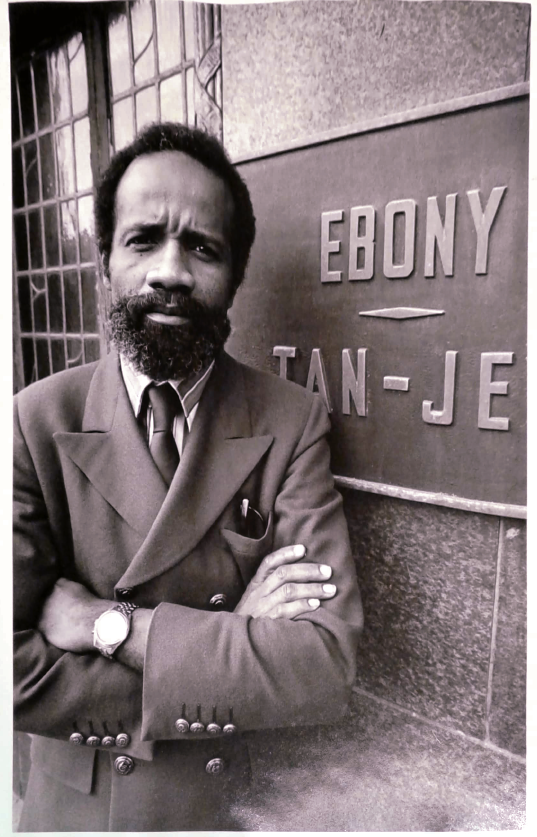
#WABJ Mourns The Loss of Longtime #BlackPress Journalist James Wright

The Washington Association of Black Journalists (WABJ) is deeply saddened by the passing of longtime journalist James L. Wright Jr., a three-decade writer for Black newspapers such as The AFRO-American and The Washington Informer as well as mainstream newspapers such as The Washington Post until his death at the age of 62.

Wright died of natural causes in his Seat Pleasant home, according to The Informer, the newspaper in which he was most associated.

The proud Texan became a pillar in the Washington, D.C. community. Wright covered business, politics and pivotal moments that shaped our city.  DC Mayor Muriel Bower said, “I knew him from my earliest days in government as a strong, fair, and honest writer who cared deeply about his city. Most of all, he loved Washingtonians and telling the stories of the least, the lost, and the left out. His connection to his readers was unparalleled.”

Many of DC’s political leaders on social media remember the dignity Wright put into his work, and the impactful stories he told. Congresswoman Eleanor Holmes Norton wrote on Facebook, “James interviewed me many times over the years as he covered the District with uncommon depth, fairness, and genuine respect for his fellow DC residents.”  Councilmember Janeese Lewis George wrote on X, “He was an extraordinary journalist who truly cared about centering DC history and local stories.”  Councilmember Kenyan McDuffie wrote, “James L. Wright Jr.’s voice was a trusted mirror and a steady bridge across the city. His journalism meant a great deal to our city and its residents, informing daily life, building trust, and sharing the stories that uplifted the very best of our city.”

Wright’s impactful work reached global audiences as he sat down with foreign leaders, including Moammar Gaddafi of Libya and Thabo Mbeki of South Africa. His work expanded across the United States, and all over the world including Afghanistan, Ghana, South Africa, Libya, Zimbabwe, Italy, and the United Kingdom.

At WABJ’s 2025 Special Honors & Scholarship Gala, WABJ President Phil Lewis shouted out Wright for his efforts in lending a helping hand with the gala. Phil Lewis said, “James Wright was a fierce advocate for journalists.  He loved this city and his work. He will be deeply missed.”

Wright joined Alpha Phi Alpha Fraternity, Incorporated, Eta Gamma Chapter at Prairie View A&M University in 1984.  He became a life member of  Alpha Phi Alpha, and served through the Mu Lambda Chapter.  He formerly served as vice president of the Seat Pleasant City Council, and was the church historian at Asbury United Methodist Church in Washington, D.C.

###

Founded in 1975, the Washington Association of Black Journalists is an organization for African-American journalists, journalism professors, public relations professionals and student journalists in the Washington, D.C., metro area. WABJ provides members with ongoing professional education opportunities and advocates for greater diversification of the profession.

https://www.phillytrib.com/obituaries/james-wright-washington-informer-writer-dies-at-62/article_62855e77-730a-4687-8bf9-c6c3ea1a648b.html

Book Mini-Review: The Glossy Raised Fist

Writing history, making history, repeating for generations, then becoming history

Our Kind of Historian: The Work and Activism of Lerone Bennett, Jr.

E. James West.

Amherst and Boston: University of Massachusetts Press, 328 pp., $27.95.

West uses his mastery of the histories of Black Chicago and Ebony/Jet well here, significantly building on and adding to his previous work on the topic. An author explains an author in a wonderful intellectual history that sticks to very exciting facts: Lerone Bennett rises in a rising time, gaining knowledge and experience and pointing them toward what he would call in print the Black Revolution. He transforms himself from journalist to historian, from moderate, Kappa Morehouse Man to Pan-Africanist revolutionary. Absolutely necessary for those who want to understand 20th-century Black press history and, perhaps more importantly, how one “Black-famous” author’s Black history texts–all the outgrowth of one national Black magazine, a 20th-century legend once on every Black American coffee table–were significant weapons in the Black struggle before African-Americans had full access to local and national broadcasting and now international streaming.

New Book On Lerone Bennett Jr. Out Now!

A 20th-century one-of-a-kind, forged and operating during a historical era

I put my request in tonight, and I can’t wait!!!!

“You Know Because You Read The AFRO!” To Gayle King And Others Like You: It’s Really Okay If You Just Lie Next Time :)

Writing this while reading Richard Prince’s Journal-isms column that has people reacting to the idea that CBS’ Gayle King, one of the nation’s top Black journalists, did not know about the lives and work of Ethel Payne and Alice Dunnigan.

Admittedly, I’m not an average person when it comes to the Black press, so I can’t relate. As a ’80s teenager, I read Ethel Payne in real-time in the newspaper I started my career at, The New Jersey Afro-American! (“You know because you read THE AFRO” was the newspaper chain’s motto 🙂 ) My Afro’s Op-Ed page was “national,” not local, and so that meant it was added on to local editions like ours by the Baltimore headquarters. Payne had an Op-Ed column there, “Behind The Scenes.” And because the Black press is so self-referential, whenever she was honored, they’d tell her history. At 22, I had also read the 2nd edition of Roland Wolseley’s The Black Press, USA, a flawed-but-important book that shaped my decision three decades ago to become a Black media historian. Of course it mentions her, as does later a much better general-history book written by historian Clint C. Wilson II.

Yeah, I wish prominent Black people in public would stop being so honest about their ignorance. 🙂 Not knowing something and being rich and famous means you don’t have to know it, right? This means that Gayle King has never regularly read historic/legacy (20th century) Black newspapers!

It’s one thing when David McCullough admitted in 1989, as he did in his PBS’ American Experience intro on William Greaves’ Ida B. Wells film, that he didn’t know who she was, but another when one of us does it!

Don’t think our young Black journalism students are not peeping that because I’ve taught them at HBCUs and I know. (And this is part of a larger, systemic dumping of all media history classes because of J-schools’ well-funded digital focus. When I last checked, Maryland, my grad alma mater, stopped teaching journalism history as separate classes years ago.) Sadly, this public omission proves Gen Z’s irrelevancy point from its perspective.

P.S. Prince reminded me of this, so they’re really little room for excuses.