
I missed this because I was at the MMM.
Liked the below, from Ras Baraka’s Twitter account:
power reveals our limitations and trouble exposes our character
I missed this because I was at the MMM.
Liked the below, from Ras Baraka’s Twitter account:
power reveals our limitations and trouble exposes our character
Boycott Christmas? I have to admit–that’s REAL Black and radical! LOL! 🙂
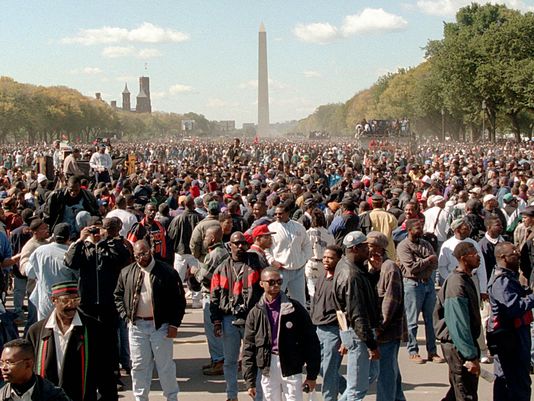
At the 20th anniversary of the Million Man March in Washington, D.C. yesterday, Nation of Islam leader Louis Farrakhan said it was a mass action Blacks could use to punish the whites who enslaved their Ancestors centuries ago and whose police shoot them down in the street today.
Here’s four reasons why what the Minister wants will be difficult to implement:
1) Yes, Black people have buying power, but they don’t have wealth. Black people spend money for the same reasons as every other group–to sustain themselves. And let’s be real: many Christmas gifts are practical items people seriously need.
2) Yes, Black people are angry about the public epidemic of police shootings. But historically, boycotts work when an aggrieved community decides collectively that their interests will be served by the group sacrifice. (See Montgomery, Alabama and Martin Luther King.) If there was an actual, practical end result that was measurable for Black people–an actual gain that, for example, would make them safe in the presence of the police–I believe the people would follow Minister Farrakhan and make the sacrifice. But if not, no.
3) Economic boycotts have to be well-organized. Is the NOI going to spend the millions in organizational support, media advertisements, etc., it would take to organize 40 million people in roughly 40 states? To do it right, it would have to be on the scale of a presidential election campaign.
4) Black people love Christmas–all of it. For many Blacks, all of the X-Mas traditions are as important to them as their churches. (It’s why Maulana Karenga, the founder of modern-day Kwanzaa, set up the holiday between Christmas and New Year’s as an alternative/substitute/supplement to it, because he understood the deal.)
What Farrakhan is asking for, and how he is talking about doing it, is admirable, but without the buy-in (if you forgive the expression) of a substantial part of Black America, the call has all the potency of, say, demanding statehood for the District of Columbia: maybe someday it will happen with a lot of struggle, but not today–and definitely not this Christmas.
*****
Near me a Sigma and a Delta brought their children, who sat on their child lawn chairs, eating and working on a puzzle book. Apologies to Sly and the Family Stone, but….
The Nation of Islam showed that it may be the first Black group to understand that youth must be served by publicly serving. The emcees–Tamika Mallory, a former youth leader for the Rev. Al Sharpton, Nuri Muhammad of the Nation of Islam (who talked about Black people’s war with police, which he called the “Blu Klux Klan” and also with “niggativity”) and upcoming leader the Rev. Jamal Bryant, were presented as emerging leaders, not “youth leaders.”
Farrakhan, 82, was a grandfather talking to his grandchildren. He said what the Nation and the crowd knew: “What good are we if we think we can last forever and not train the young to follow in our footsteps?”
******
OCTOBER 14th UPDATE: My friend Linn Washington Jr. went. Here’s his public take:
Saturday’s Justice march was “powerful” in the words of my 12-year-old grandson. I went primarily to take him so he could experience it – I was there as a participant not a reporter.-But I can report that the 200k participant ‘guess-ta-ment” for the 10/10/15 Justice march is not far off.-That event did not have anywhere near the million+ of the ’95 M3 event…yet there was that spiritual-like ’95 unity vibe albeit not as INtense and focused as 1995.-In ’95 I walked from the Capitol steps back to the Washington Monument to get a scope of the crowd (i knew the media/authorities would lie on the count)…and in ’95 it was a solid sea of men on the Mall spilling into parallel streets. Saturday, the multitude did not have the people-per-square-inch density or Capitol to Monument seamlessness of participants…occupying the Mall only and the distance of a few blocks back. (And, fidelity to fact: I didn’t do the Capitol to Monument stroll on Saturday but could see open space around Monument unlike in ’95)-Below are a few observations from a participant not from a thorough reporter:–Saturday’s event did have a more diverse crowd – 8 to 80, 8 as in eight months old. A striking aspect for me on Saturday was the presence of families (Dad/Mom kids) and extended families lil ones to grands, all rolling as a ‘crew’ – a lot of women were there also…and whites were there (seemingly not on a ‘zoo visit’ attytood)– Saw a few Native Americans but did not see many Hispanics.-Yes, there were a lot, A Lot of 20-30 somethings in the crowd and there were organizations galore in ‘see-me’ attire from black Greeks to the New Black Panther Party.-Of course, in 2015: it was ‘selfie’ city…saw folks popping into the NBPP formation to get their pics taken…-Judging from tee shirts and other attire items, folks came from north/south, east/west to attend.-A few similarities between Saturday & 1995:-Much media coverage was not in-depth…for example, didn’t see mention in articles that I read about the on stage remarks by a sister of Sandra Bland, the father of Michael Brown and the mother of Trayvon Martin — Justice or Else definitely includes police brutality so how can cover an anti-police abuse event and not report on symbols of that struggle???-Another similarity between 1995 & 2015 (and I will probably get my ‘Black Card’ revoked for this observation): Farrakhan talked TOO much. I respect the Brother Minister deeply, but, Yo, cogent and concise hits harder. (Grandson and I toured the entire Smithsonian Native American Museum from top to bottom, beginning visit 15 minutes into Farrakhan’s remarks, we did all four floors of the museum and when we exited Farrakhan was still talking. Interesting seeing [again] how ameriKKKa JERKED the Indians like they jerked us -broken treaties, abusive justice system, LIES aplenty, attacking the victim for opposing their oppression, etc.)-The trip Saturday to Justice or Else for me was about the grandson: He said the event was “really cool.” Said he liked that people “are coming together.” Said he doesn’t want to group up and have to “deal with” brutal cops. He liked “the support” he saw at the march Saturday.
Black public affairs television at its finest!

A. Peter Bailey, veteran of Jet magazine and currently with the Trice Edney News Service, speaks at the Journalists Roundtable. Photo by Sharon Farmer.
I stole this stuff from Richard Prince’s Facebook page. With Sidmel’s death earlier that day, it was a bad day for Black journalists.
Journalists Roundtable, Oct. 6, 2015
UpdatedPhotos (c) by Sharon Farmer
Crown Bakery, Washington, D.C.
Our October roundtable changed topics quickly in response to news the previous day of the resignation of George E. Curry, editor-in-chief of the news service of the trade association for black community newspapers, and one of his staff members.
The National Newspaper Publishers Association had cut their salaries in half and its board chair, Denise Rolark Barnes of the Washington Informer, disclosed that the NNPA board imposed the budget cuts after a decline in revenue and sponsorships prompted by competition from the digital world.
“The drain couldn’t continue,” Barnes said. <http://bit.ly/1FRGfDc>.
Barnes joined us along with roundtable regular Hazel Trice Edney, a former editor-in-chief of the NNPA news service who founded TriceEdneyWire.com.
We also heard from DeShuna Spencer, a social entrepreneur, journalist and the Founder/CEO of kweliTV, an internet video streaming network for the black consumer. She won a $20,000 grant from The New U: News Entrepreneurs. See: <http://unityjournalists.org/news/unity-announces-newu-2014-winners/>.
DeShuna described kweliTV as a “black Netflix,” a phrase she would rather not use since she believes such projects should be described on their own terms. One criterion for adding films to the site is that they have appeared in film festivals.
Denise said it was imperative that black publishers move more quickly into the digital age. “For the last three or four years, we haven’t made any money,” she said of the NNPA websites. The latest difficulties “provide us with an opportunity to get refocused.”
She noted that in June, Apple announced it was looking to hire editors with a journalism background to work on its new app called News it <http://observer.com/2015/06/apple-is-hiring-journalists/>, and yet NNPA members, herself included, have not been contacted. “What perspective are these stories going to have?” Denise asked.
Still, she said, the black press has always been struggling. The first black newspaper was published 50 years before the end of slavery, when most black people were illiterate. Gannett, which publishes the Informer, will no longer be able to do so under its new direction, so that will be another challenge. Yet the black press also steps up to the plate for community activities when needed, again demonstrating its value.
The Informer now sponsors the Prince George’s County spelling bee, since the Washington Post Co. closed the Prince George’s Gazette, the bee’s previous sponsor, in August. The Informer started a monthly section for millennials, WI Bridge, though fewer younger people are turning to newspapers.
However, publishing a newspaper is no longer enough. Advertisers now want digital prowess, Denise said. “Now we’ve got to tap dance and sing,” too, she said.
A surprise was that Denise agreed with mostly everything those in the roundtable said about problems with the black press. Fifteen of us participated, and most had worked in the mainstream media.
Much of the discussion was about how to get companies to recognize their obligation to advertise in the black press, given the number of dollars African Americans spend with those companies. A. Peter Bailey, an author, speaker, journalist and former Malcolm X associate, suggested that publishers make public the number of dollars black consumers spend with certain business sectors. “Let these people see that you’re not doing us a favor,” he said.
Peter added that black publishers should require organizations whose leaders want columns in the black press to make sure their members are reading black newspapers.
Likewise, when Jesse Jackson goes to Detroit this week to discuss diversity within the auto industry and attends Friday’s 16th Annual Rainbow Push Global Automotive Summit, he should raise the issue of advertising in the black press. [Denise said later that Jackson’s automotive report card to be released on Friday will include advertising.]
Richard Prince contended that advertisers and consumers should want the product because it is compelling, not because of a sense of obligation.
Denise agreed, and added that the black press “needs an echo chamber, such as black Twitter.” Peter said the black press should do more on white subjects that affect the black community, such as the Koch brothers. “We’re writing these stories,” Denise said, but they need promotion.
Lynne Adrine said the name “black press” itself is dated. Why not say “black media?” DeShana went so far as to recommend that NNPA change its name to get rid of “Newspaper.” “The whole mindset needs to change,” she said. Richard Prince gave the example of the online-only Q City Metro <http://www.qcitymetro.com/> in Charlotte, N.C., started by Glenn Burkins, who was business editor of the Charlotte Observer. See: <http://mije.org/richardprince/barbering-while-black-clipping-while-hispanic#Burkins>.
“We are somewhat isolated,” Denise said. “My role is to expose our publishers” to these other ideas. “They need to hear what we’ve heard and what’s expected of us.”
Moreover, publishers have to believe in the value of their product.
When Denise asked why black people in the mainstream press who had been laid off aren’t flocking to the black press, roundtable members said that there are cultural as well as professional differences.
Prince said people need to feel that they are working for an organization that is part of the future and forward-looking ways. Consumers don’t want to wait a week for news anymore. The Village Voice and the New Yorker, though weekly print products, now publish daily online. Black publishers must start thinking that way, too.
Denise agreed and said she has been disappointed when she has gone to black press websites for information on breaking news and seen Associated Press copy. That doesn’t advance the purpose of the black press.
In another part of the discussion, Peter Bailey and Hazel Edney insisted that authentic black publications must be published by black people. [Bailey added later that he “refers to White-owned media that attempts to attract Black people or address issues of Black people as ‘Black-oriented media” — not authentic Black media.]
Betty Anne Williams and Richard Prince maintained that the content is what counts to the consumer. A Ta-Nehisi Coates, Prince maintained, is no less authentic because he appears in the white-owned Atlantic.
Hazel said that the social justice tradition of the black press should not be overlooked as a key element in authenticity. She also suggested that NNPA’s board include more people from such corporations as AT&T and Verizon in addition to publishers. Hazel maintained that black newspapers will always exist. “They’ve been here since 1827,” she said.
Referring to the new partnership between NNPA and the National Association of HIspanic Publishers <http://www.prweb.com/releases/2015/10/prweb12991418.htm>, Prince suggested looking into a partnership with the Association of Alternative News Media, whose members include alternative weeklies such as the Village Voice and the Washington City Paper, since that organization has acknowledged a diversity problem. <http://bit.ly/1ifOGh2>.
Denise said was open to the idea, as she has joined other newspaper associations, such as the Maryland, Delaware, DC Press Association. Other black publishers have joined similar associations.
The first roundtable took place in May 1999 with Alice Bonner, Betty Anne Williams, Bobbi Bowman, Richard Prince and Bill Alexander. The purpose was to commemorate Alice’s return to Washington after obtaining a Ph.D at the University of North Carolina, Chapel Hill. Paul Delaney, Jessica Lee and Walt Swanston were also among the early founders.
When Alice left, she asked that we keep the gatherings going while she was gone, and we have. Some of the faces at the dinner gatherings have changed, but the enthusiasm for the fellowship has only grown.

……is here.

…….is here.

It’s a seamless transition from previous productions and an actual awards show that you can watch with your children where big stars actually show up.
They had Rev. Joseph Lowery up there and he’s still entertaining at 94 years old.There’s a real political edge this year that addresses police brutality heavily and that’s all Rev. Al’s work.
A lot of Negus hate on Rev. Al, but they probably sitting there with their kids watching the Trumpet Awards now!!!
Do revolutionary’s eat Fried Chicken???
Um, I guess. Anything else?
I just wanna mention Xernona Clayton, who carried the banner for the beginning for the Trumpet Awards. She deserves all the respect in the world for positioning the show to a place where people like TV One and Rev. Al could take it to another level. Her job was much harder.
Cool. I have a Black Press Fellowship named after her!


 Drums in the Global Village