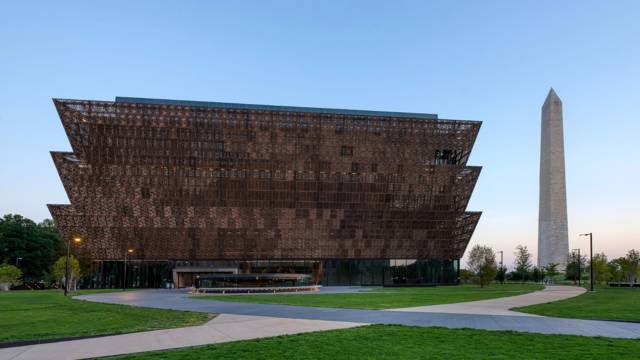
On Tuesday, President Trump attacked the narrative long taught in US schools and documented in museums, about the abhorrent, centuries-long practice of slavery. He focused on The Smithsonian Institution, the world-renowned center of learning and culture based in Washington, DC.
Trump wrote on his social media platform, “The Smithsonian is OUT OF CONTROL, where everything discussed is how horrible our Country is, how bad Slavery was.”
“How bad slavery was.” It is simply unbelievable that such a statement could be uttered by a president in 2025. Yes, slavery was bad, President Trump. It was evil and remains a stain on this country. We should never stop talking about it.
Lonnie G. Bunch III is the 14th Secretary of the Smithsonian, overseeing the entire institution. Prior to that, he was the co-founder of the Smithsonian’s internationally renowned National Museum of African American History and Culture.
Democracy Now! interviewed Bunch in February, 2020, just before the pandemic struck. Bunch described the importance of depicting slavery:
“One of the most important things for me was to talk about the slave trade…I felt that we had to find real remnants of a slave ship,” Bunch said.
“We found the São José. It was a ship that left Lisbon in 1794, went all the way to Mozambique and picked up 512 people from the Makua tribe, was on its way back to the New World when it sank off the coast of Cape Town. Half of the people were lost. The other half were rescued and sold the next day.”
Bunch recalled Trump’s visit to the African American Museum in 2017, at the beginning of his first term as president:
“The first place Donald Trump visited in an official capacity was the museum. I think he was stunned by the stories we told, and there was so much he didn’t know,” Bunch said. “What I realized is that if people who didn’t know but had political influence could come through the museum, I could help them understand, hopefully, something that would change the way they did it.”
Given Trump’s new assault on The Smithsonian, it seems his visit to the African-American Museum didn’t have Lonnie Bunch’s hoped-for uplifting impact.
In late March of this year, Trump issued an executive order targeting the museum conplex. The order alleges that “the Smithsonian Institution has, in recent years, come under the influence of a divisive, race-centered ideology.” The order further creates a committee to review the contents of exhibits for “improper ideology.”
Trump has set the tone, normalizing the rejection of history, of the indescribable horror of slavery in the United States. His loyalists follow suit.
In 2023, Florida Governor Ron DeSantis promoted a revision to the state’s school curriculum, to include instruction on “how slaves developed skills which, in some instances, could be applied for their own personal benefit.” DeSantis defended the offensive guidelines, saying “I think that they’re probably going to show some of the folks that eventually parlayed, you know, being a blacksmith, into doing things later in life.”
Trump’s Defense Secretary Pete Hegseth recently joined a growing Christian Nationalist congregation. The church’s co-founder, Doug Wilson, has written that slavery “produced in the South a genuine affection between the races.” Hegseth has ordered that previously removed statues of Confederate officers be put back, and is restoring Confederate names to military installations that had been recently removed.
The National Park Service has announced that the only outdoor statue in Washington, DC honoring a Confederate, Albert Pike, which was removed following the racial justice protests of 2020, will be restored. Pike was a Confederate general and alleged member of the Ku Klux Klan.
And as Trump has successfully defunded public broadcasting, some are advocating that PBS content be replaced with material from the rightwing media company PragerU. In one clip from Prager already being used in 10 states, an animated cartoon Christopher Columbus is shown downplaying slavery:
“Being taken as a slave is better than being killed, no?”
Annette Gordon-Reed, professor of history at Harvard University, president of the Organization of American Historians and Pulitzer award-winning author, said on Democracy Now!, “It’s an attempt to play down or downplay what happened in the United States with slavery…This is a whitewashing of history.”
With Trump’s all out assault on truth, learning, and the institutions that preserve and curate our collective history, places like The Smithsonian Institution are more important than ever.
“In the era of Donald Trump,” Bunch concluded in 2020, “the museum has become a pilgrimage site, a site of resistance, a site of remembering what America could be, and a site to engage new generations to recognize they have an obligation to make a country live up to its stated ideals.”
The original content of this program is licensed under a Creative Commons Attribution-Noncommercial-No Derivative Works 3.0 United States License. Please attribute legal copies of this work to democracynow.org. Some of the work(s) that this program incorporates, however, may be separately licensed. For further information or additional permissions, contact us.
The march to authoritarianism in the US accelerated on May 9th with another arrest of an elected official by the Trump administration. Mayor Ras Baraka of Newark, the largest city in New Jersey, had accompanied a Congressional delegation to Delaney Hall, a private prison run by GEO Corporation under contract to ICE, Immigration and Customs Enforcement. The delegation included Congressmembers Bonnie Watson Coleman, LaMonica McIver and Rob Menendez, Jr., all Democrats representing districts that include or are near Newark. They went to the East coast’s largest migrant jail to conduct oversight as authorized by law.
They were allowed to pass through the gate, along with Mayor Baraka. There they waited for over an hour. Baraka was told to leave, which he did, moving outside the gate to public property. His subsequent unprovoked arrest was a shocking abuse of federal police power, another clear instance of President Donald Trump and his enablers trying to seize power and crush dissent.
Mayor Baraka was held by ICE for five hours then released, charged with trespass. He is no stranger at the gates of Delaney Hall, as he explained days after his arrest on the Democracy Now! news hour:
“I actually go there every day…I go at 7 a.m. with fire code officials, UCC [Uniform Construction Code] officials, health inspectors, to get in, as it is our right to inspect the facility for them to apply for a certificate of occupancy. We’re in court with GEO right now, because they’re defying city ordinances.”
GEO rapidly ramped up operations at the 1,000-bed jail in order to serve as a major hub for Trump’s mass deportations. Newark sued GEO on April 1st, alleging it “blatantly continues to violate City ordinances and regulations.”
Baraka recounted his arrest:
“When the special agent in charge, Patel [Ricky Patel, Special Agent in Charge of Homeland Security Investigations, Newark] showed up, he escalated the situation. The Congresspeople tried to reason with him, surrounded me inside, and finally got him to agree for me to leave. I left, on the other side of the fence…They arrested me, and the congresspeople and other bystanders tried to shield me from being arrested.”
Homeland Security later issued a press release falsely claiming that “a group of protestors, including two members of the U.S. House of Representatives, stormed the gate and broke into the detention facility. Representatives Robert Menendez, Jr. and Bonnie Watson Coleman and multiple protestors are holed up in a guard shack.” Acting US Attorney for New Jersey Alina Habba, one of Trump’s former personal lawyers, falsely claimed on X that Mayor Baraka “committed trespass and ignored multiple warnings from Homeland Security Investigations to remove himself from the ICE detention center in Newark…NO ONE IS ABOVE THE LAW.”
DHS spokesperson Tricia McLaughlin expanded on the lies, telling CNN Saturday, “There will likely be more arrests coming. We actually have body-camera footage of some of these members of Congress assaulting our ICE enforcement officers, including body-slamming a female ICE officer.”
Congressmember Bonnie Watson-Coleman, who is an 80-year-old cancer survivor, rejected the government’s allegations, saying on Democracy Now!,
“There was no body-slamming. The Department of Homeland Security or the representatives from the administration are doing what they do consistently, and that is to lie and to deflect and to try to create legitimacy for illegitimate things that they are doing.”
So, in addition to arresting an elected city mayor, the Trump administration is now threatening to arrest sitting members of Congress. This makes even more alarming a pronouncement by Trump’s Deputy Chief of Staff Stephen Miller, hours before Baraka’s arrest:
“The Constitution is clear…that the privilege of the writ of habeas corpus can be suspended in a time of invasion. It’s an option we’re actively looking at.”
Habeas corpus is the right of those detained to demand the government justify their imprisonment in court or be freed.
Mayor Baraka, who is running for governor and is campaigning for the June 10th Democratic primary, appeared in federal court on Thursday, pleading not guilty to trespass. Alina Habba demanded a full trial, despite the mountain of exculpatory evidence.
The prosecution of Mayor Ras Baraka, like the prosecution of Milwaukee County Judge Hannah Dugan in Wisconsin, accused of helping an immigrant avoid arrest by ICE agents, and the threatened arrest of members of Congress – all portend a frightening escalation in Trump’s drive to authoritarianism.
Several blocks from the Newark courthouse is Harriet Tubman Square, where in 2023 Mayor Baraka unveiled a memorial to the great Underground Railroad conductor and abolitionist, who escaped slavery and returned again and again to lead others to freedom. Newark has a long history of resistance to oppression, as President Trump and his enablers are about to find out.
The original content of this program is licensed under a Creative Commons Attribution-Noncommercial-No Derivative Works 3.0 United States License. Please attribute legal copies of this work to democracynow.org. Some of the work(s) that this program incorporates, however, may be separately licensed. For further information or additional permissions, contact us.
The Trump administration’s nationwide roundup of international students accused of holding opinions it dislikes is picking up speed, sowing fear, separating families and driving people to go underground or out of the country. This targeting appeals to President Trump and his followers as it bolsters three pillars of the MAGA movement: It attacks universities, long reviled as a source of liberal power; it fuels the anti-immigrant fervor long promoted by people like Trump advisor Stephen Miller; thirdly, by targeting Palestinian solidarity activists on campus, it amplifies the false narrative that criticizing the state of Israel is antisemitic (even though many of the protesters are Jewish) enabling the attacks on academia while providing cover for Israel’s resumed ethnic cleansing in Gaza.
History teaches us that standing by silently as others are disappeared is a failed strategy, as the next person grabbed off the street by masked agents of the state may be you.
Mahmoud Khalil, a Columbia University grad student until last December, was the first arrested, on March 8. He was a legal permanent resident of the United States, with a green card (now revoked). His wife, Dr. Noor Abdalla, is a U.S. citizen who is about to give birth to their first child. Eight months pregnant, she filmed her husband’s arrest as she spoke to his lawyer on the phone. She tried to learn the identities of the arresting plainclothes agents as they dragged Mahmoud into an unmarked car.
Mahmoud joined in the Palestine solidarity protests at Columbia University last spring, and was accepted by both the protesters and administration as a negotiator. He thus had a prominent public role in the first major protest encampment against Israel’s ongoing assault on Gaza, which sparked similar encampments nationwide. This is very likely why he was targeted for deportation. He has been held in an ICE jail in Jena, Louisiana, since March 9. A federal judge has blocked his deportation while his legal team fights for his release.
Days after his arrest, President Donald Trump threatened on his social media site, “This is the first arrest of many to come.” Secretary of State Marco Rubio, addressing the press on March 27, claimed that at least 300 student visas had been revoked.
Names of those targeted have been surfacing day by day.
Ranjani Srinivasan, another Columbia graduate student, left for Canada after her visa was revoked and agents came to her door. She wrote in an open letter, “With the rapidly escalating situation, the criminalization of free speech, and imminent travel bans, what has happened to me can happen to you. … We must exert maximum pressure on Columbia and other universities to protect international students from these arbitrary state actions.”
Momodou Taal, a graduate student at Cornell University and a citizen of both the U.K. and The Gambia, left the U.S. rather than risk deportation or imprisonment. Before leaving, he appeared on the Democracy Now! news hour, saying from an undisclosed location, “What we’re seeing now isn’t just a crackdown on pro-Palestinian speech … but we’re seeing that any criticism of the state of Israel, any criticism of the United States government or Trump’s administration, you can be liable for deportation.”
Those targeted include Columbia students Leqaa Kordia, a Palestinian from the Occupied West Bank, and Yunseo Chung, a South Korean native and green card holder, who has been in the U.S. since she was 7 years old. Rasha Alawieh, a Brown University medical doctor, was deported to Lebanon. Badar Khan Suri of Georgetown University has been locked up by ICE, not for his activism, but likely because his wife, a U.S. citizen and thus not deportable, is an activist.
In one of the most disturbing incidents, Tufts University Ph.D. student and Fulbright scholar Rumeysa Ozturk was snatched off the street outside Boston by half a dozen masked ICE agents as she was walking to iftar with friends, to break the daily fast during Ramadan. The abduction, caught on a neighbor’s doorbell camera, was a chilling demonstration of the brutal tactics being used against this vulnerable population. The day after her arrest, over 1,000 people turned out to protest near Tufts, demanding her release.
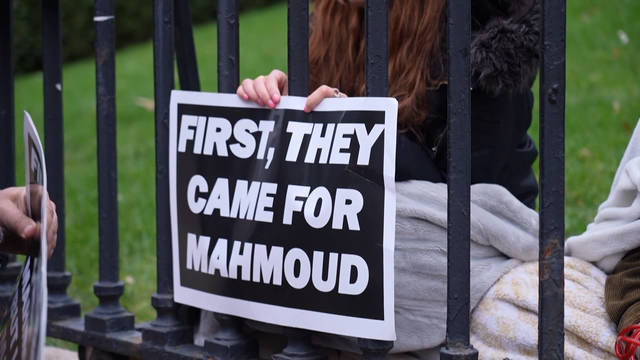
Back at Columbia University, protests continue. On Wednesday, about a dozen Jewish students chained themselves to two campus gates. Aharon Dardik, an Israeli American student, speaking to Democracy Now!, explained why:
“We, as Jewish students … said that we weren’t going to leave until the university named who it was amongst the trustees who collaborated with the fascist Trump administration to detain our classmate, Mahmoud Khalil, and try to deport him.”
Among the signs they held was one that read, “First, they came for Mahmoud,” a reference to Pastor Martin Niemöller’s famous saying from Nazi Germany that ends, “and I said nothing … then they came for me, and there was no one left to speak out.”
The original content of this program is licensed under a Creative Commons Attribution-Noncommercial-No Derivative Works 3.0 United States License. Please attribute legal copies of this work to democracynow.org. Some of the work(s) that this program incorporates, however, may be separately licensed. For further information or additional permissions, contact us.
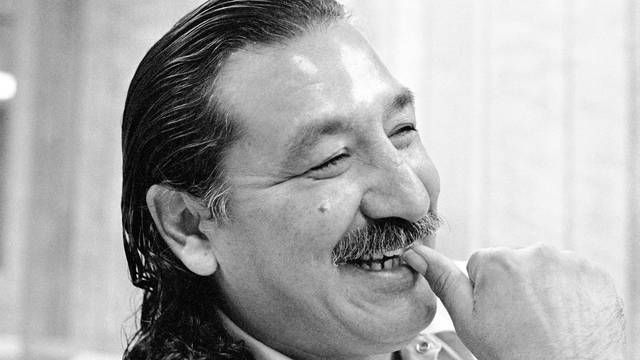
While many brace for the return of Donald Trump to the White House, let’s remember that until Monday, January 20th, #JoeBiden is still president, with all the power that confers. The Constitution grants the president the “Power to grant Reprieves and Pardons for Offences against the United States,” to remedy a criminal justice system riddled with faults. One strong candidate for presidential clemency, as recently called for by Amnesty International USA, is 80-year-old Anishinabe-Lakota elder #LeonardPeltier, who has been incarcerated for close to half a century for a crime he maintains he did not commit. This Thanksgiving weekend, when people across the US enjoy a holiday based on the myth of a shared meal between native people of Massachusetts and the English settler-colonists who would later violently displace them, #PresidentBiden should free Leonard Peltier.
The case of Leonard Peltier encapsulates the modern era of indigenous resistance. After centuries of #genocide launched by #ChristopherColumbus and expanded by successive waves of European settlers, by the 1950s most of the surviving indigenous nations in North America had been contained in isolated and impoverished reservations. Hollywood appropriated, caricatured and monetized the vibrant mosaic of indigenous cultures. Many Native people moved to cities seeking economic opportunity but still faced racism and discrimination. Out of this, and amidst the civil rights and other social movements of the 1960s, the #AmericanIndianMovement, or #AIM, was born.
In 1973, AIM went to the #PineRidgeReservation in South Dakota, where a corrupt tribal government was working in league with federal and local authorities to violently suppress a growing movement to restore traditional practices – and to block extractive industries from exploiting traditional lands. More than 50 Lakota people and their allies were murdered there over a three-year period.
On June 26, 1975, Leonard Peltier was present at an AIM camp on the property of a targeted family. The camp was fired upon by unknown assailants, and the AIM members returned fire. In the ensuing minutes, two FBI agents and one young AIM activist were killed.
Two AIM members were later arrested for killing the agents. At trial, the jury agreed that they had fired in self-defense and acquitted them. Leonard Peltier, arrested later, was tried separately and convicted. Peltier’s trial was marked by gross FBI and federal prosecutorial misconduct, with the coercion of witnesses, fabricated testimony, and suppressed exculpatory evidence.
When Peltier was on trial in 1976, Joe Biden, then a young US Senator, was a founding member of the Senate Select Committee on Intelligence. The committee was created after the explosive Church Committee hearings that investigated the unconstitutional and criminal conduct of the FBI and its “ #COINTELPRO ” operations against civil rights leaders and organizations, including AIM.
A global movement grew, demanding justice for Leonard Peltier. Human rights icons like South African #PresidentNelsonMandela and #ArchbishopDesmondTutu called for his release, as did one of the federal judges involved, and, years later, one of the prosecutors who tried the case.
#AmnestyInternational has campaigned for Peltier’s release for decades. The group recently sent a letter to President Biden, reiterating their demand.
“Over the decades at Amnesty, we have been calling on administration after administration to do the right thing by Leonard. He was in hospital in June, he was in hospital again in October. It’s time to give him a chance to spend his last days with his family and with his community,” Paul O’Brien, Executive Director of #AmnestyInternationalUSA, said on the Democracy Now! news hour.
In late October, President Biden traveled to the Gila River Indian Community in Arizona to formally apologize for the US government’s treatment of Indigenous children forced into boarding schools.
“All told, hundreds and hundreds of Federal Indian Boarding Schools across the country. Tens of thousands of Native children entered the system. Nearly 1,000 documented Native child deaths, though the real number is likely to be much, much higher; lost generations, culture, and language; lost trust. It’s horribly, horribly wrong. It’s a sin on our soul,” Biden said.
Nick Tilsen, executive director of the Indigenous-led NDN Collective, responded on #DemocracyNow!, saying,
“What this means for Indian Country is that we hope that this is the beginning of an era of repair between the United States government and the Indigenous people, the First People of this land…He [Peltier] was in the Sisseton Wahpeton boarding school, in South Dakota. Leonard Peltier and many people who became leaders in the American Indian Movement were boarding school survivors. They came out of that era, and then they resisted.”
If President Biden’s apology at Gila River was genuine, he could demonstrate it by commuting the sentence of Leonard Peltier. It would be a long-overdue gesture to Indigenous people across the US, for which we could all give thanks.
The original content of this program is licensed under a Creative Commons Attribution-Noncommercial-No Derivative Works 3.0 United States License. Please attribute legal copies of this work to democracynow.org. Some of the work(s) that this program incorporates, however, may be separately licensed. For further information or additional permissions, contact us.
“The Message”: Ta-Nehisi Coates on the Power of Writing & Visiting Senegal, South Carolina, Palestine
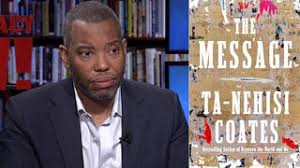
We spend the hour with the acclaimed writer Ta-Nehisi Coates, whose new book The Message features three essays tackling the Israeli-Palestinian conflict, book bans and academic freedom, and the legacy of the transatlantic slave trade. The Message is written as a letter to Coates’s students at Howard University, where he is the Sterling Brown Endowed Chair in the English department. As part of the research for the book, Coates traveled to Senegal and visited the island of Gorée, often the last stop for captured Africans before they were shipped to the Americas as enslaved people. Coates also visited a schoolteacher in South Carolina who faced censorship for teaching Coates’s previous book, Between the World and Me, an experience he says showed him the power of organizing. “That, too, is about the power of stories. That, too, is about the power of narratives, the questions we ask and the questions we don’t,” Coates says of the community’s response.
AMY GOODMAN: Vigils and memorials were held across the globe Monday and this weekend on the first anniversary of October 7th to mourn Israelis and Palestinians who have been killed over the past year. The anniversary comes as Israel is widening its assault on Gaza and sending more troops into Lebanon.
Today, we spend the hour with the acclaimed writer, the journalist Ta-Nehisi Coates, author of the new book The Message, based in part on a trip he took last year to the occupied West Bank and Israel. Ta-Nehisi compares Israel’s apartheid system to that of Jim Crow here in the United States. He writes, “It occurred to me that there was still one place on the planet — under American patronage — that resembled the world that my parents were born into.”
In his book, Ta-Nehisi Coates also writes about traveling to Senegal, where he visited the slave trade memorial at Gorée Island, and going to South Carolina, where school officials tried to ban his book Between the World and Me, which won the National Book Award in 2015.
The Message is written as a letter to his students at Howard University, where Ta-Nehisi Coates is the Sterling Brown Endowed Chair in the English department. The Message is Ta-Nehisi’s first collection of nonfiction work since his 2017 book, We Were Eight Years in Power: An American Tragedy.
Ta-Nehisi, welcome back to Democracy Now! Last time, during the pandemic, you were in another studio, so it’s great to be with you in our New York studio.
I wanted to read one of your quotes: “We are plagued by dead language and dead stories that serve people whose aim is nothing short of a dead world. It is not enough to stand against these dissemblers. There has to be something in you, something that hungers for clarity. And you will need that hunger, because if you follow that path, soon enough you will find yourself confronting not just their myths, not just their stories, but your own.” Ta-Nehisi Coates in The Message.
We’re going to talk a lot about what’s happening in the Occupied Territories, in Gaza, in the West Bank. But I wanted to start where you go in The Message first, and that is to Senegal.
TA-NEHISI COATES: Right.
AMY GOODMAN: Talk about this journey that you actually took with great trepidation.
TA-NEHISI COATES: I did. I did. As you said, you know, we’ll spend a lot of time talking about the Occupied Territories and Israel and the West Bank, but it’s good to start here because the two parts are kind of paired to each other.
African Americans are a group of people who have lived under the weight of an artifice or creation, a kind of mythology of what Africa is in our minds. All of the myths of racism, all the justifications for enslavement, all the justifications for Jim Crow, at the end of the day, they have their origins in these constructions of Africa as this savage place, the idea that, you know, having been brought here, we’re better off — very, very typical of, you know, colonizing and conquering a movement. And one of the things we’ve done to push back is create our own narratives, our own journeys, our own ideas of what Africa is. My very name comes out of that, which I’m very uncomfortable with, as I talk about in the book. And —
AMY GOODMAN: Talk about it.
TA-NEHISI COATES: Oh boy. Oh Lord. I wrote it. I should be very comfortable talking about it. You know, I was born in 1975, and that was a period in time coming out of Black Power, coming out of “Black is beautiful,” like really discovering this idea that our sense of beauty, our nose, our lips, our names, our heritage, we had the right to take control over that, including our history.
And so, my name is an ancient Egyptian name that refers to the ancient kingdom of Nubia. The notion was that, put very, very crudely, that if the West had its kings and queens, if it had its great monuments, if it had its great ideas, so did we. And part of growing older, part of, you know — and I actually talk about this in Between the World and Me — part of becoming a writer, actually, is, like, our job is to be skeptical of clean stories. And I learned that very, very early on. And The Message is kind of a continuation of that.
Of course, the ultimate, I would say, I guess, climax in that journey is going to see the continent itself and moving past myth, moving past the idea of constructed narratives, even when they’re liberatory, even when they’re emancipationist, to see the people themselves. And that is what took me to Dakar. And that is what I think took so long for me to go to Dakar.
JUAN GONZÁLEZ: And in terms of what most surprised you in the trip, could you talk about that?
TA-NEHISI COATES: Yeah. What most surprised me is a thing that will not surprise any African American watching this interview. It was my deep sorrow. It was my deep, deep, deep sorrow. And I think, like, much of what I just said in answer to Amy’s question, I had already intellectualized before I went, and so I was already thinking about this. But thinking about something and being confronted with it is a totally, totally different thing. As the great Mike Tyson said, everybody’s got a plan until they got punched. And as soon as that plane started descending out of the clouds over Dakar and I saw the buildings rising up, I was being punched. It is one thing to think about the Middle Passage, to think about your ancestors theoretically. It is quite another to literally sit on the edge of the Atlantic Ocean and look out and understand that this was, if even only symbolically, last stop.
JUAN GONZÁLEZ: And when you went to Gorée, you decided that you did not want to have any of the tour guides —
TA-NEHISI COATES: No.
JUAN GONZÁLEZ: — that you wanted to wander around on your own.
TA-NEHISI COATES: No, but it —
JUAN GONZÁLEZ: Talk about that experience.
TA-NEHISI COATES: Juan, by then, it was like day three. And so, I understood that as much as I thought I was going to see the continent, I was actually going to see some sort of departed version of myself, you know, from hundreds of years ago. I was walking with ghosts the whole time. And I just — I didn’t want to be talked to.
My family is from the Eastern Shore of Maryland, not too far from Ocean City, for anybody who knows that geography. It’s like right on the Atlantic Ocean. And so, to get back to Senegal, to get to Dakar, which is itself right on the tip of the continent, you know, I would look out, and I would have these moments, and I would say, “My god!” You know what I mean? “There’s part of me all the way on the other side, and then there’s part of me that’s here.”
And so, again, Gorée is a place that has a lot of story and a lot of myth around it. And I had read about that. I thought I was fully prepared. But I’m going to tell you, brother, you get on that boat, and that boat pulls off, and you think about all your ancestors. And it was 7 a.m. in the morning, and I was alone on that boat. And it is a very, very different experience.
AMY GOODMAN: And back to your name, Ta-Nehisi?
TA-NEHISI COATES: Yes.
AMY GOODMAN: And also, which goes to your parents, as well —
TA-NEHISI COATES: Yes.
AMY GOODMAN: — and their influence on you. Your dad, a former Black Panther, ran a publishing — a publishing press right in your house.
TA-NEHISI COATES: Yeah, yeah, no. And I think, like, what they were really trying to do — and this actually goes to the core of what the book is about. How do you tell your own story? How do you free yourself from a history, from novels, from film, from television, an entire architecture that is designed to tell you that you are exactly where you belong because of who you are, because of what you are, either because of your genes, because God said, you know, you belong there? How do you construct something different?
And one of the things I’m trying to confront in the book is, I think perhaps step one is almost to make a mirror image of the people that have put you in that situation: “Well, you say we’re this. We’re actually that.” But I think one of the most difficult things is to free yourself entirely of that structure and to construct your own morality, your own stories, your own ideas, that don’t necessarily depend on those who have put you in the situation to begin with.
JUAN GONZÁLEZ: And the structure of your book is addressed to your students at Howard. The decision to choose that form for your book?
TA-NEHISI COATES: You know, I was, to be honest with you — I have not said this anywhere — I was very worried about that, because I had done that. Like, I had written this letter in Between the World and Me, and I thought people were going to say, “Oh my god, he’s going to do this again. What? Between the World and Me again?”
But the fact of the matter is, I am always trying to achieve intimacy with the reader. That’s the primary job. You know, I would tell my students all the time, “Look, you are dealing with readers who could be doing anything else. They could be on their smartphones. They could be playing video games. They could be watching movies. They could be watching TV, be somewhere making love. They could be doing anything but reading you. And so, you have a responsibility to make them feel a sense of intimacy and immediacy.” And I was lucky in the sense that, you know, these were very, very real conversations that I had had with my students, so I had something to pull from, and also the fact of just the letter form allowed me to do that and allows me to get a kind of intimacy with my reader.
AMY GOODMAN: Talk about George Orwell, “Why I Write,” and —
TA-NEHISI COATES: That’s a great essay.
AMY GOODMAN: — connecting politics and language in the promise you made to your students at Howard. Between the World and Me was written to your son Samori.
TA-NEHISI COATES: Yeah.
AMY GOODMAN: This, to the students.
TA-NEHISI COATES: Yeah. So, we usually start, actually, with “Politics and the English Language.” That’s the first essay that I have them read, you know, just to think about language as a political thing. You know, we live in this world where I feel that oftentimes we are taught — not that everybody subscribes to this — that art lives over here and politics lives over here, and that politics itself is actually very, very limited, that it happens every two or four years — it’s in the voting booth, it’s who you decide to vote for, it’s what issues you decide to activate on. But one of the arguments that I make in The Message is that there’s an entire architecture outside of the world of mean politics that determines how politicians actually talk, the choices they give, you know, etc. Why does Kamala Harris feel the need, for instance, to say that she has a gun? What is that actually based on? And I would say it is based on archetypes of femininity. I would say it’s based on archetypes of race, archetypes of the cowboy. And where do those archetypes come from? They come from our art. They come from our literature. They come from our film, our TVs, our commercials. And at their base, they ultimately come from writing, because somebody has to write those ultimately. And in that world, things that seem separated from politics never really are. And so, I wanted to start that book — or, this book, The Message, with that Orwell quote, because that’s like one of the things he kind of is obsessing with in that essay.
And at the same time, there’s this beautiful tension that I often feel, which is, in a different world, you know, he would just write beautiful stories. He would just play with language for the hell of playing with language. But he doesn’t live in that world. And I don’t feel that my students live in that world. They live in a world of, as we’ll talk about, genocide, apartheid, segregation, global warming, you know, Category 5 hurricanes, flood on one coast, fire on the other. These are immediate issues. And I don’t believe that they, as writers, we, as writers, have the luxury of sort of sitting back in our salons and in our living rooms simply constructing beautiful language for the hell of constructing beautiful language. It has to be engaged with something.
JUAN GONZÁLEZ: And, Ta-Nehisi, from Senegal, you take us to Columbia, South Carolina. Why that choice?
TA-NEHISI COATES: Well, I was writing this in a time where this wave of book bannings was happening. And I always wanted to write about that, but I felt that — I was worried about making the writer the center of the book banning, because even though the work is directed at the writer, the writer is actually not the person that suffers under the book ban. The teachers suffer under the book ban. It’s the teachers who are under threat for losing their job. It’s the teachers who get harassed. It’s the librarians who are under threat of losing their jobs, the librarians who get harassed. It’s the students who lose the ability to have access to different worlds and different ways of thinking. And I was trying to figure out how I could write this in such a way so that I would not be the center of it.
Luckily, you know, I ended up in conversation with a teacher by the name of Mary Wood from Chapin, South Carolina, went to Chapin High School, where she teaches and where she was trying to teach Between the World and Me and got into some amount of trouble for that. And she invited me down, you know, just to go to a hearing. And that’s what I did. And it was quite eventful. It was not the world that I expected. It was not the audience I expected. It was interesting to see how much support actually was rallied behind her, even though she’s in a deep red area in a deep red state. And so, that, too, is about the power of stories. That, too, is about the power of narratives, the questions we ask and the questions we don’t.
AMY GOODMAN: You write, in The Message, about this experience in South Carolina, “I see politicians in Colorado, in Tennessee, in South Carolina moving against my own work, tossing books I’ve authored out of libraries, banning them from classes, and I feel snatched out of the present and dropped into an age of pitchforks and bookburning bonfires. My first instinct is to laugh, but then I remember that American history is filled with men and women who were as lethal as they were ridiculous.”
TA-NEHISI COATES: That’s right.
AMY GOODMAN: Now, if —
TA-NEHISI COATES: We got one running for president right now, you know? Lethal and ridiculous.
AMY GOODMAN: Well, you talk about the area you were in, 70-30 split, 70% for Trump. And yet — and this is what you were just talking about — this 30%, how surprised you were by the minority, the power of it when it’s mobilized.
TA-NEHISI COATES: Yeah. You know, it’s like one of these things. Like, again, like, this goes back to how we construct language. It’s either a blue or red district, right? Even purple doesn’t quite, like, carry the quite — you know, like the real context. They think it’s red. OK, battle’s over. Why am I here? You know? But 30% — if 30% activated around an actual issue, it’s actually a lot of people. You know what I mean?
And it was like — like, I could not have known that without seeing it. Like, you have to — and this is, like, one of the messages I have for my students in the book. You have to walk the land. You can’t sit on your butt reading reports — you know what I mean? — and even reading books like this one, and say, “Hey, I’m going to be a writer.” You have to have actual experiences. And so, I have to walk in that room and meet this white woman in her seventies, you know, who tells me, in the wake of George Floyd, “We organized a reading group at our church for Black authors, and I love Colson Whitehead. Oh my god! Have you read him?” You know, like, I have to have that experience with somebody. You know, I have to have that shock, you know? And so, I just feel like it was, like, really, really important in The Message to actually model the work that I was articulating or model the lessons that I was actually articulating for my students.
AMY GOODMAN: When you just referred to President Trump, can you elaborate further?
TA-NEHISI COATES: He looks ridiculous, but he is in fact quite lethal. You know? And I think, certainly in 2016, there was great, great temptation to laugh. You know what I mean? You hear these things, you know, you hear him say certain things, you see him in certain places, and there’s a kind of dismissiveness. But what we actually are dismissing is a kind of darkness that I think lurks deep, deep within all of us and can actually be appealed to. It’s not comfortable to say that you can win through hate. It’s not comfortable to say that you can win through anger. It’s not comfortable to say, historically, it actually has been very effective, electorally, to pick out weak people or people who are not in the most advantaged political space and to demonize them and use them as a tool, that that actually has been quite effective for people in pursuit of power. We would rather think that good wins all the time, that people see the best in each other. It reifies our notions of what America is, our stories that we tell ourselves of what America is, but it doesn’t correspond with the actual history and the truth.
Ta-Nehisi Coates: I Was Told Palestine Was Complicated. Visiting Revealed a Simple, Brutal Truth
As the war on Gaza enters its second year and Israel expands its attacks on Lebanon, we continue our conversation with the acclaimed writer Ta-Nehisi Coates. His new book, The Message, is based in part on his visit last year to Israel and the occupied West Bank, where he says he saw a system of segregation and oppression reminiscent of Jim Crow in the United States. “It was revelatory,” says Coates. “I don’t think the average American has a real sense of what we’re doing over there — and I emphasize ‘what we’re doing’ because it’s not possible without American support.”
AMY GOODMAN: This is Democracy Now!, democracynow.org, The War and Peace Report. I’m Amy Goodman, with Juan González.
Last night here in New York, hundreds of activists — Jewish and Jewish allies and Palestinians — rallied in Union Square for a vigil on the first anniversary of October 7th to mourn Israelis and Palestinians who have been killed and to call for an end to the Israeli massacre in Gaza and beyond. People performed prayers. There were rabbis there. And they read out the names of those who have lost their lives. One of those who spoke, I talked to afterwards, Eva Borgwardt. She is a spokesperson for the group IfNotNow.
AMY GOODMAN: Right now people are wearing signs that say “No U.S. money for bombs.” And talk about the motto of this October 7th vigil.
EVA BORGWARDT: So, the motto is “every life a universe,” and it’s from ”pikuach nefesh,” which says that to destroy a life is to destroy an entire world, and to save a life is to save an entire world. And our government is not treating every single life as a universe. They’re treating Palestinian lives as less sacred.
AMY GOODMAN: How did you get so involved with this issue?
EVA BORGWARDT: I got involved through the Ferguson uprising. And I was watching Black and Palestinian activists trading tips on Twitter about how to deal with tear gas, and it became clear that Palestinians in the West Bank are facing a military charged with policing, and Black Americans are facing a militarized police force. And that was my entry point, where I said, “I need to organize my community,” which was unable — or, which was limited in being able to show up for the civil rights fight of our time, for the Black Lives Matter movement, because they were upset about the messaging for a free Palestine in those protests. And so, I’ve spent the last 10 years of my life working on building the movement of Jewish Americans who are calling for equality, justice and a thriving future for all, no matter where people live.
AMY GOODMAN: That’s Eva Borgwardt of the group IfNotNow, one of hundreds of people here in New York City in Union Square for two large rallies on the anniversary of October 7th. Our guest today is Ta-Nehisi Coates, the prize-winning journalist and author of the new book, The Message, in part about a visit he took last year, organized by the Palestine Festival of Literature, PalFest, to the West Bank and Israel. Talk about this whole journey you took. You were part of the PalFest, and then you also stayed.
TA-NEHISI COATES: Yeah. And I guess, to be honest, my journey began 10 years ago, when I published “The Case for Reparations.” And there was a section — again, as a writer, as a journalist, you’re always trying to make people feel things, make things real. And there was a section where I offered an analog for reparations, for how it could possibly look. And it was from West Germany to the state of Israel — and I need to be very specific about that — not to Holocaust survivors, but to the state of Israel itself. And that part of that essay came under quite a bit of critique — and what became clear to me was, deservedly so. It took 10 years for me to get it fixed, because writing takes a long time, you know? But I knew I had to — like, that I was going to have to go at some point. You know, I knew it wouldn’t be enough for me to, you know, appear at a rally, do a slogan, whatever.
And long story short, I began talking to PalFest in 2016, finally got there in 2023, just in time for The Message. I spent five days with them, mostly traveling through the Occupied Territories and through East Jerusalem as a Palestinian would, getting a sense of what their daily life was. And then, the next five days I spent mostly in the company of a group called Breaking the Silence, former IDF veterans who are against the occupation, and I saw the country largely through the views of an Israeli, how they move through the world, how they move through Jerusalem, how they move through the roads. But I also, again, spent a lot of time actually talking more to Palestinians.
It was revelatory. It was — I don’t think the average American has a real sense of what we’re doing over there — and I emphasize “what we’re doing” because it’s not possible without American support. I have heard people say over and over again, “There are great evils happening the world, states across the world perpetrating evils against whole groups of people. Why pick on Israel?” And the thing I say is, “I’m an American. This is the thing that we have our fingerprints on.” Those bombs over Gaza, the planes that drop bombs on Gaza, the plaques that I saw, for instance, in Jerusalem, all of that is America. And we are going around the world propping ourselves up as the font of democracy. We are going around the world propping Israel up as the only democracy in the Middle East. This is a deep, deep fiction, a very, very dangerous fiction that must be addressed. And that’s what I tried to do in the book.
JUAN GONZÁLEZ: You write in the book, quote, “It occurred to me that there was still one place on the planet — under American patronage — that resembled the world that my parents were born into.” Can you elaborate?
TA-NEHISI COATES: Yes. And I think I talked about it the last time I was here, actually. These are the words I have even now, and they are probably insufficient to what a Palestinian would offer who experiences this, but the words that come to me are “segregation.” When you are on the West Bank, there are separate roads. There are roads for Israeli settlers and citizens of Israel, and there are roads for Palestinians. These roads are not separate and equal; these roads tend to be separate and unequal. It tends to take longer to get where you want to go if you’re a Palestinian. If you enter a city like Hebron, for instance, Hebron is quite literally segregated. There are streets that Palestinians cannot walk down. There are streets that Israeli settlers are given complete and free movement of. Moving throughout the West Bank in general, there are checkpoints everywhere for Palestinians. These checkpoints are sometimes normal checkpoints that they know are there. Sometimes checkpoints appear out of the blue, what they call flying checkpoints. Your basic movement is constantly in peril.
The justice system, which is deeply familiar for African Americans today, is quite literally segregated. There is a civil justice system that the minority of Israeli settlers, as Israeli citizens, enjoy, and then there is an entirely separate justice system that Palestinians on the West Bank are subject to. You can be arrested, for instance, as an Israeli citizen, and you are, you know, due all the due rights that we are familiar with. You have to be told what the charges are, etc. If you are arrested as a Palestinian, you can just be taken. In another political context, we would call those hostages, because nobody has to say why you’re taken, nobody has to say what you were taken for, nobody has to inform your family. You are under the jurisdiction of the military.
It has been this way since 1967. And the word we use for that is “occupation,” which is a kind of a deeply vanilla word that does not actually describe what is going on. How a country that maintains this separate and unequal system, how a country that does not even allow the, quote-unquote, “Palestinian citizens” of the state full equality with its Jewish Israeli citizens is allowed to refer to itself as a democracy is a mystery to me. And the closest analog I can think of is the time in which the United States of America referred to itself as a democracy even as it was disenfranchising whole swaths of Black people in the Southern states. And so, when I say Jim Crow, when I say segregation, that is because that is the period that immediately comes to mind for me.
AMY GOODMAN: Talk about being stopped by an Israeli soldier, Ta-Nehisi.
TA-NEHISI COATES: Oh, well, we were stopped all the time, to be clear, you know, because we were on the roads. We were constantly stopped. You know, I was — you know, you just kind of got used to it after a while, which was also weirdly familiar. But I think the instance you’re referring to is when I was in Hebron, which is a flashpoint for anybody that’s been over there.
I was walking down a street attempting to patronize a Palestinian vendor, and a guard, IDF guard or IDF soldier, stopped out — he was young enough to be my son — stopped out and asked me what was my religion. It was clear that I had to state my religion in order to pass. When I told him that I was not religious, he asked what my mother’s religion was. When I told him my mother wasn’t particularly religious, he asked what my grandmother’s religion was. And this is a very, very important thing, because when you start asking what my mother and grandmother’s religion is, you are referring to something beyond do I accept Christ as my personal savior or what god I pray to. You are asking a deeper question about my ancestry. And it became clear that if I did not give the right answer to that question, I would not be allowed to pass.
I highlight this because when you hear Palestinian and Palestinian American activists make the charge of racism, this is what they’re talking about. Why does who my grandmother or my mother worshiped matter, if we’re strictly talking about a god? Not that it would be right even in that sense. But when you hear the charge of racism, this is what people are referring to.
AMY GOODMAN: Ta-Nehisi, this is a powerful book, and you went on CBS This Morning recently to talk about the publication of it. And I want to go to that interview —
TA-NEHISI COATES: Oh, that will be fun.
AMY GOODMAN: — on CBS This Morning. The New York Times is now reporting CBS News has rebuked one of the morning anchors, Tony Dokoupil, over what he did in that interview to you, and, maybe you could also say, to his fellow anchors as he dominated this. CBS executives said the interview fell short of the network’s editorial standards. This is an excerpt of that interview.
TONY DOKOUPIL: Ta-Nehisi, I want to dive into the Israel-Palestine section of the book. It’s the largest section of the book. And I have to say, when I read the book, I imagine if I took your name out of it, took away the awards and the acclaim, took the cover off the book, the publishing house goes away, the content of that section would not be out of place in the backpack of an extremist. And so, then I found myself wondering, “Why does Ta-Nehisi Coates, who I’ve known for a long time, read his work for a long time, very talented, smart guy, leave out so much?” Why leave out that Israel is surrounded by countries that want to eliminate it? Why leave out that Israel deals with terror groups that want to eliminate it? Why not detail anything of the First and the Second Intifada, the cafe bombings, the bus bombings, the little kids blown to bits? And is it because you just don’t believe that Israel, in any condition, has a right to exist?
TA-NEHISI COATES: Well, I would say the perspective that you just outlined, there is no shortage of that perspective in American media. That’s the first thing I would say. I am most concerned always with those who don’t have a voice, with those who don’t have the ability to talk. I have asked repeatedly in my interviews whether there is a single network, mainstream organization in America with a Palestinian American bureau chief or correspondent who actually has a voice to articulate their part of the world. I’ve been a reporter for 20 years. The reporters of those who believe more sympathetically about Israel and its right to exist don’t have a problem getting their voice out. But what I saw in Palestine, what I saw on the West Bank, what I saw in Haifa, in Israel, what I saw in the South Hebron Hills, those were the stories that I have not heard.
AMY GOODMAN: So, Ta-Nehisi, you sitting on the set of CBS This Morning with the former football player, now anchor, Nate Burleson, Gayle King, very well known, both African American anchors, and Tony Dokoupil. He dominated the discussion, talking about your book belonged, could be found in an extremist’s backpack. Talk about the backlash on this, the aftermath of this, and also who you felt was most wronged in this.
TA-NEHISI COATES: Well, it wasn’t me. I mean, at that point, let me tell you, it was not me, you know? It certainly — and I don’t know that it was anybody on that set. Look, I think there is a meta-conversation that happens here, where we end up — because we’re media, where we end up talking about media and media politics. But I do think it’s really important to broaden the frame from the few people that were there, and talk about what was actually excluded and who was actually excluded from that conversation by the very structure itself. I just don’t want to lose sight of that.
I don’t really have a problem with a tough interview. You know, I knew what I wrote. You know, I knew I’d be confronted. You know, was he rude? Was he aggressive? You know, like, I can’t really get into that. Like, it’s not really something that I think too much about.
The question I would ask, though, is: How often on CBS, on NBC, on ABC, or on any major news organization, do you see someone who is a defender of the Israeli state project get confronted in that kind of way, given a tough interview in that kind of way? When was the last time you saw, for instance, a defender of Israel, a defender of Zionism confronted with the fact that major human rights organizations say that Israel is practicing apartheid? How do you defend that? When is the last time you’ve seen an interviewer, how often do you see interviewers — because I don’t want say it never happens — how often do you see interviewers say, “Listen, we have the former head of Human Rights Watch that says you are practicing genocide right now in Gaza. How do you respond to that?” How often do you — how often do you see that? How often do you see, “How do you define yourself as a democracy when fully half the people under your rule are not equal?”
There is no problem with confronting me. You know, I would like to see some other people confronted. And the second part of that is: Who gets to do the confronting in the first place? I have said, and I will continue to say, I am a little uncomfortable with this role and a little uncomfortable with the publicity, not because I feel like I do not know, but because I feel like there are people who are going through this experience and who have gone through this experience, who know so much more, who are completely out of the frame. And those are Palestinians and Palestinian Americans. So, it’s not just the issues that are raised in the confrontation. The question I would ask is, you have to imagine a world where a Palestinian American journalist could be on a mainstream show like CBS This Morning and confront someone who wrote a book that, say, defended Israel or defended Zionism with that kind of aggression. It’s fine if I get it, but I want to live in that world, too, you know?
And that really is, you know, like, one of the things I was really, really trying to get at in the book, in The Message, you know? It’s the questions we ask. It’s the stories we get to tell and the stories that we don’t tell. And perhaps most importantly, it’s who gets to tell them and who doesn’t. And I just — I really feel this passionately. This is not about me. This is not about Tony. This is not about Gayle. This is not about Nate. We’re going to be fine. It’s the people who are invisible. It’s the people who were not in that set — you know, on that set to begin with, who were not part of that conversation.
JUAN GONZÁLEZ: And, Ta-Nehisi, this criticism that you weren’t sufficiently taking into account the history, when the reality is here we are on the anniversary of the October 7th attacks, and very little discussion occurs about what was Gaza like before October 7th of last year and how were the residents of Gaza being treated, essentially, in an open-air prison.
TA-NEHISI COATES: Yes, no, I completely agree. Look, I love the young lady who was saying earlier in the lede in, “Every life is a universe.” I truly, truly believe that. And so, you know, as I’ve said before, like, there really is no part of my politics that has the ability to look at October 7th and not mourn the death, the massacre, the atrocities perpetrated. I just wish that some of my countrymen — especially my countrymen, especially Americans who are responsible for this, who are propping this up — had that same sort of compassion and that same sort of energy for October 6th, October 5th, etc.
You know, this kind of abstracting events outside of their historical context is really necessary to the political order, because it allows us to justify ourselves and not have to think harder or not have to ask much deeper questions. You really have to be able to hold both. And I know that that sounds a bit cliché, but I truly do believe that you have to, you know, believe in this idea that I actually just heard today, that every life is a universe. You know, I think that’s a really, really beautiful articulation, you know? And that has to be true for all life. That has to be true on October 7th, you know, and loudly said, but it has to be true on 6, 5, 4, 3, 2, 1 also.
JUAN GONZÁLEZ: And also, I wanted to go back for a second, because we are running out of time, and ask you about —
TA-NEHISI COATES: I’m sorry my answers are so long.
JUAN GONZÁLEZ: Yeah — about President Trump and the upcoming election. The great surprise to me, all these years now, is the enormous support that Donald Trump still has among huge swaths of the American public. To what do you attribute this?
TA-NEHISI COATES: Darkness. There’s a darkness in all of us. I mean, this is — this is not new. You know? And if you just took American history from the perspective of an African American, and I suspect from the perspective of the Indigenous people of this continent, what they would tell you is there is nothing new in people using power, in people using the worst tropes in the world to win and to dominate. For any Black person that grew up in the South from — I don’t know — 1876 to 1964 and probably beyond — I’m being very conservative by saying that — this is what politics was. Like, this is just what we grew up under.
And so, I think maybe we thought, or we allowed ourselves to believe, that somehow we had escaped the gravity of history. But no people, no country escapes the gravity of history. We live within it. We are part of it. And so, I think it’s a very, very dangerous thing that our leaders led us to believe in 2016 that this was like a thing that could not happen in America, you know, whereas had we looked at history from another perspective, we would know that this actually is very American. You know, that doesn’t make us inhuman or somehow demonically evil; on the contrary, it just makes us human. It means that we’re subject to, you know, the darkness in our souls like any other group of people would be.
AMY GOODMAN: Ta-Nehisi, I wanted to go to that point you say of who gets heard. We were at the Democratic convention. Everywhere we were interviewing people —
TA-NEHISI COATES: I saw you out there.
AMY GOODMAN: We saw you in the background.
TA-NEHISI COATES: Yes, yes, yes.
AMY GOODMAN: We were interviewing the delegate from, what, Michigan, from Florida and from Connecticut —
TA-NEHISI COATES: Yeah.
AMY GOODMAN: — who unfurled a banner in the Florida delegation that said “Stop arming Israel.”
TA-NEHISI COATES: Yeah.
AMY GOODMAN: You were there as we were interviewing them in the hallway. When we were outside, when they were about to begin the sleep-in overnight, demanding that Kamala Harris allow a Palestinian American to speak, you were there. And then, the next day, you wrote a piece in Vanity Fair about your experience, “A Palestinian American’s Place Under the Democrats’ Big Tent?” the piece looking at the “uncommitted” movement and their unsuccessful efforts to have such a speaker. This is Ruwa Romman of the uncommitted movement. She’s a Palestinian American Georgia state representative. This is part of what she would have said if she was chosen.
RUWA ROMMAN: For 320 days, we’ve stood together demanding to enforce our laws on friend and foe alike, to reach a ceasefire, end the killing of Palestinians, free all the Israeli and Palestinian hostages, and to begin the difficult work of building a path to collective peace and safety. That’s why we are here, members of this Democratic Party committed to equal rights and dignity for all. What we do here echoes around the world. They’ll say this is how it’s always been, that nothing can change. But remember Fannie Lou Hamer, shunned for her courage, yet she paved the way for an integrated Democratic Party. Her legacy lives on, and it’s her example we follow.
AMY GOODMAN: So, that’s the Georgia state Representative Ruwa Romman. And needless to say, there was not a Palestinian American voice on the stage. Last night, Kamala Harris did an interview with 60 Minutes — at least they played it last night. This is what she had to say about Israel-Palestine.
VICE PRESIDENT KAMALA HARRIS: When we think about the threat that Hamas, Hezbollah presents, Iran, I think that it is, without any question, our imperative to do what we can to allow Israel to defend itself against those kinds of attacks. Now, the work that we do diplomatically with the leadership of Israel is an ongoing pursuit around making clear our principles, which include the need for humanitarian aid, the need for this war to end, the need for a deal to be done which would release the hostages and create a ceasefire. And we’re not going to stop in terms of putting that pressure on Israel and in the region, including Arab leaders.
AMY GOODMAN: That’s Democratic presidential nominee Kamala Harris speaking on 60 Minutes last night. As we wrap up, you were just talking about Trump. Talk about what the position of the Biden-Harris administration is right now. They did hold two separate commemorations yesterday. President Biden was at the White House, and he lit a candle and also, I also, crossed himself right after. And Kamala Harris, the vice president, in the Naval Observatory, planted a tree, a pomegranate tree.
TA-NEHISI COATES: Well, you know, that’s good and appropriate, you know. Like I said, we don’t want to have a politic that does not take life serious and does not take loss of life serious. On the larger question, and maybe even as an extent of that, but we have to take all life seriously. I don’t think we’re doing that. This is morally untenable.
What I saw was — and this is the first time I’ve ever said this or put this in this frame, and maybe the uncommitted delegates understood this — there was as much a moral gap between what I saw in Chicago, that is to say, to go on stage and promote these values of diversity, humanity, big tent, and to exclude the peoples whose families are being bombed right now, as it was in the early 1960s and before, when the Democratic Party claimed to be for the working man and the working person while millions of workers all through the South were effectively in a system of indentured servitude, and they refused to give those people political representation. It is a gigantic moral gulf, that is troubling, disappointing, heartbreaking and deeply, deeply personally upsetting.
AMY GOODMAN: Ta-Nehisi Coates, award-winning journalist, author, professor. His new book is The Message. That does it for our show. I’m Amy Goodman in New York, with Juan González in Chicago.
The Democratic National Convention wrapped up in Chicago on Thursday with Vice President Kamala Harris formally accepting the presidential nomination, capping a week of political showmanship and celebration for many party members. “One of the things that struck me most was the level of choreographed mass spectacle of this convention that would be really worthy of Leni Riefenstahl,” says Democracy Now! co-host Juan González. He says Democrats and Republicans presented “the two faces of American capitalism” at their respective conventions this summer, with the GOP home to “white supremacist capitalism” while Democrats promote a “multiracial neoliberal capitalism.” He adds that despite the constant chants of “U.S.A.” throughout the week, “the reality is that the United States has never been lower in its prestige and never more discredited around the world than it is today.”
*****
AMY GOODMAN: But before we end, Juan, we began this week with you and Bill Ayers going back to 1968, talking about the protests of the time. And as we begin to wrap up, can you share your thoughts about this week?
JUAN GONZÁLEZ: Well, you know, I think one of the things that struck me most was the level, as I said, of choreographed mass spectacle of this convention that would be really worthy of Leni Riefenstahl, the famous Nazi, Hitler’s filmmaker and propagandist, in terms of controlling the narrative that the America people receive of what the Democratic Party is about.
We’ve seen that both the Republican convention and the Democratic convention show the two faces of American capitalism. On the one hand, with the Republicans, you have a party of a white supremacist capitalism, of anti-immigrant xenophobia, of patriarchy and of war on the working class. And now, this past week, we’ve seen the party of multiracial neoliberal capitalism, for a party that seeks a kinder and gentler form of mass deportation and border militarization, and one that is even more aggressive in the imperial policies of the United States than even the Republican Party, if you consider that.
And both parties sort of having a disconnect with the rest of the world. I was stunned by all the chants of “U.S.A.! U.S.A.! U.S.A.!” throughout the Democratic convention, when the reality is that the United States has never been lower in its prestige and never more discredited around the world than it is today as a result of — especially of the war in Gaza, but of all the attempts at regime change and controlling other countries and forcing other countries to do what it wants.
And it reminds me constantly that “one person, one vote” is a dangerous concept, because there’s always the possibility that the masses of people will act in ways that the rulers don’t want. So, the necessity to control the narrative, to control what the people consider possible, is so important to our ruling classes. And that’s why they invest so much time and so much effort in this choreographing of spectacle to, somehow or other, prevent the people from thinking of other possibilities.
And so, I think that that’s what most — had most impact on me, and also the fact that the social movements have had impact. I think Kamala Harris’s choice of Tim Walz was a direct response to the sense among this multiracial neoliberal wing of capitalism that they’ve got to, somehow or other, placate the masses of the people and bring the young people back into the fold. And so, I think they’ve attempted to do that. We’ll see what happens in the coming weeks. But I think that the choices have never been clearer between the two forms of capitalism. And we’ll see what the American people decide in the coming weeks.
BARBARA RANSBY: I agree. I was nodding and amening as Juan was commenting. Yeah, I mean, two faces of capitalism, because we see — you know, it’s very hard to be enthusiastic about this moment in the Democratic Party, with Gaza and everything else. And I think the cynicism of this orchestrated consensus at the convention is one example of that.
…..have openly demoted themselves to special correspondents. I’d like to think it’s a public commentary on the limitations of network anchoring and a true hunger to produce 20th-century, middlebrow magazine-like narrative–and those professional aspects might play a part. But hearing these goodbyes, it really sounds more like the intimate results of a work-life balance self-inventory, a real understanding that they are in a post-COVID/pre-old-age-illness vortex. (I mean, even Amy Goodman–who used to helm Democracy Now! no matter how sick she got!–actually took a day off last week to be part of a relative’s graduation.) In Chuck’s case, it’s almost like someone in his family told him, “You’re missing it.” Well, now he, Judy and Rachel won’t.
Amid a worldwide uprising against police brutality and racism, we discuss the historic moment with legendary scholar and activist Angela Davis. She also responds to the destruction and removal of racist monuments in cities across the United States; President Trump’s upcoming rally on Juneteenth in Tulsa, the site of a white mob’s massacre of Black people; and the 2020 election, in which two parties “connected to corporate capitalism” will compete for the presidency and people will have to be persuaded to vote “so the current occupant of the White House is forever ousted.”
****
AMY GOODMAN: This is Democracy Now!, democracynow.org, The War and Peace Report, The Quarantine Report. I’m Amy Goodman. As the nationwide uprising against police brutality and racism continues to roil the nation and the world, bringing down Confederate statues and forcing a reckoning in city halls and on the streets, President Trump defended law enforcement Thursday, dismissing growing calls to defund the police. He spoke at a campaign-style event at a church in Dallas, Texas, announcing a new executive order advising police departments to adopt national standards for use of force. Trump did not invite the top three law enforcement officials in Dallas, who are all African American. The move comes after Trump called protesters ”THUGS” and threatened to deploy the U.S. military to end, quote, “riots and lawlessness.” This is Trump speaking Thursday.
PRESIDENT DONALD TRUMP: They want to get rid of the police forces. They actually want to get rid of it. And that’s what they do, and that’s where they’d go. And you know that, because at the top position, there’s not going to be much leadership. There’s not much leadership left.
Instead, we have to go the opposite way. We must invest more energy and resources in police training and recruiting and community engagement. We have to respect our police. We have to take care of our police. They’re protecting us. And if they’re allowed to do their job, they’ll do a great job. And you always have a bad apple no matter where you go. You have bad apples. And there are not too many of them. And I can tell you there are not too many of them in the police department. We all know a lot of members of the police.
AMY GOODMAN: Democratic presidential nominee Joe Biden is also calling for an increase to police funding. In an op-ed in USA Today, he called for police departments to receive an additional $300 million to, quote, “reinvigorate community policing in our country.” On Wednesday night, Biden discussed police funding on The Daily Show.
JOE BIDEN: I don’t believe police should be defunded, but I think the conditions should be placed upon them where departments are having to take significant reforms relating to that. We should set up a national use-of-force standard.
AMY GOODMAN: But many argue reform will not fix the inherently racist system of policing. Since the global protest movement began, Minneapolis has pledged to dismantle its police department, the mayors of Los Angeles and New York City have promised to slash police department budgets, and calls to “defund the police” are being heard in spaces that would have been unthinkable just a few weeks ago.
Well, for more on this historic moment, we are spending the hour with the legendary activist and scholar Angela Davis, professor emerita at the University of California, Santa Cruz. For half a century, Angela Davis has been one of the most influential activists and intellectuals in the United States, an icon of the Black liberation movement. Angela Davis’s work around issues of gender, race, class and prisons has influenced critical thought and social movements across several generations. She’s a leading advocate for prison abolition, a position informed by her own experience as a prisoner and a fugitive on the FBI’s top 10 wanted list more than 40 years ago. Once caught, she faced the death penalty in California. After being acquitted on all charges, she’s spent her life fighting to change the criminal justice system.
Angela Davis, welcome back to Democracy Now! It’s great to have you with us today for the hour.
ANGELA DAVIS: Thank you very much, Amy. It’s wonderful to be here.
AMY GOODMAN: Well, do you think this moment is a tipping point, a turning point? You, who have been involved in activism for almost half a century, do you see this moment as different, perhaps more different than any period of time you have lived through?
ANGELA DAVIS: Absolutely. This is an extraordinary moment. I have never experienced anything like the conditions we are currently experiencing, the conjuncture created by the COVID-19 pandemic and the recognition of the systemic racism that has been rendered visible under these conditions because of the disproportionate deaths in Black and Latinx communities. And this is a moment I don’t know whether I ever expected to experience.
When the protests began, of course, around the murder of George Floyd and Breonna Taylor and Ahmaud Arbery and Tony McDade and many others who have lost their lives to racist state violence and vigilante violence — when these protests erupted, I remembered something that I’ve said many times to encourage activists, who often feel that the work that they do is not leading to tangible results. I often ask them to consider the very long trajectory of Black struggles. And what has been most important is the forging of legacies, the new arenas of struggle that can be handed down to younger generations.
But I’ve often said one never knows when conditions may give rise to a conjuncture such as the current one that rapidly shifts popular consciousness and suddenly allows us to move in the direction of radical change. If one does not engage in the ongoing work when such a moment arises, we cannot take advantage of the opportunities to change. And, of course, this moment will pass. The intensity of the current demonstrations cannot be sustained over time, but we will have to be ready to shift gears and address these issues in different arenas, including, of course, the electoral arena.
AMY GOODMAN: Angela Davis, you have long been a leader of the critical resistance movement, the abolition movement. And I’m wondering if you can explain the demand, as you see it, what you feel needs to be done, around defunding the police, and then around prison abolition.
ANGELA DAVIS: Well, the call to defund the police is, I think, an abolitionist demand, but it reflects only one aspect of the process represented by the demand. Defunding the police is not simply about withdrawing funding for law enforcement and doing nothing else. And it appears as if this is the rather superficial understanding that has caused Biden to move in the direction he’s moving in.
It’s about shifting public funds to new services and new institutions — mental health counselors, who can respond to people who are in crisis without arms. It’s about shifting funding to education, to housing, to recreation. All of these things help to create security and safety. It’s about learning that safety, safeguarded by violence, is not really safety.
And I would say that abolition is not primarily a negative strategy. It’s not primarily about dismantling, getting rid of, but it’s about re-envisioning. It’s about building anew. And I would argue that abolition is a feminist strategy. And one sees in these abolitionist demands that are emerging the pivotal influence of feminist theories and practices.
AMY GOODMAN: Explain that further.
ANGELA DAVIS: Well, I want us to see feminism not only as addressing issues of gender, but rather as a methodological approach of understanding the intersectionality of struggles and issues. Abolition feminism counters carceral feminism, which has unfortunately assumed that issues such as violence against women can be effectively addressed by using police force, by using imprisonment as a solution. And of course we know that Joseph Biden, in 1994, who claims that the Violence Against Women Act was such an important moment in his career — the Violence Against Women Act was couched within the 1994 Crime Act, the Clinton Crime Act.
And what we’re calling for is a process of decriminalization, not — recognizing that threats to safety, threats to security, come not primarily from what is defined as crime, but rather from the failure of institutions in our country to address issues of health, issues of violence, education, etc. So, abolition is really about rethinking the kind of future we want, the social future, the economic future, the political future. It’s about revolution, I would argue.
AMY GOODMAN: You write in Freedom Is a Constant Struggle, “Neoliberal ideology drives us to focus on individuals, ourselves, individual victims, individual perpetrators. But how is it possible to solve the massive problem of racist state violence by calling upon individual police officers to bear the burden of that history and to assume that by prosecuting them, by exacting our revenge on them, we would have somehow made progress in eradicating racism?” So, explain what exactly you’re demanding.
ANGELA DAVIS: Well, neoliberal logic assumes that the fundamental unit of society is the individual, and I would say the abstract individual. According to that logic, Black people can combat racism by pulling themselves up by their own individual bootstraps. That logic recognizes — or fails, rather, to recognize that there are institutional barriers that cannot be brought down by individual determination. If a Black person is materially unable to attend the university, the solution is not affirmative action, they argue, but rather the person simply needs to work harder, get good grades and do what is necessary in order to acquire the funds to pay for tuition. Neoliberal logic deters us from thinking about the simpler solution, which is free education.
I’m thinking about the fact that we have been aware of the need for these institutional strategies at least since 1935 — but of course before, but I’m choosing 1935 because that was the year when W.E.B. Du Bois published his germinal Black Reconstruction in America. And the question was not what should individual Black people do, but rather how to reorganize and restructure post-slavery society in order to guarantee the incorporation of those who had been formerly enslaved. The society could not remain the same — or should not have remained the same. Neoliberalism resists change at the individual level. It asks the individual to adapt to conditions of capitalism, to conditions of racism.
AMY GOODMAN: I wanted to ask you, Angela Davis, about the monuments to racists, colonizers, Confederates, that are continuing to fall across the United States and around the world. In St. Paul, Minnesota, Wednesday, activists with the American Indian Movement tied a rope around a statue of Christopher Columbus and pulled it from its pedestal on the state Capitol grounds. The AIM members then held a ceremony over the fallen monument. In Massachusetts, officials said they’ll remove aColumbusstatue from a park in Boston’s North End, after it was beheaded by protesters early Wednesday morning. In Richmond, Virginia, protesters toppled a statue of Confederate President Jefferson Davis from Monument Avenue Wednesday night. In the nearby city of Portsmouth, protesters used sledgehammers to destroy a monument to Confederate soldiers. One person sustained a serious injury, was hospitalized after a statue fell on his head. In Washington, D.C., House Speaker Nancy Pelosi joined other lawmakers demanding the removal of 11 Confederate statues from the National Statuary Hall in the Capitol.
Meanwhile, President Trump said he will “not even consider” renaming U.S. Army bases named after Confederate military officers. There are 10 such bases, all of them in Southern states. Trump tweeted Wednesday, “These Monumental and very Powerful Bases have become part of a Great American Heritage, and a history of Winning, Victory, and Freedom,” unquote. Trump’s tweet contradicted Defense Secretary Mark Esper and Joint Chiefs of Staff Chair General Mark Milley, who suggested they’re open to discussion about renaming the bases. And a Republican committee in the Senate just voted to rename these bases, like Benning and Bragg and Hood, that are named for Confederate leaders.
Meanwhile, in your hometown of Birmingham, Alabama, Angela, comedian Jermaine Johnson is pleading not guilty to charges of “inciting a riot” after he urged protesters at May 31st rally to march on a statue of Charles Linn, a former officer in the Confederate Navy.
Did you think you would ever see this? You think about Bree Newsome after the horror at Mother Emanuel Church in Charleston, South Carolina, who shimmied up that flagpole on the grounds of the South Carolina Legislature and took down the Confederate flag, and they put it right on back up. What about what we’re seeing today?
ANGELA DAVIS: Well, of course, Bree Newsome was a wonderful pioneer. And I think it’s important to link this trend to the campaign in South Africa: “roads must fall.” And, of course, I think this reflects the extent to which we are being called upon to deeply reflect on the role of historical racisms that have brought us to the point where we are today.
You know, racism should have been immediately confronted in the aftermath of the end of slavery. This is what Dr. Du Bois’s analysis was all about, not so much in terms of, “Well, what we were going to do about these poor people who have been enslaved so many generations?” but, rather, “How can we reorganize our society in order to guarantee the incorporation of previously enslaved people?”
Now attention is being turned towards the symbols of slavery, the symbols of colonialism. And, of course, any campaigns against racism in this country have to address, in the very first place, the conditions of Indigenous people. I think it’s important that we’re seeing these demonstrations, but I think at the same time we have to recognize that we cannot simply get rid of the history. We have to recognize the devastatingly negative role that that history has played in charting the trajectory of the United States of America. And so, I think that these assaults on statues represent an attempt to begin to think through what we have to do to bring down institutions and re-envision them, reorganize them, create new institutions that can attend to the needs of all people.
AMY GOODMAN: And what do you think should be done with statues, for example, to, oh, slaveholding Founding Fathers, like George Washington and Thomas Jefferson?
ANGELA DAVIS: Well, you know, museums can play an important educational role. And I don’t think we should get rid of all of the vestiges of the past, but we need to figure out context within which people can understand the nature of U.S. history and the role that racism and capitalism and heteropatriarchy have played in forging that history.
AMY GOODMAN: Can you talk about racism and capitalism? You often write and speak about how they are intimately connected. And talk about a world that you envision.
ANGELA DAVIS: Yeah, racism is integrally linked to capitalism. And I think it’s a mistake to assume that we can combat racism by leaving capitalism in place. As Cedric Robinson pointed out in his book Black Marxism, capitalism is racial capitalism. And, of course, to just say for a moment, that Marx pointed out that what he called primitive accumulation, capital doesn’t just appear from nowhere. The original capital was provided by the labor of slaves. The Industrial Revolution, which pivoted around the production of capital, was enabled by slave labor in the U.S. So, I am convinced that the ultimate eradication of racism is going to require us to move toward a more socialist organization of our economies, of our other institutions. I think we have a long way to go before we can begin to talk about an economic system that is not based on exploitation and on the super-exploitation of Black people, Latinx people and other racialized populations.
But I do think that we now have the conceptual means to engage in discussions, popular discussions, about capitalism. Occupy gave us new language. The notion of the prison-industrial complex requires us to understand the globalization of capitalism. Anti-capitalist consciousness helps us to understand the predicament of immigrants, who are barred from the U.S. by the wall that has been created by the current occupant. These conditions have been created by global capitalism. And I think this is a period during which we need to begin that process of popular education, which will allow people to understand the interconnections of racism, heteropatriarchy, capitalism.
AMY GOODMAN: Angela, do you think we need a truth and reconciliation commission here in this country?
ANGELA DAVIS: Well, that might be one way to begin, but I know we’re going to need a lot more than truth and reconciliation. But certainly we need truth. I’m not sure how soon reconciliation is going to emerge. But I think that the whole notion of truth and reconciliation allows us to think differently about the criminal legal system. It allows us to imagine a form of justice that is not based on revenge, a form of justice that is not retributive. So I think that those ideas can help us begin to imagine new ways of structuring our institutions, such as — well, not structuring the prison, because the whole point is that we have to abolish that institution in order to begin to envision new ways of addressing the conditions that lead to mass incarceration, that lead to such horrendous tragedies as the murder of George Floyd.
AMY GOODMAN: We’re going to come back to this discussion and also talk about President Trump going to Tulsa on Juneteenth. We’re speaking with Angela Davis, the world-renowned abolitionist, author, activist and professor emerita at the University of California, Santa Cruz, author of many books, including Freedom Is a Constant Struggle. Stay with us.
[break]
AMY GOODMAN: “Shanty Tones” by Filastine. This is Democracy Now! The Quarantine Report. I’m Amy Goodman, as we spend the hour with the legendary activist, scholar, Angela Davis, professor emerita at the University of California, Santa Cruz.
President Trump has announced he’s holding his first campaign rally since the quarantine, since lockdowns across the country, since the pandemic. He’s holding it in Tulsa, Oklahoma, on June 19th — a highly symbolic day. It was June 19, 1865, that enslaved Africans in Texas first learned they were free, two years after Abraham Lincoln signed the Emancipation Proclamation. The day is now celebrated as Juneteenth. California Senator Kamala Harris tweeted in response, “This isn’t just a wink to white supremacists — he’s throwing them a welcome home party,” unquote.
Well, Tulsa recently marked the 99th anniversary of one of the deadliest mass killings of African Americans in U.S. history. In 1921, a white mob killed as many as 300 people, most of them Black, after a Black man was accused of assaulting a white woman. The white mobs destroyed a thriving African American business district known at the time as the Black Wall Street of America.
Well, this all comes as a Tulsa police major is coming under fire after denying systemic racism in the police force there and saying African Americans probably should be shot more. Listen carefully. This is Major Travis Yates in an interview with KFAQ.
MJR. TRAVIS YATES: If a certain group is committing more crimes, more violent crimes, then that number is going to be higher. Who in the world in their right mind would think that our shootings should be right along the U.S. census line? All of the research says we’re shooting African Americans about 24% less than we probably ought to be, based on the crimes being committed.
AMY GOODMAN: “We’re shooting them less than they probably ought to be”? Tulsa’s mayor and police chief have both blasted Yates for the comment, but he remains on the force. And on Friday, President Trump will be there. Angela Davis, your thoughts on the significance of the moment, the place?
ANGELA DAVIS: Well, that’s — well, you know, I can’t even respond to anything he does anymore. It’s just so, so, so, so ridiculous. And it is, however, important to recognize that he represents a sector of the population in this country that wants to return to the past — “Make America great again” — with all of its white supremacy, with all of its misogyny. And I think that at this moment we are recognizing that we cannot be held back by such forces as those represented by the current occupant of the White House. I doubt very seriously whether the people who come out to hear him in Tulsa on this historic day — of course, all over the country, people of African descent will be observing Juneteenth as an emancipatory moment in our history.
But I think that our role is to start to begin to translate some of the energy and passion into transforming institutions. The process has already begun, and it can’t be turned back, at least not by the current occupant of the White House. I’m not suggesting that it’s easy to create lasting change, but at least now we can see that it is possible. When someone like Roger Goodell says “Black lives matter,” even though he did not mention Colin Kaepernick, and even though he may have — he probably did not really mean it, what that means is that the NFL recognizes that it has to begin a new process, that there is a further expansion of popular consciousness.
In New York, of course, you need to ask whether you really want to create new jails in the boroughs in the aftermath of closing Rikers, or whether you need new services. You know, I’ve been thinking about the case of Jussie Smollett, and I’m wondering why — in Chicago, given the conditions surrounding the murder of Laquan McDonald, the police department should be thoroughly investigated. And we need to ask: How is it that the public could so easily be rallied to the police narrative of what happened in the case of Jussie Smollett?
So, there is so much to be done. And I think that the rallies that the current occupant of the White House is holding will fade into — don’t even merit footnotes in history.
AMY GOODMAN: Angela Davis, I wanted to ask you about another event that’s taking place on Juneteenth, on June 19th. The Birmingham Civil Rights Institute is finally going to issue you the Fred L. Shuttlesworth Award during a virtual event on Juneteenth. And I wanted to ask you about this, because you returned to your hometown of Birmingham, Alabama, last February after the institute had at first rescinded the award due to your support for BDS — Boycott, Divestment and Sanctions movement — and your support of Palestinians. After outcry, the institute reversed its decision. More than 3,000 people gathered to see you talk at an alternative event to honor you, which was hosted by the Birmingham Committee for Truth and Reconciliation. This is a clip of your comments that day.
ANGELA DAVIS: It became clear to me that this might actually be a teachable moment.
IMANI PERRY: Yes.
ANGELA DAVIS: … That we might seize this moment to reflect on what it means to live on this planet in the 21st century and our responsibilities not only to people in our immediate community, but to people all over the planet.
AMY GOODMAN: We were there covering this amazing moment, where the Birmingham Civil Rights Institute had rescinded the award to you, the Fred L. Shuttlesworth Award, went through enormous turmoil. The mayor of Birmingham, so many people across the spectrum criticized them for it, but then this process happened, and you are going to be awarded this. Can you talk about the significance of this moment? And what do you plan to say on Juneteenth, the day that President Trump will be in Tulsa?
ANGELA DAVIS: Well, thank you for reminding me that these two events are happening on the same day. And, of course, that was, I think, the last time I actually saw you in person, Amy, in Birmingham. A lot has happened over the last period, including within the context of the Birmingham Civil Rights Institute. They have completely reorganized. They have reorganized their board. They have been involved in conversations with the community. Of course, as you know, the mayor of Birmingham was threatening to withdraw funding from the institute. There was a generalized uprising in the Black community.
And, you know, while at first it was a total shock to me that they offered this award to me, and then they rescinded it, I’m realizing now that that was an important moment, because it encouraged people to think about the meaning of human rights and why is it that Palestinians could be excluded from the process of working toward human rights. Palestinian activists have long supported Black people’s struggle against racism. When I was in jail, solidarity coming from Palestine was a major source of courage for me. In Ferguson, Palestinians were the first to express international solidarity. And there has been this very important connection between the two struggles for many decades, so that I’m going to be really happy to receive the award, which now represents a rethinking of the rather backward position that the institute assumed, that Palestinians could be excluded from the circle of those working toward a future of justice, equality and human rights.
AMY GOODMAN: Speaking about what’s going on in the West Bank right now and about the whole issue of international solidarity, the global response to the killing of George Floyd. In the occupied West Bank, protesters denounced Floyd’s murder and the recent killing of Iyad el-Hallak, a 32-year-old Palestinian special needs student who was shot to death by Israeli forces in occupied East Jerusalem. He was reportedly chanting “Black lives matter” and “Palestinian lives matter,” when Israeli police gunned him down, claiming he was armed. These links that you’re seeing, not only in Palestine and the United States, but around the world, the kind of global response, the tens of thousands of people who marched in Spain, who marched in England, in Berlin, in Munich, all over the world, as this touches a chord and they make demands in their own countries, not only in solidarity with what’s happening in the United States? And then I want to ask you about the U.S. election that’s coming up in November.
ANGELA DAVIS: Well, yes, Palestinian activists have long supported Black people’s struggle against racism, as I pointed out. And I’m hoping that today’s young activists recognize how important Palestinian solidarity has been to the Black cause, and that they recognize that we have a profound responsibility to support Palestinian struggles, as well.
I think it’s also important for us to look in the direction of Brazil, whose current political leader competes with our current political leader in many dangerous ways, I would say. Brazil — if we think we have a problem with racist police violence in the United States of America, look at Brazil. Marielle Franco was assassinated because she was challenging the militarization of the police and the racist violence unleashed there. I think 4,000 people were killed last year alone by the police in Brazil. So, I’m saying this because —
AMY GOODMAN: And, of course, the president of Brazil, a close ally of President Trump. We only have two minutes, and I want to get to the election. When I interviewed you in 2016, you said you wouldn’t support either main-party candidate at the time. What are your thoughts today for 2020?
ANGELA DAVIS: Well, my position really hasn’t changed. I’m not going to actually support either of the major candidates. But I do think we have to participate in the election. I mean, that isn’t to say that I won’t vote for the Democratic candidate. What I’m saying is that in our electoral system as it exists, neither party represents the future that we need in this country. Both parties remain connected to corporate capitalism. But the election will not so much be about who gets to lead the country to a better future, but rather how we can support ourselves and our own ability to continue to organize and place pressure on those in power. And I don’t think there’s a question about which candidate would allow that process to unfold.
So I think that we’re going to have to translate some of the passion that has characterized these demonstrations into work within the electoral arena, recognizing that the electoral arena is not the best place for the expression of radical politics. But if we want to continue this work, we certainly need a person in office who will be more amenable to our mass pressure. And to me, that is the only thing that someone like a Joe Biden represents. But we have to persuade people to go out and vote to guarantee that the current occupant of the White House is forever ousted.
AMY GOODMAN: Angela Davis, I want to thank you so much for this hour, world-renowned abolitionist, author, activist, professor emerita at the University of California, Santa Cruz, author of many books, including Freedom Is a Constant Struggle: Ferguson, Palestine, and the Foundations of a Movement. I’m Amy Goodman. Thanks so much for joining us. Stay safe.