
I’m scared of Google (who wouldn’t be scared of a mission statement that says, “We want to organize everything in the world, then and now?”), but I gotta admit to be happy about this.
Onto the Supreme Court!
I’m scared of Google (who wouldn’t be scared of a mission statement that says, “We want to organize everything in the world, then and now?”), but I gotta admit to be happy about this.
Onto the Supreme Court!
So that’s his legacy, according to him. Some would have other views, of course. 😉
******
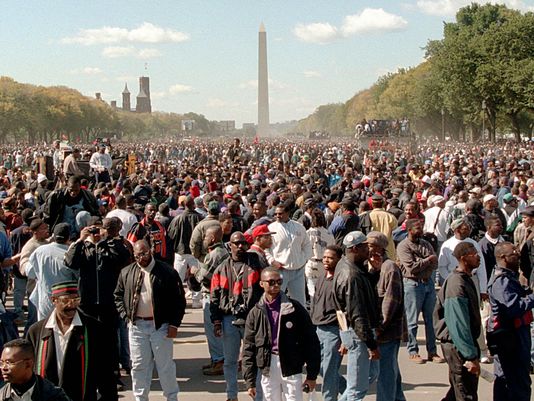
OCTOBER 14th UPDATE: My friend Linn Washington Jr. went. Here’s his public take:
Saturday’s Justice march was “powerful” in the words of my 12-year-old grandson. I went primarily to take him so he could experience it – I was there as a participant not a reporter.-But I can report that the 200k participant ‘guess-ta-ment” for the 10/10/15 Justice march is not far off.-That event did not have anywhere near the million+ of the ’95 M3 event…yet there was that spiritual-like ’95 unity vibe albeit not as INtense and focused as 1995.-In ’95 I walked from the Capitol steps back to the Washington Monument to get a scope of the crowd (i knew the media/authorities would lie on the count)…and in ’95 it was a solid sea of men on the Mall spilling into parallel streets. Saturday, the multitude did not have the people-per-square-inch density or Capitol to Monument seamlessness of participants…occupying the Mall only and the distance of a few blocks back. (And, fidelity to fact: I didn’t do the Capitol to Monument stroll on Saturday but could see open space around Monument unlike in ’95)-Below are a few observations from a participant not from a thorough reporter:–Saturday’s event did have a more diverse crowd – 8 to 80, 8 as in eight months old. A striking aspect for me on Saturday was the presence of families (Dad/Mom kids) and extended families lil ones to grands, all rolling as a ‘crew’ – a lot of women were there also…and whites were there (seemingly not on a ‘zoo visit’ attytood)– Saw a few Native Americans but did not see many Hispanics.-Yes, there were a lot, A Lot of 20-30 somethings in the crowd and there were organizations galore in ‘see-me’ attire from black Greeks to the New Black Panther Party.-Of course, in 2015: it was ‘selfie’ city…saw folks popping into the NBPP formation to get their pics taken…-Judging from tee shirts and other attire items, folks came from north/south, east/west to attend.-A few similarities between Saturday & 1995:-Much media coverage was not in-depth…for example, didn’t see mention in articles that I read about the on stage remarks by a sister of Sandra Bland, the father of Michael Brown and the mother of Trayvon Martin — Justice or Else definitely includes police brutality so how can cover an anti-police abuse event and not report on symbols of that struggle???-Another similarity between 1995 & 2015 (and I will probably get my ‘Black Card’ revoked for this observation): Farrakhan talked TOO much. I respect the Brother Minister deeply, but, Yo, cogent and concise hits harder. (Grandson and I toured the entire Smithsonian Native American Museum from top to bottom, beginning visit 15 minutes into Farrakhan’s remarks, we did all four floors of the museum and when we exited Farrakhan was still talking. Interesting seeing [again] how ameriKKKa JERKED the Indians like they jerked us -broken treaties, abusive justice system, LIES aplenty, attacking the victim for opposing their oppression, etc.)-The trip Saturday to Justice or Else for me was about the grandson: He said the event was “really cool.” Said he liked that people “are coming together.” Said he doesn’t want to group up and have to “deal with” brutal cops. He liked “the support” he saw at the march Saturday.

……is here.

…….is here.

Because the ones I’m reading right now are “off the chain,” as the post-modern expression goes.
This must be the month magazine’s submit for the National Magazine Award, because the Sunday going-to-meeting clothes have appeared on the last Rolling Stone (excellent articles on the Pope and cover-boy Trump), and October’s Smithsonian (the Egyptian pyramids, Einstein, the Brazilian Gordon Parks, and Hemingway)! I’ve viewed Smithsonian as a wannabe National Geographic, but it does more than that. I especially like its articles on technological and popular culture history.
The October National Geographic promised and delivered on a lost city in Honduras, the Congo River, Sweden wilderness, sea wolves and, on the cover, a new link in the human evolutionary chain! WOW!
OCTOBER 15th UPDATE: Was happy to read this.
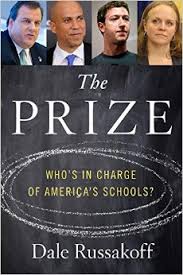
The Prize: Who’s in Charge of America’s Schools?
By Dale Russakoff.
New York: Houghton Mifflin Harcourt.
240 pp. $27.
The word “conspiracy” gets thrown around a lot in African communities, ever since the middle of the last century. And it’s understandable: the assassinations of King and X, the discovery of the Federal Bureau of Investigation’s COINTEL-PRO files, and the disposal in one way or another of any leader of African descent who doesn’t toe the blood-dotted line of the West. But how much of a conspiracy is it when the victim doesn’t have the required amount of power for self-determination in the first place? This book, released today, is about how relatively powerless people fought back against their status when, insult to injury added, even their relatively little power was taken from them.
It starts with Cory Booker, the neo-liberal mayor of Newark, New Jersey, and Chris Christie, the conservative governor of the state, secretly deciding all by themselves in the backseat of a Chevy Tahoe in 2009 that they will transform American education by turning Newark into a laboratory for the New York-based, greatly monied education reform movement. Mark Zuckerberg, the founder and CEO of Facebook, develops a political man-crush on Booker and signs on by 2011, pledging $100 million (to be matched by other donors) to make New Jersey’s largest city into a charter-school haven in five years, staffed by six-figure, non-unionized teachers. Like the benevolent colonizers of old, all believe they go in with good intentions: self-government by the dark, poor people has not worked in the internal colony, the reasoning goes, or the state would not have taken over the school district back in 1995. The teacher’s unions are stopping progress, the reformers argued to themselves, by making sure they tie the hand of local politicos and school board members. So, they privately reasoned, the only way to change the system is to overthrow it—to go past all the community obstacles. So they hire $1,000-a-day consultants and get to work.
After absorbing the opening shot heard-round-the-world of the revolution it now understood it was a pawn in, the Newark grassroots is then introduced to Cami Anderson, a white woman of hippie background who has been named the school’s superintendent by Christie and Booker. Like education reformer Michelle Rhee did in Washington, D.C., she then sets out, from the community perspectives, to close as many schools and alienate every teacher and parent she can. Meanwhile and not coincidentally, charter schools, some rising out of the closed public ones, begin flourishing in the the old, struggling-against-decay, never-recovered-from-the-1967-rebellion ghetto, providing resources and specialized attention to small, selected groups of poor Black and Brown children the always-struggling public schools can’t match.
Everyone flexes what muscle they have. The teacher’s unions demand their back pay as a condition to their negotiations with Booker and Anderson over being able to fire bad teachers and financially reward good ones, and get it. The money people get their calls answered from the celebrity mayor, who eventually uses his Captain America persona to get elected to the U.S. Senate in 2013. Newark students organize and protest Anderson, with more than a little help from a well-known local name: Ras Baraka, a high-school principal and city councilman (and one of the sons of poet-activists Amiri and Amina Baraka). He seizes the issue that will get him elected mayor in 2014, defeating a Theo Huxtable-type candidate propped up by the same education reform movement. “The festering resistance to Anderson, the backlash against [the top-down reforms], and the first mayoral campaign of the post-Booker era became one and the same.” The street protests grow so large and consistent in Newark that Christie—days away from announcing his Republican presidential nomination run this past summer—makes a deal with newly-elected Mayor Baraka that, at this September 2015 writing, may transfer city education power back to the people a year from now. A bewildered Anderson is sent packing, replaced, amazingly, by a former state education commissioner—one of the chief architects of the neo-colonial plan! Whether the new school district superintendent cleans up his own mess is this story’s next chapter, to be written by today’s journalists and tomorrow’s historians.
Dale Russakoff, a longtime Washington Post journalist and resident of Montclair, a middle class suburb of Newark, embeds herself with Christie, Booker and Anderson while, simultaneously, sits in on more than 100 school-related community meetings (“There it was again: disrespect. The word rose from conversations all over the auditorium”), and the reporting not only shows, but shines. Her spectacular juggling act blames everybody but those whose demonstrated first commitment is to the students. In her telling, nearly everyone involved received something and/or learned something but the city’s least-of-these. She makes a clear observation that needs to be on T-shirts in the city: “For four years, the reformers never really tried to have a conversation with the people of Newark. Their target audience was always somewhere else, beyond the people whose children and grandchildren desperately needed to learn and compete for a future.”
The book’s author might not agree with the following assessment: that her carefully crafted work clearly documents that white supremacy’s psychotic historical urge to covertly or overtly experiment with the lives of poor Black people—whether medically, socially, economically or, in the case, educationally—is not some obscure 19th or 20th century Africana Studies classroom topic, but as current as the next awarded education grant. African-Americans used to be classified as sub-human, because of their three-fifth status under the U.S. Constitution. Then, after the Civil War, they became second-class citizens, because they didn’t have the right to vote or use public accommodations. In this updated 21st century form of pseudo-democracy, poor Black and Brown communities like Newark are filled with sub-citizens: those who have no input on their future, no matter how much taxes they pay and how often they vote. Christie and (especially) Booker should be ashamed of their public actions here, but who could, or would, succeed in shaming them that they would actually respect?

I learned a lot of basic spiritual lessons from this man, who dominated PBS fundraising for at least a decade!
I’ll miss those long Sunday morning sessions! In my time in Maryland, it was the closest I ever got to going to church!
See you on YouTube, Dr. Dyer!

…….is here.

Writing on the Wall: Selected Prison Writings of Mumia Abu-Jamal. Edited by Johanna Fernandez. Foreword by Cornel West.
San Francisco: City Lights.
370 pp., $17.95 (paperback).
If the fight earlier this year for the right of imprisoned writer Mumia Abu-Jamal to get correct care for his diabetes had failed, this book, his eighth, would have been possibly the last he would get to approve under his name. The diabetes complication was not just a shock to his system. There is an insane sense of normality that has now developed around the idea of Abu-Jamal’s work—the assumptions that he is writing, and will be writing frequently, that his commentaries will get emailed around the world, that his recorded voice will be on YouTube. Frankly, Abu-Jamal’s rat-a-tat journalistic contribution would be almost taken for granted if he hadn’t almost died. The ubiquitousness of the author and product shows how much he has succeeded in creating a foothold in Black radical thought in the last 20 years.
And that Panther-inspired bootprint continues here. Following in the steps of Noelle Hanrahan’s 2000 Abu-Jamal column collection “All Things Censored,” Fernandez, an assistant professor of history and Black and Puerto Rican Studies at Baruch College/City University of New York, creates a second unofficial “Mumia Reader” of 107 columns and speeches that span from the former Black Panther Party member’s 1981 arrest for the killing of a white Philadelphia police officer to 2014. The editor takes significant time to explain the how, when, what and why of Abu-Jamal’s essays. She shows that the intellectual scope and depth of Abu-Jamal’s writings precede Hanrahan’s mid-1990s recordings—the ones that, along with a 1995 death warrant and a ready-to-go international anti-death penalty movement, jump-started the “Free Mumia” movement and pushed it straight to the international Leftist stage.
The “new” gems discovered here are, ironically, among his oldest. “Christmas In a Cage,” his rarely read 1981 account of his own arrest and treatment by the police (“Where are the witnesses to the [police] beating that left me with a four-inch scar on my forehead? A swollen jaw? Chipped teeth?”) is worth the price of the book alone.
The editor situates the first few columns in a way that explains him, not just his opinions. Upfront, his love for the MOVE Organization and its founder, John Africa, is clearly articulated, using the 1982 trial and conviction statements he made as an understandably angry young man. (“John Africa is not a slave to this foul, messed up system—he is not bought and sold.”) An example of what he told the court after it decided it wanted his death: “On December 9, 1981, the police attempted to execute me in the street; this trial is just a result of their failure to do so.”
And as the wall writing progresses with a combination of memories, obits and news riffs that, policy-wise, string Reagan to Obama, the reader feels the air from the older Abu-Jamal’s steady, intellectual darts thrown at, for example, the post-911 legalization of COINTEL-PRO under George W. Bush, the devastation that followed Katrina, et. al. Abu-Jamal’s commentaries, taken together, target the contradictions of the established order, pointing to its corrupt nature versus the natural power of people-fueled resistance. (“The objective of all politics is power,” he writes in a 2000 column about the police killing of Amadou Diallo, a Black man shot in his building’s vestibule in New York City. “No major political party in America can even begin to promise Black folks in America the power to stand on their own doorstep[s], or ride their own car[s], or walk the streets of the urban center, without the very real threat of being ‘accidently’ blasted into eternity.”) The book, therefore, is a half-lifetime of well-researched, historically radical Black print rage, from waxing nostalgia about his brief political brush with Huey Newton in and the Black Panther Party circa 1970 to predicting in advance the acquittal of George Zimmerman of the 2012 shooting of Trayvon Martin.
It is now assured that, whatever his future health in prison, Abu-Jamal’s body of work will outlast his actual one. The writer, as Cornel West discusses in the preface, belongs in “that cultural continuum of struggle that shaped urban Black people between 1950 and 1980.” It remains to be seen in a 2015 world of social media if the masses of “Black Lives Matter” Tweeters will develop the skill, discipline and commitment of their now- elder statesman Abu-Jamal, who wrote in the margins of the society decades before it became cool.

