Category Archives: television
The Conversation: Nikki and Jimmy
The above conversation was one of the many accomplishments of this television program. The trailer for the documentary film on the program can be found below.
Do You Know The Way To Wakanda? One Year Later, It’s Clear That “Black Panther” Finished The Conversation That “Roots” Started

This month not only marks the first anniversary of the release of “Black Panther,” a.k.a. The Film That Won’t Go Away. What will be little noted is that this February is also the 40th anniversary of another well-remembered African/African-American moment.
On the small screen in February 1979, James Earl Jones, fresh from his then-uncredited voice-over role as Darth Vader in the first “Star Wars,” was seen in a safari shirt and glasses on every ABC-tuned television in America, stabbing his pen into a pad, shouting the following into the then five-channel television universe: “You old African! I found you! I found you! Kunta Kinte, I found you!”
“Roots: The Next Generations,” the mammoth 1979 sequel to the groundbreaking 1977 original, ends with Haley’s (Jones’s) journey to the Gambia to search for the young ancestor who was captured when, as the Haley family legend goes, he went into the woods to make himself a drum.
The search for Haley’s fantasy-ish Juffure resonated with African-Americans (in fact, it’s partly how we eventually accepted that term for ourselves in the late 1980s), and with millions more who wanted to find out about themselves. It’s the core story, the central idea that, in 2019, spurs those Ancestry.com commercials and has given Henry Louis Gates, the Harvard Africana Studies professor, a new career in public television.
Haley’s historical novel and the vision of comicbook legends Stan Lee and Jack Kirby hold more similarities that one thinks. Aren’t both the imaginary product of 1960s magazine content producers? Isn’t Killmonger just a version of Kunta Kinte who finally makes it back home and reclaims his birthname and birthright? Isn’t the Juffure showed in “Roots: The Next Generations” a low-tech Wakanda of sorts—a (relatively) unspoiled, seemingly un-interrupted Africa?
Although “Roots” was created for television as an American family tale, it nevertheless brought home the central tenets of Black Power and Afrocentrism—that we are an African people. ABC broke through with a depiction of Africa that defied the “Tarzan” movies from the 1930s through the 1950s that were a staple of Saturday afternoon viewing on local television channels. For a people that had recently abandoned “Afro-American” for Black, the contrast was jarring. I was 9-years-old when the first “Roots” miniseries aired, and it shook me to the core. But not completely: I still loved those Tarzan films, watching them for years afterward, but I began to wonder why I couldn’t understand the Africans, and why they kept dying consistently.
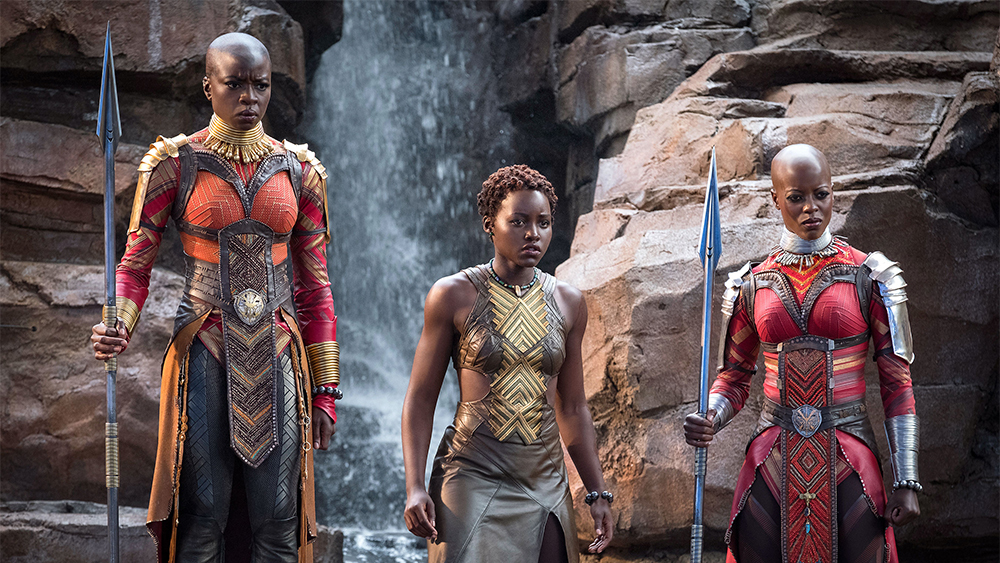
Marvel Studios’ BLACK PANTHER
L to R: Okoye (Danai Gurira), Nakia (Lupita Nyong’o) and Ayo (Florence Kasumba)
Credit: Matt Kennedy/©Marvel Studios 2018
What happened between “Roots” and “Black Panther?” More knowledge. Africana Studies—now in its 50th year, struggling to survive, but back then growing and expanding as a discipline. Sci-Fi-era technology that allows us to see Africa and converse with Africans every day. World travel not being a big deal anymore. A growing Afro-futurism movement that is including all people of African descent, regardless of geography, gender or gender orientation. So “Panther” came right on time, as a production of visual African/Black nationalism, a visual sense of Black/African victory, to counter the white nationalism of Trump and Brexit.
The very idea that the African Union has set out to create a Wakanda shows that even Africans are searching for the Africa they see in their own minds. Imagination serving its highest role—as inspiration. (I hope and pray that the AU, thus inspired, will turn down requests for the Chinese to build it.)
For better or worse, Black History Month now has an imaginary element. We have merged with Kunta Kinte, and have turbo-charged his drum with Vibranium. Using American mid-20th century fantasy, we have gone in our minds from victims of colonization to superheroes forging our own destiny. In 2019, we have checked our DNA, and know more fact than fiction about ourselves. Of course we are of African descent, we now say, confused how anyone could think otherwise.
Whether “Black Panther” wins any Oscars later this month is much less important than this truth that might double as fact: Ryan Coogler, T’Challa, Okoye and Shuri have killed Tarzan, for real this time.
The Speech That Got Marc Lamont Hill Fired From CNN
Book Mini-Review: Galactic Improvisation

So Say We All: The Complete, Uncensored, Unauthorized History of Battlestar Galactica.
Mark A. Altman & Edward Gross.
Tor Books. 718 pp., $27.99.
No, it wasn’t the record-breaking-rated, universally-loved show it is now seen as, almost ten years after it ended. No, it wasn’t unconditionally loved and cherished by its network–until the awards and critical acclaim came in, and the showrunners announced that the fourth season would be its last. From its beginnings 40 years ago as an often ill-fated attempt to bring the visual and spiritual power of Star Wars to ABC primetime screens every week, to its let’s-kill-every-rule-Star-Trek-ever-had-and-hold-up-a-mirror 21st century Sci-Fi (now SyFy) Channel revival during the post-911/War on Terror years, Battlestar Galactica was almost always an acquired taste, a pleasant, almost-mainstream discovery. But how powerful the concoction! Altman and Gross, who interview as many cast and crew members that a human mind can absorb on a given page, take us step by step through the mythology as it developed, the last three words being key; perhaps the biggest shock of the book–practically its thru line–is how much of the new version was editorially done on the fly, and how its showrunners, Ronald D. Moore and the series’ often-unsung hero, David Eick, trusted its writers to fly Galactica–a complex series about race/identity and its connection to current politics, ancient Earth history and world religion–to a powerful, albeit controversial to many, end. What a great way for Altman and Gross to end a trilogy (four books, technically) of fan-favorites–Star Trek, then Buffy/Angel, and now BSG. These kind of books, especially with its oral history formats, take the rabid deep into the rabbit(-ears) whole, allowing the reader to see into the experience, and stay there. For a BSG fan, this is essential, since the series presented much but purposely answered little.
Funeral Notes–Aretha and McCain: One Question, Three Comments
Yep, I watched Aretha ALL DAY Friday on the livestream. Even after-the-fact caught Meghan McCain’s tribute to her daddy yesterday.
It was a weird weekend for funeral eulogy. W’s McCain eulogy was better than Obama’s! (And, thankfully, much shorter!) I would have never have seen that coming!
Okay, I see most of the news coverage about Queen Ree-Ree is about how the bishop enjoyed himself a little too much with Ariana Grande, who, telling the truth, was wearing a little too little for church. 🙂 And no, Bill Clinton did not keep his eyes in his head, but, c’mon, everyone saw that coming. 🙂 ) But I had one question and three comments:
- Why didn’t Minister Louis Farrkahan speak, or get to speak, at the funeral? All the other dignities–former President Bill Clinton, Rev. Al Sharpton, Michael Eric Dyson, and Rev. Jesse Jackson–sat with him, and they all spoke. Also: I’m glad some people noticed what I did–that he was being constantly cropped out of the shots, both photo and live video. He sat up there a long time to get gipped like that in public, if that’s what indeed happened. Whether he got cut from the pulpit or not, at least it seemed that he was enjoying himself. [OCT. 22 UPDATE: Richard Prince tells me today he didn’t want to speak, but he wanted to show up to thank the Queen for what she did for him in 1972 (!)].
- I think I was in the kitchen when U.S. Rep. Maxine Waters gave the Wakandan salute. Just found out about that while researching this post.
- The MSM are focused on Dyson’s slamming of Trump. But I appreciated his shade on Obama. Without referring to him by name, Dyson said “some” (meaning you, Daddy-O) were too afraid to come and stand in front of the entire Black community –which, FOX News’ confusion be damned, includes Farrakhan! (Sharpton read a letter from 44.) I’m not the biggest Dyson fan by a looong shot, but I appreciated that!
- As far as John McCain is concerned, well……let’s just say that if Angela Davis–an American hero!–becomes an Ancestor before me, I look forward to hearing tributes to her courage from the Right, Center and Center-Left (liberals). 🙂
Thank You, Steve Ditko…….

Thank You, Anonthy Bourdain

You went around the world. Showed culture. Talked to people. Listened to what they said. That’s all that supposed to be done.
Sorry that your demons caught up with you, because I would have liked to have known that more stories were coming from you.
Happy 80th, Superman!
And yes, I got my copy of Action Comics No. 1000!
THANKS TO…….
…..the IMIXWHATILIKE Crew for the opportunity, Highline College and Seattle Central College for their commitment to us,
and TERP magazine for this article!
And a special thanks to Dr. Darryl Brice and Sister Yoshiko Harden for hosting us while in Seattle!


