
I missed this because I was at the MMM.
Liked the below, from Ras Baraka’s Twitter account:
power reveals our limitations and trouble exposes our character
I missed this because I was at the MMM.
Liked the below, from Ras Baraka’s Twitter account:
power reveals our limitations and trouble exposes our character
Boycott Christmas? I have to admit–that’s REAL Black and radical! LOL! 🙂
At the 20th anniversary of the Million Man March in Washington, D.C. yesterday, Nation of Islam leader Louis Farrakhan said it was a mass action Blacks could use to punish the whites who enslaved their Ancestors centuries ago and whose police shoot them down in the street today.
Here’s four reasons why what the Minister wants will be difficult to implement:
1) Yes, Black people have buying power, but they don’t have wealth. Black people spend money for the same reasons as every other group–to sustain themselves. And let’s be real: many Christmas gifts are practical items people seriously need.
2) Yes, Black people are angry about the public epidemic of police shootings. But historically, boycotts work when an aggrieved community decides collectively that their interests will be served by the group sacrifice. (See Montgomery, Alabama and Martin Luther King.) If there was an actual, practical end result that was measurable for Black people–an actual gain that, for example, would make them safe in the presence of the police–I believe the people would follow Minister Farrakhan and make the sacrifice. But if not, no.
3) Economic boycotts have to be well-organized. Is the NOI going to spend the millions in organizational support, media advertisements, etc., it would take to organize 40 million people in roughly 40 states? To do it right, it would have to be on the scale of a presidential election campaign.
4) Black people love Christmas–all of it. For many Blacks, all of the X-Mas traditions are as important to them as their churches. (It’s why Maulana Karenga, the founder of modern-day Kwanzaa, set up the holiday between Christmas and New Year’s as an alternative/substitute/supplement to it, because he understood the deal.)
What Farrakhan is asking for, and how he is talking about doing it, is admirable, but without the buy-in (if you forgive the expression) of a substantial part of Black America, the call has all the potency of, say, demanding statehood for the District of Columbia: maybe someday it will happen with a lot of struggle, but not today–and definitely not this Christmas.
*****
Near me a Sigma and a Delta brought their children, who sat on their child lawn chairs, eating and working on a puzzle book. Apologies to Sly and the Family Stone, but….
The Nation of Islam showed that it may be the first Black group to understand that youth must be served by publicly serving. The emcees–Tamika Mallory, a former youth leader for the Rev. Al Sharpton, Nuri Muhammad of the Nation of Islam (who talked about Black people’s war with police, which he called the “Blu Klux Klan” and also with “niggativity”) and upcoming leader the Rev. Jamal Bryant, were presented as emerging leaders, not “youth leaders.”
Farrakhan, 82, was a grandfather talking to his grandchildren. He said what the Nation and the crowd knew: “What good are we if we think we can last forever and not train the young to follow in our footsteps?”
ANY excuse to post ANYTHING about EWF will ALWAYS be taken! So I was happy to see this article about this song! 🙂 Black Beatles forever!
Now, if someone could just write about EWF’s theme song (below), one of its most underrated songs (since the group considers “That’s The Way of The World” its “national anthem“).
SEPTEMBER 2016 UPDATE: This was GREAT! Thanks, Richard Prince, for showing me this!
It’s Been Beautiful: Soul! and Black Power Television.
By Gayle Wald (with photographs by Chester Higgins).
Durham, N.C.: Duke University Press.
288 pp. $25.95 (trade paperback).
This book understands the right story to tell—one of, in author Gayle Wald’s words, “a fragile alliance of liberal and radical interests, both public and private”–and, thankfully, arrives at the right places. “Soul!” (1968-1973), a nationally distributed public television program that could loosely be described as the radical sister of the more commercial “Soul Train,” fired the imagination and reflected the multi-faceted sensibilities of its Black community of viewers. Using largely untapped wells of research about the early days of American public television vis-à-vis Black America, Wald relates a nuanced story of how the condescension of white American public television officials seeking to provide an outlet for the angry Black community in the late 1960s led to a (largely) Black-controlled showcase of the Black Arts Movement on (largely) Black aesthetic terms. It is the restrained approach, however, of choosing as this book’s scholarship basis intellectual sources outside the “soul” of Black/African folks that makes this book strangely appealing and more than a little irritating.
“Soul!” (episodes of which can be found online) was first a product of Black insurrection. Reacting to that outpouring of anger and violence, white funders, somewhat accidentally, allowed a Black producer, Ellis Haizlip, to have his way. WNET-Channel 13 (now known as Thirteen), then and now the New York-based flagship station of the PBS collective, wanted a companion show to “Black Journal,” its Black newsmagazine. The initial and white idea of a “Black Tonight Show” developed under Haizlip into a Black Arts salon that was cooler than the “The Flip Wilson Show” and Don Cornelius’ large Afro. Wald wisely includes as much of Haizlip’s life story into this book as she can fit. (A documentary film on the “Soul!” producer, done by his niece Melissa Haizlip, is struggling to get funding.) The letters of support “Soul!” received are well used in Wald’s book; they show the involvement of the Black community instead of just describing the appreciation of an audience.
“It’s Been Beautiful” builds somewhat on Devorah Heitner’s “Black Power TV,” a pioneering 2013 intellectual narrative on the early days of East Coast Black public affairs television, and does so with great intellectual gusto. Wald, a professor of English and American Studies at George Washington University, rightly uses the New York-based “Soul!”—a program that would feature, for example, Nikki Giovanni interviewing James Baldwin or a studio performance of The Last Poets, or Earth, Wind and Fire—to find “a key TV text of the era or as a cultural project joined by common cause to 1960s and 1970s political struggles.” The show’s arc matches its era: Martin Luther King, Jr. was killed two weeks before the grant to create the show was submitted, and it was cancelled because PBS’ funders, facing the onslaught of the Nixon era and the fading of the Black Power movement, wanted to create programming that would have Blacks and whites interacting.
Chapters Three and Four—which dissect “Soul!” as a program, along with its performers and producers—are worth the price of the book alone. Wald does not shy away from explaining Black American culture in all its glory and anger. But she doesn’t seem to want to dig into the African, non-Western roots of what she is seeing and describing. She correctly emphasizes the ideological and cultural diversity of the performances, and explores the unity-without-uniformity cultural and political ideology present at the time, but doesn’t want to go in-depth into how Africans in America came to create those products and their ideas in a world drenched in white supremacy and anti-African-ness. Instead, Wald chooses to emphasize the gender and sexual orientation undercurrents of the visual text: “’Soul!’ created a television space where Black people—imagined to include Latinos of various hues who were seeking alternatives to whiteness, Black women marginalized by nationalist conceptions of both the public and private spheres, and Black gays and lesbians rendered as ‘unnatural’ and ‘freakish’—could see, hear and almost feel each other.” For example, she seems more interested in Haizlip’s negotiation of his public gayness than the undiluted African thought processes that produced him and his approach to Black art and the Black community. Wald is not ignorant of African-centered thought; she doesn’t think it’s intellectually relevant enough to examine when quotes from Black Arts Movement stalwarts will do.
The 21st century public television landscape is deeply complicated in ways that this book’s bell-bottom era forecasts. The fact that, for example, on “The PBS NewsHour,” one will find in 2015 occasional in-depth discussions of African and African-American artists and their work is the realization of public broadcasting’s assimilation goals. (After reading Wald, the cross-cultural appeal of PBS’ “Tavis Smiley” could been seen as a page out of a memorandum written by the 1970s PBS executives.) And the 2015 decision by the Sesame Workshop to sell first-run rights of “Sesame Street” to premium cable outlet Home Box Office shows that funding and producing these non-commercial programs are still challenging, even for PBS’ signature programs. So Wald accomplishes with her detail the goal of all scholars: to be both historical and current.
Wald’s and Heitner’s approach to analyzing Black media—focusing on the televisual performance and its socio-political and socio-cultural implications, grounded in European-approved disciplines of American (film) studies, (Black) feminism, queer studies, et. al.—provides both a fascinating read and important scholarship. (Anyone interested in continuing their newly-established tradition should seriously consider studying PBS’ “With Ossie and Ruby,” an almost-forgotten treasure of a Black cultural container similar to “Soul!” in important ways. A study from those perspectives would be fascinating, and perhaps a scholar will one day attempt it.) Ultimately though, Black people need scholarly narratives of these Black cultural television programs from the unapologetic point-of-view of African-centered thought and philosophy.
Since it’s the soundtrack for the commercial about Eva Mendes’s clothing line, which has been on TV EVERY weekday evening for MONTHS.
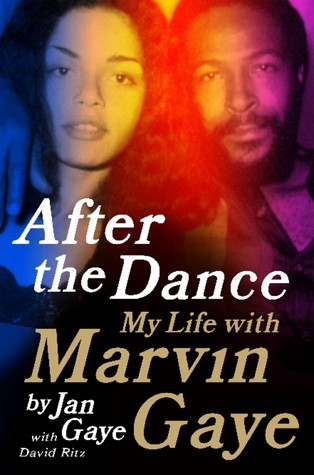
After The Dance: My Life with Marvin Gaye.
Jan Gaye with David Ritz.
New York: Amistad/HarperCollins.
282 pp., $25.99 (hardcover).
In ancient African religious systems, Ibeji (an Orisha, from the Yoruba and the Ifa) is known as the deity of twins, while Ma’at (from Egypt) was the goddess of, among other things, balance. This book, a memoir of a talented, troubled attractive young woman who falls in love with an equally troubled man whose voice and lyric reverberated around the world, tells a story that screams for their intercession. If these gods did act, they chose to abruptly end the dualities that circled around them like cocaine and marijuana: when Marvin Gay Sr. murdered his son in 1984 with the gun the son had purchased, it almost seemed like either an evil or heavenly release of all of the tension, anger and depression that had wafted around the singer.
Whether it fashions itself thusly or not, and whether the authors admit it or not, “After The Dance: My Life with Marvin Gaye” is a supplement to Ritz’s 1985 stellar biography, “Divided Soul: “The Life of Marvin Gaye.” The emotional divisions introduced by Ritz 30 years ago are laid bare by Marvin’s ex-wife, Janis. Serenity vs. paranoia. Love vs. fear. And ultimately, conflict into love and clarity into a warped sense of being. Discord, turmoil and competition were necessities for Marvin Gaye, a man who competed with his own domineering father for his mother’s love, competed with other Black recording artists for chart dominance and public adoration, competed with other men to win Janis back when he lost her, and even tried to seriously compete with Muhammad Ali in a charity boxing exhibition. He was a man who, according to Janis, believed that “perhaps misery and conflict make for great music. Perhaps without misery and conflict my well would run dry.” And, like the first Aquarian, what was the water he was bringing? “To get people to see below the surface of reality.”
The entire book is awash in 1970s post-Civil Rights Movement euphoria. Music, television and performance made gods of men and women, flawed human beings who were openly worshipped and adored. Marvin Gaye was the first Motown artist to break free of the company’s strict formula; to demand artistic freedom. He became his own Black Power Man, with his own studio, his own musical ideas and with his own family separate from Motown—the one he created with a young teenage girl he saw while in the studio. He sang a song to her, this surface ingénue, who was, and perhaps would always be, his premier acolyte. They were almost instantly conjoined by sensuality, by spirituality, by pain and the promise of enjoying, and finding home in, the new freedoms available.
In this book, the Gayes are twins of pain, cycling through, and back to, their dysfunction. Their marriage, Gaye’s second, eventually ended in the early 1980s (“The struggle to stop struggling was finally over”). Artistically, Marvin Gaye was on a comeback. Unfortunately, he did not have the chance to exorcise his personal devil—the one that had his name on it, written by his own hand—even though he knew he had to give it up. His father’s sick need to win their competition dominated, and a talent stilled, existing forever in a musical loop, a skullcap covering his head like a crown.
Marvin Gaye represented African (-American) people’s joy and pain like few artists in the 20th century. Janis Gaye’s story emphasizes all of the edges of the disjointed souls these drama junkies occupied and shared with each other, grasping for an elusive peace while naturally plotting ever-accessible turmoil. It is the story of a couple who needed love, and found it, but failed to create a life that belonged only to themselves, because ultimately, even when it was just the two of them, there were just too many sides to satisfy.


The whole interview.
NAME: Katea Denise Stitt
TITLE: Interim Program Director, WPFW Pacifica Radio in Washington, D.C.
How did you find out about this letter? What was your reaction to it?
My good friend and Jazz historian, William Brower, forwarded the letter to me.
How does it feel to know that Malcolm X knew your father (“they all know me well,” he said in the letter), and that he was one of his favorite artists?
My immediate, visceral reaction was the smile, a huge smile, followed by a bit of melancholy in wishing I could have had discussion about Malcolm X with my father. I was thrilled to read it, not only because he speaks so warmly of my father, but his thoughts on the significant role of music, and that of the musician, were immensely moving. And, of course, the intimacy of a hand-written letter!
Did your father ever tell you that he knew “Detroit Red” and/or Malcolm X? Was it unusual or usual for him to talk about who he knew? And if he did, what did he say about Red/X? Did he tell you about his reaction to Malcolm X’s assassination, 50 years ago this month?
He never told me about knowing Malcolm X, although he did mention The Nation, and Elijah Muhammad, in terms of proper diet, living, etc. He would reference the book “How to Eat to Live” when discussing health with us. He often talked about his friends and contemporaries. Folks like Miles Davis, Dizzy Gillespie, of course, Dexter, Sonny Rollins, Don Patterson, Nancy Wilson, Amina Myers, Milt Jackson, Stan Getz – they were all great friends. Some would come to the house when they were playing town, or sometimes he’d take us to see them perform. While he never spoke of Malcolm’s assassination, my father was progressive and kept abreast of political happenings, especially as it pertained to African Americans, so I’d assume that he was saddened and deeply troubled.
What did you tell your children about this letter, their grandfather and Detroit Red/Malcolm X?
Well, I have a 13 year old daughter, Johanna, and we talk about her grandfather all the time. She is pretty open and receptive, thankfully. I asked her to read it, and share her thoughts with me. She had questions about the other musicians referenced, and who Malcolm was, etc. At the end of our discussion, her words were, “That’s really cool, Mom!”
Did you bid for the letter?
No. I was not aware it was being auctioned. That said, I would hope that whomever possesses it would gift or loan it to a museum where the public could see the actual document.
What is your opinion of what Malcolm X said about music (and your father) in the letter? “Music, Brother, is ours—it is us—and like us it is always here—surrounding us—like the infinite particles that make up Life, it cannot be seen— but can only be felt—Like Life!!! No, it is not created—but like the never-dying Soul—eternally permeates the atmosphere with its Presence—ever-waiting for its Master—the Lordly Musician—the Wielder of Souls—to come and give it a Temple—mould it into a Song. Music without the Musician is like Life without Allah…both being in need of the house—a home—The Temple — the Complete Song and its Creator Sonny & Milt Jackson played together up in Flint, Mich.”
Again, it was so profound, and so deeply personal. It felt a bit like eavesdropping to read it. Music is Life to me, a very sacred experience – I feel this way about all good music, regardless of genre. I completely empathized with this sentiment. To have him refer to my father, and Jazz, no less, in that way is mindblowing to me!!
This month marks the 50th anniversary of the assassination of Malcolm X and this fall marks the 50th anniversary of the publication of the Autobiography. You’re an interim program director at a Pacifica station that plays jazz, so this kind of thing must be very important to you. From your view as a manager of an on-air art forum, what should we remember about Malcolm X AND the artistic vision exemplified by your father, that he praised so well?
Malcolm X is one of my heroes, particularly after his pilgrimage to Mecca, but really, all of Malcolm. To show how you can change your life, and how your transformation to help and uplift others – a constant lesson and challenge for humanity. Through the letter, we get a different glimpse of Malcolm as a cultural icon and thinker, in addition to a political one. His comparison of the Creators of The Music to Life and Allah really speaks volumes as to what Jazz, Great Black Music, if you will, means to us as a people, as a society – national and globally. Simply put, Jazz is sustenance for the soul – beautiful! All of the creators of Jazz, and all music of a higher vibration, empower us to expand our minds, and access a higher spiritual experience or sensibility. This is indeed what we try to do with Music at WPFW. By the way, on February 20th, WPFW will present Malcolm and the Music, based, in part on this letter. I hope folks will listen and certainly offer feedback.
Did you know about this Ahmadiyya movement Malcolm is talking about? If so, what do you know about it? Was your father part of it? Did you know any jazz artists that were a part of it? What did he think of it, and what did/do you think of it? (And is Malcolm referring to something specific to your father when he talks about a “temple” and a “complete song?”)
Unfortunately, I only know the little I’ve read about it, and I don’t know if my father or other musicians were a part of it. I don’t think his words there are specific to my father, but speaking more to The Musician as a key to Life and Liberation – or as he says “…the Wielder of Souls.”
Now, feel free to add or say anything you want below–to answer something I didn’t ask! Someone you want me to try to fit in the article.
It was just wonderful to experience a part of Malcolm X that is not heralded enough in my opinion – his deep love for, and commitment to all humanity. HIs understanding of an interconnectedness, not on this plain, but as a spiritual experience, through music. Certainly, it gave me a new and wonderful perspective on how deep and far-reaching my father’s contributions to music were, and still are.

Selected Letters of Langston Hughes.
Edited by Arnold Rampersad and David Roessel with Christa Fratantoro.
New York: Knopf.
423 pp., $35 (hardcover).
If he were alive today, Langston Hughes would have tried to write this book review as quickly as possible. He had bills to pay (and loans from friends to pay back), so he leapt into the plays, novels and short stories he had to write. Meanwhile, an ever-mounting pile of correspondence awaited him to sort and answer—which he did, often into the late night and early morning.
Luckily for Hughes aficionados, that lifetime’s worth of letters were regularly shipped, from 1940 until his 1967 death at the age of 65, to Yale University’s James Weldon Johnson Memorial Collection of American Negro Arts and Letters. (The idea for the collection was Carl Van Vechten’s, the man history identifies as the white champion of the Harlem Renaissance.) It’s from that massive Hughes output—thousands of letters that date back to 1921, letters that eventually filled 671 boxes—that the reader can see the artist at work.
And it’s almost mostly just his work schedule—with a smattering of self-opining and sometimes-frank opinions of his fellow artists thrown in—that’s absorbed from this comprehensive survey. Hughes’s definitive biographer Arnold Rampersad and literature scholar David Roessel, with help from independent scholar Christa Fratantoro, chose the letters that give as much insight as the often-intangible Hughes chooses to reveal. His most frequent communications, according to this assemblage, were to his literary agent, Maxim Lieber, his publisher Blanche Knopf (the matron of the publishing house that is celebrating its centennial with this book and a re-issue of Hughes’ first-and-still-classic 1926 poetry collection The Weary Blues), his friend and quasi-patron Noel Sullivan, and his best pal and writing partner, Arna Bontemps.
In this book, which mightily struggles to be more than a work ledger, Hughes is almost constantly at work, writing anything from quickie children’s books to newspaper columns to his two autobiographies, 1940’s The Big Sea: An Autobiography and 1956’s I Wonder as I Wander: An Autobiographical Journey. Sadly for the general reader but semi-happily for Hughes, the master poet had a near-obsession with writing a successful stage musical, which would have given him the financial security that eluded him his entire struggling-against-being-a-vagabond life. His attempts to fight being fleeced by racist white producers and playwrights are as tedious as they are outrageous.
Hughes kept everything that interested him. He followed Black newspapers and magazines with great care, and kept track what those periodicals were saying about Black artists, especially him. Periodicals were Hughes’ lifeblood: he sold many short stories, poems and essays to Black magazines such as The Crisis and Phylon and white magazines such as Esquire. Irony abounds in Negro life: Hughes’ Chicago Defender Op-Ed column hit book and stage musical paydirt for with his creation of the character Jesse B. Semple (“Simple”), but The Defender, now having access to cheaper, white columnists, wanted to cut the little he made from it.
With the exception of the musical producers and, not insignificantly, the McCarthy witch-hunters who tried to destroy him in the 1950s, these collective letters display a man’s need to be loved and needed by everyone. He is always attempting anthologies (especially for African writers) and is ceaselessly encouraging his fellow scribes, especially younger ones that he proudly claims as his discoveries, like Margaret Walker (Alexander) and, later, a young Alice Walker (“She is really ‘cute as a button’ and real bright…Mine is her first important publication [and her first story in print], so I can claim her discovery, too, I reckon,” he writes to Bontemps in 1966). For the most part, he holds back his anger and his hurt, and tries to put a positive spin on almost everyone, even the younger, angrier writers—James Baldwin and LeRoi Jones—who criticize him in his later years. The personal outlook matches the professional persona well, since Hughes had to depend on the largesse and kindness of many, many friends and associates in order to survive. The letters are his day-to-day-reality-as-performance, but his romantic life, his sexuality, his personal needs are permanently off-stage, not for even semi-public consumption.
Rampersad’s high biographical standard continues to hold. The annotations alone—of people, places end events that populate Hughes’ almost-countless adventures and misadventures around the world and around New York City—make it worth the time it takes to go through his life, one thought and one year at a time. The introductions to the chronological sections show the trio of writers at their concise, detailed best.
This book can be read on its own, but it is the perfect companion to either of Hughes’ autobiographies, Rampersad’s two-volume biographical magnum opus, or even just a collection of the artist’s poetry. It’s not too obvious to say it is a fantastic addition to the bookcases filled with Hughes’ writing and Hughes scholarship. It is a must for those who want a peek behind the curtain of a Black artist, but don’t need to see too much.
*******
APRIL 11th UPDATE: An earlier version of this review was printed inside here.



 Drums in the Global Village