Category Archives: newspaper
Column: This #Thanksgiving, #PresidentBiden Should Grant Clemency to #LeonardPeltier
As posted from here: https://www.democracynow.org/2024/11/27/this_thanksgiving_biden_should_grant_clemency
November 27, 2024
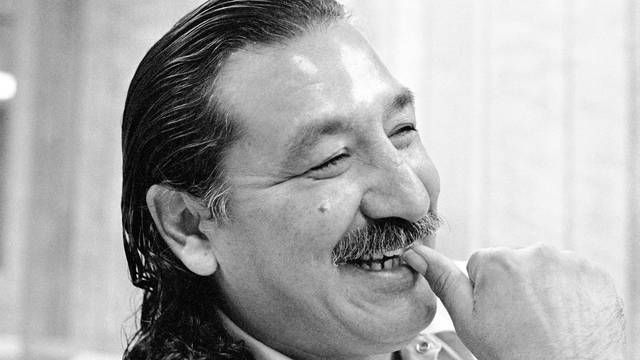
Political prisoner Leonard Peltier is the author of the memoir Prison Writings: My Life Is My Sun Dance.
By Amy Goodman & Denis Moynihan
While many brace for the return of Donald Trump to the White House, let’s remember that until Monday, January 20th, #JoeBiden is still president, with all the power that confers. The Constitution grants the president the “Power to grant Reprieves and Pardons for Offences against the United States,” to remedy a criminal justice system riddled with faults. One strong candidate for presidential clemency, as recently called for by Amnesty International USA, is 80-year-old Anishinabe-Lakota elder #LeonardPeltier, who has been incarcerated for close to half a century for a crime he maintains he did not commit. This Thanksgiving weekend, when people across the US enjoy a holiday based on the myth of a shared meal between native people of Massachusetts and the English settler-colonists who would later violently displace them, #PresidentBiden should free Leonard Peltier.
The case of Leonard Peltier encapsulates the modern era of indigenous resistance. After centuries of #genocide launched by #ChristopherColumbus and expanded by successive waves of European settlers, by the 1950s most of the surviving indigenous nations in North America had been contained in isolated and impoverished reservations. Hollywood appropriated, caricatured and monetized the vibrant mosaic of indigenous cultures. Many Native people moved to cities seeking economic opportunity but still faced racism and discrimination. Out of this, and amidst the civil rights and other social movements of the 1960s, the #AmericanIndianMovement, or #AIM, was born.
In 1973, AIM went to the #PineRidgeReservation in South Dakota, where a corrupt tribal government was working in league with federal and local authorities to violently suppress a growing movement to restore traditional practices – and to block extractive industries from exploiting traditional lands. More than 50 Lakota people and their allies were murdered there over a three-year period.
On June 26, 1975, Leonard Peltier was present at an AIM camp on the property of a targeted family. The camp was fired upon by unknown assailants, and the AIM members returned fire. In the ensuing minutes, two FBI agents and one young AIM activist were killed.
Two AIM members were later arrested for killing the agents. At trial, the jury agreed that they had fired in self-defense and acquitted them. Leonard Peltier, arrested later, was tried separately and convicted. Peltier’s trial was marked by gross FBI and federal prosecutorial misconduct, with the coercion of witnesses, fabricated testimony, and suppressed exculpatory evidence.
When Peltier was on trial in 1976, Joe Biden, then a young US Senator, was a founding member of the Senate Select Committee on Intelligence. The committee was created after the explosive Church Committee hearings that investigated the unconstitutional and criminal conduct of the FBI and its “ #COINTELPRO ” operations against civil rights leaders and organizations, including AIM.
A global movement grew, demanding justice for Leonard Peltier. Human rights icons like South African #PresidentNelsonMandela and #ArchbishopDesmondTutu called for his release, as did one of the federal judges involved, and, years later, one of the prosecutors who tried the case.
#AmnestyInternational has campaigned for Peltier’s release for decades. The group recently sent a letter to President Biden, reiterating their demand.
“Over the decades at Amnesty, we have been calling on administration after administration to do the right thing by Leonard. He was in hospital in June, he was in hospital again in October. It’s time to give him a chance to spend his last days with his family and with his community,” Paul O’Brien, Executive Director of #AmnestyInternationalUSA, said on the Democracy Now! news hour.
In late October, President Biden traveled to the Gila River Indian Community in Arizona to formally apologize for the US government’s treatment of Indigenous children forced into boarding schools.
“All told, hundreds and hundreds of Federal Indian Boarding Schools across the country. Tens of thousands of Native children entered the system. Nearly 1,000 documented Native child deaths, though the real number is likely to be much, much higher; lost generations, culture, and language; lost trust. It’s horribly, horribly wrong. It’s a sin on our soul,” Biden said.
Nick Tilsen, executive director of the Indigenous-led NDN Collective, responded on #DemocracyNow!, saying,
“What this means for Indian Country is that we hope that this is the beginning of an era of repair between the United States government and the Indigenous people, the First People of this land…He [Peltier] was in the Sisseton Wahpeton boarding school, in South Dakota. Leonard Peltier and many people who became leaders in the American Indian Movement were boarding school survivors. They came out of that era, and then they resisted.”
If President Biden’s apology at Gila River was genuine, he could demonstrate it by commuting the sentence of Leonard Peltier. It would be a long-overdue gesture to Indigenous people across the US, for which we could all give thanks.
The original content of this program is licensed under a Creative Commons Attribution-Noncommercial-No Derivative Works 3.0 United States License. Please attribute legal copies of this work to democracynow.org. Some of the work(s) that this program incorporates, however, may be separately licensed. For further information or additional permissions, contact us.
Little-Seen, Never-Aired 61-Year-Old (Authorized) Documentary on “Peanuts”
Wow! The team formed even earlier than I thought! This was before *all* of the films and TV specials!
You can find out about this documentary here.
#TriceEdneyNewsWire: “Photographer Roy Lewis Honored by #NationalAssociationofBlackJournalists #NABJ at Chicago Confab” By Hamil R. Harris
Every Black community has somebody like Roy Lewis. When I lived in the D.C. area and was at a Black political event, the way I knew I was at the main one of the day was spotting Roy, clicking away.
*****
 |
| Having taken thousands of photos of people receiving awards and making news, Roy Lewis waited his turn to be honored by the National Association of Black Journalists. PHOTO: Roland Martin/#Roland Martin Unfiltered |
 Roy Lewis, relaxing later with his NABJ Legacy Award. Roy Lewis, relaxing later with his NABJ Legacy Award. |
 Roy Lewis (center) receives the Legacy Award from NABJ representatives Frank Holland of CNBC and Abby Phillip of CNN. PHOTO: Roland Martin/#Roland Martin Unfiltered September 2, 2024 Photographer Roy Lewis Honored by NABJ at Chicago Confab By Hamil R. Harris (TriceEdneyWire.com) – Roy Lewis has photographed iconic images across Black America for decades and his love for the lens was captured by Jet magazine in 1964 when it published his photograph of pianist Thelonious Monk. Born in 1937, on a plantation below Natchez, Mississippi, Lewis’s resourcefulness is part of his gift. He first fell in love with vocational photography in high school. He later practiced that love on a professional level at the Johnson Publishing Company on South Michigan Avenue in Chicago. He earned the money for a 35-mm camera after he was drafted into the U.S. Army. This summer, Lewis, 87, was back on South Michigan Avenue in Chicago, but not at the John H. Johnson headquarters. He was there to receive “special honors,” at the convention of the National Association of Black Journalists.“I worked for Mr. Johnson from 1956 to 1968 and then to be honored on this Avenue…” Lewis said. “It’s not about the pictures; it’s about the feeling of being honored by your peers and being back in Chicago, where I did some of my top work.” Lewis was bestowed with the Legacy Award during NABJ’s annual convention in August. The Legacy Award recognizes a Black print, broadcast, digital, or photojournalist of “extraordinary accomplishment who has broken barriers and blazed trails.” Legacy Award honorees are those who have “contributed to the understanding or advancement of people and issues in the African Diaspora,” according to NABJ. The NABJ wrote, “Lewis is a renowned photographer and activist whose photography career started in 1964 when Jet magazine published his photograph of musician Thelonious Monk. His work has been celebrated nationwide, including in his ‘Everywhere with Roy Lewis Exhibition,’ beginning in 2008 at the Essence Music Festival.” Lewis, who left Chicago in 1973 and moved to Washington D.C., was nominated for the award by Sam Ford, a founding member of the NABJ who worked for more than 51 years as an award-winning broadcaster for three decades on air at WJLA-TV, Washington, D.C.’s ABC affiliate. “Roy has been part of the Washington press corps for as far as I can remember,” Ford said. “Roy started taking pictures when he was 17 years old. He will be 87 this year…That is more than 70 years connected with the news media except when he was in the army.” Lewis also worked in his hometown paper in Natchez and went back to work for Ebony and Jet after the army. He has a large collection of pictures from his days at Ebony and Jet from the 1960s and he is still a photographer for The Washington Informer newspaper, the Trice Edney News Wire and the NNPA News Service, which serves 200 Black newspapers and their websites. “I thought he needed recognition. When a person is going for 87 years you don’t want to wait too long,” Ford said. According to Lewis’ HistoryMakers biography, he was drafted in 1960, and he developed his photography talent in the army. He purchased his first camera for just $25. In 1968, Lewis left Johnson Publishing and joined the staff at Northeastern University, filming student activities. In 1970, Lewis videotaped an exclusive interview with the late Honorable Elijah Muhammad. Lewis’s work was featured in the film A Nation of Common Sense. In 1974, Lewis traveled to Zaire to film the Muhammad Ali-George Foreman fight. This historic video would later be featured in the documentary on that classic clash, When We Were Kings. In 1975, Lewis worked on River Road on the Mississippi, a pictorial book that focused on African-American people and life along the Mississippi River. Dr. Ben Chavis, NNPA president/CEO, said in an interview, “The National Newspaper Publishers Association salutes Roy Lewis as a phenomenal photojournalist and for his long-standing contribution to freedom, justice, and equality. Roy Lewis is an icon of the Black Press.” Likewise, Hazel Trice Edney, editor-in-chief of the Trice Edney News Wire, said, “Roy Lewis’s name is synonymous with excellence in Black Press photography.” Under her leadership as president of the Capital Press Club in 2014, Lewis was also an award recipient during the CPC’s 70th anniversary celebration. She said, “Roy is deserving, not just because of great and historic photography, but because of his commitment to the cause.” |
| Trice Edney Communications | 6817 Georgia Avenue | Washington, DC 20012 US I Unsubscribe | Update Profile | Constant Contact Data Notice |
From #DemocracyNow! (8-23-24): “Two Faces of American Capitalism”: #JuanGonzález (and #BarbaraRansby) on What the #RNC & #DNC Reveal About U.S. Politics


The Democratic National Convention wrapped up in Chicago on Thursday with Vice President Kamala Harris formally accepting the presidential nomination, capping a week of political showmanship and celebration for many party members. “One of the things that struck me most was the level of choreographed mass spectacle of this convention that would be really worthy of Leni Riefenstahl,” says Democracy Now! co-host Juan González. He says Democrats and Republicans presented “the two faces of American capitalism” at their respective conventions this summer, with the GOP home to “white supremacist capitalism” while Democrats promote a “multiracial neoliberal capitalism.” He adds that despite the constant chants of “U.S.A.” throughout the week, “the reality is that the United States has never been lower in its prestige and never more discredited around the world than it is today.”
*****
AMY GOODMAN: But before we end, Juan, we began this week with you and Bill Ayers going back to 1968, talking about the protests of the time. And as we begin to wrap up, can you share your thoughts about this week?
JUAN GONZÁLEZ: Well, you know, I think one of the things that struck me most was the level, as I said, of choreographed mass spectacle of this convention that would be really worthy of Leni Riefenstahl, the famous Nazi, Hitler’s filmmaker and propagandist, in terms of controlling the narrative that the America people receive of what the Democratic Party is about.
We’ve seen that both the Republican convention and the Democratic convention show the two faces of American capitalism. On the one hand, with the Republicans, you have a party of a white supremacist capitalism, of anti-immigrant xenophobia, of patriarchy and of war on the working class. And now, this past week, we’ve seen the party of multiracial neoliberal capitalism, for a party that seeks a kinder and gentler form of mass deportation and border militarization, and one that is even more aggressive in the imperial policies of the United States than even the Republican Party, if you consider that.
And both parties sort of having a disconnect with the rest of the world. I was stunned by all the chants of “U.S.A.! U.S.A.! U.S.A.!” throughout the Democratic convention, when the reality is that the United States has never been lower in its prestige and never more discredited around the world than it is today as a result of — especially of the war in Gaza, but of all the attempts at regime change and controlling other countries and forcing other countries to do what it wants.
And it reminds me constantly that “one person, one vote” is a dangerous concept, because there’s always the possibility that the masses of people will act in ways that the rulers don’t want. So, the necessity to control the narrative, to control what the people consider possible, is so important to our ruling classes. And that’s why they invest so much time and so much effort in this choreographing of spectacle to, somehow or other, prevent the people from thinking of other possibilities.
And so, I think that that’s what most — had most impact on me, and also the fact that the social movements have had impact. I think Kamala Harris’s choice of Tim Walz was a direct response to the sense among this multiracial neoliberal wing of capitalism that they’ve got to, somehow or other, placate the masses of the people and bring the young people back into the fold. And so, I think they’ve attempted to do that. We’ll see what happens in the coming weeks. But I think that the choices have never been clearer between the two forms of capitalism. And we’ll see what the American people decide in the coming weeks.
AMY GOODMAN: Your final thought on that, Barbara Ransby?
BARBARA RANSBY: I agree. I was nodding and amening as Juan was commenting. Yeah, I mean, two faces of capitalism, because we see — you know, it’s very hard to be enthusiastic about this moment in the Democratic Party, with Gaza and everything else. And I think the cynicism of this orchestrated consensus at the convention is one example of that.
*****
Here’s the video:
UPDATE:
Will This #AssociatedPress #FutureAwardWinningPhoto Re-Elect #DonaldTrump?

#MarcLamontHill Speaks To (Student) Activists @ #RutgersNewark
Seton Hall University Africana Update

Okay, look, don’t let the smiles fool you! Lot more to do….
Saving Nigeria’s History – Through The News | The Listening Post
PO1135809: Racketeering, “A Criminal Conspiracy,” (American) Enterprise (cont’d)

 Drums in the Global Village