From today’s “Democracy Now!” :
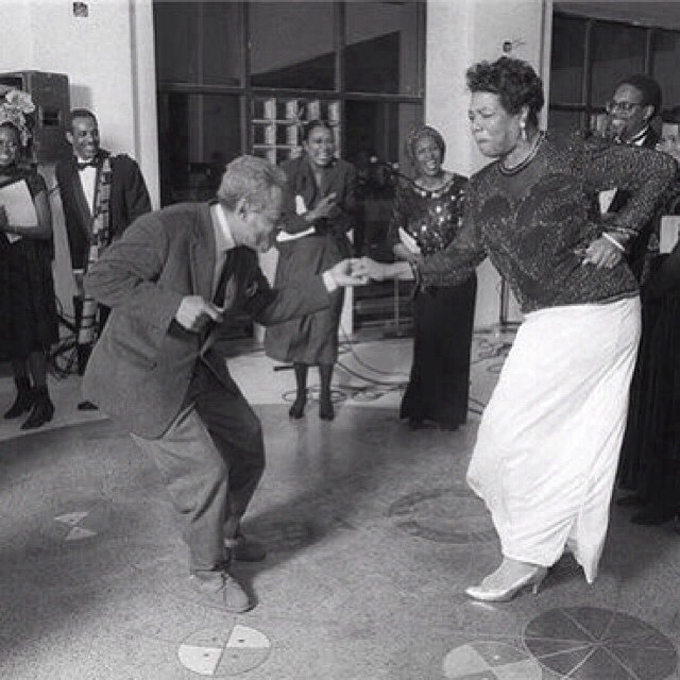
JUAN GONZÁLEZ: We devote much of today’s program to honoring the life and legacy of the writer and activist Maya Angelou. She died Wednesday at her home in North Carolina. She was 86 years old. Her son, Guy Johnson, issued a statement that she, quote, “lived a life as a teacher, activist, artist and human being. She was a warrior for equality, tolerance and peace.”
Born Marguerite Ann Johnson in St. Louis, Maya Angelou grew up in Arkansas in the Jim Crow South. At the age of seven or eight, she was raped by her mother’s boyfriend. He was killed shortly thereafter. As a result of the trauma, she remained virtually silent for five years, speaking only to her brother.
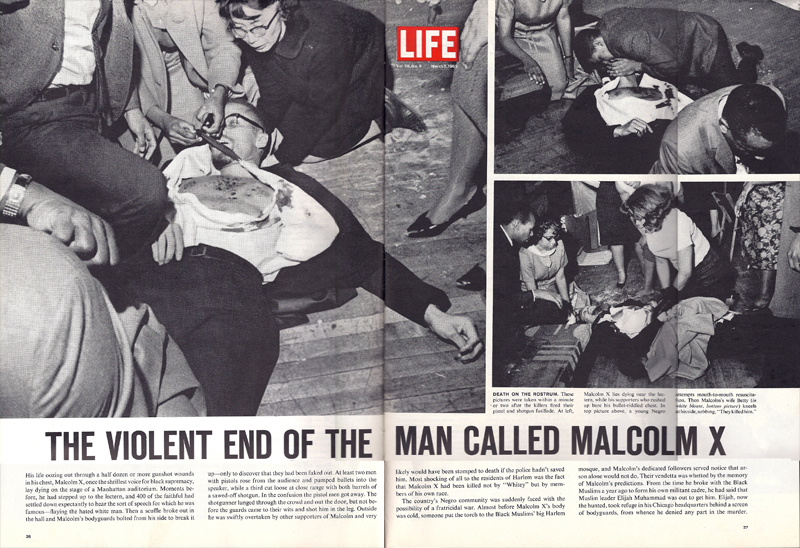
She became a mother at age 17. In the 1950s and ’60s she went on to become an actress, singer and dancer. After she fell in love with a South African civil rights activist, they moved to Cairo. She later lived in Ghana, where she met Malcolm X, and the two collaborated on developing his Organization of Afro-American Unity. She returned to the U.S. to support the effort, but Malcolm X was assassinated shortly after her return.
AMY GOODMAN: That tragedy and the 1968 assassination of her friend, Rev. Martin Luther King Jr., devastated Angelou. It was in 1969 she was encouraged by the author James Baldwin, among others, to focus on her writing. Thus was born “I Know Why the Caged Bird Sings,” her first of seven autobiographies and the phenomenal career for which she is known around the world. Maya Angelou was also an award-winning people’s poet. This is Maya Angelou in her own words, as she reads one of her most celebrated poems, “Still I Rise.”
MAYA ANGELOU:You may write me down in history
With your bitter, twisted lies,
You may trod me in the very dirt
But still, like dust, I’ll rise.
Does my sassiness upset you?
Why are you beset with gloom?
Just ’cause I walk as if I have oil wells
Pumping in my living room.
Just like suns and like moons,
With the certainty of tides,
Just like hopes springing high,
Still I rise.
Did you want to see me broken?
Bowed head and lowered eyes?
Shoulders falling down like teardrops,
Weakened by my soulful cries?
Does my sassiness upset you?
Don’t take it so hard
Just ’cause I laugh as if I have gold mines
Diggin’ in my own backyard.
You can shoot me with your words,
You can cut me with your lies,
You can kill me with your hatefulness,
But just like life, I’ll rise.
Does my sexiness offend you?
Oh, does it come as a surprise
That I dance as if I have diamonds
At the meeting of my thighs?
Out of the huts of history’s shame
I rise
Up from a past rooted in pain
I rise
A black ocean, leaping and wide,
Welling and swelling I bear in the tide.
Leaving behind nights of terror and fear
I rise
Into a daybreak miraculously clear
I rise
Bringing the gifts that my ancestors gave,
I am the hope and the dream of the slave.
And so, naturally, there I go rising.
JUAN GONZÁLEZ: Maya Angelou, reading from her poem “Still I Rise.” In 1993, she recited her poem “On the Pulse of Morning” at Bill Clinton’s first inauguration. She was the first poet to make an inaugural recitation since Robert Frost did so at John F. Kennedy’s inauguration in 1961.
MAYA ANGELOU: Mr. President and Mrs. Clinton, Mr. Vice President and Mrs. Gore, and Americans everywhere:
A Rock, A River, A Tree
Hosts to species long since departed,
Marked the mastodon,
The dinosaur, who left dry tokens
Of their sojourn here
On our planet floor,
Any broad alarm of their of their hastening doom
Is lost in the gloom of dust and ages.
But today, the Rock cries out to us, clearly, forcefully,
Come, you may stand upon my
Back and face your distant destiny,
But seek no haven in my shadow.
I will give you no hiding place down here.
You, created only a little lower than
The angels, have crouched too long in
The bruising darkness,
Have lain too long
Face down in ignorance.
Your mouths spilling words
Armed for slaughter.
The Rock cries out to us today, you may stand upon me,
But do not hide your face.
Across the wall of the world,
A River sings a beautiful song. It says,
Come, rest here by my side.
Each of you, a bordered country,
Delicate and strangely made proud,
Yet thrusting perpetually under siege.
Your armed struggles for profit
Have left collars of waste upon
My shore, currents of debris upon my breast.
Yet today I call you to my riverside,
If you will study war no more. Come,
Clad in peace, and I will sing the songs
The Creator gave to me when I and the
Tree and the Rock were one.
Before cynicism was a bloody sear across your
Brow and when you yet knew you still
Knew nothing.
The River sang and sings on.
There is a true yearning to respond to
The singing River and the wise Rock.
So say the Asian, the Hispanic, the Jew,
The African, the Native American, the Sioux,
The Catholic, the Muslim, the French, the Greek,
The Irish, the Rabbi, the Priest, the Sheikh,
The Gay, the Straight, the Preacher,
The privileged, the homeless, the Teacher.
They all hear
The speaking of the Tree.
They hear the first and last of every Tree
Speak to humankind today. Come to me, here beside the River.
Plant yourself beside the River.
Each of you, descendant of some passed on
Traveler, has been paid for.
You, who gave me my first name,
You, Pawnee, Apache and Seneca,
You, Cherokee Nation, who rested with me,
Then forced on bloody feet,
Left me to the employment of
Other seekers—desperate for gain,
Starving for gold.
You, the Turk, the Arab, the Swede, the German, the Eskimo, the Scot,
You, the Ashanti, the Yoruba, the Kru,
Bought, sold, stolen, arriving on a nightmare
Praying for a dream.
Here, root yourselves beside me.
I am that Tree planted by the River,
Which will not be moved.
I the Rock, I the River, I the Tree
I am yours—your passages have been paid.
Lift up your faces, you have a piercing need
For this bright morning dawning for you.
History, despite its wrenching pain,
Cannot be unlived, but if faced with courage,
Need not be lived again.
Lift up your eyes upon
This day breaking for you.
Give birth again
To the dream.
Women, children, men,
Take it into the palms of your hands,
Mold it into the shape of your most
Private need. Sculpt it into
The image of your most public self.
Lift up your hearts.
Each new hour holds new chances
For new beginnings.
Do not be wedded forever
To fear, yoked eternally
To brutishness.
The horizon leans forward,
Offering you space to place new steps of change.
Here, on the pulse of this fine day
You may have the courage
To look up and out and upon me,
The Rock, the River, the Tree, your country.
No less to Midas than the mendicant.
No less to you now than the mastodon then.
Here, on the pulse of this new day
You may have the grace to look up and out
And into your sister’s eyes,
And into your brother’s face, your country
And say simply
Very simply
With hope
Good morning.
AMY GOODMAN: Maya Angelou, reciting the poem she wrote for Bill Clinton’s 1993 inauguration, “On the Pulse of Morning.” Eight years later, President Barack Obama awarded her the Presidential Medal of Freedom. When we come back, we’ll be joined by Maya Angelou’s close friend, Sonia Sanchez, the renowned writer, poet, playwright and activist.
[break]
AMY GOODMAN: “Run Joe” by Maya Angelou from her 1957 album “Miss Calypso”. By the way, over the years Democracy Now! featured Angelou’s tributes to Fanny Lou Hamer, Ossie Davis, Correta Scott King, Max Roach and Nelson Mandela. You can go to our website to see all of her selected speeches from eulogies our archives with full transcripts at democracynow.org. This is Democracy Now!, democracynow.org, the war and peace report. I’m Amy Goodman with Juan Gonzalez.
JUAN GONZÁLEZ: We’re joined now by Maya Angelou’s close friend Sonia Sanchez. Sonia was a renowned writer, poet, playwright, activist and one of the foremost leaders of the Black Studies and the Black Arts movement. She is the author of 20 books including “Morning Haiku,” “Shake Loose My Skin,” and “Homegirls and Hand Grenades.”
AMY GOODMAN: Sonia Sanchez joins me here in Philadelphia. We welcome you back to Democracy Now! It is such a pleasant to be with you in person, though sad on this occasion, Maya Angelou’s death. Maya Angelou lived 86 years, she died in North Carolina. Talk about how you first met her and share your reflections about her life and her contributions.
SONIA SANCHEZ: It’s going being her sister, Amy, and you are right, it is a very sad occasion, but anytime I can hear and see her perform, you know that she will live forever. I first met Sister Maya in the 1960’s. That was period when we were all gathering together to change the world. I saw her on a couple of occasions at affairs where we all read our poetry. I most especially remember her in the play “The Blacks.” She came out in her tall, six feet majesty, and you were just stricken by her, by her beauty and by her grace. And I still have in my memory, when Lumumba was killed, Louise Meriwether and Sister Maya, climbing, going over the walls there at the U.N. They were protesting. To have seen that, you stood there in awe.
AMY GOODMAN: The first president of the Congo.
SONIA SANCHEZ: Yes, Lumumba.
AMY GOODMAN: The democratically elected president of the Congo.
SONIA SANCHEZ: It was an amazing moment to see the resistance that they were doing there in New York City at the U.N. But over the years, I got to know her in so many ways on the road, when we read together at various occasions and going to her home there in North Carolina when she was given her birthday parties. Sister Oparah would give birthday parties for her. And she had everybody you can imagine. You imagine that person, that person was there at Sister Maya’s house in North Carolina for birthday parties. You could call her on the telephone and cry and say, what a terrible mistake I made. You could call and say, I don’t know if I’m doing the right thing, and she will listen and say, dear, dear, Sonia, you need to come on down here to the house and just rest for a while and sleep. You need for me to cook you some good food.
AMY GOODMAN: Now, Sonia Sanchez, she lived in a lot of pain. She was raped and she was a child. The rapist was her mother’s boyfriend, he was murdered. Is it true she stopped talking for five years to everyone but her brother?
SONIA SANCHEZ: That is what we were told. This is an interesting thing, this idea of people not talking. Audrey Lloyd also stopped talking at some point in her life. When my grandmother died, the trauma was so great that I began to stutter. I was the child that went … I. And Luckily enough, that stutter saved me a great deal because my sister and I after my grandmother died, were sent to house to house to house. As I walked into the house, it was announced, oh here’s Pat, she’s the beautiful one, my sister, and here comes S-s-s-sonia, so just give her a book and put her in a corner. So, it’s amazing, but I think that when you don’t speak, when you’re quite like that, you’re filtering out perhaps all of the damage that was done to you, all the pain gets filtered out. Finally when you do speak, you are healed.
JUAN GONZÁLEZ: Sonia Sanchez, I wanted to ask you, Maya Angelou was already an accomplished singer, dancer, actress, but then she gets involved in the civil rights movement. Could you talk about the relationship between her art and her activism? She worked with both Martin Luther King and then with Malcolm X later.
SONIA SANCHEZ: There was no separation for us between our art and activism at all. Sister Bernice Reagon talks about the blues singer Montgomery who said we all come here naked. Even though we all come here naked, one of the things we have to do is we have to make arrangements for other people beyond ourselves. This is what she did. Yes, and she raised so much money for the civil rights movement. People forget that. She and Brother Harry Belafonte raised money because the movement needed money. Yes, she marched and did all these things that other people did and she wrote and she knew brother Malcolm, she knew Brother Martin, she was in Africa, she knew Nkrumah. This is a woman who simply at some point moved constantly with her art and activism and saw no problem with the two of them.
AMY GOODMAN: I wanted to turn to Maya Angelou talking about her close friend Coretta Scott King. The two shared a close bond as Dr. Martin Luther King was assassinated on Maya Angelou’s birthday. They would talk every year on that date, April 4. In 2006, Maya Angelou spoke at Coretta Scott King’s funeral in Georgia.
MAYA ANGELOU: On those late nights when Coretta and I would talk, I would make her laugh. And she said that Martin King used to tell her, you don’t laugh enough. There is a recent book out about sisters in which she spoke about her blood sister. At the end of her essay she said I do have a chosen sister— Maya Angelou, who makes me laugh even when I don’t want to. And it is true. I told her some jokes, jokes only for no mixed company. Many times on those late evenings, she would say to me, “Sister, it shouldn’t be an either or, should it? Peace and justice should belong to all people everywhere all the time. Isn’t that right?” And I said then and I say now, Coretta Scott King, you are absolutely right. I do believe that peace and justice should belong to every person, everywhere, all the time.
Those of us who gather here, principalities, presidents, senators, those of us who run great companies, who know something about being parents, who know something about being preachers and teachers, those of us, we owe something from this minute on. So that this gathering is not just another footnote on the pages of history. We owe something. I pledge to you, my sister, I will never cease. I mean to say, I want to see a better world. I mean to say, I want to see some peace somewhere. I mean to say, I want to see some honesty, some fair play. I want to see kindness and justice. This is what I want to see. I want to see it through my eyes and through your eyes, Coretta Scott King. [singing] I open my mouth to the Lord, and I won’t turn back. No I will go. I shall go. I’ll see what the end is going to be. Thank you.
AMY GOODMAN: That was Maya Angelou speaking in 2006 at Coretta Scott King’s funeral. And this is her speaking in 2011 around the time when she was awarded the presidential medal of freedom.
MAYA ANGELOU: What I thought about first, this morning, actually, is how wonderful it is to be an American. We have known the best of times and the worst of times. We have actually enslaved people and been enslaved. And we have actually liberated people and been liberated. Amazing. Amazing. If I had my druthers, I’d rather be born black, American, female in the 20th century. And I was. What a luck I have. I’m trying to be a Christian. And trying to be a Christian is like trying to be a jew or Buddhist or Muslim or Shintoist. I’m always amazed when people walk up to me and say, I’m a Christian. I think, already? You already got it? I’m working at it. Which means that, I try to be as kind and fair and generous and respectful and courteous to every human being. Seeing myself as him, not as his keeper or her keeper, but really seeing myself. Black, white, Asian, Spanish speaking, Native American — I try to treat everybody as I want to be treated. And that is no small matter. Really, that is trying to be an American because we have to say, I am a human being. Nothing human can be alien to me. The statement is made by a Terence in 154 B.C. — black man, a slave sold to a senator. He was freed by that senator. This man became the most popular playwright in Rome. Five of his plays and that one statement have come down to us from 154 B.C., I am a human being. Nothing human can be alien to me. And by the time I leave my students and they leave me, some of — they have ingested some part of that, and they can never be the same. Be proud, not haughty, but proud of what you have achieved. And see the future as your career, your job. This is not a rehearsal. This is your life.
JUAN GONZÁLEZ: Maya Angelou speaking in 2011 around the time she was awarded the Medal of Freedom by President Bill Clinton. Sonia Sanchez, among the many collaborations that you had with your friend Maya Angelou over many years was on a peace mural in Philadelphia. Could you talk about that?
SONIA SANCHEZ: Oh, yes. I became the Poet Laureate here in Philadelphia. One of the things that I wanted to do — the first thing was to have a peace mural. So, I called Sister Maya and Sister Toni Morrison and Alice Walker and I said, I want you to send me three lines about peace. And they did immediately. I got in contact with Brother Carmen and we also put some — three lines from Brother Martin and Sister Bernice Reagon. It is a beautiful mural. We ended up doing a book also called “Peace is a Haiku Song.” Sister maya said to me, Sonia, good, do that, we need peace. One of the things we wanted to do was to have her words there. I chose words from her book “Amazing Peace,” a Christmas poem that she had put out. So, If you’re ever in Philadelphia, come too Broad and Christian Street and you’ll see this beautiful mural with the words of these women and these men, simply talking about peace. Because peace is indeed a right for all of us on this earth. Our dear Sister Maya was a peace warrior. She was a cultural worker. She was a woman who insisted the way Max Roach and Abby Lincoln instead about peace. Freedom now, peace now, we insist.
AMY GOODMAN: Her radical nature — Maya Angelou’s — now as she’s being remembered, she read the poem at the presidential inauguration. As you said, climbing over the wall for Lumumba, the assassinated president of Congo. Befriending Fidel Castro in Cuba. Meeting Malcolm X in Africa, coming back with them to help him organize The Organisation of African Unity, we’re not hearing as much about it.
SONIA SANCHEZ: That is what you do as an activist. She always said simply, we have to listen to everyone’s story. We have to be involved with everyone. We cannot separate ourselves. So, she spoke at the Million Man March, if you remember that march. She was there with a problem. She was always every place. Anyplace there was any action, we used to say, you would find sister maya there, constantly talking, constantly entreating people to find a way to resolve and solve problems.
AMY GOODMAN: Her books, some have been banned from libraries as she unflinchingly described her life and the experience of people, African-Americans, and others. I remember when I was in high school, our library invited Maya Angelou to speak. Hundreds of people came out, a rainbow of people. She didn’t just be, she spoke, she sang, she danced, and she moved everyone together.
SONIA SANCHEZ: My dear sister, when she got on stage, she would start off with — we do it ourselves too. I started one of the programs, “woke up this morning with my eyes on Maya, woke up this morning with my eyes on Maya, woke up this morning with my eyes on Maya, going to resist, going to love, going to resist just like her, her, her. We learn how to mix the song and the poem and the poetry and the love. People came in rain to see her. When I brought her to Temple University, there were 3000 people standing up waiting to hear her. There were little children lined up who recited her poetry. This is, was, a great woman. When I was told yesterday that she had made transition. I sat up in my bed and I said, Na nga def? Sister Maya, Na nga def? It was important to say, how are you, dear sister? I heard a voice say, maa ngi fi rekk, Maa ngi fi rekk. I am well, I am well, I am well. And we are well because this great woman walked on this earth, my dear sister.
AMY GOODMAN: We are going to end with Maya Angelou’s own words. In 2005, she spoke at Riverside Church in Harlem during the funeral of Ossie Davis, the famous actor, director, activist. He and his wife Ruby Dee were renowned civil rights activists. In her address, Maya Angelou reads from her poem “When Great Trees Fall.”
MAYA ANGELOU: When great trees fall, rocks on distant hills shudder. Lions hunker down in tall grasses, and even elephants lumber after safety. When great trees fall in forests small things recoil into silence, their senses are eroded beyond fear. When great souls die, the air around us becomes sterile, light rare. We breathe briefly. Our eyes briefly see with a hurtful clarity. Our memory, suddenly sharpened, examines gnaws on kind words unsaid, on promised walks not taken. Great souls die, and our reality bound to them takes leave of us. Our souls, dependent upon them, upon their nature, upon their nurture, now shrink wizened. Our minds formed and informed by their radiance seems to fall away. We are not so much maddened as reduced to the unutterable silence of dark, cold caves. And then our memory comes to us again in the form of a spirit, and it is the spirit of our beloved. It appears draped in the wisdom of DuBois, furnished in the humor and the grace of Paul Laurence Dunbar. We hear the insight of Frederick Douglass and the boldness of Marcus Garvey. We see our beloved standing before us as a light, as a beacon, indeed, as a way. We are not so much reduced. Suddenly the peace blooms around us. It is strange. It blooms slowly, always irregularly. Space is filled with a kind of soothing electric vibration. We see the spirit, and we know our senses. We change, resolved, never to be the same. They whisper to us from the spirit. Remember, he existed. He existed. He belonged to us. He exists in us. We can be, and be more, every day more. Larger, kinder, truer, more honest, more courageous, and more loving because Ossie Davis existed and belonged to all of us.
AMY GOODMAN: That was Maya Angelou, in 2005, speaking at Riverside Church, remembering the famous actor and activist Ossie Davis who is survived by his wife Ruby Dee, also a well known activist and actor. As we remember Maya Angelou today, she died yesterday at her home in North Carolina at the age of 86.