DRUMS IN THE GLOBAL VILLAGE
By Todd Burroughs

WORDS+POLITICS+MUSIC+HUMOR=THE GENIUS OF GIL SCOTT-HERON
NEW YORK—When you read poetry you don’t understand, said Gil Scott-Heron to his Harlem audience, you say, “Hey that must be deep.” Laughter.
As deep as his hypnotic voice and jazzy chords?
As vast as his symbolic and metaphoric lyrics?
As rich as his in-your-face poetry?
As serious as his commitment to place art and humanity and world peace above artistic prostitution for 26 years, all of it presented to you through the Bluesology frequency on his Midnight Band?
As amazing as his ability to place words together in ways that boggle, create laughter, disturb or provoke serious thought about our society and our times?
The military and the monetary / Get together whenever they think is necessary / they’re turning our brothers and sisters into mercenaries / they’re turning the planet into a cemetery
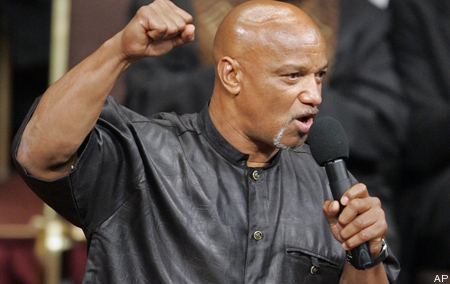
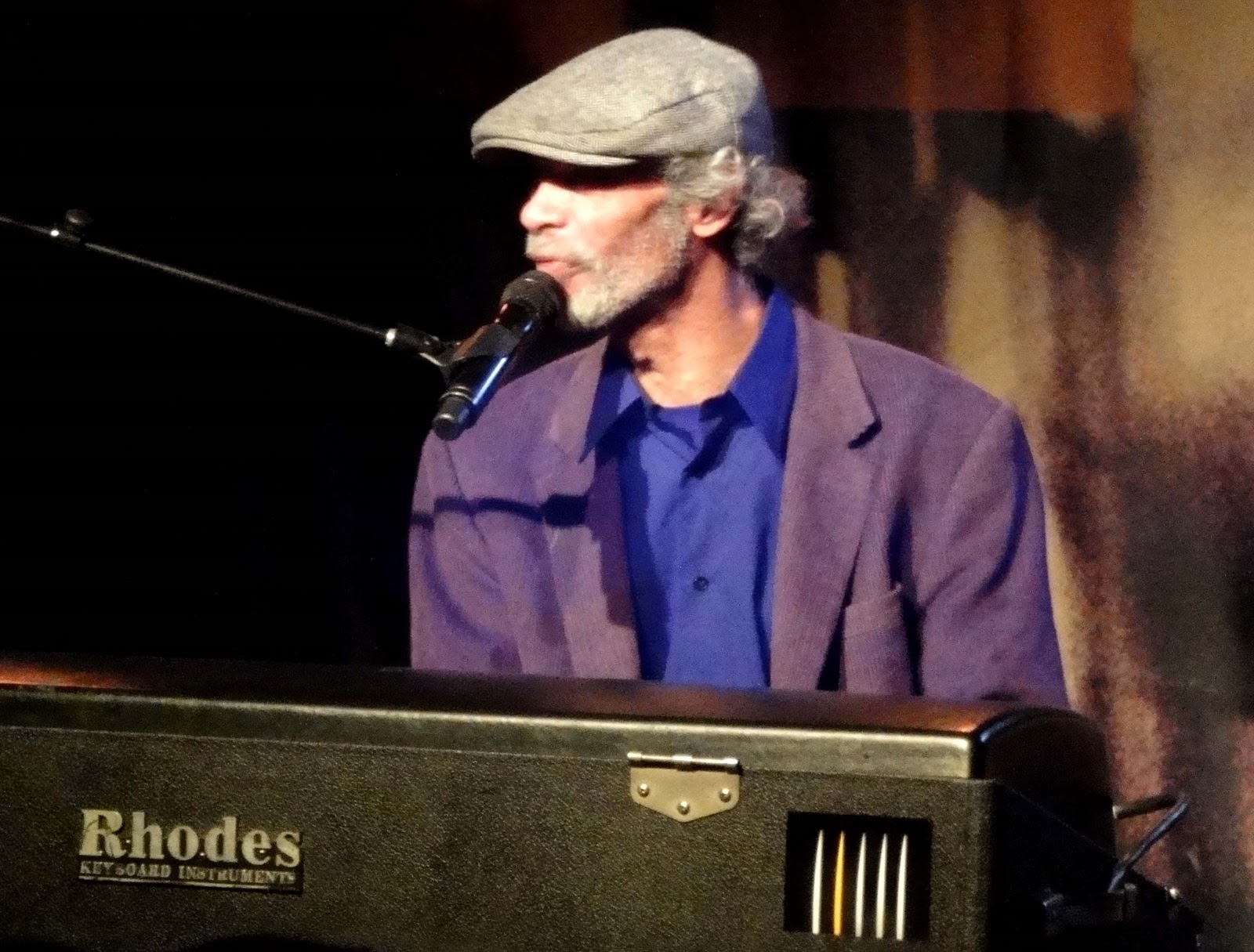
Gil Scott-Heron. Forget televised revolutions. This was no re-run, brother; I saw him LIVE in concert recently as the Schomburg Center for Black Culture in Harlem kicked off its 1996-1997 performance season. The Harlem resident was on his never-ending tour with the Amnesia Express, his latest band.
I was sleepy, and drifted, eyes open, lost in the sound of percusssion, drums, drums, DRUMS.
Words-as-power.
Blues+poetry+groove=a happy crowd.
The only sad part about seeing Gil Scott-Heron was, well, seeing him. He looks and physically acts almost 20 years older than his 40-something self. His hair, hidden under a baseball cap, is all gray. His tallness and skinniness seem to cross the line to gaunt.
And it was a little unsettling to know that ironically, what he called his “song of celebration” is “The Bottle,” his mid -1970s classic on alcoholism. He sang it as an encore.
It jammed, as did the whole concert. Intellectually. Musically. Spiritually.
“Celebrate your life!” he sang. He didn’t have to tell us twice.
Will we ever understand Gil Scott-Heron? How someone so gifted could have obviously abused his body so, but remaining—even as a shadow of his former self—more powerful, filled with more clarity, more life, than we?
Probably not. But that doesn’t matter. For after all, to be poetic, joked the Bluesologist, “is to have a little part of (the poem) no one understands.”
Copyright 1996, 2011 by Todd Steven Burroughs, Ph.D.
************
And here’s another voice:

GIL SCOTT-HERON, Radical Poet (1949 – 2011)
[col. writ. 5/29/11] (c) ’11 Mumia Abu-Jamal
At half past 50, one should hardly be surprised at death – especially natural ones.
But we are often betrayed by feelings such as those, as exampled by the recent passing of Gil Scott-Heron, a pioneering poet of the 1970s and ’80’s, who, with his remarkable baritone, made the smooth transition from protest poet to singer, succeeding brilliantly at both.
As poet, his phrasings were often backed by the percussive power of drums. His later works were supported by a full band of talented musicians, notably the pianist, Brian Jackson – leader of the aptly named Midnight Band.
During this period we also saw the emergence of the somewhat similar Last Poets, a group, usually numbering no more than 4, who also used rich musical accompaniment to support their poetry.
Scott-Heron’s poems and songs were often scathing political critiques, which were powerful cultural commentaries, especially during the Watergate-era, around the time of President Nixon’s resignation.
Gil Scott-Heron’s work, like “The Revolution Will Not Be Televised”, and “Living in the Bottle”, neatly threaded the needle between the political and the personal, and enjoyed considerable airplay on Black and college radio.
Like many artists (especially of the Jazz era) Scott-Heron reportedly utilized controlled substances to feed his need. His influence (as well as those of the Last Poets) had a powerful impact on the Rap genre that would succeed him.
Gil Scott-Heron was 62.
= –(c) ’11 maj





 Drums in the Global Village