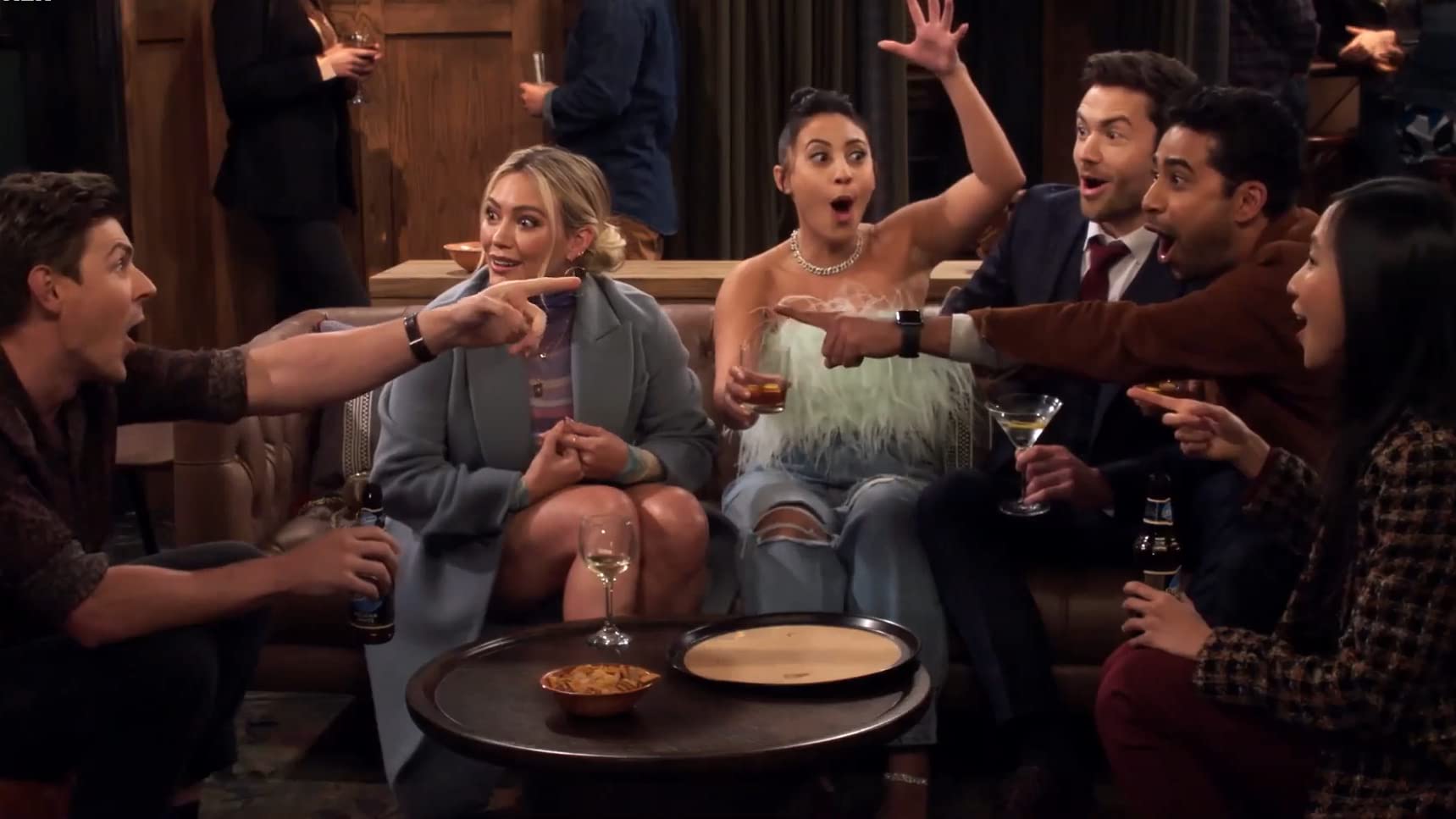

Kids, the second season of How I Met Your Father ended early this morning, and the show has finally hit its stride. After almost a season and half of floundering, it finally figured out how to take the format of the post-modern classic sitcom How I Met Your Mother, its predecessor show, and apply it to a new generation with new problems. The new showrunners have made it clear that their How will be simpler with less mystery than its older, more beloved (and much more layered) wife. With the season-two-finale-last-minute reveal of Charlie’s destiny–to marry Valentina and have a baby–the Father’s identity is now down to two candidates: best friend Sid or off-again, now-on-again Charlie. Who will young Sophie (Hilary Duff) choose? We don’t get to see the son that older Sophie (Kim Catrall) is talking to as she flashbacks, and now we know why: he’s either 100 percent white or 50 percent East Indian.
At first the Gen Y sitcom felt like the writers were just using stereotypical ideas from, say, New York magazine—jokes about OnlyFans and references to dating apps were Spider-sensed a mile away. But Father finally began to work once the focus shifted to how our heroes were managing themselves and their various relationships and the writers found their own rhythm away from recent memories of Ted, Robin, Marshall, Lily and Barney. It’s streaming on Hulu, so there’s not a lot of room for overdoing great bits like Barney’s Playbook or Robin Sparkles or expressing a deep love of suits. Twenty episodes in—the amount of just one season on a broadcast network a decade or so ago—and the successor is becoming fully formed. With the WGA strike ongoing (and maybe also the SAG-AFTRA strike looming) as I type, we have a real-world To Be Continued.
Mother was a phenom I refused to be involved in at first. I was the ultimate Friends fan and the last thing I wanted to do was stay longer in white-privileged Manhattan. And this new show, complete with print ads too reminiscent of my now-old pals, was on CBS, the Old White People’s Network, so double no thanks. But I was bored one year in the cord-cutting teens and wound up watching the entire last season, its ninth and considered worst, in real-time. I was intrigued by the level of creativity I saw, so a year or so later, with cable returning to my life, I started binging it on FX, which back then was airing it three hours a day and largely in chronological order. So I quickly became obsessed and quickly forgot all about my worn-out Central Perk pals. I wound up watching the entire Mother run about three times. The more I watched it, the better it got. If Stan Lee’s Marvel genius was placing a traditional, bland superhero comic in a bowl and pouring into it the maximum amount of comics monster, romance and comedy, as comics historian Douglas Wolk explains, then HIMYM took the Friends format and poured as much Sex in The City and Mad About You and Woody Allen movies and real-life family heartbreak as would fit. Although you can tell that both Hows were created from personal experience, it was Mother that took you on a tour-de-force of the internal nature of relationships.
So what was Mother about, anyway? Well, the most important thing to know is that it wasn’t about meeting anybody. If you scan any corner of the Web, it was loudly declared a waste of time because, many, many, angry and devoted fans argue, Mother wasted all its buildup. The titular object character, used only for a season and an episode. Ninety-five percent of Season 9 was basically one extended plot. The two-part series finale, punctuated by an ending that seemed unforgivable—They lied to us in the pilot!!! They said the show wasn’t going to be about Ted and Robin!!!—left betrayed legions of die-hard fans. (I found out that there are HIMYM fans who are so hardcore, they even picked their own series ending: for some, Victoria, a great love of Ted’s, is their real Mother, and so for that audience, their driving off into the sunset at the end of Season 7 is their fini.) Because I saw the series’ ending first, I side with the writers/ showrunners, who were brave enough to fulfill their original vision. The whole nine seasons are only about Ted’s emotional development into a great husband and father; he gives a speech in the pilot that kinda explains this. So the rabidly loyal audience, from my view, got waayy too stuck on the show’s title and the titular character, and maybe even Robin, too. It’s really a show about how hard dating is and how difficult relationships of all types are as you develop until full adulthood. The HIMYM cast are portraying young adults trying to prepare, in their own very specific ways, for the quickly-arriving middle age.
Father, in contrast, is about a different generation—one, if stereotypes hold, is more inclined to hookups and journeys into personal wellness. They are still emerging adults, even though all of them are in their late 20s and early 30s. They hold down jobs like actual grownups but still have held onto a lot of college-level fluctuating maturity. Thusly, sometimes thought I was watching early-season eps of Friends or That ‘70s Show. Unimaginative writing, particularly in comparison with the multi-leveled Mother? Yep….And/or the showrunners were taking things that worked for their characters and merging them into the How world. Ambitions are low: where the Mother characters want to achieve something adult-hard and career-specific in their lives, the Father characters just yearn to see themselves as psychologically stable and emotionally functional. The already-established Mother themes—Daddy Search, friend/lover co-dependency—are done through this younger lens. So there are different tensions in Father that, if you are a Mother fanatic like I guess I am, seem like a lack of such until you figure out that our new heroes are still developing personally and emotionally, still trying to figure things out. They might laugh at Barney’s lifetime goal of achieving legendary status; a good time is good enough for these folks.
The new show also has it harder because it can’t rely on the blatant sexism and racism of the old. The crucial humor in HIMYM was provided by a never-ending clash of interpersonal relations and personal philosophies. At one McClaren’s booth, a young married couple lock horns with two single people—one desperate to be a married father, the other in search of a top-flight television news career—and one blatant, unmarried misogynist. Barney’s statements and antics belie very clear and unapologetic sexism—if you are dumb enough to fall for my shenanigans, he strongly implies for the entire Mother run, you deserve the bad treatment I’m going to love to give you. Feminists Lily and Robin love and tolerate Barney while being repulsed by what he does, a schism that today would subject the entire quartet to complicity charges. Stepping firmly out of that shadow, Father showrunners took pains to show that post-MeToo Barney not only has grown as a person but is also continually punished for his past behavior.
A mid-21st-century sitcom, HIMYF is trying to make up for the all-white TV New Yorkers at the turn of the century. It didn’t help that Mother was publicly guilty of blatant yellowface:
#HowIMetYourRacism, gulp! And this, ironically, was after the all-white sitcom made fun of the guilt of (unintentional) white cultural insensitivity:
So the key question here is: in the platform cosmos, is this continuation actually necessary? Not sure. I enjoyed the Mad About You revival but didn’t need it. Any two HIMYM scenes are laugh-out-loud funnier than entire episodes of Father. But the new show is charming as a perpetuation of a joyfully-recognizable format. I am rooting for a third Father season not because I necessarily have fallen in love and therefore now miss these new characters, but because I found out that, faint echo be damned, I consistently yearn for this specific storytelling universe, to return to this mall.
SEPTEMBER 1 UPDATE: 😦 https://www.hollywoodreporter.com/tv/tv-news/how-i-met-your-father-canceled-hulu-2-seasons-1235580393/
 Drums in the Global Village