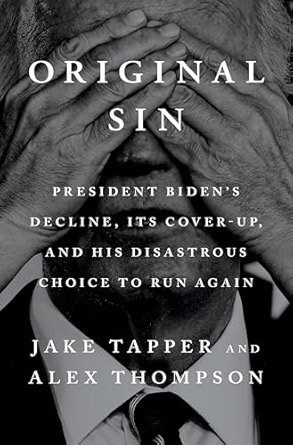
The election-insider story never gets old because America’s elite political class, like everyone else, loves a good reality show, particularly if it’s starring them and their family members and loved ones in longform narrative text. In this downer Election 2024 tale, which would have made a better magazine article and will one day make a better major block in a chapter on a future Vol. 2, 800-page Biden autobiography, Tapper and Thompson use reporting and transcripts to document a decline everyone saw and understood in real time, including the whys–why he refused to recognize it at first, why he is now saying he could have won, etc. Normally, a book like this would be dominated by fast-paced acts designed to win an election; here the repeated scenes of lying, denial, protection and delusion–“a theology that bordered on zealotry” is how the authors put it–just add up to a sad tale of a 20th-century Delaware power couple, the Fates’ tough-as-nails playthings, who survived very dark times to get the crowns and scepters too late. Leading the world when you have to be personally led around is an amazing spectacle but power demands complete, mobster-like loyalty. So Special Counsel Robert Hur, the book’s coal-mine canary and his supervisor U.S. Attorney General Merrick Garland get eventually vindicated but not publicly apologized to for, respectively, telling the truth and exhibiting ethics over partisanship because, well, politics ain’t beanbag. The idea that Biden’s roundtable would “Weekend-at-Bernie’s” a president is disturbing but most of the Monday-morning, anonymous quarterbacking by the politicos reads shallow because it is that; they signed on to the (lucrative) Washington political establishment with their blood a long time ago. With the Republican and Democratic parties about to experience a youth spurt in 2028, perhaps this almost-necessary book is just part of the last chapter of the Boomer and pre-Boomer political dynasties. For political diehards only.
The Democratic National Convention wrapped up in Chicago on Thursday with Vice President Kamala Harris formally accepting the presidential nomination, capping a week of political showmanship and celebration for many party members. “One of the things that struck me most was the level of choreographed mass spectacle of this convention that would be really worthy of Leni Riefenstahl,” says Democracy Now! co-host Juan González. He says Democrats and Republicans presented “the two faces of American capitalism” at their respective conventions this summer, with the GOP home to “white supremacist capitalism” while Democrats promote a “multiracial neoliberal capitalism.” He adds that despite the constant chants of “U.S.A.” throughout the week, “the reality is that the United States has never been lower in its prestige and never more discredited around the world than it is today.”
*****
AMY GOODMAN: But before we end, Juan, we began this week with you and Bill Ayers going back to 1968, talking about the protests of the time. And as we begin to wrap up, can you share your thoughts about this week?
JUAN GONZÁLEZ: Well, you know, I think one of the things that struck me most was the level, as I said, of choreographed mass spectacle of this convention that would be really worthy of Leni Riefenstahl, the famous Nazi, Hitler’s filmmaker and propagandist, in terms of controlling the narrative that the America people receive of what the Democratic Party is about.
We’ve seen that both the Republican convention and the Democratic convention show the two faces of American capitalism. On the one hand, with the Republicans, you have a party of a white supremacist capitalism, of anti-immigrant xenophobia, of patriarchy and of war on the working class. And now, this past week, we’ve seen the party of multiracial neoliberal capitalism, for a party that seeks a kinder and gentler form of mass deportation and border militarization, and one that is even more aggressive in the imperial policies of the United States than even the Republican Party, if you consider that.
And both parties sort of having a disconnect with the rest of the world. I was stunned by all the chants of “U.S.A.! U.S.A.! U.S.A.!” throughout the Democratic convention, when the reality is that the United States has never been lower in its prestige and never more discredited around the world than it is today as a result of — especially of the war in Gaza, but of all the attempts at regime change and controlling other countries and forcing other countries to do what it wants.
And it reminds me constantly that “one person, one vote” is a dangerous concept, because there’s always the possibility that the masses of people will act in ways that the rulers don’t want. So, the necessity to control the narrative, to control what the people consider possible, is so important to our ruling classes. And that’s why they invest so much time and so much effort in this choreographing of spectacle to, somehow or other, prevent the people from thinking of other possibilities.
And so, I think that that’s what most — had most impact on me, and also the fact that the social movements have had impact. I think Kamala Harris’s choice of Tim Walz was a direct response to the sense among this multiracial neoliberal wing of capitalism that they’ve got to, somehow or other, placate the masses of the people and bring the young people back into the fold. And so, I think they’ve attempted to do that. We’ll see what happens in the coming weeks. But I think that the choices have never been clearer between the two forms of capitalism. And we’ll see what the American people decide in the coming weeks.
BARBARA RANSBY: I agree. I was nodding and amening as Juan was commenting. Yeah, I mean, two faces of capitalism, because we see — you know, it’s very hard to be enthusiastic about this moment in the Democratic Party, with Gaza and everything else. And I think the cynicism of this orchestrated consensus at the convention is one example of that.


 Drums in the Global Village