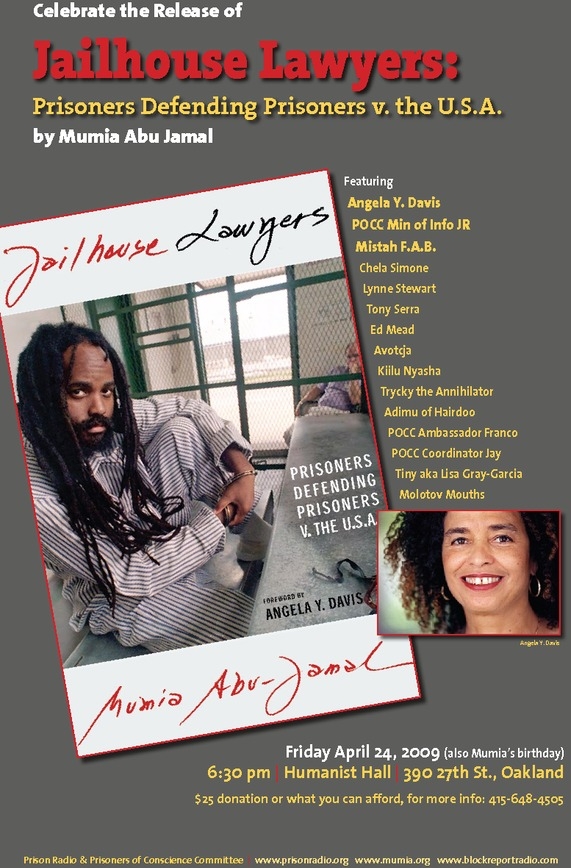
She’s speaking on Mumia Abu-Jamal’s birthday (April 24th) at a program in Oakland celebrating Abu-Jamal’s sixth book.
Book Review: Mumia The Institution
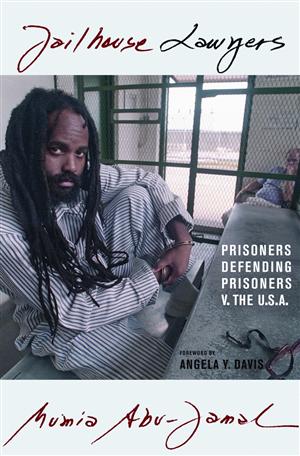
Jailhouse Lawyers: Prisoners Defending Prisoners v. The USA.
Mumia Abu-Jamal.
Foreword by Angela Davis.
City Lights Books.
251 pp. $16.95.
Mumia Abu-Jamal points out in his latest book, his sixth from Death Row in Pennsylvania, that unfortunately jailhouse lawyers—prisoners who learn the law in the joint and help other prisoners with appeals and legal problems—have a reputation of freeing others while they squat. “It’s the bane of jailhouse lawyers. They seem to be able to help everybody but themselves.” That truth hit home earlier this month when the U.S. Supreme Court refused, without comment, to hear the former Black Panther’s appeal for a new trial based on the prosecution’s consistent exclusion of blacks from his 1982 jury pool. He turns 55 Friday, which means he has officially spent more than half his life in jail. Unless further appeals work, a new Philadelphia jury will eventually be composed, and it will give him life imprisonment or re-institute his death sentence for the 1981 murder of Daniel Faulkner, a white Philadelphia police officer. Then the state of Pennsylvania will try to kill him again.
Abu-Jamal, a journalist and activist who has been a jailhouse lawyer, does not define his existence as one of a prisoner, even though his daily world is a small cell that he has said is the size of a bathroom. That dual actuality makes his return “home” of sorts with this work even more interesting. “Jailhouse Lawyers” boomerangs back to themes Abu-Jamal established in his first book, a collection of journalistic essays called “Live From Death Row”: that America works hard to create, then to forget, the prison industrial complex; that struggle breeds both repression, and more struggle, and that laws were made to be broken, bent and ignored when the oppressed are concerned. As usual, Abu-Jamal blends history with current perspectives effortlessly; his decades of reading, writing and analyzing from behind bars has transformed him into his own John Henrik Clarke or Lerone Bennett Jr. History in rhythm, commentary with bite.
This “act of underground reportage,” filled with interviews of those considered jailhouse lawyers from Texas, Pennsylvania, California, New Jersey, Florida and other states, is a well-documented exploration of the sub-title. In several short profiles of courage, he collides the rights of prisoners and the nation’s political reality of law. To the prisoner, writes the prisoner, the law is as “real as steel and hard as brick.” And jailhouse lawyers, he writes, practice law “written with stubs of pencils or with four-inch long, rubberized flex pens, in the hidden, dank dungeons of America—the Prisonhouse of Nations.” Therefore, explains the author, “[f]or both jailhouse lawyer and client, the state is the entity that stole their freedom and with which they must contend, and they are thus highly motivated to fight for those who enlist their help.”
A highlight is a powerful account of how members of the MOVE Organization successfully represented themselves in the bowels of Babylon. The chapter gives new insight as to why a radicalized 28-year-old Abu-Jamal, a supporter of MOVE, kept demanding two things during his 1982 murder trial: to represent himself, and to have MOVE founder John Africa be his co-counsel. (The judge, Albert Sabo, only granted the former, and that only for a little while, while, ironically, John Africa never showed up.) In writing about another MOVE supporter who represented himself, Abu-Jamal relates that the man “had to reiterate his words repeatedly, incessantly, in order to be heard, finally.”
Not even an embryo in the Reagan years, the “Free Mumia” movement is showing its age in the dawn of the Obama era. The photo portrait on the cover is fourteen years old. Emerge magazine, a Black monthly newsmagazine, used it for its 1995 cover story. Abu-Jamal is probably a little grayer, now, at 55, but he’s still living, while Emerge is just a memory on faded glossy paper, a quaint mass media-era memento marking the last moment before the Internet took over. Meanwhile, that same man in 2009, who, in all probability, will not be released from prison alive—and who allegedly has never been online, one who uses a typewriter and hand-written notes to write his books and essays—continues to use his words to illustrate a hidden chapter of a struggle he now knows he is probably not going to personally win.
As with his other five books, “Jailhouse Lawyers” is another example of Abu-Jamal’s resistance—against state oppression, against collective political amnesia, against America’s constant denial of what is left in its shadows. With this first writing cycle complete and his power strengthened and renewed from it, the author confronts the idea that he has successfully written himself into (his own) history.
Elite Washington, D.C. Media Still Heart Obama :)

My Gosh! 🙂 Is there such a thing as good Black objectification? Ladies, I’ll let you answer this one. 🙂
When A Local, Independent Bookstore Dies………….

…..that booksigning you were going to have one day at your “home” when your book was finally going to be published is now not going to happen.
…..that great friend or SO you were going to meet there you now won’t.
…..you lose a fun, save haven for children.

…..that important fact or truth you were going to learn from the special guest, there shilling his or her book, you now are not going to learn.
……that great book you accidently found while searching for something else you will now never read.
…..you lose another place where the owners remember your name.
……you again are reminded that habits change and they don’t change back.
…..you lose another place where your worldview is affirmed.
……life becomes a little bit less filled with a sense of community.
Thanks, Todd and Bridget (the couple on the right), for fighting The Good Fight for so long!
Asante Sana, John Hope Franklin
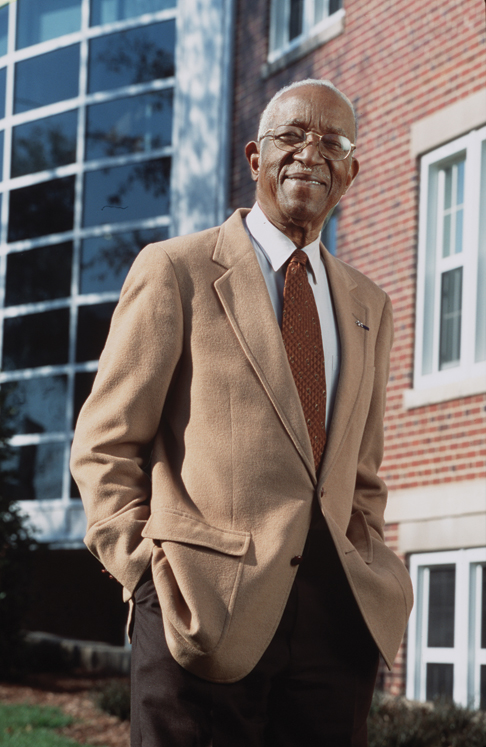
John Hope Franklin aided Thurgood Marshall in the Brown case and wrote a definitive history of African-Americans. If that was all he did, it would be enough. But he was a very productive scholar who was serious squared about (African-)American history.
A Slow Death?

It’s going WAY too fast for me. My friend Wayne Dawkins explained to me that the Great Recession has turned what was a 10-year transfer away from print into a one-year shift, which is why it’s so painful for so many. I think he’s right.
Presenting…… "In Blackest Night: Rise of the Lantern!"

I’m happy to say that I know several Morgan State University students who are involved in this short. 🙂 This student project—which reimagines how John Stewart became Green Lantern—stars three students I had the honor of teaching, and one of our (Department of Communications Studies) faculty members.
The sequel is in post-production. I think I caught a scene being filmed in the hallways a couple of weeks ago. 🙂
Fiore Has Done It Again!

What a GREAT way to show the problems in Darfur!
Why We Still Need Mainstream (Print) Journalism

An important story on important work.
Did You Read………..
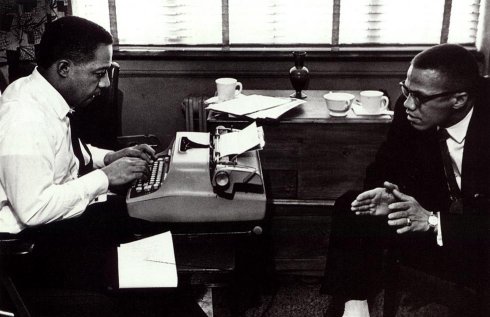
….this interview with Manning Marable about his upcoming biography of El-Hajj Malik El-Shabazz (Malcolm X)?