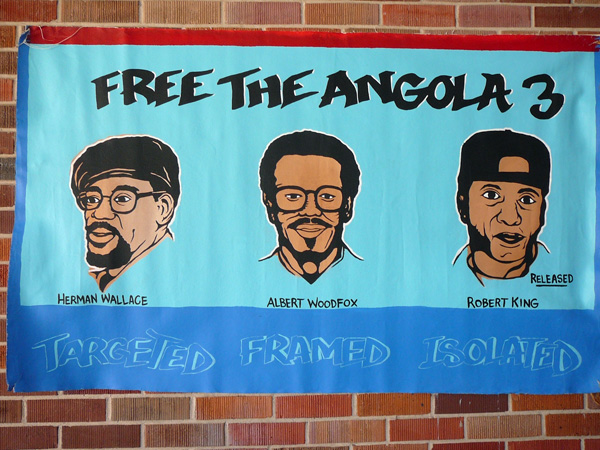
Herman Wallace Has Joined The Ancestors

Angola3_40_years

What’s amazing about this is that he enjoys THREE DAYS of “freedom” after a judge finally let him out (scroll to middle)!

This morning we lost without a doubt the biggest, bravest, and brashest personality in the political prisoner world.  It is with great sadness that we write with the news of Herman Wallace’s passing.

Herman never did anything half way.  He embraced his many quests and adventures in life with a tenacious gusto and fearless determination that will absolutely never be rivaled.  He was exceptionally loyal and loving to those he considered friends, and always went out of his way to stand up for those causes and individuals in need of a strong voice or fierce advocate, no matter the consequences.
Anyone lucky enough to have spent any time with Herman knows that his indomitable spirit will live on through his work and the example he left behind.  May each of us aspire to be as dedicated to something as Herman was to life, and to justice.
Below is a short obituary/press statement for those who didn’t know him well in case you wish to circulate something.  Tributes from those who were closest to Herman and more information on how to help preserve his legacy by keeping his struggle alive will soon follow.
———————-
On October 4th, 2013, Herman Wallace, an icon of the modern prison reform movement and an innocent man, died a free man after spending an unimaginable 41 years in solitary confinement.
Herman spent the last four decades of his life fighting against all that is unjust in the criminal justice system, making international the inhuman plight that is long term solitary confinement, and struggling to prove that he was an innocent man.  Just 3 days before his passing, he succeeded, his conviction was overturned, and he was released to spend his final hours surrounded by loved ones.  Despite his brief moments of freedom, his case will now forever serve as a tragic example that justice delayed is justice denied.
Herman Wallace’s early life in New Orleans during the heyday of an unforgiving and unjust Jim Crow south often found him on the wrong side of the law and eventually he was sent to the Louisiana State Penitentiary at Angola for armed robbery.  While there, he was introduced to the Black Panther’s powerful message of self determination and collective community action and quickly became one of its most persuasive and ardent practitioners.
Not long after he began to organize hunger and work strikes to protest the continued segregation, endemic corruption, and horrific abuse rampant at the prison, he and his fellow panther comrades Albert Woodfox and Robert King were charged with murders they did not commit and thrown in solitary.  Robert was released in 2001 after 29 years in solitary but Herman remained there for an unprecedented 41 years, and Albert is still in a 6×9 solitary cell.
Herman’s criminal case ended with his passing, but his legacy will live on through a civil lawsuit he filed jointly with Robert and Albert that seeks to define and abolish long term solitary confinement as cruel and unusual punishment, and through his comrade Albert Woodfox’s still active and promising bid for freedom from the wrongful conviction they both shared.
Herman was only 9 days shy of 72 years old.
Services will be held in New Orleans. The date and location will be forthcoming.

For more information visit www.angola3.org and
http://angola3news.blogspot.com/.

From Wednesday’s “Democracy Now!”:

NERMEEN SHAIKH: We begin today’s show with news in a case Democracy Now! has been following closely. Herman Wallace, a member of the so-called Angola Three, has been released from prison after being held for nearly 42 years in solitary confinement. He was taken directly to the hospital, where he now lays dying of advanced stage liver cancer.

Wallace and two others were in prison for armed robbery, then accused in 1972 of murdering a prison guard at the Louisiana State Penitentiary, known as Angola. The men say they were framed because of their political activism as members of one of the first prison chapters of the Black Panther Party.

The dramatic series of events on Tuesday began when Federal Judge Brian A. Jackson of the Middle District Court of Louisiana ordered Wallace’s release and overturned his conviction. In the order, Judge Jackson called on the state to, quote, “immediately release Mr. Wallace from custody” due to an improperly chosen grand jury that excluded women jurors in violation of the 14th Amendment. The state appealed the ruling, but Judge Jackson quickly responded with another order that said failure to release Mr. Wallace from custody will, quote, “result in a judgment of contempt.”

AMY GOODMAN: As the legal battle played out, Herman Wallace’s lawyers sent an ambulance to wait outside the gates of the prison to pick him up. Then, at 7:30 p.m. Central time Tuesday night, Herman Wallace, who is 71 years old, was met by members of his legal team at the gates and left the prison in the ambulance that took him to New Orleans. He was taken directly to a hospital, where supporters there greeted him.

SUPPORTER: That’s him! [cheering]

AMY GOODMAN: For more, we’re joined by one of the people who met Herman Wallace to deliver the news he would be released: fellow Angola Three member Robert King. Until Tuesday night, King was the only freed member of the Angola Three. He spent 29 years in solitary confinement for a murder he did not commit. He was released in 2001 after his conviction was overturned.

The third member of the Angola Three, Albert Woodfox, remains in prison at the David Wade Correctional Center in Homer, Louisiana. In recent months, he says he’s been subjected to strip searches and anal cavity searches as often as six times a day.

Robert King joins us from Austin, just back from visiting Wallace. In fact, he was the one who delivered the news to Herman Wallace that his conviction had been overturned.

Here in New York, we’re joined by Herman Wallace’s defense attorney, George Kendall.

But first we go directly to the New Orleans hospital where Herman Wallace lies. We’re joined by Jackie Sumell, the artist behind Herman’s House. She joined us on Monday in studio in New Orleans when Democracy Now! was broadcasting from there, broadcasting about the case of Herman Wallace, then still in prison. Now she joins us by phone at the bedside of Herman Wallace from the LSU—Louisiana State University—Medical Center, where Herman Wallace is now.

Jackie, can you talk about Herman’s condition at this point?

JACKIE SUMELL: Yeah, good morning, Amy. Herman has taken a turn for the worse. At about 3:00 in the morning, I got a phone call from one of the other supporters, who said, “You should come in.” The doctors aren’t sure if his kidneys are also failing, as well as his liver. So I’ve been with him since 3:00. He’s not very—he’s able to speak a word, like if you move him around, he’ll yell or indicate that he’s uncomfortable, but he doesn’t seem to be cognizant in any other way. Yeah, it’s a really intense time right now. And it’s myself and a few other long-term supporters and his sister that are bedside with him.

AMY GOODMAN: Jackie, did he understand yesterday at the prison that he was being released?

JACKIE SUMELL: You’d have to ask George and King whether or not he understood it at the prison. I know that he did understand it last night when we had about a hundred supporters cheering him on, welcoming him home with banners and signs, chanting “Power to the people!” He was very cognizant then. You know, this turn for the worse happened, like I said, at about 2:30, 3:00 this morning.

AMY GOODMAN: Let’s turn to Robert King, another member of the Angola Three. Robert King is free after 29 years. Albert Woodfox remains in prison. And, of course, as we said, Herman Wallace, in a complete surprise move of a federal judge, had his conviction overturned yesterday with a demand for his immediate release, which happened last night. Robert King, you were in prison with Herman Wallace visiting him to say your final goodbye as he lay dying of liver cancer. You delivered the news to him about the overturning of his conviction. How did Herman respond?

ROBERT KING: Thank you, Amy. Straight to the point, yes, of course, when we brought the news to Herman that he was being released, we had to do it in part, in bits and pieces. We only learned on our way to the prison from George Kendall, the head attorney, that Herman’s case had been overturned, and so we were a bit surprised, but we had some good news for him. And when I saw him, I saw, as Jackie indicated, he’s pretty—pretty bad; he’s in pretty bad shape. His body is failing him.

But I was there, Amy, you know, not so much as to witness his death, but, as you said, to also try to encourage him to hold on and to try to get him to recognize that his supporters, lawyers and all included were on board and trying to get him released from prison. And when we heard about this, we told him. And I think we managed to penetrate—we managed to penetrate and get to him the point that he would probably be released or could be released. I remember the lawyer on the way out telling Herman to hold on. And his word, which were the best words of the day, he said, “I will hold on. I’ll hold on. I’m going to hold on.” And it was pretty touching.

And I do feel this, Amy, that he will hold on, in spite the fact that his body has failed and is failing him. I believe in—I still believe in miracles, and I believe we can perform miracles. People can perform miracles. And there are doctors among us who can perform miracles to deal with a situation such as this, and hopefully this is one of those times. Hopefully, it is not too late.

But in any case, Herman, whatever happen or whatever transpires, Herman will know one thing. I think he recognizes this, and he understood this and understands that there are many people, millions of people, who really love him and who support him, and they are by his side. And he feel that he has contributed in some way to the struggle, regardless of what happen. If Herman survive, he will continue to struggle. But if not, then his millions and legions of supporters around the world are on board to continue the struggle, but it’s—because this is not just a fight to have him released from prison, but to have his conviction overturned and to deal with so many other. And we have Albert Woodfox to consider, as well. He is still on board, and he is suffering just as much as Herman. He has now the—will now be the longest-serving prisoner in solitary confinement. So we have to deal with him. We have to continue with all the rest of the stuff that is going on regarding prison, the Mumias of our society. We have to think about them, as well. But Herman—

AMY GOODMAN: Robert, he was with you—

ROBERT KING: —will be OK.

AMY GOODMAN: Robert, he was with you yesterday, Albert Woodfox. I mean, this is an unusual, to say the least, gathering. You would never have been allowed to visit Herman Wallace. And, of course, Albert Woodfox wouldn’t, either, as he remains in prison. But it was the final goodbye. What was Albert Woodfox’s words for Herman Wallace in that prison cell, in the prison, where you were with him, in the hospital there?

ROBERT KING: Well, Albert’s—yes, thank you. Albert’s last word was, “Herman, we love you, and you’re going to get out here today. We’re trying to get you out. The lawyers will have you out today.” And it was his last word, and he kissed him on the forehead. But prior to that time, he had been encouraging him and that—you know, to hold on and that he will be free and that there are people working for him and that he won’t be—he won’t be forgotten in any way.

AMY GOODMAN: Was he shackled?

ROBERT KING: Albert Woodfox was very much shackled and handcuffed. He had the usual, traditional belt on, chain with the belt, the locks and so forth and so on. And it was difficult for him to eat his meal. He was having problems. We had to help him to eat, because he could not hold the tray in which the food—that held the food.

AMY GOODMAN: George Kendall, you’re Herman Wallace’s attorney. How did this happen?

GEORGE KENDALL: The courts—there are many tragedies in this case, and one of them is that the state judiciary in Louisiana knew for a long time that this trial was very unfair but just refused to grant a new trial—decades ago. When Judge Jackson finally took a look at this case, I think he concluded pretty quickly, “This is unfair, and I have to overturn it.” And to his great credit, he did so. Herman wrote to the judge, after he learned that he was diagnosed with terminal liver cancer, and said, “I’ve fought for 40 years to receive a new trial. Please, don’t let me die before I hear from you.” We filed a bail motion. A lot of federal judges don’t know this: They have the power to grant bail in these habeas proceedings. It’s rarely used. And Judge Jackson said, “I’m not going to grant bail now, but I will decide this case without delay.” Of course, we would have liked him to decide this quicker, but when he decided the case, he made it very clear—two things: The first trial was unfair, violated the Constitution—Mr. Wallace was right—and that he needed to be released today. And, unfortunately, it took state officials hours to comply with that. In fact, Judge Jackson had to issue a second order at 6:00 p.m. last night. And it was only, I think, because the prison knew that Judge Jackson was not playing, and we had an ambulance at the gate.

AMY GOODMAN: The warden had gone out to dinner and said he would not be returning to release Herman Wallace?

GEORGE KENDALL: The warden said at 2:30 that he was not going to release him. And the judge then issued a second order at 6:00 p.m. that said, “I meant what I said. He is to be released immediately.”

NERMEEN SHAIKH: So, I want to—I want to read from U.S. District Judge Brian A. Jackson’s order that led to Herman Wallace’s release Tuesday. He wrote, quote, “The record in this case makes clear that Mr. Wallace’s grand jury was improperly chosen in violation of the Fourteenth Amendment’s guarantee of ‘the equal protection of the laws’ … and that the Louisiana courts, when presented with the opportunity to correct this error, failed to do so,” Judge Jackson wrote. He added, quote, “Our Constitution requires this result even where, as here, it means overturning Mr. Wallace’s conviction nearly forty years after it was entered.” So, George Kendall, can you talk about why it is that it was this particular aspect of the trial that he—that the judge chose to emphasize, the absence of women from the grand jury?

GEORGE KENDALL: There were several very strong claims in this case, and I think Judge Jackson just—this was so straightforward and clear, that the law required him to grant habeas relief on this, he took this issue. And it also showed, if you read the opinion, that Herman had determinedly, on his own, tried to litigate this issue before the Louisiana state courts for decades—I mean, cited new cases when they came down, put the record facts in. And there were—there were two or three judges in the state process, as his appeals went through, that said, “You know, we need to grant relief in this case,” but they never had the majority during this time. So, it was no secret that there were profound problems with his case, but it’s tragic that it took four decades for him to get a new trial.

AMY GOODMAN: What does this mean for Albert Woodfox?

GEORGE KENDALL: Albert has twice—three times had his case overturned. Last year Judge Brady, also in the Middle District of Louisiana, overturned his conviction for a second time.

AMY GOODMAN: Were they tried together?

GEORGE KENDALL: They were not tried together, tried separately. But Albert won on a discrimination, racial discrimination in the grand jury composition in his case. That case, his case, now is up on the state’s appeal to the Fifth Circuit Court of Appeals. The Fifth Circuit wants to overturn Judge Brady’s grant of a new trial.

AMY GOODMAN: What’s very interesting is that in this case the widow of the prison guard who was murdered in 1972, Teenie Verret—she was just 17 at the time that her husband, Brent Miller, was stabbed to death. This is what she had to say in the documentary In the Land of the Free.

TEENIE VERRET: I’ve been living this for 36 years. There’s not a year that goes by that I don’t have to relive this. And it just keeps going and going. And then these men, I mean, if they did not do this—and I believe that they didn’t—they have been living a nightmare for 36 years.

AMY GOODMAN: That was Teenie Verret, the widow of the prison guard who was murdered. So, let’s be clear, George Kendall, Albert Woodfox and Herman Wallace went to jail for robbery.

GEORGE KENDALL: Correct.

AMY GOODMAN: It was in jail that they—in the prison, that they were accused of murder and for which they have served longer on death row—on solitary confinement, consecutively—you know, I said “death row,” but for a lot of that time they were actually on the row—

GEORGE KENDALL: That’s correct.

AMY GOODMAN: —than any prisoner in U.S. history.

GEORGE KENDALL: We have found that there’s no prisoners who have served—who have been locked up for four decades, in a cell, 23 hours a day, the way they have been. Some of those days, they did not get out at all; other days, they got out for 15 minutes at a time. We have a separate lawsuit that will go to trial in Baton Rouge in June that seeks an injunction and damages for all the time that they have wrongly been housed in solitary confinement in Louisiana.

NERMEEN SHAIKH: And what about the litigation that challenges his—Mr. Herman Wallace’s unconstitutional confinement? That’s likely to continue. Could you say a little about that?

GEORGE KENDALL: Yes. That is a lawsuit that Mr. King is involved in and Mr. Woodfox, all. That case will—it involves violations of the cruel and unusual punishment clause, because they’ve been held in cells for so long without any justification, and of the 14th Amendment. That case is set to go to trial in Baton Rouge in June of next year.

AMY GOODMAN: I want to go—oh, go ahead.

GEORGE KENDALL: And I also want to mention that Albert Woodfox—you said that he has just recently again been subjected to anal searches every time he leaves his cell, whether it’s just a walk down the tier to take a shower. Albert, 30 years ago, on his own, filed a lawsuit and won a lawsuit that prohibited the Department of Corrections from engaging in those kind of searches. And we called that to the attention of the Corrections Department when they started doing it again, and they said, “We’re going to continue to do it.” We filed yesterday in federal court in Baton Rouge a lawsuit seeking an injunction barring the Department of Corrections from using that kind of search on Mr. Woodfox and others in that cell block.

AMY GOODMAN: The judge who issued the order that he should not be strip-searched like this—anal cavity, oral cavity strip-searched—died.

GEORGE KENDALL: That’s correct.

AMY GOODMAN: Right afterwards, they resumed?

GEORGE KENDALL: That’s correct.

AMY GOODMAN: Doesn’t a judge’s word carry on beyond his life?

GEORGE KENDALL: We think that the Department of Corrections is going to find out that it does. We are—we are optimistic that Judge Brady is going to tell the Department of Corrections, “You cannot do this. Stop.”

NERMEEN SHAIKH: I mean, on what basis were these three subjected to such extraordinary—extraordinarily punitive measures in prison? And on what basis was that justified for decades?

GEORGE KENDALL: They were perceived in 1972 as black militants. At the time, the investigation into the tragedy of Brent Miller’s death was—went off the rails by racist Louisiana prison officials.

AMY GOODMAN: And yet, as we’ve heard, his own widow did not believe these men did it.

GEORGE KENDALL: That’s correct. There is a bloody fingerprint. Whoever committed that crime left a bloody fingerprint. It is not Herman Wallace’s. It is not Albert Woodfox. It’s not anyone who was charged with that crime.

AMY GOODMAN: Robert King wasn’t even in the prison at the time.

GEORGE KENDALL: He was not even in the prison at the time. These men, over the years, despite being locked up, have helped numerous other inmates on those tiers in many ways. I have another client at that institution who got there at the age of 17 and would never have survived. It was the bloodiest prison in America at that time. And he, to this day, said, “I would never have survived Angola in the ’70s, but for the wise counsel and love I received from Herman Wallace and Albert Woodfox.”

AMY GOODMAN: Robert King, could you talk about that, the philosophy of the Black Panther chapter in the prison where you were, the preaching against the violence and the racism?

ROBERT KING: Yes. Well, it was the—the philosophy was and the idea was to bring some type of consciousness to the prisoner. There were 17—as George pointed out, there were—Angola was considered the bloodiest prison in the nation. And there were 17—it was a slave plantation. There were 17 hour of work every day, and especially during can season, sometimes longer. Men were working, going into the fields without boots or raincoat, without being fed adequately.

Albert and Herman and other members of the Black Panther Party decided to bring this knowledge to prisoners that they still have a right, they were human beings. And this was the teaching of the Black Panther Party ideology, you know, that we were protected by due process, 14th Amendment and other constitutional grounds. And we adhered to that. Of course, the prison tried to discourage us and, you know, impose punitive measures for—upon us for doing this, but we continued to do so. And we were successful. Herman and Albert were very, very successful, along with other people who also organized with them.

And as a result, they have paid dearly for it, because people, as George pointed out and other prisoners point out, that during that time it was a—it was a dire period in prison—and Herman and Albert. There were numerous rapes that were going on and that were being allowed by the prison officials. Inmate guards ran the prison. They were the backbone of security in prison. They sold younger prisoners to older inmates for sexual—you know, for sexual purposes and so forth. And this was something that, while the Black Panther Party members were not homophobic or anything like this, but to be in a situation where you were forced into this type of activity was something that we frowned on. And even if we had not been members of the Black Panther Party, we still would have frowned upon this, because it was a dehumanizing practices in a dehumanizing environment. And we felt the need and went out with—into prison, and I joined Herman and Albert, having the same ideology and being a member of the Black Panther Party and being a struggle—struggler, because I felt the need to struggle. I joined them. I willingly joined their efforts to kind of combat some of the stuff that was going on. And as a result, like I said, we were successful.

And as a result, Herman and Albert has paid dearly for it: more than 40 years in solitary confinement, convicted for a crime that is, for the most part, questionable, in which all the evidence has been undermined, where actual, not just factual, innocence exists, but actual innocence also exists. The facts adduced does not—you know, does not suggest that the trial was fair, the conviction was fair. And then there are actual innocence. Like George pointed out, there was a bloody fingerprint that was perhaps left by the person who committed the crime, that didn’t match any of the people who were subsequently charged. But nevertheless, they were charged with this. And so, they have paid dearly.

And I think the state recognized this. All—the state refused to recognize it openly, but I think, in time, they will recognize it. And I think, with the support that we have around the world, have garnered around the world, with, you know, the legions of supporters, I think they will continue to keep this out into the public, this case and cases like this in the public. And it won’t be forgotten.

NERMEEN SHAIKH: Well, let’s go to a clip of Herman Wallace in his own words, describing the impact of solitary confinement on his body. This is from the film Herman’s House.

HERMAN WALLACE: Being in a cage for such an extended period of time, it has its downfalls. I mean, you may not feel it, you may not know it, you may think that you’re OK, and you just perfunctorily move about, you know. However, when you was removed from out of that type of situation and placed in an open environment where, you know, you’re even breathing that oxygen and it’s getting into your lungs and you’re feeling something growing within you, and—you begin to develop a different mode within your body. I even watched my body. I’ve looked in the mirror, and I’ve seen muscles and [bleep] begin to pop out there. I began to run even faster and [bleep]. And I’m saying, “Whoa, what the hell is going on here?” Much was preserved. But then I got locked up again after eight months. And being locked up like that, the whole body just got confused.

NERMEEN SHAIKH: And I want to go to another clip from the end of the film, Herman’s House. It’s Herman Wallace describing a dream he had. Listen carefully.

HERMAN WALLACE: I’ve had a dream where I got to the front gate, and there’s a whole lot of people out there. And you ain’t going to believe this, but I was dancing my way out. I was doing the jitterbug. I was doing all kind of crazy, stupid-ass [bleep], you know? And people was just laughing and clapping and [bleep], you know, until I walked out that gate. And I remember that dream, and I turn around, you know, and I look, and there are all the brothers in the window waving and throwing the fist sign, you know? It’s—it’s rough, man. It’s so real, you know. I can feel it even now, you know, talking about that.

AMY GOODMAN: That is from the film Herman’s House. It’s the story of Jackie Sumell, who is now at Herman Wallace’s side as he lays dying in a New Orleans hospital, just brought back—released from prison after 42 years in solitary confinement. The film is about how Jackie Sumell, the artist, has worked with Herman to imagine a house he could be released to after being in a six-by-nine-foot cell for so many decades. We’re wrapping up now and moving on to another case of men in prison, this in Egypt. But, George Kendall, this, as we get word from the hospital about Herman’s condition, just released hours ago, is not the end of his case or Albert Woodfox’s.

GEORGE KENDALL: Albert Woodfox’s case is before the Fifth Circuit Court of Appeals. He also was awarded a new trial last year. We’re hoping that that court will sustain that order, so he will be entitled to a new trial.

AMY GOODMAN: And, Jackie Sumell, your final words, as you heard Herman talking about his dream of being released? That dream, very bittersweet, has been realized, as he fights for his life right now outside the prison walls.

JACKIE SUMELL: Yeah, I mean, my last words would be to actually remind people that this is a tremendous victory and a miracle that Herman Wallace will die a free man. You know, he’s had 42 years of maintaining his innocence in solitary confinement. And if his last few breaths are as a free man, we’ve won. We really won.

AMY GOODMAN: Jackie Sumell, we want to thank you for being with us, at the bedside of Herman Wallace at LSU Hospital right now in New Orleans. Robert King, thanks for joining us. Folks can go to our website to see our extended interviews with you, Robert—

ROBERT KING: Thank you.

AMY GOODMAN: —freed member of the Angola Three, spent 29 years in solitary confinement. Albert Woodfox remains in prison. And George Kendall, the attorney for Herman Wallace.

herman-2-april-2013

HERMAN WALLACE:  Revolutionary

[col. writ. 10/10/13] © ’13 Mumia Abu-Jamal

The long and tortured  life of Herman Wallace, of the famed Angola 3, was meant to terrorize us; to  stifle the resistance that flamed throughout Black America (and many others  across the country) during the ‘60s and ‘70s.

If so, it failed  utterly.

For Herman Wallace,  former Black Panther, despite the monstrous torture he sustained of 41 years in  the hole of Angola (I will not dignify it with the name, prison) – slave  plantation, was one who was caged precisely because, in mind, if not in body, he  was free.

He was one of 3 me, his  fellow ex-Panthers, Robert Hillery King and Albert Woodfox (the rest of the  Angola 3), who exampled strength, determination, and will during their hellish  times in Louisiana’s wretched dungeons.

I have used the words;  torture and I don’t use it lightly.

Juan Mendez, Special  Rapporteur for the United Nations, has found that solitary confinement, for any  period past 14 days, constitutes real psychological torture that destroys human  beings. 14  days.

Herman Wallace,  convicted on trumped-up charges under poisonous Louisiana ‘justice’, spent 41 years in  solitary.

In Angola. In Lousiana.  In the United States of America.

Forty-one years. Let’s  put it another way.

Herman Wallace spent  14,965 days in solitary.

Herman Wallace spent  359,160 hours in solitary.

Herman Wallace spent  21,549,600 seconds in solitary.

When a federal judge  tossed out his illegal and unconstitutional conviction, ordering his release,  Herman Wallace, bed-ridden, spent 3 days in freedom, until returning to his  ancestors.

His flesh is returned  to the earth, our Mother.

But his spirit burns  with strength, and rock solid commitment to freedom for us  all

According to published  reports, Herman’s last words were, “I am free!”

But, he always  was.

Herman’s contribution  to freedom, even while in the vilest dungeons in America, while in shackles and  chains, in Angola, was immense.

If he were still  present, he would urge us all not to forget his brother-in-chains, Albert  Woodfox. For, as the saying goes, ‘Freedom is a Constant  Struggle!’

In the Black Panther  Party, there was a saying: ‘When an oppressor dies, it is lighter than a  feather; but when a revolutionary dies, it is heavier than a  mountain.’

Herman’s death is  heavier than a mountain, for he deserved more than 3 days of freedom, away from  the stench of Angola and Louisiana ‘justice’.

Yet, his death, his  suffering, his torture, his loneliness reminds us all of the true nature of the  System; and the dark, monstrous features of the Prison Industrial Complex; a  complex of matchless cruelty, and unbridled savagery.

Herman, Albert and  Robert were subjected to such treatment because they courageously resisted and  opposed such repression. They organized a chapter of the Black Panther Party  while prisoners in Angola!

They were targeted and  tortured for engaging in (I kid you not) “Black  Pantherism!”

So, remember Herman’s  sacrifice; 41 years. 14,965 days.  359,160 hours. 21,549,600 seconds.

And his last words: “I  am free!”

May we all live to find  such freedom!
–© ‘13maj
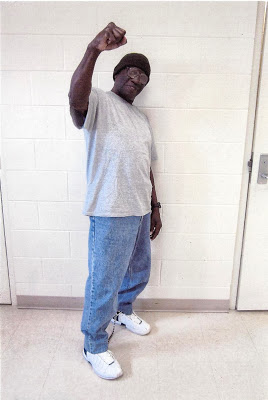
[UPDATED: BLACK PANTHER PARTY MEMBER HERMAN WALLACE FREED! (Scroll to End)] “Angola 3” Member Herman Wallace On “Democracy Now!”

Angola prisoner Herman Wallace is dying of liver cancer after 42 years in solitary confinement. A member of the so-called Angola Three, Wallace and two others were in jail for armed robbery, then accused in 1972 of murdering a prison guard at the Louisiana State Penitentiary, known as Angola prison. The men say they were framed because of their political activism as members one of the first prison chapters of the Black Panther Party. Wallace’s supporters say he has just days to live, but his requests for compassionate release has so far gone unanswered. We speak with Jackie Sumell, a New Orleans-based artist behind “Herman’s House,” a collaboration with Wallace, which is the subject of a new documentary by the same name. “I’m not sure in the state of Louisiana if compassion is part of the vocabulary of those who are in power. I always felt that compassionate release, or asking for compassionate release, was important in terms of a multipronged effort to have Herman released,” Sumell says. “But there’s been 42 years of the state continuing to deny Herman’s due process. It’s incredible. He’s the longest known serving in solitary confinement in the United States.” We are also joined by Malik Rahim, one of the founders of the Louisiana chapter of the Black Panther Party and a co-founder of the Common Ground Collective, which helped bring thousands of people from all over the world to help rebuild New Orleans after Hurricane Katrina.

AMY GOODMAN: We’re on the road in New Orleans, Louisiana. We’re broadcasting from New Orleans Public Television station WLAE. We turn now to look at the case of a man who’s spent more than 42 years in solitary confinement in Louisiana, believed to be one of the longest-serving prisoners who served on death row for that amount of time. He is dying now of liver cancer. His supporters are pleading for his compassionate release.

I’m talking about Herman Wallace, a member of the so-called Angola Three. He and two others were in jail for armed robbery, then accused in 1972 of murdering a prison guard at the Louisiana State Penitentiary, known as Angola. The men say they were framed because of their political activism as members one of the first prison chapters of the Black Panther Party. Herman Wallace is now 71 years old in the late stages of liver cancer. Robert King Wilkerson was released in 2001 after 29 years in solitary confinement. The third of the Angola Three, Albert Woodfox, remains in prison and says he’s been subjected to strip searches and anal cavity searches as often as six times a day.

Well, as Herman Wallace faces the end of his life, we’re joined now by two people. But first I want to turn to a clip from a new film about Herman’s collaboration with one of our guests. Twelve years ago, artist Jackie Sumell began writing to Herman Wallace, and one day she asked him, “What kind of house does a man who has lived in a six-foot-by-nine-foot box for over 30 years dream of?” Wallace wrote back with a description, and soon afterward Jackie made a commitment to build the house so Herman could either live in it upon his release, or so it could serve as a symbol of survival and hope. The two have often spoken by phone in between their visits, though Herman is now too weak to speak anymore. The calls are part of the story documented in a new film called Herman’s House that just premiered on PBS on POV. In this clip, it was Herman who comforts Jackie after the Louisiana Court of Appeals just turned down his latest appeal.

HERMAN WALLACE: Jackie?

JACKIE SUMELL: Yes.

HERMAN WALLACE: What’s the matter?

JACKIE SUMELL: Nothing.

HERMAN WALLACE: I’ll see you tomorrow, right?

JACKIE SUMELL: Yeah.

HERMAN WALLACE: Jackie.

JACKIE SUMELL: What?

HERMAN WALLACE: Look, this is a struggle, kiddo, all right? You hear me?

JACKIE SUMELL: I hear you.

HERMAN WALLACE: This is a struggle, and it’s worth it. It’s part of that. You have to roll with that. And it should make us stronger, right?

JACKIE SUMELL: Yeah, well—

HERMAN WALLACE: So, please, come on, last thing you want to feel is down. You are too much of a strong, happy person for that. And I think as long as you know that I’m OK, I think that’s all that should matter, right?

JACKIE SUMELL: That’s correct.

HERMAN WALLACE: Right, and I’m OK.

AMY GOODMAN: That was Herman Wallace speaking with our guest today, Jackie Sumell. She is the New Orleans-based artist behind Herman’s House, a collaboration with Herman Wallace and the subject of this new documentary by the same name that premiered on PBS POV this summer.

We’re also joined here in New Orleans by Malik Rahim, one of the founders of the Louisiana chapter of the Black Panther Party. He introduced the Angola Three members to the party in prison. He is also co-founder of the Common Ground Collective, which helped bring thousands of people from all over the world to help rebuild New Orleans after Hurricane Katrina. In 2008, Malik ran for Congress as a Green Party candidate.

We welcome you both to Democracy Now!

We did submit a request to interview Herman Wallace after he was removed into the prison hospital, but we were told James LeBlanc, secretary of the Louisiana Department of Public Safety and Corrections, had, quote, “denied similar requests in the [last] few weeks and he did not want to make an exception in this case.”

Jackie Sumell, Malik Rahim, welcome to Democracy Now! Jackie, you just came back from seeing Herman yesterday. What is his condition?

JACKIE SUMELL: Thank you so much, Amy. It’s an honor to be here. I had an opportunity to visit with Herman yesterday. And it’s really obvious, beyond a reasonable doubt, that we are days, if not hours, from watching the state of Louisiana kill another innocent man behind bars.

AMY GOODMAN: Was he able to speak?

JACKIE SUMELL: He’s still able to speak a few words. Yesterday he asked me to put his cap on. The inmates had just bathed him, and he was without his cap. He was cold. His words are few and far between. He sleeps most of the time. His belly is distended. He’s incredibly uncomfortable. And I think these will be his last few breaths before he joins the ancestors.

AMY GOODMAN: Compassionate release, is it a possibility?

JACKIE SUMELL: I’m not sure in the state of Louisiana if “compassion” is part of the vocabulary of those who are in power. I always felt that compassionate release or asking for compassionate release was important in terms of like a multipronged effort to have Herman released. But there’s been 42 years of the state continuing to deny Herman’s due process, so—

AMY GOODMAN: I mean, 42 years in solitary confinement.

JACKIE SUMELL: Yeah, it’s incredible. It’s incredible. He’s the longest known serving in solitary confinement in the United States. And one of the things I think is important to illustrate, or that Herman’s fight has been, is to illustrate the fact that the U.S. still employs the use of solitary confinement. There’s over 80,000 inmates at any given time, and, as you said, the highest incarcerator in the world, that are in solitary confinement, a six-foot-by-nine-foot cell, a minimum of 23 hours a day. And it’s an indefinite period that most people are in solitary confinement.

AMY GOODMAN: I wanted to play a clip of Teenie Verret, the widow of the murdered prison guard. She was just 17 when her husband, Brent Miller, was stabbed to death in 1972. This is the murder that Herman Wallace was convicted of. This is Teenie Verret from the documentary In the Land of the Free.

TEENIE VERRET: I’ve been living this for 36 years. There’s not a year that goes by that I don’t have to relive this. And it just keeps going and going. And then these men, I mean, if they did not do this—and I believe that they didn’t—they have been living a nightmare for 36 years.

AMY GOODMAN: That was Teenie Verret saying, if they did not do this—and she doesn’t believe that Albert Woodfox and Herman Wallace did this—then they should not be serving these sentences.

JACKIE SUMELL: You know, there’s tens of thousands of people who believe that they did not do this. You know, I have absolutely no doubt that Herman Wallace, Albert Woodfox and obviously Robert King are innocent.

AMY GOODMAN: And Robert King is out.

JACKIE SUMELL: Yeah, Robert King was released in 2001, under investigation for the same crime and had just served 29 years of solitary confinement for a crime he didn’t commit.

AMY GOODMAN: Malik Rahim, you are well known in this area. Yes, you ran for Congress. You helped save New Orleans after the Hurricane Katrina. You knew these men in prison. They say they were framed for this murder because of their political organizing. You were involved with that political organizing.

MALIK RAHIM: Yes. First I want to say that compassionate—compassionate justice do not exist in Louisiana. Their confinement is based upon what the state call Black Pantherism, you know, that the Black Panther Party was just an organization of blacks who hated whites and was bent on killing. And that’s what they have based their conviction on. They stay in solitary, have been, basically because of that Black Pantherism. It have been used throughout their 41 years. Burl Cain—they have repeatedly said that even if they was found innocent, he would still be keep them in solitary, because of Black Pantherism.

AMY GOODMAN: I want to go to a clip of Herman Wallace in his own words describing the impact of solitary confinement on his body. This is from the film that just premiered this summer on POV called Herman’s House.

HERMAN WALLACE: Being in a cage for such an extended period of time, it has its downfalls. I mean, you may not feel it, you may not know it, you may think that you’re OK, and you just perfunctorily move about, you know. However, when you was removed from out of that type of situation and placed in an open environment where, you know, you’re even breathing that oxygen and it’s getting into your lungs and you’re feeling something growing within you, and—you begin to develop a different mode within your body. I even watched my body. I’ve looked in the mirror, and I’ve seen muscles and [bleep] begin to pop out there. I began to run even faster and [bleep]. And I’m saying, “Whoa, what the hell is going on here?” Much was preserved. But then I got locked up again after eight months. And being locked up like that, the whole body just got confused.

AMY GOODMAN: That was Herman Wallace describing solitary confinement. Jackie, you’ve talked to him a great deal about this.

JACKIE SUMELL: Yeah. I mean, one of the things I want to be clear about, Amy, is that the state of Louisiana has never relied on lethal injection to kill its incarcerated. Right? There’s a history, a documented history, of neglect, abuse, cruel and unusual punishment, and what I would call lethal injustice, which is the denial and delaying of due process or our so-called constitutional guarantees. And within that framework, you have men who are spending 40 years in solitary confinement.

AMY GOODMAN: Jackie, you did something unbelievable with Herman Wallace. You wrote to him and said you wanted to build a house that he would design?

JACKIE SUMELL: Yeah, it’s unusual.

AMY GOODMAN: What was the question you put to him?

JACKIE SUMELL: I was at Stanford University, a full ride with stipend to study art, when I met Robert King. And it was really hard for me to—

AMY GOODMAN: One of the Angola Three, the one who was released.

JACKIE SUMELL: The one who was released. It was just about two months after he was released. And it was really hard for me to contextualize my relative privilege to the situation that Herman and Albert were still enduring. And I knew that I had to do something. And, you know, my greatest tool is my imagination. So I asked Herman what kind of house he dreams of after spending then 30 years in solitary confinement in a six-foot-by-nine-foot box. And I did that with the hope that this would be the opportunity for him to just use his imagination to get out of that box.

AMY GOODMAN: I want to play a clip of Herman from Herman’s House where Herman Wallace describes what sort of details he’d like to see as part of his house.

HERMAN WALLACE: Jackie, in your letter you asked me what sort of house does a man who lives in a six-foot-by-nine-foot cell dream of? In the front of the house, I have three squares of gardens. The gardens are the easiest for me to imagine, and I can see they would be certain to be full of gardenias, carnations and tulips. This is of the utmost importance. I would like for guests to be able to smile and walk through flowers all year long.

AMY GOODMAN: This is not just a figment of Herman Wallace’s imagination, Jackie. You are building this house. You’re here buying property for this house, as Herman Wallace lays dying in a prison hospital.

JACKIE SUMELL: Yeah, I made a commitment to Herman over 10 years ago that I would build his dream house, with the intention, as you said at the beginning of this segment, that this house is a testament to his imagination, to the triumph of the imagination, and to Herman’s legacy, which will outlive his flesh and bones—you know, Herman’s legacy, his commitment to the people and the story of his injustice. And it’s important to build this house in the incarceration capital of the world.

AMY GOODMAN: I want to go to the end of Herman’s House, the documentary, where Herman Wallace describes a dream. Listen carefully.

HERMAN WALLACE: I’ve had a dream where I got to the front gate, and there’s a whole lot of people out there. And you ain’t going to believe this, but I was dancing my way out. I was doing the jitterbug. I was doing all kind of crazy, stupid-ass [bleep], you know? And people was just laughing and clapping and [bleep], you know, until I walked out that gate. And I remember that dream, and I turn around, you know, and I look, and there are all the brothers in the window waving and throwing the fist sign, you know? It’s—it’s rough, man. It’s so real, you know. I can feel it even now, you know, talking about that.

AMY GOODMAN: Herman Wallace, describing his dream of freedom. Malik Rahim, your thoughts as we end today, as, well, we don’t know how many minutes or days Herman Wallace has left?

MALIK RAHIM: I believe that this is one of the saddest occasions in my life. It wouldn’t have been a Common Ground if it wouldn’t have been the Angola Three. And if it wouldn’t have been a Common Ground, then the over 200,000 people that we serve in direct services, what would have happened to them? You cannot say that justice prevail when you have individuals that, under the harshest conditions—I mean, going through the brutal summers locked in those cells, and the coldest winters locked in those cells, and still have enough compassion to help save this city that have literally forgotten him. You know, I mean, a Common Ground never would have been sent out the way it was. It was started by a common—by an Angola Three supporter, scott crow. You know, it never would have happened without the Angola Three. And then this is the reward that he get for saving this city and this area, is to die in a prison cell. You know, I mean, it’s something that—you know, it leave a bitter taste in my mouth.

AMY GOODMAN: Malik and Jackie, I want to thank you for being with us. Malik Rahim, one of the founders of the Louisiana chapter of the Black Panther Party, knew Herman Wallace in jail and ended up running for Congress on the Green Party ticket. Jackie Sumell is building the house that Herman has dreamed of. Herman’s House describes their collaboration on PBS POV.

*********

MY COMMENTS: I was very sorry to hear about his impending crossover to the Realm of the Ancestors. The system is determined to have as many radical activists die in prison as possible, especially Black Panther Party members. In this case, it may be getting its wish.

I found some more on Herman Wallace, the film, and the issues:

BREAKING NEWS: THIS JUST IN! Looks like Herman will be able to see some updated plans for that home!

From Angola 3 News:

Miraculous news this morning! Judge Jackson has overturned Herman’s conviction, granting him full habeas relief based on the systematic exclusion of women from the jury in violation of the 14th Amendment. Read today’s court ruling here.

Even more astonishingly, the Judge clearly orders that “the State immediately release Mr. Wallace from custody.” No application for bail is required, and the State is given 30 days to notify Herman if they plan to re-indict him.

We pray that Herman can still hear this all-important decision that he’s waited these four decades for. Although the State will no doubt contest this decision, this is what Herman has been struggling for – and at the end of his life, he’s won!

Albert Woodfox and Robert King are meeting at the prison this morning to say their farewells and and will instead have this amazing news to share with Herman and maybe even be able to take him home. To everyone that’s pushed for this victory – thank you – it means the world to Herman.

Manning Marable’s Malcolm X: Objectivity vs. Memory

book cover

The recent death of Malcolm Shabazz, the grandson of El-Hajj Malik El-Shabazz (Malcolm X), during the same month as Malcolm X’s 88th birthday (on May 19th), has brought the 20th century radical leader’s contributions, death and legacy back into current Black public consciousness.

Unfortunately, Manning Marable’s controversial, and Pulitzer Prize-winning, biography of the elder Shabazz, “Malcolm X: A Life of Reinvention,” put Malcolm X into America’s public conversation two years ago in shallow ways. The book’s many, many flaws were ignored by supporters of Marable, who died days before the book was published in April 2011.

This essay—the Coda of the new book “A Lie of Reinvention: Correcting Manning Marable’s Malcolm X,” edited by Jared A. Ball and Todd Steven Burroughs and published by Black Classic Press—is a meditation on African-American historical memory in light of Marable’s monumental blunder.


One day when I was lost, I discovered a Black writer by the name of Manning Marable. I was studying journalism, in a private, predominantly White Catholic university in the midst of the Reagan era, with the clear goal of one day writing for the New York Times. I had just turned eighteen, a second-semester freshman working as a freelancer for the New Jersey edition of the Afro-American weekly newspaper chain. It was just a newspaper to me. I was a reporter, and we both (the newspaper and I) just happened to be Black.

The New Jersey Afro carried the national Afro’s opinion page, and I found there a column called “From the Grass Roots” and its weekly entry titled “Challenge to Black Journalists.” The author of the piece was Manning Marable. “The white media generally refuses to admit that virtually all journalism is a form of ‘propaganda’ in the interests of certain political, economic and social class interests—and that Blacks’ interests never surface on that agenda,” Marable wrote, directly contradicting the so-called objectivity I had been taught to entrench in my reporting. I read on:

When we read Le Monde, does anyone doubt that we are encountering the interpretations of French journalists, with all the historical, cultural, and political baggage of that tradition? When we read Pravda and Izvestia, no one doubts that the perspectives of Soviet writers advance a particular view on society and politics. And when one reads the New York Times, everything from the selection of stories to the orientation of the editorials represents a type of bias towards the white corporate establishment…

Not surprisingly, I had a hard time absorbing Marable’s perspective. I did not see how his kind of thinking was going to get me a job in White corporate America. But something kept tugging at me, so I kept reading.

What is the social responsibility of Black journalism in the period of colorblind racial discrimination? Black writers must see themselves part of a rich historical tradition, as the latest generation in the heritage of free, democratic-oriented journalists….What is a Black journalist? As writers, as part of this tradition of Afro-American critical thought, we have a responsibility to comprehend that racism still exists, and that we should never apologize for taking an uncompromising attitude against racial inequality in our work.

Poverty and hunger still exist, and are becoming worse. Unemployment, educational underdevelopment, and political underrepresentation have not yet been overcome. And our task and challenge, as Black writers, is to raise questions revealing these problems, and to write with a critical vision of social justice and human equality, the basic values which were embodied by the lives of previous generations of Black writers.

I clipped out the column and put it in a notebook. It took me a few years to agree with Marable’s positions, but eventually I came to terms with it and him. I even cited his work in my doctoral dissertation fifteen years later. And that is the Manning Marable I will always remember.

But that day, almost thirty years ago, has nothing to do with this day, at least not consciously, but I’m getting a little bit ahead of myself. Let’s go back about a year…

********

So I’m getting out of a cab across the street from the Schomburg Center for Research in Black Culture in Harlem. I had decided to attend the 2011 Harlem Book Fair in general and the panel at the Schomburg on Malcolm X: A Life of Reinvention in particular. The panelists were poet Sonia Sanchez, one of the legends of the Black Arts Movement; Zaheer Ali, the Columbia University graduate student who had made the talk-show rounds after Marable’s death and the almost-simultaneous release of that book, for which he served as Marable’s head researcher; Peniel E. Joseph, the Tufts University history professor whose work chronicles aspects of the Black Power Movement; and Herb Boyd, the venerable journalist, historian, and activist (and a great friend and mentor of mine). The moderator was Yohuru Williams, associate professor of African American history at Fairfield University.

The panelists collectively praised Marable for what he did do in his life and work and were polite, not harsh, in their criticism of what he did not do. It was a scene that we journalists objectively term a “marked contrast” to the torrent of often public, often private criticism that emanated from left-of-center Black scholarly and activist circles after A Life of Reinvention’s publication. I looked around in vain for what newspaper reporters would term “the veteran Black activists” to literally get in line to blast A Life of Reinvention. When they did not appear, I began to feel a sense of tension that I could only partially identify as nervousness and some dread because I knew what had to come next.

When Williams asked for questions—not comments—from the audience, I got up, knowingly breaking the rules, and started talking about the book (the one you are reading) Jared Ball and I were planning. I was only barely able to mention that the book would be coming out soon and thanking both Black Classic Press and Third World Press for committing to publish their respective essay collections critical of A Life of Reinvention before Williams abruptly thanked me for my comments and moved on to the next person. Prior to Williams lowering the boom, however, Sanchez interrupted my flow, exhorting my coeditor and me to include as many women as possible in the volume. (We tried very hard, Sister Sonia!)

Strangely, that moment at the Harlem Book Fair felt like incidents I had read about in some of the media theory and criticism books I’ve read and tried to understand. In those books, left-of-center media scholars write about how “objectivity” limits the intellectual range of information given to the public. They argue that those who own and control the media only want an “acceptable” range of criticism aired and printed, with “acceptable” being defined by the owners and controllers themselves. Were the Harlem Book Fair organizers and these panelists essential “operators” of a pre-determined, live, public, televised presentation of ideas? Were they doing to me, an openly harsh critic of Marable’s Malcolm X, what African American political and cultural activists claim Whites in power have done historically, and still do, to them? (And just where, by the way, were the veteran Black scholar-activists who were critical of Marable’s Malcolm X biography that day? The ones whose powerful, hard-hitting reviews of the book I had read online? The ones who would have pushed me out of the way both that day as well as twenty years ago to critique an equally controversial biography of Malcolm by Bruce Perry, a White man?) Or, I wondered, were the organizers of the panel, which was being blasted live around the world on C-SPAN 2 and which would be forever embedded in its online archives, trying to protect a fellow New York City activist/scholar/author, now unable to defend himself?

Frankly, I remember thinking: I’m not even close to being important enough to be “censored,” and I couldn’t discern my censor’s motives or intent for only taking questions, not comments. I could recognize, however, the results of this one public session: that no one on the panel represented “the harsh critical wing” of the reviewers of A Life of Reinvention. No harsh criticism was allowed of Marable or his controversial book on a public, televised panel at a national book fair held in Harlem, known historically as a place where Black writers, artists, activists and their audiences often speak publicly, harshly, and freely.

It all felt very (intra-racially) “objective” to me. So much for public “dialogue”!

The panel’s commentary was nuanced and, admittedly—at least to this rule-breaking, sour-grapes audience member—often penetrating. For her part, Sanchez asserted that Malcolm did not reinvent himself because that would suggest an ulterior motive such as the need to package oneself for a market. Instead, she claimed, Malcolm re-imagined himself. She questioned the rationale behind and effectiveness of Marable’s oft-cited and so-called “humanization” of Malcolm, as manifested in A Life of Reinvention by the often-scandalous information inserted throughout on Malcolm’s personal life. She also questioned how that type of insertion benefited either the scholarship on Malcolm or the book’s readers, and she chided writers and historians for being too preoccupied with voyeurism. What readers should take away from the book, Sanchez concluded, is that Marable demystified Malcolm and showed how Malcolm demystified White America by dissecting its police force, White liberal class, government, and so on. She further noted that Marable’s book offers important insights about the language of survival and resistance used by Malcolm and other leaders of his time, language she encouraged those of us in the audience to pass along to our children—and especially to President Barack Obama.

Zaheer Ali’s comments confirmed something that I had originally suspected: that Marable’s book started out as a political biography. Normally political biographies do not contain the extensive research and interviews of a full biography. Upon reading A Life of Reinvention, that point makes sense to me on many levels. It explains, for instance, why Marable only interviewed a handful of people and why he apparently did not seem to worry about why he did not interview more.

As Ali noted, Marable taught that history is “a contestation of interpretations over fact.” This is a point with which I can wholeheartedly agree, but only if one actually has all the facts and has done all the research. History, Ali added, is also corroborative, and Marable (whom Ali admitted was “a little flippant” in some parts of the book) did too little of that. Ali also contended that biographers engage in a “certainty-versus-probability” contest, and again, I agree. However, they are not supposed to sacrifice the consistency of verifiable truth for a good yarn.

Nonetheless, Ali defended his mentor’s sourcing and documentation, claiming that Marable took pains to label anything circumstantial—including Malcolm’s alleged homosexual relationship with a White man—as just that. (Huh? That statement made me think of how a great Black biographer, Arnold Rampersad, once wrote about how he got in hot water with the gay community because he found no evidence to confirm that his biographical subject of over a thousand or so pages, Langston Hughes, ever had a homosexual or any other kind of romantic relationship—so he simplyconcluded that Hughes was probably asexual.) At the Harlem Book Fair event, however, Ali dismissed those folks who were upset about Marable’s book reporting of Malcolm’s alleged homosexual relationship as being believers in “a ‘one-drop’ rule of gayness.” He also asserted that every controversial allegation in the book had at least three sources. I don’t know if that’s true, but he may be correct—that is, if you consider secondhand sources as legitimate ones!

Peniel Joseph, a very talented writer who has described the Black Power movement in “new” and “innovative” ways, was the next panelist to speak. He described Malcolm X as a “local organizer who transformed the Black freedom struggle” and who, along with other Black civil rights activists, kept up a “long-running dialogue” with the idea of America and changed American democracy. (Joseph has been rewarded and praised in elite White circles for his portrayal of the Black Power movement in this fashion, with glowing reviews in mainstream media and interviews on public television.) He repeated the claims I have heard from Zaheer Ali, Michael Eric Dyson, and other friends of Manning Marable since the Malcolm biography’s publication: that many critics of A Life of Reinvention had only read the parts that address Malcolm’s personal life and not those addressing his political one.

Herb Boyd was, as always, his very polite self, willing to take both sides in the debate. (Those of us who are cursed to be around journalists for any length of time have gotten used to this!) He agreed with Sanchez about squashing Marable’s use of the term reinvention to describe Malcolm’s development, and stated that he preferred instead the term political evolution. He also urged the members of the audience to read the book in its entirety and to come to their own conclusions about it with the words: “You have that responsibility.”

******

Normally, I would have given some of the comments I heard at the Harlem Book Fair panel—even the ones I strongly disagree with—a pass. I would have put on my (still-trying-to-be) objective journalist’s hat and said, “Well, that’s their view. Others will have different opinions, but all will have to read the whole book and make up their own minds.” I would have taken my notes, written them up, penned an “objective” article, and moved on. However, since reading Manning Marable’s Malcolm X book in its entirety, other perspectives—ones that reveal clearly the numerous problems I personally found with the book as well as many, many others I did not find—have demanded my serious attention.

Those additional views are best captured in the exchange of ideas and perspectives that I imagine might have taken place had several of the current volume’s contributors come together to form a critical panel of their own focusing on A Life of Reinvention.  This “invented” panel would serve as an apt and appropriate counterbalance to the “objectivity” of the Harlem Book Fair discussion. Given the comments excerpted below from their compiled essays, the exchange most likely would have gone as follows:

Mumia Abu-Jamal:    Marable seems to go for the sensational rather than for that which he can substantiate.

Kali Akuno:               It is the contemporary weaknesses of the Black Liberation Movement as a whole, and of its Black Nationalist wings more specifically—buttressed by imperialism’s hegemonic cooptation of Afrocentrism and other liberal variants of multiculturalism into the “postracial” politics of American nationalism that define the so-called “Age of Obama”—that co-enabled the production of this work.

Kamau Franklin:       Marable’s work is the latest to attempt to remake or reinvent Malcolm X and turn him into a political football for political and moneyed interests….[Making Malcolm X] the embodiment of his own ideological viewpoints amounts to what I call an ivory tower assassination attempt on Malcolm X’s meaning as an ideological force for Black self-determination.

William Strickland:   The problems…are many and multiple. They range from historical gaffes and endless nonsequitors to key historical omissions. Manning thus becomes his own authority, quoting himself as his evidentiary source!

Raymond Winbush:   The arrogance of Marable oozes out in so many places throughout the book….Marable’s opinion mattered to him, just as the opinions of broadcast media journalists on Fox News and MSNBC matter to those individuals. Their listeners crave their opinions and speculations concerning contemporary political issues, and these commentators get paid, and paid well, to provide just that. Sadly, in the case of Manning Marable and his last work of speculative nonfiction on one of the great persons in the African world, opinion took precedence over originality and speculation superseded scholarship and a reliance on reliable sources and primary research.

Rosemari Mealy:        This omission of women’s voices amplifies the concerns of African American womanist scholars that Marable’s book widens the gap in the existing literature about Malcolm X written by men because it fails to acknowledge the extraordinary contributions that African American women historically have made to constructing the leadership styles of progressive and revolutionary African American male leaders.

Greg Thomas:            The noncritical discourse published under the name of Manning Marable amounts to simple PR for Marable’s name brand, his specific academic signature, and thus for Viking Books and its parent company, Penguin Group—not to mention his institution of employment, Columbia University. Under these mantles, Malcolm X is absolutely questionable, in every way, while the brand of Manning Marable (i.e., his writings, motives, methods, dogmata, etc.) is absolutely unquestionable.

Sundiata Keita

Cha-Jua:                    On analytical grounds, the verdict on A Life of Reinvention is mixed. For the most part, its readers learn nothing new of significance; Marable merely provides greater detail of things already known.

Eugene Puryear:        Putting aside Marable’s claims of having produced a definitive biography, A Life of Reinvention has raised more questions than answers. Some of these questions may be irresponsible and some may confuse matters that should be crystal clear, but Marable’s biography of Malcolm X has at least shown the need to study and debate Malcolm’s legacy and the movements from which he sprang.

Karl Evanzz:               Malcolm X: A Life of Reinvention is an abomination. It is a cavalcade of innuendo and logical fallacy, and is largely “reinvented” from previous works on the subject.

Amiri Baraka:            Some of the characterizations in the book are simply incorrect and suffer from its author only knowing about the movement on paper.

Thus, this fictitious panel might have concurred with Peniel Joseph, who stated at the Schomburg that we (meaning Black folks, I presume) “cannot have sacred cows” and that “Malcolm had no sacred cows”; and with Zaheer Ali, who maintained that “Malcolm was not a sacred cow, and neither was Manning Marable.” Might then Joseph and Ali, in turn, also agree with the overriding reason for this volume?

**********

A year later, I have finally, fully identified the source of the tension I felt sitting in the Schomburg auditorium that summer afternoon. Part of it was the realization that, at every bit of age forty-four, I am now partly yet increasingly responsible for the present and future of Black history and for the propagation of commonsense and proper propaganda. When Herb Boyd asked the audience of about 150 people at the Harlem Book Fair panel, most of whom looked to be under forty years old, if they had read Marable’s book, less than a score of hands went up. Although the strength of this book’s contributors tells me that I am far from being ideologically stranded alone on an island somewhere, I recognized then how very different the second decade of the twenty-first century is going to be for many of us who were born in the later decades of the century past.

I keep thinking about how this book might not have been necessary if the media systems I grew up with in the New York tri-state area were still in play. If A Life of Reinvention had come out in, say, 1988, a Black news-talk radio station named WLIB-AM, 1190 on the New York City dial, would have featured numerous detailed discussions on the book. Other discussions would have aired on a late-night, national program called “Nighttalk with Bob Law” on WLIB’s rival, 1600 WWRL-AM, the flagship station of the National Black Network. Those programs would have been moderated by hosts who knew they would be speaking directly and almost exclusively to Black people, so they would not have bothered with “objectivity.”

I can imagine hearing John Henrik Clarke and many other Black scholars providing blistering on-air critiques of Marable’s Malcolm X biography, educating young listeners like me. I can also picture myself reading a bombastic Brooklyn weekly newspaper called The City Sun, which would have published a special section on this intellectual controversy. Those “unapologetically Black” media venues taught by example. They never had a problem criticizing Black public figures harshly and publicly if they failed Black people.

Back then there were also several local and national television shows in the New York area—Tony Brown’s Journal, Like It Is, Essence: The Television Program, Positively Black, and Black News/The McCreary Report, among others—that probably would have presented other balanced (read: critical) discussions and forums focusing on Manning Marable and his A Life of Reinvention, all for large audiences. They surely would have explored and explained the depth of Marable’s mistakes. All, however, are gone now, one way or another. (Ironically, that is why I think C-SPAN 2’s annual airing of the Harlem Book Fair on its “Book TV” program is so important. Like the fair itself, this broadcast event is one of the few mass forums left where Black perspectives can be heard and seen, live and unedited, by large numbers of people.)

In the 1980s, I would have depended on these forums and the activists who sponsored and participated in them, to do the work we, the editors and contributors to this volume, have done today. I would have remained pretty much silent, letting those elders, Black print journalists, and broadcasters take responsibility for finding and promoting my and our collective voice. I would not have even thought twice about breaking the “rules” much less about doing so in front of a national or international television audience on C-SPAN. But clearly too much time has passed. This century demands more of me. I now bear the responsibility for that collective voice.

The remaining source of my tension also became evident as I meditated about all that has occurred around Marable and A Life of Reinvention. Two diametrically opposed quotes, both previously scrolling along in a loop at the bottom of my mind’s television screen, began to assume prominence. The first was one stated quite plainly by a Presidential candidate in 2008. The candidate was making a great compromise address about some remarks made by his pastor. During the campaign, it was hailed as “The Race Speech” but now it is known as the “A More Perfect Union” address, presumably because it was crafted to allow the candidate to unify perfectly two audiences—the powerful and the powerless—at once. Here is the first quote:

The profound mistake of Reverend [Jeremiah] Wright’s sermons is not that he spoke about racism in our society. It’s that he spoke as if our society was static; as if no progress has been made [emphasis mine]; as if this country—a country that has made it possible for one of his own members to run for the highest office in the land and build a coalition of White and Black; Latino and Asian, rich and poor, young and old—is still irrevocably bound to a tragic past. But what we know—what we have seen—is that America can change. That is the true genius of this nation. What we have already achieved gives us hope—the audacity to hope—for what we can and must achieve tomorrow.

The second (and much shorter) quote, originating from the collective unconsciousness of struggle, contradicts the first more and more as that former candidate’s Presidency continues. It states simply the following: “All change is not progress, as all motion is not forward.” Upon reflection on that statement, how sadly appropriate it seems that Manning Marable’s creation of a presumably race-neutral Malcolm X shares the same space with the racially/culturally born-neutered, or self-neutered, Barack Obama.  There are times in which cultural history and cultural reality trumps objectivity, and this is one such time. Manning Marable’s biography of Malcolm X occupies the space between the heralding of a new era of Black “progress” versus the ideas and beliefs of Malcolm’s expanding ideas, including those “scary” Black Nationalist-Leftist-Pan-Africanist ones. In the new era, if the latter ideas are brought up today, they must be dismissed as intellectually stunted or as belonging to history itself.

The scholarship on Malcolm X has moved as a result of Marable’s book, but in what direction? A new generation of Black writers and scholars is finding new ways to interpret old ideas, some of which expand people and movements into new places. However, the cost of moving into these newly gentrified intellectual neighborhoods, for some, may be too high. There are Blacks who may not know what has been lost by this gentrification, and those who understand all too well what has happened will probably be politely silent and “objective,” choosing not to remember, at least not publicly.

The late Gil Scott-Heron—a great writer who lived in Harlem as did his hero, Langston Hughes—passed away about two months before the 2011 Harlem Book Fair, but Scott-Heron was crystal clear forty years ago on this problem’s consequence. In the lyrics to his song, “Winter in America,” a post-revolution lament that still resonates, he sang about how “ain’t nobody fighting/‘cause nobody knows what to save.” Intellectually and historically, that time may be coming sooner than we think.

***********

In many ways, this work’s contributors have chosen to argue about a book because it was a book, The Autobiography of Malcolm X as Told to Alex Haley, that intellectually birthed so many of us in the first place. The Autobiography was the book that allowed Malcolm to enter our minds, where he witnessed our rebirths. For many of us he is still there, advising ever since, like some sort of Race Man Sensei. It’s his legacy to us.

Manning Marable’s legacy is what it is, for good and ill, like every other human. He does not need our tribute; others will take care of that. History is more important than any biographer or biographical subject’s legacy, including El-Hajj Malik El-Shabazz (Malcolm X). The issue for us is the need to preserve accurate historical memory, and to do so in concrete words and strong deeds. As contributors to this volume, we agree that Marable made decisions that produced poor history—a history that is being absorbed by an anti-intellectual popular culture via snippets of articles, brief broadcast segments, and trending tweets—about a world-historical figure. Ultimately, the biography that Marable wrote can only be countered by another, more definitive one. For us, preserving memory is more important than preserving some sort of intellectual operational unity in deference to Manning Marable’s legacy or trying to figure out a way to use, or salvage, what he did with A Life of Reinvention for the larger Black liberation movement. The book you are reading is not that biography. Rather, we humbly offer this volume as a collection of notes for that future biography.

”A Lie of Reinvention” is harshly critical of Marable and his posthumously published work. Good! Harsh public criticism is the appropriate response to harsh public actions, harsh public cultural distortions, and harsh public accommodations to the first two. It is also necessary when there are too many voices, for whatever reason, that refuse to separate critique from tribute.

The undercurrent of what has been said, or not said, publicly about Manning Marable since his death and the publication of A Life of Reinvention has often times been predicated on the idea of not speaking ill of the dead. Bill Strickland reminds us of this in his essay in this collection, which contends that this idea was “a standard Manning did not adhere to himself.” Even if he did, however, that would be irrelevant. Still, and I have no empirical evidence to substantiate this, I believe that if Marable had been White, or if he had not been the esteemed Black pioneering scholar his Black defenders claim him to be, the public reaction of many of those defenders to our collective, harsh, public critique would be, to say the least, muted.

Manning Marable should be remembered—for all his contributions—and the quality of those contributions should be, and will continue to be, argued and debated. But it is important to note that many of the public defenders of Marable’s bad biography were in some way connected to him—personally, professionally, or both. Thus, it is important to note that the vast majority of the contributors to this volume“as writers, as part of this tradition of Afro-American critical thought”we did not go to high school or college with Marable, we were not taught by him, nor did we lecture under him at Columbia. So we do not owe him our silence or knee-jerk defense.

But we do owe history. We do owe Africana Studies. Our larger commitment to historical memory dwarfs any concerns about offending Manning Marable’s admirers, colleagues, friends, and students. History is our prime concern. Therefore, we actively and proudly choose to be intellectual squatters in the new historical neighborhoods, openly breaking the rules and happily accepting any consequences of being labeled trespassers.

From the book “A Lie of Reinvention: Correcting Manning Marable’s Malcolm X,” edited by Jared A. Ball and Todd Steven Burroughs. Copyright 2012, 2013 by Black Classic Press.

Angela Davis Denounces FBI For Putting Assata Shakur On “Terrorist” List

Video and text from the May 3rd edition of “Democracy Now!”:

One day after the exiled former Black Panther Assata Shakur became the first woman named to the FBI’s Most Wanted Terrorists list, we’re joined by another legendary African-American activist, Angela Davis, as well as Shakur’s longtime attorney, Lennox Hinds. Davis, a professor at the University of California, Santa Cruz, is the subject of the recent film, “Free Angela and All Political Prisoners.” She argues that the FBI’s latest move, much like its initial targeting of Shakur and other Black Panthers four decades ago, is politically motivated. “It seems to me that this act incorporates or reflects the very logic of terrorism,” Davis says. “I can’t help but think that it’s designed to frighten people who are involved in struggles today. Forty years ago seems like it was a long time ago. In the beginning of the 21st century, we’re still fighting around the very same issues — police violence, healthcare, education, people in prison.” A professor of criminal justice at Rutgers University, Hinds has represented Shakur since 1973. “This is a political act pushed by the state of New Jersey, by some members of Congress from Miami, and with the intent of putting pressure on the Cuban government and to inflame public opinion,” Hinds says. “There is no way to appeal someone being put on the terrorists list.”

AMY GOODMAN: “A Song for Assata” by Common. This is Democracy Now!, democracynow.org, The War and Peace Report. I’m Amy Goodman, with Juan González.

JUAN GONZÁLEZ: Well, we continue to look at the case of Assata Shakur, legendary figure within both first the Black Panther Party and then the Black Liberation Army. On Thursday she became the first woman ever to make the FBI’s Most Wanted Terrorists list. In addition, the FBI and the state and New Jersey doubled the reward for her capture to $2 million.

AMY GOODMAN: To talk about her case, we are joined by two people. Here in New York, Lennox Hinds, Assata Shakur’s longtime attorney, he has represented her since 1973. He’s a professor of criminal justice at Rutgers University. And in Chicago, we’re joined by the world-renowned author, activist, scholar, Angela Davis, also a professor at University of California, Santa Cruz. And she is the subject of a recent film, Free Angela and All Political Prisoners. Angela Davis and Lennox Hinds both wrote forewords to the book Assata: An Autobiography.

We invited the FBI to join us on today’s program, but they did not respond to our request. about Assata Shakur.

I wanted to start with you, Lennox Hinds. The significance of Assata Shakur being put on the FBI’s terrorists list, the first woman ever to be added to the most wanted list?

LENNOX HINDS: My view on this is that this is a disingenuous act on the part of—driven by the state of New Jersey and particularly the state police. As you know, for decades, the state police have wanted and demanded that the Cuban government extradite Assata Shakur to the United States. There is no extradition policy between Cuba and the United States. Just to deal with this in context, the Cuban government, pursuant to international law—that is, particularly the refugee convention—have granted Assata Shakur political asylum. Now, what is the basis for that? It is if an individual has a well-grounded fear that if they return to the country from which they left, they would either be persecuted or prosecuted based upon their political beliefs or/and their race or religion. Now, this is not a new concept. There have been numerous individuals who have left the United States and went to foreign countries, allies of the United States, where those countries have refused to extradite them. France, for example, in the 1970s, there were Black Panthers who hijacked planes and went to France. Now, both France and the United States have extradition treaties. Not only that, France signed the 1963 Tokyo Convention, the 1970 Hague Convention and the 1973 Montreal Convention, with the United States. All of these are international agreements that require countries, host countries, that are holding individuals—who have hijacked planes—to extradite them or try them. France, after conducting their own independent review of these Black Panthers, refused to extradite them to the United States based upon France’s assessment that if they would be returned, they would be subject to political and racial repression. So, I say that the Cubans’ position is well grounded in international law.

Now, why today is Assata Shakur now being branded a terrorist? If we look at the definition of terrorism, what is it? It is the use or the threat of use of force against a civilian population to achieve political ends. What happened in the case of Assata Shakur? You have heard, in her own words, this woman was a political activist. She was targeted by whom? J. Edgar Hoover and the FBI in a program that was called COINTELPRO. That program was unveiled by whom? Frank Church, Senator Frank Church, in the 1970s. He chaired the Senate Intelligence Committee. That committee determined that the FBI was using both legal, but mostly illegal, methods—to do what? In the FBI’s own words, they wanted to discredit, to stop the rise of a black messiah—that was the fear of the FBI—so that there would not be a Mau Mau, in their words, uprising in the United States. And they were, of course, referring to the liberation movement that occurred in Kenya, Africa. Now, the FBI carried out a campaign targeting not only the Black Panther Party. They targeted SCLC. They targeted Martin Luther King. They targeted Harry Belafonte. They targeted Eartha Kitt. They targeted anyone who supported the struggle for civil rights, that they considered to be dangerous.

It is in that context we need to look at what happened on the New Jersey Turnpike in 1973. What they call Joanne Chesimard, what we know as Assata Shakur, she was targeted by the FBI, stopped. And the allegation that she was a cold-blooded killer is not supported by any of the forensic evidence. If we look at the trial, we’ll find that she was victimized, she was shot. She was shot in the back. The bullet exited and broke the clavicle in her shoulder. She could not raise a gun. She could not raise her hand to shoot. And she was shot while her hands were in the air. Now, that is the forensic evidence. There is not one scintilla of evidence placing a gun in her hand. No arsenic residue was found on her clothing or on her hands. So, the allegation by the state police that she took an officer’s gun and shot him, executed him in cold blood, is not only false, but it is designed to inflame.

JUAN GONZÁLEZ: But, Mr. Hinds, before we get into more of the details of the case, this whole issue of 40 years later—

LENNOX HINDS: Yeah.

JUAN GONZÁLEZ: —suddenly branding her a terrorist and also insisting that she is a threat to the United States government at this time, could you talk about the significance—

LENNOX HINDS: Yes.

JUAN GONZÁLEZ: —of that declaration?

LENNOX HINDS: Well, I believe that we have to look at it in the context of what has just happened in Boston. I think that with the massacre that occurred there, the FBI and the state police are attempting to inflame the public opinion to characterize her as a terrorist, because the acts that she was convicted of has nothing to do with terrorism. The acts that she was convicted of, if you look at the evidence, she was convicted of aiding and abetting, and therefore was present during the shootout. The FBI and the state police’s theory was that Sundiata Acoli shot Officer Foerster. That was their theory during his trial.

JUAN GONZÁLEZ: One of the people in the car with her, that—

LENNOX HINDS: One of the people in the car, yeah.

AMY GOODMAN: Well, let me read the FBI press release, and you can respond to how they describe it. And we want to bring Angela Davis in, as well. This was their press release yesterday describing the May 2nd, 1973, shooting. They said, “On May 2, 1973, Chesimard and a pair of accomplices were stopped by two troopers for a motor vehicle violation on the New Jersey Turnpike. At the time, Chesimard—a member of the violent revolutionary activist organization known as the Black Liberation Army—was wanted for her involvement in several felonies, including bank robbery.

“Chesimard and her accomplices opened fire on the troopers. One officer was wounded, and his partner—Trooper Foerster—was shot and killed at point-blank range. One of Chesimard’s accomplices was killed in the shoot-out and the other was arrested and remains in jail.

“Chesimard fled but was apprehended.”

That’s their statement yesterday.

LENNOX HINDS: Right. Also in their statement that I read, the superintendent of state police claimed that Assata Shakur took the Officer Foerster’s weapon and shot him while he was on the ground. There is not one scintilla of evidence at the trial attesting to that. In fact, as I was saying before, she was incapable of lifting her hands, much less firing a weapon.

Now, you asked what is the reason for this allegation at this time. We have to remember that 10 years ago, a little over 10 years ago, the then-governor of the state of New Jersey, former Governor Christie Todd Whitman, she had issued and posted a $1 million bounty for Assata Shakur. Today it has been doubled. But we believe that putting Ms. Chesimard, putting Assata Shakur on the FBI’s 10 most wanted list is designed to inflame the public and to characterize her as a terrorist, when none of the acts alleged relates to terrorism. In fact, of all of the charges that have been leveled against her in New York, case after case, she was acquitted, or the charges were dismissed. There was insufficient evidence to support any of the charges.

AMY GOODMAN: Well, let’s just—in 1971, armed robbery case was dismissed; 1971, she was acquitted of bank robbery; 1972, hung jury; 1972, kidnap of drug dealer, acquitted; and then several other cases dismissed. Angela Davis, you’re in Chicago right now to give a major address tonight at the University of Chicago. Can you talk about this news of Joanne Chesimard, Assata Shakur, being—now being put on the top 10 wanted terrorists list, the first woman ever to be put on this list?

ANGELA DAVIS: Well, first of all, it was a major shock to hear that Assata Shakur has become the first woman to be added to the FBI’s Most Wanted Terrorists list and then to learn that they’re adding another million dollars to the reward, the bounty. Really, it seems to me that this act incorporates or reflects the very logic of terrorism. I can’t help but think that it’s designed to frighten people who are involved in struggles today. Forty years ago seems as if it were a long time ago, four decades; however, in the 21st century, at the beginning of the 21st century, we’re still fighting around the very same issues—police violence, healthcare, education, people in prison, and so forth. So I see this as an attack not so much on Assata herself, although of course she deserves to be brought home. She deserves to be able to live out her life, and with justice and peace. It was wonderful that you allowed people, through this program, to hear Assata’s words, because, 40 years later, people really don’t know the details of the case and are not aware of the extent to which she was targeted by the FBI by the COINTEL Program, as Lennox pointed out. And it’s amazing that in 2013, where she is living in Cuba as a political refugee, having given—having been given political asylum by Cuba, she is still pursued. And actually, this is an invitation for anyone to travel to Cuba illegally and to kidnap her and bring her back to the United States, if not shoot her dead. This is—as I said, was an extremely shocking revelation.

JUAN GONZÁLEZ: And, Angela Davis, the government statement that she remains a threat to the United States, the implication being that she’s somehow still trying to organize attacks on the country, it really is mind-boggling. It’s one thing to say, “We have a case here of someone who’s still wanted.” It’s another thing to say that they’re still a threat to the United States, when there’s been no indication over the last 30, 40 years that Assata Shakur has been involved in any type of movements or organizations directed against the United States government.

ANGELA DAVIS: Well, see, there’s always this slippage between what should be protected free speech—that is to say, the advocacy of revolution, the advocacy of radical change—and what the FBI represents as terrorism. You know, certainly, Assata continues to advocate radical transformation of this country, as many of us do. You know, I continue to say that we need revolutionary change. This is why it seems to me that the attack on her reflects the logic of terrorism, because it precisely is designed to frighten young people, especially today, who would be involved in the kind of radical activism that might lead to change.

But you’re absolutely right, Assata is not a threat. If anything, this is a—this is a vendetta. She is innocent, and many of us have looked at the evidence. And as Lennox pointed out, there’s no way that she could have possibly been the person who killed Foerster, because she had her hands up and was shot in the back with her hands in the air and could not have used a gun at that time. And so, to represent her as a person who continues to be a threat to the U.S. government in the way that is described is, it seems to me, an effort to strike fear in the hearts of young people who would be active in the struggles that are represented historically by Assata and struggles that continue today. Struggles against police violence, for example, continue. The fact—consider the fact that so many people have been killed by the police in recent years. And I’m thinking about Kimani Gray in New York. I’m thinking about Alan Blueford in Oakland, of course Oscar Grant in Oakland. I’m thinking about—there’s some 63 people who were killed last year in Chicago by the Chicago police.

AMY GOODMAN: Lennox Hinds, this issue of what this allows the U.S. government to do? To be on the Most Wanted Terrorists list, I mean, does this mean the government could move in, like they moved in on Osama bin Laden, for example? Could—

LENNOX HINDS: I think what Angela said was right on point. It is an open invitation, not only with respect to the United States government, but for anyone, in Cuba or elsewhere, to become a vigilante, to go there and to not only apprehend and bring her back, or to kill her. So it’s an open invitation. And, you know, when we—Cuba is accused of harboring terrorists. And when we look at the role of the United States and the United States government vis-à-vis Cuba, the United States government and the CIA have encouraged, trained, sent individuals to not only disrupt the Cuban economy by killing tourists, placing bombs in restaurants and hotels, but to assassinate Fidel Castro, and individuals who admitted that they were involved in the downing of a Cuban airliner in 1973. I’m talking about Posada Carriles. Here was a man who made the open admission, trained by the CIA, harbored by the United States. When he was found in the United States, did the United States prosecute him for those crimes? No. They, on a pretext, prosecuted him for lying to the FBI, all right? and acquitted him of that.

AMY GOODMAN: I wanted to go back to Assata Shakur when she was here, when she was imprisoned. This is a clip of a documentary, Eyes [of] the Rainbow: The Assata Shakur Documentary. In this, Assata Shakur talks about her experience in prison.

ASSATA SHAKUR: Prisons are big business in the United States, and the building, running and supplying of prisons has become the fastest-growing industry in the country. Factories are moving into the prisons, and prisoners are forced to work for slave wages. This super-exploitation of human beings has meant the institutionalization of a new form of slavery. Those who cannot find work on the streets are forced to work in prison.

AMY GOODMAN: That was Assata Shakur in the film Eyes [of] the Rainbow: The Assata Shakur Documentary. Lennox Hinds, you went to court to change the prison conditions that Assata Shakur was in after she was arrested. Describe what happened to her after she was arrested. I mean, she was near death.

LENNOX HINDS: She was near death. She was chained to her hospital bed. After she recovered, she was placed in an all-male prison. She was under 24-hour surveillance by male prison guards who were watching and monitoring her very personal needs during that time period. We went into federal court and challenged the conditions of her confinement, where she was kept in solitary confinement for two years. We won that case. And they—that is, the Middlesex County Correctional Department were forced to place her in a women’s facility. But that was a horrible situation amounting to torture.

AMY GOODMAN: Your case went to the Supreme Court, how you were treated in the court?

LENNOX HINDS: Well, there’s the illusion—you know, I wrote a book called Illusions of Justice. There is the illusion that we have justice in the United States. I made the mistake of thinking that lawyers enjoyed a First Amendment right, and I called a press conference, and I criticized the trial judge at the trial and said that the case was a legalized lynching. And before you know it, I was facing disbarment. They attempted to disbar me by bringing charges against me. And they asked me to come and explain myself. I refused. I sued the judge. I sued the prosecutor. And I sued all of the members of the Ethics Committee, forced them to come to my office. I took their depositions. And the case went all the way up to the United States Supreme Court. United States Supreme Court said, “Well, Hinds could not have understood the seriousness of the charges; otherwise, he would not have made that sort of statement.” They sent the case back to New Jersey. The New Jersey Supreme Court agreed and tossed it out.

AMY GOODMAN: You’re still a lawyer today, and you—

LENNOX HINDS: I’m still a lawyer today.

AMY GOODMAN: And you represented South African President Nelson Mandela?

LENNOX HINDS: That’s correct, yeah.

JUAN GONZÁLEZ: I wanted to ask you about the trial itself, the only trial for which Assata Shakur has ever been convicted.

LENNOX HINDS: Convicted, that’s correct.

JUAN GONZÁLEZ: In New Jersey. You write in the preface, “It had been and is my view that it was the racism in Middlesex County, fueled by biased, inflammatory publicity in the local press before and throughout the trial, fanned by the documented government lawlessness, that made it possible for the white jury to convict Assata on the uncorroborated, contradictory, and generally incredible testimony of trooper Harper, the only other witness to the events on the turnpike.” There was one other state trooper, Harper, who survived the confrontation and who was the main witness against Assata.

LENNOX HINDS: Yeah, but Harper ran away during the shootout, came back, and his story was conflicted and contradictory. And—

JUAN GONZÁLEZ: He originally claimed that he had seen her pull out a gun.

LENNOX HINDS: That’s right, but there was no evidence to support that.

JUAN GONZÁLEZ: Right.

LENNOX HINDS: As I said, no fingerprints on any weapon. They claim that she fired a weapon. There were no arsenic powder marks or residue on her clothing or on her hands, etc. No forensic evidence.

JUAN GONZÁLEZ: And he later also admitted that the original reports and testimony that he had given was wrong on that.

LENNOX HINDS: Was wrong, that’s right. That’s right.

JUAN GONZÁLEZ: And yet she was still convicted.

LENNOX HINDS: Yeah, she was convicted. And it was an all-white jury. The pretrial publicity was such that people in Middlesex County and people from the northern part of New Jersey believed then, and believe now, that she is guilty. The mere fact that she was in the car meant that she was guilty. And in fact, the instructions to the jury—because there was no evidence of her doing any shooting, the instructions to the jury was that if you find that she was present and supported the action of the people who did the shooting, she can be found guilty as a principal. And that is under the felony murder rule.

AMY GOODMAN: Now, Angela Davis, I wanted to go to your own case years ago, because it’s coming up with a new film, your own history. I wanted to play a trailer to the new documentary Free Angela and All Political Prisoners.

REPORTER: Philosophy Professor Angela Davis admitted that she is a member of the Communist Party.

UNIDENTIFIED MAN 1: Hoover put her on the top 10. Everybody had a file on her.

UNIDENTIFIED WOMAN: Her first lecture drew 2,000 students.

FANIA DAVIS: Angela’s education is now being put into practice.

UNIDENTIFIED MAN 2: Angela Davis purchased four guns.

ANGELA DAVIS: There is a conspiracy in the land. It’s a conspiracy to wipe out the black community as a whole.

UNIDENTIFIED MAN 3: Well, I think she’s trying to overthrow our system of government, and she admits that.

PRESIDENT RICHARD NIXON: The actions of the FBI in apprehending Angela Davis, a rather remarkable story.

REPORTER: The U.S. district court judge set bail at $100,000.

FANIA DAVIS: She knows that the movement to free all political prisoners is growing every day.

GOV. RONALD REAGAN: This entire incident was a deliberate provocation.

ANGELA DAVIS: They wanted to break me. They wanted me to respond.

UNIDENTIFIED WOMAN 2: There was enormous feeling for Angela everywhere in the world.

SALLYE DAVIS: We know that she is innocent.

RALPH ABERNATHY: We want to tell that pharaoh in Washington to let Angela Davis go free.

UNIDENTIFIED MAN 4: What they’re doing to her is an exaggerated form of what happens every day to black people in this country.

PROTESTERS: Free Angela! Free Angela! Free Angela!

ANGELA DAVIS: What does it mean to be a criminal in this society?

UNIDENTIFIED WOMAN 3: They are not going to kill her. They’re not going to imprison her. We’re going to free her. We’re going to win her freedom.

AMY GOODMAN: You’ve been listening to an excerpt of a trailer, Free Angela and All Political Prisoners, that has just been finished, quite an interesting film by Shola Lynch. Angela Davis, if you could share your own experience that you went through? It was right about the same time that Assata Shakur was going through what she was.

ANGELA DAVIS: Well, yes, it was. And I find it really interesting that the FBI decided to focus quite specifically on black women, because somehow they feared, it seems to me, that the movement would continue to grow and develop, particularly with the leadership and the involvement of black women. I was rendered a target, an ideological target, in the same way that Assata Shakur was called the “mother hen” of the Black Liberation Army. The way in which she was represented became an invitation for racists and everyone who assented to the repressive behavior of the U.S. government to focus very specifically on her, to focus their hate, to focus vendettas on her. And I really find it surprising that when the grandchildren of those who were active in the late ’60s and early ’70s are becoming involved in similar movements today, there is this effort to again terrorize young people by representing such an important figure as Assata Shakur as a terrorist.

And let me say that I was quite surprised that in the aftermath of the Boston Marathon bombing, where, before the Tsarnaev brothers were discovered to be the alleged perpetrators, there was an attempt to represent the person who planted the bombs as either a black man or a dark-skin man with a hoodie, I believe—this racialization of what is represented as terrorism is an attempt to bring the old-style racism into conversation with modes of repression in the 21st century.

And there’s one other point that I would like to make. And that is that at the same time that Assata Shakur is being designated the first woman ever on the 10 Most Wanted Terrorists list, the Cuban Five, Cuban citizens who attempted to prevent terrorist attacks on Cuba, continue to be held in prison in the United States.

JUAN GONZÁLEZ: Lennox, I’d like to ask you about this whole issue of the FBI and COINTELPRO that you mentioned earlier on the role that the FBI has historically played in terms of persecution of black activists and revolutionaries, beginning obviously with an incident that shaped Assata Shakur’s thinking: the murder of Fred Hampton.

LENNOX HINDS: That’s correct.

JUAN GONZÁLEZ: And when you talk about people who—everyone who was involved in an incident, there were many FBI and Chicago police folks involved in the murder of Fred Hampton. Could you talk about that?

LENNOX HINDS: No question about it, no question. There were literally hundreds of victims of the FBI COINTELPRO program. These are individuals who were killed, assassinated. The instructions that were given by the FBI to not only their field agents, but also to the local police, it was essentially shoot on sight. And the case of Fred Hampton was a clear case where the—again, the investigations that were conducted showed that of the dozens of bullets that were fired, at least 40 bullets that were fired, only one, if that many, were fired by the Panthers who were in the house.

AMY GOODMAN: And then, of course, Fred Hampton was the head of the Black Panther Party in Chicago.

LENNOX HINDS: Fred Hampton was in bed.

AMY GOODMAN: He in bed, he and Mark Clark killed on December 4th, 1969.

LENNOX HINDS: That’s right. They were killed. Fred Hampton was in bed, and he was shot while lying in bed. And so, again, the victims of the Counter Intelligence Program were individuals who were not only falsely accused, falsely arrested, but many of them were assassinated.

AMY GOODMAN: Finally, you are Assata Shakur’s lawyer. Is there anything you can do as a lawyer right now with her being named to the terrorism list? Is there any way to appeal this?

LENNOX HINDS: No, there is no way to appeal someone being put on the terrorists list. This is a political act, and this is an act that has been done by—being pushed by the state of New Jersey by some members of Congress from Miami, and with the intent of putting pressure on the Cuban government and to inflame public opinion.

AMY GOODMAN: Well, I want to thank you both very much for being with us. Lennox Hinds, Assata Shakur’s attorney, he’s represented her since 1973, professor of criminal justice at Rutgers University. He also represented Nelson Mandela in the United States. And Angela Davis, joining us from Chicago, author, professor and activist, a professor at the University of California, Santa Cruz, joining us from Chicago.