 Â
Â
…………my friend, publisher/author Wayne Dawkins, who has put together a GREAT site about a crusading Black newspaper publisher BEFORE he became a crusading Black newspaper publisher.
Â
…………my friend, publisher/author Wayne Dawkins, who has put together a GREAT site about a crusading Black newspaper publisher BEFORE he became a crusading Black newspaper publisher.

Take a brown crayon to the above, and the resemblance is uncanny. 🙂

……which means, I guess, that we’ll soon see what “role” a presidential campaign can play. Again.
It’s been 20 years since Jesse attempted to take pages from MLK’s 1968 playbook while running for president. Jackson ran a good campaign, then happily took his concessions while staying on the plantation.
Barack knows the path he’s about to travel, but how much can Mr. Cautious really do in 2008, 40 years to the day of the blood? And, as a very different type of African-American, would he really go there?
Barack has to decide who’s side he’s on, and go for broke. If he’s really on The People’s side, he’s got to show more passion and less deliberation. He should observe his boy Edwards at work. Stop being so wishy-washy, Charlie Brown! This was our problem the LAST time! AAAUGGGHHHHH!!!!!
 Â
Â
Jan. 14, 2007 Â
FOR IMMEDIATE RELEASE
Contact: Craig Aaron, (202) 441-9983 (in Memphis); Jen Howard, (703) 517-6273 (in Memphis)
Speeches Evoke The Civil Rights Movement While Urging A New Generation Of Activists To Mobilize For Better Media
MEMPHIS—On the weekend before Dr. Martin Luther King Jr.’s birthday, headliners at the National Conference for Media Reform evoked the legacy of the civil rights movement while rallying more than 3,500 attendees for media reform.
“The nettlesome task about which Dr. King spoke is still being carried out by people who embody character, courage and the fortitude to make decisions in support of truth not spin, people who critically embrace diversity and reject monopoly,” actor and activist Danny Glover told the crowd Friday.
The Rev. Jesse Jackson pushed for more access to media and independent news.
“[King] brings us to this point today, 40 years later, to define the great issues of our time—the broken promises, the new schemes of denials, the impact of a media that freezes out democracy, the media that looks at the world through a key hole and not the door,†he said. “We must fight to open up airwaves for all the people.â€
“The absence of women in the media is glaring,†Jane Fonda said in a speech at the conference’s closing session. “The media environment that is overwhelmingly white is also overwhelmingly male. Today, I hope to show you that media that leaves women out is fundamentally, crucially flawed.”
Jane Fonda delivers one of the main addresses
“Martin Luther King Jr. didn’t get famous giving a speech called, ‘I have a complaint,’ ” said Van Jones, founder for the Ella Baker Center for Human Rights. “The brother had a dream. We need to be able to have a movement that stands for that.â€
“The wave of the future is a wave of technological empowerment and innovation,” said Rep. Ed Markey (D-Mass.). “It is a wave of grassroots activism that can make a difference in Washington, D.C., down to every single community in our country. It’s a wave of digital democracy the likes of which we have never seen in the history of our country.â€
“The depth of this conference reflects the maturing power of this grassroots movement into a real force in American politics,†said Federal Communications Commissioner Jonathan Adelstein. “No longer on the defense, media reform has a positive agenda to reclaim citizen, especially minority, ownership of the public airwaves and equal access to the Internet. Nobody in government can afford to ignore the organization and sophistication of this national movement for media democracy.”
Video of major speeches and audio of all sessions at the National Conference for Media Reform are available at www.freepress.net/conference .
###
Free Press (www.freepress.net ) is a national, nonpartisan organization working to reform the media. Through education, organizing and advocacy, we promote diverse and independent media ownership, strong public media, and universal access to communications.
 Â
Â
Got this from playahata.com. I’ve tacked on the group’s press release at the end. Also, here’s some required reading from the Black perspective.
———
Historic event draws Hollywood actors, famed journalists, legendary civil rights leaders, renowned musicians, acclaimed scholars, grassroots activists to Memphis MEMPHIS — Riding a wave of unprecedented activism and interest around media issues, the 2007 National Conference for Media Reform— hosted by Free Press—will kick off this week in Memphis.
WHAT: 2007 National Conference for Media Reform
WHERE: Memphis Cook Convention Center, Memphis
WHEN: Jan. 12-14, 2007
WHO: Nearly 3,000 activists, media makers, journalists, policymakers, scholars and concerned citizens from across the country.Online registration for conference participants is now closed.
However, those wishing to attend the conference can still register and pay at the conference site. Tuesday, Jan. 9 is the last day for members of the media covering the event to register for press credentials — please send all requests by noon to credentials@freepress.net.
Conference speakers and presenters and Free Press staff are available for interviews or comment before and during the event. The full conference schedule is now available here.
Â
The event is packed with nearly 100 hands-on workshops, film screenings and interactive panels. See below for a list of some of the daily highlights of this momentous weekend:
THURSDAY, JAN. 11
9 p.m. — Join Free Press and MoveOn.org Civic Action for
SavetheInternet.com’s Party for the Future at the Gibson Guitar Factory near historic Beale Street (145 Lt. George Lee Ave.).FRIDAY, JAN. 12
(All events at the Memphis Cook Convention Center)
9:30 a.m. — Welcome from Dr. Willie Herenton, Mayor of Memphis.10 a.m. — Opening plenary with legendary journalist Bill Moyers.
11:30 a.m. — Press conference releasing new media ownership studies.
12:15 p.m. — Rev. Jesse Jackson headlines the afternoon plenary.
1:15 p.m. — Phil Donahue moderates “Inside Corporate Media: Can It Tell the Truth?” panel. Plus sessions on “The Fight over Media Ownership”; “Media and Elections”; “State Battlegrounds in Media Reform”; and more.
3:15 p.m. — “Saving the Internet” explores what’s next for the grassroots movement that made Net Neutrality a major issue last year; industry critic Paul Porter looks at “Payola: Radio, Records and the FCC”; former FCC Commissioner Gloria Tristani moderates a discussion on “Children & Media Policy”; and more.
8 p.m. — “The Memphis Music Showcase & Rally” features appearances by Rev. Al Green’s Gospel Choir, North Mississippi Allstars, Burnside Exploration, Jimbo & Olga, FCC Commissioners Michael Copps & Jonathan Adelstein, actor and activist Danny Glover, Amy Goodman of Democracy Now!, hip-hop activist Davey D and more.
SATURDAY, JAN. 12
(All events at the Memphis Cook Convention Center)
8 a.m. — Sen. Bernie Sanders (I-Vt.) addresses the conference.9 a.m. — FCC Commissioners take questions on what’s happening in Washington; leaders discuss “Why Media Policy Is a Civil Rights Issue”; Dan Gillmor and Jay Rosen join a panel on “Citizen Journalism”; and more.
11 a.m. — Reps. Maurice Hinchey (D-N.Y.), Steve Cohen (D-Tenn.) and Sanders offer a “Capitol Hill Update”; Memphis musicians Sid Selvidge and James Alexander join a panel on “Music & Media Reform”; grassroots activists on “The Battle to Control America’s Media”; and more.
1 p.m. — Andy Bichlbaum of The Yes Men shows clips from his upcoming film.
2: 30 p.m. — Laura Flanders, Amy Goodman, Robert Greenwald and blogger Atrios highlight “Winning Alternatives”; D.C. policy experts look ahead at “Washington 2007”; “Hip-Hop Activism for Media Justice”; and more.
4:30 p.m. — Veteran White House correspondent Helen Thomas debates “The Press at War & the War on the Press”; Media watchdogs David Brock, Janine Jackson and Norman Solomon; PBS’s David Brancaccio leads a panel on “The Future of Public Broadcasting”; plus a discussion about Dr. Martin Luther King Jr. and the media with Judge D’Army Bailey and other civil rights experts; and more.
8 p.m. — A Keynote Event features Geena Davis, Rep. Ed Markey (D-Mass.), Media Monopoly author Ben Bagdikian, former NAACP director Ben Hooks, Rev. Lennox Yearwood of the Hip-Hop Caucus, radio host Deepa Fernandes, Free Press founder Robert W. McChesney and other special guests — plus a performance by The Bar-Kays.
SUNDAY, JAN. 14
(All events at the Memphis Cook Convention Center)
9 a.m. – Jeff Chester of the Center for Digital Democracy, Ms. Magazine executive editor Katherine Spillar, journalist Roberto Lovato and community media innovator Wally Bowen on “Envisioning the Future of Independent Media”; plus hands-on workshops and a presentation by leading media scholars.11 a.m. – The 2007 National Conference for Media Reform concludes with stirring closing remarks from Academy award-winner and activist Jane Fonda and Van Jones of the Ella Baker Center for Human Rights.
More information about the National Conference for Media Reform is available here.
***
Jan. 10, 2007
FOR IMMEDIATE RELEASE
Contact:
Craig Aaron, (202) 441-9983 (in Memphis)
Jen Howard, (703) 517-6273 (in Memphis)
Â
Memphis Conference Spotlights Media Issues
National Conference for Media Reform kicks off Friday, with nearly 3,000 activists, journalists, policymakers and concerned citizens in attendance
MEMPHIS—The 2007 National Conference for Media Reform—a landmark event filled with rousing speeches, musical performances, provocative panels and instructive workshops—promises to put reforming America’s media system in the national spotlight.
“More than 3,000 activists from across the country will gather in Memphis to declare that media reform is now on the national agenda,†said Robert W. McChesney, president and co-founder of Free Press, the national, nonpartisan group hosting the conference. “After years of fighting to prevent further consolidation of media ownership and the dumbing down of our airwaves, the movement is ready to pursue reforms that will transform American media.â€
Headliners at the event—taking place at the Memphis Cook Convention Center—include legendary broadcaster Bill Moyers, Rev. Jesse Jackson, actors and activists Jane Fonda, Geena Davis and Danny Glover, Vermont Sen. Bernie Sanders, Massachusetts Rep. Ed Markey, New York Rep. Maurice Hinchey, FCC Commissioners Michael J. Copps and Jonathan S. Adelstein, and civil rights activist Van Jones plus musical performances by The Bar-Kays, Rev. Al Green’s Gospel Choir and the North Mississippi Allstars.
“Media reform in this country is a story of activism that has made a huge difference,†said Commissioner Michael J. Copps. “The bipartisan, nationwide cry of outrage over our media has coalesced into a genuine and superbly organized grassroots movement. This year’s Free Press conference promises to be a first-rate forum for the latest thinking on how citizens can get involved in the fight for a better, fairer and more democratic media system in this country.†The beginning of a new Congress in January means that legislators will have a fresh start in crafting a new media and telecommunications legislation, with new leadership in place on key committees in both the House and Senate.
“The National Conference for Media Reform in Memphis will provide a venue where those of us who care about ensuring that this country has a free, diverse and independent media will come together to exchange ideas, work to create even better ones, and help to continue setting this country on the right path with media reform,” said Congressman Maurice Hinchey (D-N.Y.), chairman of the Future of American Media Caucus.
From Jan. 12-14, more than 3,000 media activists, educators, journalists, policymakers and concerned citizens from nearly every state in the union will attend the National Conference for Media Reform, an event that aims to move media issues to the forefront of public discourse in the United States.
“We cannot achieve equality for women without full and fair representation in the media,†said Kim Gandy, president of the National Organization of Women. “This conference provides the opportunity to network with activists from around the country and ensure that women’s rights issues are an integral part of the burgeoning media reform movement.â€
On the weekend before Dr. Martin Luther King Jr.’s birthday, media reformers will honor Dr. King’s legacy and vision by exploring and deepening the significant connections between the civil rights movement and the movement for media reform. “Memphis and the Mid-South are fortunate to have a conference here of this magnitude,†said Judge D’Army Bailey, founder of the National Civil Rights Museum. “For an area that has experienced so much social activism and civil rights history to have people of this caliber and commitment to social justice raising important issues of media and communications is a windfall. Hopefully this conference will leave behind strategies for local community leaders and activists that will make difference long after the event has left town.â€
This is the third National Conference for Media Reform and builds on the success of the 2005 conference in St. Louis and 2003 conference in Madison, Wis.
“The activists who gather in Memphis recognize that they are no longer shouting from the sidelines; they are beginning to shape communications policy in the United States,†said journalist and Free Press co-founder John Nichols.
Online registration for conference participants is now closed. However, those wishing to attend the conference can still register and pay at the conference site.Full coverage of the 2007 National Conference for Media Reform—including streaming video, audio downloads of key sessions, and daily editions of the Media Minutes radio show—will be available at throughout the weekend at http://www.freepress.net/conference .
###
Free Press is a national, nonpartisan organization working to reform the media. Through education, organizing and advocacy, we promote diverse and independent media ownership, strong public media, and universal access to communications.
 Â
Â
I only read an article here, a profile there, an Op-Ed in the corner, etc., but I enjoyed what I had read.
I’m glad the site will stay up. And I agree, a book would be a good idea.
………..this?
If not, you should.
Black Voices In Commentary
The Trotter Group [Editorial Team: DeWayne Wickham, Wayne Dawkins, Rochelle Riley, Cheriss May]
August Press, ISBN: 0963572091
128 pp., $15.95

Reviewed by Todd Steven Burroughs
Trotter Group members are neither irreverent nor famous. Although known to other journalists, they are hardly household names. Unless he does a national forum on print media coverage of Black communities, most will never get a call from Tavis Smiley’s booking agents to be on those February C-SPAN rhetoric marathons. That’s because the vast majority of Trotter members are seasoned print journalists who work(ed) hard at major white newspapers every day, far away from the national infotainment spotlight. The privilege to speak their communal Black-but-objective journalistic mind for their respective Metro or Op-Ed pages was a hard-earned one, back in the mass media era that now seems to have peaked. So, for as long as they can, they use their salaried opportunities to document their lives and opinions through their Black perspectives, educating white readers and re-affirming Black ones.

The 23 columnists here—among those who gather every year in the name of William Monroe Trotter, an agitating, early 20th century Black newspaper publisher—meld the past and present by making sure important local, regional and national Black stories got told. Even though most of the columns here range roughly from 2004 through 2006, collectively they weave strands of African-American history from Jim Crow up through “Hustle And Flow.†Pieces of memory, fragments of encounters, reporting of current events—all are here, dispatched from Boston, Detroit, Virginia, and other regions, intersecting in a multi-faceted piece of geography called Black America. This amalgamation allows the brief tale of a 23-year-old voter in Milwaukee to share space with the account a 103-year-old Tulsa, Oklahoma riot survivor preaching a revival in Seattle. The book’s slightly heartbreaking coda, “Memories,†contain the final first-person goodbyes from the Trotter members who are now Ancestors. Asante Sana, Vernon Jarrett, Norman Lockman, Peggy Peterman, Gregory Freeman and Lisa Baird, and other prominent Black journalists who seem to be dying every month.
 
Vernon Jarrett, One Of My Scribe AncestorsÂ
This collection adds well to Wickham’s own Black columnist anthologies, “Fire At Will,†his 1989 solo effort, and his 1995 edited work, “Thinking Black: Some Of The Nation’s Best Black Columnists Speak Their Mind.†This book, an unnamed sequel to the latter, keeps good company with the small group of first-person books written within the last two decades by Black journalists who have toiled in the journalistic mainstream. Many of these authors and columnists injected African-American perspectives in America’s public sphere while Smiley was still getting coffee for Tom Bradley and Michael Eric Dyson was cooped up in a library researching his master’s thesis. 🙂
But as 2007 approaches, these Black establishment voices seem, well, too traditional (read: old) in the blogging age. The tight newspaper spaces work against, not with, these pieces. The lack of intensity throughout reveals that these writers either do not have, or regularly use, the power to really witness in the ways The Village Voice, The Nation or I.F. Stone’s Weekly, to name three examples, made famous in the middle of the last century. The almost unvarying middle-of-the-road political perspectives read very corporate, restrained; none of the independent, righteous rage of, say, a Mumia Abu-Jamal or an Ann Coulter—or a Trotter, frankly!—is found here.

Many of the journalists included here would, for the most part, consider that last criticism somewhat of a compliment. They have sought broad community attention to educate and illuminate, not to provide fodder for Bill O’Reilly. They are proud of their white mainstream affiliations and the power they have traditionally carried. They are not trying to be cute, popular, or controversial. They would not fit well between Tom Joyner’s old-school jams and “Melvin’s Love Lines.â€
But in a new-media world of tens of thousands of amateur journalists using new toys that provide worldwide distribution without having to paint within established white lines, it might be difficult to make future opinionated Black scribes care about this important distinction. Then again, maybe the illusion of white power, coupled with steady green power, would be enough for many of them, after all. Choices abound because of the barrier-busting work of the Trotter Group. It’s just too bad those options don’t include a Black equivalent of Slate or Salon—some professional journalistic forum that would allow these veteran writers to stretch out and loosen up.
If the platform-shoe-d journalistic generation fails to inspire its multi-platformed media successors, however, it can at least pass into eldership knowing it succeeded in telling important African-American stories to, and for, teachers, churchgoers, politicians, bakers, dentists and supermarket cashiers back when the authority of a major metropolitan newspaper still meant something. That temporary glory is more than enough for it.
A sad anniversary approaches—the 25th anniversary of the fatal shooting of Daniel Faulkner. Mumia Abu-Jamal, a former member of the Philadelphia branch of the Black Panther Party who was convicted of the crime in 1982, has been under lock and key for 25 years this month.
The NNPA News Service originally distributed this story in December 2001. Here is the full version, with some pictures added from the Web.
For the record, I did try to find Maureen Faulkner at the time. I was unsuccessful.
Special thanks to Linn Washington for making this story happen.
There have been some changes since this story was published. Lydia Barashango’s husband, the Rev. Ishakamusa Barashango, joined the Ancestors. Abu-Jamal has written two more books since this article. (Here are links to all of his books thus far.) And to the relief of many of his supporters, Abu-Jamal’s legal team and strategy have significantly changed.
Meanwhile, you might find this interesting.
————–
Mumia Abu-Jamal’s Family Faces Future While Fighting Fear
20th Anniversary of 1981 Shooting Approaches
By Todd Steven Burroughs
NNPA News Editor
[ORIGINALLY PUBLISHED DECEMBER 2001]
PHILADELPHIA (NNPA)—A poster of Mumia Abu-Jamal, Philadelphia radio newscaster-turned-international death penalty cause celebre, hangs at a gathering of relatives in a local hotel suite.
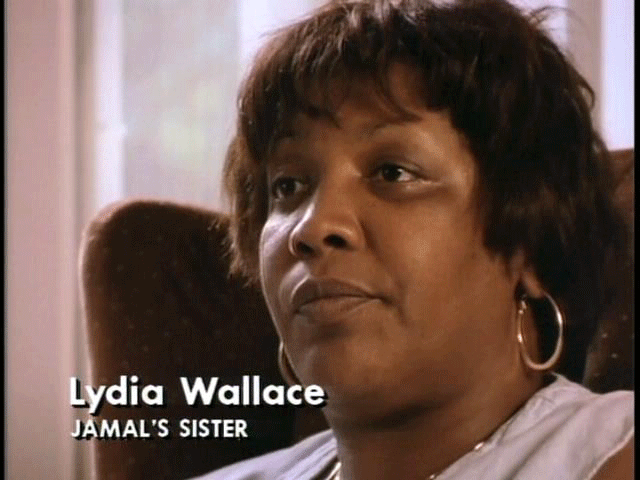
At times, Lydia Barashango, Abu-Jamal’s sister, held the camcorder. Her husband, the Rev. Ishakamusa Barashango, knelt down to a potted plant in the center of the room. As he began to pour libations, he began to call on the ancestors, “known and unknown.” Family members responded by repeating the word, “Ashe,” a West African term loosely meaning “the power to make it so.”

The name Edith Cook, Abu-Jamal’s late mother, was called. They had gathered in her name, proclaimed Rev. Barashango, “because everybody in here is either related to her. And if not directly related to her, spiritually related to her.” She died during Abu-Jamal’s second decade in prison.
It was the day after Thanksgiving, and Lydia had organized a get-together in Philadelphia to renew family ties, begin discussions about purchasing a family estate outside of the city, the making of a family quilt, and updating all about the latest in Abu-Jamal’s case.
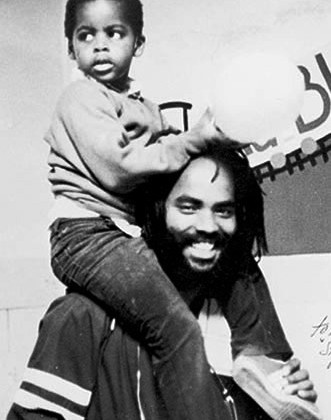
Next Sunday will mark the 20 years behind bars for Abu-Jamal, the 47-year-old former Black Panther. He is on death row in Waynesburg, Pa. for the killing of Daniel Faulkner, a White police officer, on the early morning of Dec. 9, 1981.
Abu-Jamal and Faulkner were shot after the former journalist tried to stop a confrontation between his brother, William Cook, and Faulkner on a Philadelphia city street early in the morning of Dec. 9. Faulkner died at the scene.

Abu-Jamal’s family continues to fight to prove his innocence while seeking to live normal lives. It’s a difficult balance to maintain. Although they have not been behind bars, his relatives have also been locked up—chained to the country’s best-known death row prisoner by blood and by choice.
“I feel my life has been in limbo for the past 20 years,” explains Lydia. “I would really like to move out of Philadelphia, but not until Mumia is free.”
The feeling of suspension, with strong tinges of fear, permeates the air around the family of the man born Wesley Cook. Abu-Jamal has four brothers—Keith, Ronnie, William, and his twin Wayne-and a sister, Lydia. He has three children-Jamal, Lateefa and Mazi (Mumia’s hyphenated Arabic surname means “father of Jamal.”). Jamal, the oldest of the trio and one of the most outspoken family members, has his own wait; he is serving a near 16-year sentence on weapons possession.

Lateefa and Mazi were able to attend the post-Thanksgiving family meeting. Mazi—a tall, dark-skinned man with his father’s build, presence and smooth baritone—made a rare visit to the city for the family. Lateefa, more petite than her older brother, lives in Philadelphia. Both display a sense of directness and reserve.
Abu-Jamal’s only daughter Lateefa is married with two children. Lydia’s husband, Rev. Barashango—pastor of the Temple of the Black Messiah, an African-centered interfaith church in Philadelphia—performed the wedding ceremony.
“I always said Lateefa was a little princess waiting for her daddy to come home,” says Lydia. It’s been a long wait. Lateefa was 8-year-old when her father first went to jail. She is now 28 and doesn’t closely follow the case because “sometimes it’s unbearable.”
At one point in the family ceremony, Keith softly addressed the small group of about 15 family members and close family friends. A correspondent for the National Newspaper Publishers Association, a federation of more than 200 Black newspapers, was the only journalist allowed to attend the family gathering. Keith outlined the family’s history. He talked about how losing his wife last year made him “want you to know who I am, and I want to know who you are.”

Then he talked not about one of the world’s most famous leftist causes, but about his little twin brothers and a family charge.
“When we (Lydia and I) were younger, we were given the twins” by their mother to watch over and take care of, he says, struggling to maintain his composure. Keith then recalled that his mother made Wayne’s well-being Lydia’s responsibility, while Keith was given Wesley.
Regardless of the family assignments, Keith said: “It has impacted all of us that he has been incarcerated for these 20 years.”
Lydia grabbed Keith by the waist, and said, “We’re in a very, very precarious position…We’re in a position where they would rather have Mumia than the man that confessed to the murder.”
Abu-Jamal’s legal team earlier this year produced an affidavit from Arnold Beverly, a man who says he was hired by the mob to kill Faulkner because the White police officer had been interfering with department-approved mob activity on Faulkner’s beat. Abu-Jamal’s 1982 prosecutors, his former legal team, and a city judge all have dismissed Beverly’s claims.
Philadelphia’s Fraternal Order of Police and other Faulkner supporters have long called Abu-Jamal a cop-killer—a murderer who got convicted after a fair trial. Believing Abu-Jamal is stalling the inevitable, they are angry that many anti-death penalty activists call him a “political prisoner.”
Lydia recalled how in the first years after Abu-Jamal’s 1982 conviction, she battled her journalist brother using his favorite weapons—pen and paper.
“Get your [explicative] out of there and come on home,” she wrote. “I don’t want my brother to be a martyr.” She was so mad she didn’t visit or write him for two years.
“I thought that he could say something to make the system let him go,” Lydia says. She says she knows better now. “He responded as if nothing ever happened,” Lydia recalled when she re-established the relationship.

The family talks more about battling the American justice system than Maureen Faulkner, the slain officer’s widow. Lydia claims Faulkner knows Abu-Jamal is innocent and is allowing herself to be used as a “poster child” for wives of police officers.
The widow and the Fraternal Order of Police have made the same charges about Abu-Jamal’s supporters. They claim Abu-Jamal’s supporters know he’s guilty and are using the author of three books as a poster child of the radical left.
A plaque in Faulkner’s honor is scheduled to be officially unveiled in Philadelphia at 13th and Locust—the corner where he was fatally shot—at a ceremony this Sunday.
Keith and Lydia are making their own plans for the future.
At Lydia’s request, Abu-Jamal has designed a family crest. Work on a quilt has also begun. Lydia also introduced the idea of family fundraising for an estate in her mother’s name. Migration once again equals familial security, as it was for Edith, who migrated with her brother to Philadelphia from segregated North Carolina in the 1940s.
It’s time to move away from the city, Lydia says.
“We’re fearful. We’re fearful of the police officers,” says Lydia. “My nephews, my sons—especially all the males in our family—we advise them not to be in Philadelphia.”
© Copyright 2001, 2006 by the National Newspaper Publishers Association and Todd Steven Burroughs, Ph.D.
……………..but he makes a good point here.


 Drums in the Global Village