………..this?
If not, you should.
………..this?
If not, you should.
Black Voices In Commentary
The Trotter Group [Editorial Team: DeWayne Wickham, Wayne Dawkins, Rochelle Riley, Cheriss May]
August Press, ISBN: 0963572091
128 pp., $15.95

Reviewed by Todd Steven Burroughs
Trotter Group members are neither irreverent nor famous. Although known to other journalists, they are hardly household names. Unless he does a national forum on print media coverage of Black communities, most will never get a call from Tavis Smiley’s booking agents to be on those February C-SPAN rhetoric marathons. That’s because the vast majority of Trotter members are seasoned print journalists who work(ed) hard at major white newspapers every day, far away from the national infotainment spotlight. The privilege to speak their communal Black-but-objective journalistic mind for their respective Metro or Op-Ed pages was a hard-earned one, back in the mass media era that now seems to have peaked. So, for as long as they can, they use their salaried opportunities to document their lives and opinions through their Black perspectives, educating white readers and re-affirming Black ones.

The 23 columnists here—among those who gather every year in the name of William Monroe Trotter, an agitating, early 20th century Black newspaper publisher—meld the past and present by making sure important local, regional and national Black stories got told. Even though most of the columns here range roughly from 2004 through 2006, collectively they weave strands of African-American history from Jim Crow up through “Hustle And Flow.†Pieces of memory, fragments of encounters, reporting of current events—all are here, dispatched from Boston, Detroit, Virginia, and other regions, intersecting in a multi-faceted piece of geography called Black America. This amalgamation allows the brief tale of a 23-year-old voter in Milwaukee to share space with the account a 103-year-old Tulsa, Oklahoma riot survivor preaching a revival in Seattle. The book’s slightly heartbreaking coda, “Memories,†contain the final first-person goodbyes from the Trotter members who are now Ancestors. Asante Sana, Vernon Jarrett, Norman Lockman, Peggy Peterman, Gregory Freeman and Lisa Baird, and other prominent Black journalists who seem to be dying every month.
 
Vernon Jarrett, One Of My Scribe AncestorsÂ
This collection adds well to Wickham’s own Black columnist anthologies, “Fire At Will,†his 1989 solo effort, and his 1995 edited work, “Thinking Black: Some Of The Nation’s Best Black Columnists Speak Their Mind.†This book, an unnamed sequel to the latter, keeps good company with the small group of first-person books written within the last two decades by Black journalists who have toiled in the journalistic mainstream. Many of these authors and columnists injected African-American perspectives in America’s public sphere while Smiley was still getting coffee for Tom Bradley and Michael Eric Dyson was cooped up in a library researching his master’s thesis. 🙂
But as 2007 approaches, these Black establishment voices seem, well, too traditional (read: old) in the blogging age. The tight newspaper spaces work against, not with, these pieces. The lack of intensity throughout reveals that these writers either do not have, or regularly use, the power to really witness in the ways The Village Voice, The Nation or I.F. Stone’s Weekly, to name three examples, made famous in the middle of the last century. The almost unvarying middle-of-the-road political perspectives read very corporate, restrained; none of the independent, righteous rage of, say, a Mumia Abu-Jamal or an Ann Coulter—or a Trotter, frankly!—is found here.

Many of the journalists included here would, for the most part, consider that last criticism somewhat of a compliment. They have sought broad community attention to educate and illuminate, not to provide fodder for Bill O’Reilly. They are proud of their white mainstream affiliations and the power they have traditionally carried. They are not trying to be cute, popular, or controversial. They would not fit well between Tom Joyner’s old-school jams and “Melvin’s Love Lines.â€
But in a new-media world of tens of thousands of amateur journalists using new toys that provide worldwide distribution without having to paint within established white lines, it might be difficult to make future opinionated Black scribes care about this important distinction. Then again, maybe the illusion of white power, coupled with steady green power, would be enough for many of them, after all. Choices abound because of the barrier-busting work of the Trotter Group. It’s just too bad those options don’t include a Black equivalent of Slate or Salon—some professional journalistic forum that would allow these veteran writers to stretch out and loosen up.
If the platform-shoe-d journalistic generation fails to inspire its multi-platformed media successors, however, it can at least pass into eldership knowing it succeeded in telling important African-American stories to, and for, teachers, churchgoers, politicians, bakers, dentists and supermarket cashiers back when the authority of a major metropolitan newspaper still meant something. That temporary glory is more than enough for it.
A sad anniversary approaches—the 25th anniversary of the fatal shooting of Daniel Faulkner. Mumia Abu-Jamal, a former member of the Philadelphia branch of the Black Panther Party who was convicted of the crime in 1982, has been under lock and key for 25 years this month.
The NNPA News Service originally distributed this story in December 2001. Here is the full version, with some pictures added from the Web.
For the record, I did try to find Maureen Faulkner at the time. I was unsuccessful.
Special thanks to Linn Washington for making this story happen.
There have been some changes since this story was published. Lydia Barashango’s husband, the Rev. Ishakamusa Barashango, joined the Ancestors. Abu-Jamal has written two more books since this article. (Here are links to all of his books thus far.) And to the relief of many of his supporters, Abu-Jamal’s legal team and strategy have significantly changed.
Meanwhile, you might find this interesting.
————–
Mumia Abu-Jamal’s Family Faces Future While Fighting Fear
20th Anniversary of 1981 Shooting Approaches
By Todd Steven Burroughs
NNPA News Editor
[ORIGINALLY PUBLISHED DECEMBER 2001]
PHILADELPHIA (NNPA)—A poster of Mumia Abu-Jamal, Philadelphia radio newscaster-turned-international death penalty cause celebre, hangs at a gathering of relatives in a local hotel suite.
At times, Lydia Barashango, Abu-Jamal’s sister, held the camcorder. Her husband, the Rev. Ishakamusa Barashango, knelt down to a potted plant in the center of the room. As he began to pour libations, he began to call on the ancestors, “known and unknown.” Family members responded by repeating the word, “Ashe,” a West African term loosely meaning “the power to make it so.”

The name Edith Cook, Abu-Jamal’s late mother, was called. They had gathered in her name, proclaimed Rev. Barashango, “because everybody in here is either related to her. And if not directly related to her, spiritually related to her.” She died during Abu-Jamal’s second decade in prison.
It was the day after Thanksgiving, and Lydia had organized a get-together in Philadelphia to renew family ties, begin discussions about purchasing a family estate outside of the city, the making of a family quilt, and updating all about the latest in Abu-Jamal’s case.
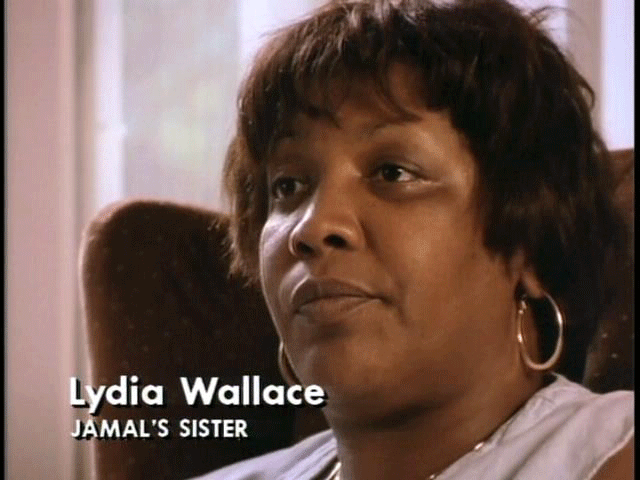
Next Sunday will mark the 20 years behind bars for Abu-Jamal, the 47-year-old former Black Panther. He is on death row in Waynesburg, Pa. for the killing of Daniel Faulkner, a White police officer, on the early morning of Dec. 9, 1981.
Abu-Jamal and Faulkner were shot after the former journalist tried to stop a confrontation between his brother, William Cook, and Faulkner on a Philadelphia city street early in the morning of Dec. 9. Faulkner died at the scene.

Abu-Jamal’s family continues to fight to prove his innocence while seeking to live normal lives. It’s a difficult balance to maintain. Although they have not been behind bars, his relatives have also been locked up—chained to the country’s best-known death row prisoner by blood and by choice.
“I feel my life has been in limbo for the past 20 years,” explains Lydia. “I would really like to move out of Philadelphia, but not until Mumia is free.”
The feeling of suspension, with strong tinges of fear, permeates the air around the family of the man born Wesley Cook. Abu-Jamal has four brothers—Keith, Ronnie, William, and his twin Wayne-and a sister, Lydia. He has three children-Jamal, Lateefa and Mazi (Mumia’s hyphenated Arabic surname means “father of Jamal.”). Jamal, the oldest of the trio and one of the most outspoken family members, has his own wait; he is serving a near 16-year sentence on weapons possession.

Lateefa and Mazi were able to attend the post-Thanksgiving family meeting. Mazi—a tall, dark-skinned man with his father’s build, presence and smooth baritone—made a rare visit to the city for the family. Lateefa, more petite than her older brother, lives in Philadelphia. Both display a sense of directness and reserve.
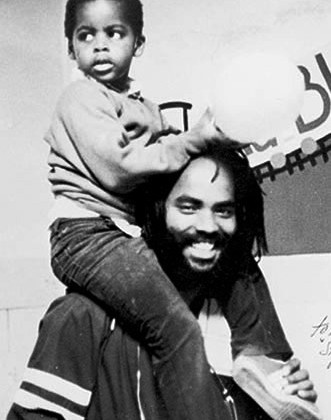
Abu-Jamal’s only daughter Lateefa is married with two children. Lydia’s husband, Rev. Barashango—pastor of the Temple of the Black Messiah, an African-centered interfaith church in Philadelphia—performed the wedding ceremony.
“I always said Lateefa was a little princess waiting for her daddy to come home,” says Lydia. It’s been a long wait. Lateefa was 8-year-old when her father first went to jail. She is now 28 and doesn’t closely follow the case because “sometimes it’s unbearable.”
At one point in the family ceremony, Keith softly addressed the small group of about 15 family members and close family friends. A correspondent for the National Newspaper Publishers Association, a federation of more than 200 Black newspapers, was the only journalist allowed to attend the family gathering. Keith outlined the family’s history. He talked about how losing his wife last year made him “want you to know who I am, and I want to know who you are.”

Then he talked not about one of the world’s most famous leftist causes, but about his little twin brothers and a family charge.
“When we (Lydia and I) were younger, we were given the twins” by their mother to watch over and take care of, he says, struggling to maintain his composure. Keith then recalled that his mother made Wayne’s well-being Lydia’s responsibility, while Keith was given Wesley.
Regardless of the family assignments, Keith said: “It has impacted all of us that he has been incarcerated for these 20 years.”
Lydia grabbed Keith by the waist, and said, “We’re in a very, very precarious position…We’re in a position where they would rather have Mumia than the man that confessed to the murder.”
Abu-Jamal’s legal team earlier this year produced an affidavit from Arnold Beverly, a man who says he was hired by the mob to kill Faulkner because the White police officer had been interfering with department-approved mob activity on Faulkner’s beat. Abu-Jamal’s 1982 prosecutors, his former legal team, and a city judge all have dismissed Beverly’s claims.
Philadelphia’s Fraternal Order of Police and other Faulkner supporters have long called Abu-Jamal a cop-killer—a murderer who got convicted after a fair trial. Believing Abu-Jamal is stalling the inevitable, they are angry that many anti-death penalty activists call him a “political prisoner.”
Lydia recalled how in the first years after Abu-Jamal’s 1982 conviction, she battled her journalist brother using his favorite weapons—pen and paper.
“Get your [explicative] out of there and come on home,” she wrote. “I don’t want my brother to be a martyr.” She was so mad she didn’t visit or write him for two years.
“I thought that he could say something to make the system let him go,” Lydia says. She says she knows better now. “He responded as if nothing ever happened,” Lydia recalled when she re-established the relationship.

The family talks more about battling the American justice system than Maureen Faulkner, the slain officer’s widow. Lydia claims Faulkner knows Abu-Jamal is innocent and is allowing herself to be used as a “poster child” for wives of police officers.
The widow and the Fraternal Order of Police have made the same charges about Abu-Jamal’s supporters. They claim Abu-Jamal’s supporters know he’s guilty and are using the author of three books as a poster child of the radical left.
A plaque in Faulkner’s honor is scheduled to be officially unveiled in Philadelphia at 13th and Locust—the corner where he was fatally shot—at a ceremony this Sunday.
Keith and Lydia are making their own plans for the future.
At Lydia’s request, Abu-Jamal has designed a family crest. Work on a quilt has also begun. Lydia also introduced the idea of family fundraising for an estate in her mother’s name. Migration once again equals familial security, as it was for Edith, who migrated with her brother to Philadelphia from segregated North Carolina in the 1940s.
It’s time to move away from the city, Lydia says.
“We’re fearful. We’re fearful of the police officers,” says Lydia. “My nephews, my sons—especially all the males in our family—we advise them not to be in Philadelphia.”
© Copyright 2001, 2006 by the National Newspaper Publishers Association and Todd Steven Burroughs, Ph.D.
……………..but he makes a good point here.
………….”COON”?!?!?

Young Blacks using the word “coon” to jokingly describe the activities of each other????
Nah. No way. I REFUSED to believe it when Richard Prince told me, but here it is.
…………Norman Solomon, who started my day by providing a hearty laugh. And a great dose of truth.
I think Friedman, The Master of Glib, means well, but his power to set the nation’s intellectual agenda about the nature of globalization is, well, woefully disproportionate. And, and Solomon points out, his lack of concern about oppressed peoples and others who will not be saved by the “new” (?) world capitalism is disturbing, to say the least.
Channeling Thomas Friedman
by Norman Solomon
Published on Monday, October 23, 2006 by
CommonDreams.org
Get ready for a special tour of a renowned outlook,
conjured from the writings of syndicated New York Times
columnist Thomas Friedman. As the leading media
advocate of “free trade” and “globalization,” he is
expertly proficient at explaining the world to the
world. If we could synthesize Friedman’s brain waves,
the essential messages would go something like this:
Silicon chips are the holy wafers of opportunity. From
Bangalore to Bob’s Big Boy Burgers, those who
understand the Internet will leave behind those who do
not.
I want to tell you about Rajiv/Mohammed/George, now
doing awesome business in Madras/Amman/Durham. Only a
few years ago, this visionary man started from scratch
with just a vision—a vision that he, like me, has
been wise enough to comprehend.
So, Rajiv/Mohammed/George built a business on the
digital backbone of the new global economy. Now, the
employees fill orders on a varying shift schedule, and
time zones are always covered. Don’t ask what they’re
selling—that hardly matters. They’re working in a
high-tech industry, and the profits are auspicious.
This is the Future. And it is good. Fabulous, actually.
Traveling the world as I do, I understand that the
world is best understood by people who travel the world
as I do.
The future is innovation across borders. The
entrepreneur who finds a good Web designer on another
continent really impresses me. Have I mentioned yet
that the Internet really impresses me? It really does.
Those who aren’t suitably impressed by IT will be left
behind.
As a journalist who visits one country after another, I
feel intoxicated by the Internet. And why shouldn’t I
be upbeat? I’m not one of the dead-end-job workers who
can look forward to mind-glazing drudgery in front of
computer screens as far as the eye can see.
For me, and for investors and managers who take me
around, what’s not to like? Commerce is about selling
things, providing services, expanding markets. All that
is so good.

Let’s face it—at this point I’m a rich guy, and I
work for a newspaper run by guys who are even richer
than I am. They’re gaga about what we like to call
globalization. So am I. We’re a perfect match.
As a matter of fact, just about any big media outlet in
the USA is run by managers who work for owners who’re
gaga for globalization. We don’t mention that there are
significant limits on our enthusiasm. Of course we
don’t want to globalize labor unions! We don’t want to
globalize powerful movements for environmental
protection! We don’t want to globalize movements
against war!
Speaking of war: I cheered the invasion of Iraq and
kept applauding for a long time afterward. I lauded the
war effort as glorious and noble—and, on the last
day of November 2003, I even likened the U.S.
occupation of Iraq to the magnanimity of the Marshall
Plan.
And if U.S. troops had been able to kill enough Iraqi
troublemakers early enough to quell the resistance, I
would have remained an avid booster of the war. There’s
no business like war business—that’s why I recycled
my clever slogan “Give war a chance” from the 1999 air
war on Yugoslavia to the 2001 military assault on
Afghanistan.
But I like winning. That’s why I kept praising Defense
Secretary Donald Rumsfeld when he looked like a winner,
and now I keep deploring him because he looks like a
loser.
Overall, I get to boil down the world to metaphors of
my own choosing. If I were one of the
anti-corporate-globalization people and I used the same
kind of simplistic metaphors, I’d be the object of
derision and scorn. But I’m not—so get used to it!
 
Never let it be said that leading U.S. pundit Thomas
Friedman has to live with the consequences of his
punditry. I think great thoughts, and I’m seriously
glib about them, and that should be more than enough if
the world is smart enough to grasp the opportunities
that are low-hanging fruit of the digital age. I can’t
expect everyone to get it, but at the very least they
should try.
The paperback edition of Norman Solomon’s latest book,
“War Made Easy: How Presidents and Pundits Keep
Spinning Us to Death,” was published this summer. For
information, go to http://www.warmadeeasy.com/Â .
Okay, I get that The Independent was trying to get attention for its coverage of Africa, but c’mon………….
http://www.nowpublic.com/uks_independent_newspaper_goes_red_with_kate_moss_cover
Couldn’t the editors have found another way to do this? IÂ mean, where was Alek Wek?
……..is really bugging me. Yet I do it anyway.
There is NO ONE ON EARTH more media-centric than me 🙂 , but c’mon……..
A whole episode of “Charlie Rose” about ex-President Bill Clinton’s “FOX News Sunday” interview?
Wall-to-wall cable coverage of The Washington Post‘s Bob Woodward coming out with a book explaining the inside story of what we knew all along?
THIS IS NEWS?????
Powerful white men go on white Tee Vee shows and discuss (read: promote) books written by other powerful white men about the actions of a third group of powerful white men (and how Condi and Colin help that third group). Meanwhile, aren’t there people still dying in Darfur right now?
Oh, sorry. Election year. Never mind.
But I’m sure I’m just jealous that we no longer have Black men who directly influence American public policy in ways that help the oppressed and scare the oppressor. I mean, we all know what happened to the last brother who did that successfully, don’t we? 😦
As a Black male would-be nonfiction author who still occasionally pretends to be a Washington, D.C.-area journalist, I also feel left out of this public-policy-book thang. (I was about to ask what happened to writing this kind of stuff for magazines, but I guess authors are tired of just making $15,000 from Esquire and Vanity Fair when they can now grab $150,000 in advance. Maybe it’s always been this way and I’m just now paying attention.) Did ALL of our top political correspondents take buyouts? Where are OUR books on the state of the nation and the world? Have any Black journalists ever met anybody in garages? LOL! 🙂
From Roland S. Martin.
ROLAND S. MARTIN: CBC Foundation Blows Another Great Opportunity
For the last four years I’ve traveled to Washington, D.C. to participate as a panelist or moderator of a workshop during the annual legislative conference put on by the Congressional Black Caucus Foundation.
An annual event for the last 36 years, the four-day confab brings together thousands of people, namely African Americans, to meet with the black members of Congress and discuss a wide variety of issues in the various “brain trusts” and seminars that are offered. Washington, D.C. hotels are packed, entertainers and celebrities blow through for a ton of receptions and parties, and attendees go back full of bubbly, food and lots of conversation.
And nothing ever really gets accomplished.
Oh, don’t get me wrong. I have a great time. Being able to converse on a panel dealing with marriage and money, as well as talking to nearly 200 young leaders, was wonderful. We shared great ideas and got a chance to dialogue, but does the conference ever produce any lasting change for Black America? Nope.
A lot of this isn’t the fault of the attendees. My position is that you always make the best of a situation and keep on moving. The problem? The repeated failure of leadership by the Congressional Black Caucus Foundation to fully understand what to do with the thousands of people who attend.
Between last year’s legislative conference and this year’s event, I didn’t receive one e-mail related to any public policy we discussed last year. The purpose of the caucus foundation is to “focus on education, public health, economic development and African globalism. CBCF is the premier organization that creates, identifies, analyzes and disseminates policy-oriented information critical to advancing African Americans and people of African descent towards equity in economics, health and education.”
So what’s up with the lack of communication? I have no clue who gets their e-mail blasts and public policy positions. You would think those who have attended past events would at least get regular updates on bills that relate to the overall mission of the group.
Then again, why should I expect to get an e-mail blast when the effort isn’t even made to drive the thousands of attendees to the U.S. Capitol to meet with their elected leaders? The way I see it, when you register, they should print on your nametag your U.S. House representative and the two U.S. senators where you hail from (be honest, a lot of us have no clue who represents us in Congress). That way, when you visited the Hill, you would meet with your rep first and then visit with others.
But the foundation must make this possible by setting aside one day to call on members of Congress. My suggestion? Make it Thursday. Members of Congress get out of town on Friday, so send folks to Capitol Hill on Thursday morning to drive home the agenda of Black America.
Other groups do it. The NAACP, Delta Sigma Theta and Alpha Kappa Alpha sororities do variations of this, so you would think that the foundation affiliated with the 43 black members of Congress would have this figured out.
Not.
And what about those great sessions? If you didn’t a chance to travel to D.C., at least make them all available as podcasts. It’s cheap and easy, and folks all over the world could benefit from the great information that is disseminated. Lastly, send the attendees home with a real agenda. This year’s theme was “Changing Course, Confronting Crises, Continuing the Legacy.” Fine. But when I got on the plane Sunday, I didn’t have a list of initiatives and talking points that reflect the agenda leading up to the next gathering. How can you speak of a “Black Agenda” but never present one?
This has often been the failure of many organizations — and not just those led by African Americans. We are the “meetingest” folks in the world, but what is accomplished out of these gatherings? Is there a collective agenda that is advanced, worked on and implemented?
I’ve shared my frustrations with multiple members of Congress, including Reps. Elijah Cummings, D-Md., and Mel Watt, D-N.C. (the outgoing and incoming chairs of the CBC) last year. What happened? Nothing. I’m not holding my breath expecting next year to be any different. And that’s a shame.
But at least the chocolate cake at Morton’s Steakhouse was good. That was about the only thing I savored the whole weekend.
Roland S. Martin is general manager/executive editor of The Chicago Defender, the nation’s largest Black daily newspaper. His columns are syndicated to newspapers nationwide by Creators Syndicate and his commentaries appear on the TV One Cable Network. And he can be heard daily from 6 a.m. to 9 a.m. on Chicago’s WVON-AM/1690 or http://www.wvon.com/ . He is the founder of BlackAmericaToday.com. He is also a contributor to The Paradox of Loyalty: An African American Response to the War on Terrorism. He can be reached at rmartin@chicagodefender.com or roland@rolandsmartin.com .


