Category Archives: newspaper
Had To Be There
And we all were. What a tribute by the Queen La, and a fantastic poem by Maya Angelou.
(The Return Of) Blue-Collar Journalists
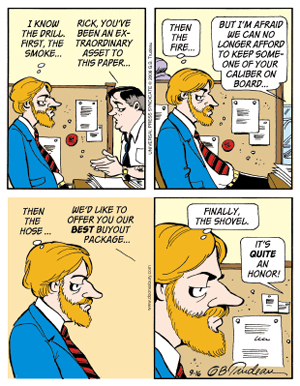
I’m not ashamed to admit that, as a kid in the mid-80s, I wanted to be Rick Redfern when I grew up. I still do. But in 2008, of course, he got laid off and had to re-invent himself as a blogger.
Meanwhile, Barbara Ehrenreich told the truth to today’s J-grads. The profession was always considered a trade, anyway. It was elevated into a profession sans license thanks to Woodward, Bernstein and the springing up of local and national television and radio newscasts. Now the vocation has become a real public utility (as in, members of the public, at best, being useful to each other), separated from “job” and “career,” and the old world ain’t coming back.
Black press veterans worked like this from the beginning. I was whining a few years back once to my friend and mentor Judy Dothard Simmons (now an ancestor) about how limited the (paid) Black (national newspaper and magazine) journalistic opportunities were (for me), and, as usual, she corrected me to the quick: “When you came along [late 1980s-early 1990s], working for a national Black(ish) magazine became a full-time job,” explaining to me how new that was. (1990-ish Newsstand Freelancer Roll Call: Black Enterprise, Vibe, The Source, Honey, Shade, Blaze, Black Elegance, The Crisis, Rappages, Emerge, Class, YSB [Young Sisters and Brothers], Heart and Soul, Code, Black Issues Book Review, Upscale, and on and on.) And now, as I see, like Simmons (and, eventually, all of us) how very temporary all of it is.
A Dignified Goodbye

Very dignified. Almost too reserved, frankly. (My mom disagreed; she thought it was an example of perfect pitch.) The comments from Berry Gordy and the Rev. Al Sharpton set the proper context. And Brooke Shields and Usher…..wow, I hope they’re being comforted. Missed Mariah Carey and Trey Lorenz’s opener, but I’m sure she nailed it. As Marlon, one of his brothers, said, “Maybe now, Michael, they will leave you alone.”
The wait by the mailbox for Rolling Stone now begins……..Vibe could have redeemed itself here, had it not died with him….. *SIGH* 😦
[JULY 10th UPDATE: And I found these two radio programs essential.]
Transformer (III of III)
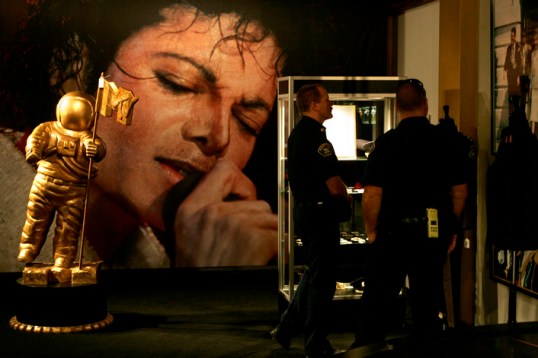
Here’s something I helped get published back in 1994. My friend and mentors’ comments here are not only still relevant, but do a good job of explaining Mike’s role.
MICHAEL JACKSON: VICTIM OF MEDIA MONEY MACHINE I
When we find ourselves having produced one of the most
powerful and influential entertainment history leaders, it
is ironic we render ourselves silent in the face of
assault—not the assault of an industry, but the assault of
the mere idea that a man of African descent can be a master
of Black images and obtain massive wealth in the process.Michael Jackson is a smokescreen in a continuous media
machine to reduce our image to the distortion normally
displayed by the news media. Michael has taken the Black
image and given it the dignity and prominence it had not
seen in years. (Forget about his current skin color:
Remember the African images in the “Remember The Time”
video, which was released during Black History Month?
Remember the multicultural focus and rage expressed in the
“Black or White” video?)People have been mesmerized by the soap opera of
non-information. What is at fault is an industry created for
the development of mediocre talent, at best. What has not
been called into question—with the notable exception of the
Los Angeles chapter of the NAACP—is the lack of
journalistic responsibility in transmitting, for the most
part, tales of gossip.Too often we forget that the aim of the mass media is to
influence public opinion. On the 6 o’clock news, we witness
a daily bloodletting of those of African descent being
sacrificed to maintain the image of purity.
The artist is involved in creative processes which fosters
independent thought and action. He or she is feared by those
who have no command of those processes.Within Corporate America, the self-esteem, humanistic spirit
and aspirations of African-Americans are being controlled,
suppressed and altered every day. Too often, Black workers’
earnings are used as a barometer for others who are rewarded
when they surpass it.With this in mind, the media assault against Michael Jackson
has created money to be spent, new personalities to be
quoted, and increases in audiences for tabloid TV shows and
rags that would not normally be doing this well in an
unstable economy. (I am reminded of the photographers that
nearly crushed the Jackson women while trying to get a shot
of the men during a 1984 “Victory Tour” press conference in
New York City.)Why is it that these accusations have mostly been carried in
news pages, but when Jackson receives a standing ovation at
the recent NAACP Image Awards, it’s just a small item in the
entertainment sections?Isn’t there a historical pattern of using Blacks to react to
a depressed economy? These accusations could have come years ago; so why have they come now, in the wake of urban
rebellions, the downsizing of Corporate America and the
general lackluster of today’s media events?The problem is between those who control the creative
process and those who control the money. The latter would
rather destroy the former than co-exist.MICHAEL JACKSON: VICTIM OF MEDIA MONEY MACHINE II
Jealousy is behind the Michael Jackson media assault.
Adults have removed a figure that has supplied three
generations of children with rhyme, lyric and image to cope
with the cynicism of adulthood. The children are the
victims, the psychological casualties of this mass media war
for power and of greed.
For an entire industry to react so singularly, so
irresponsibly, is frightening. Why? It was knowing the power
and enormous wealth of a 35-year-old man. Many are working
overtime to figure out how to tie up his money or get as
much of it as possible. This is particularly true of those
who not only have no clue to how the creative process works,
but openly resent those who obtain such power. Those who
can’t put the King in check knock all of the pieces off the
table.However, we have a clue on the level of a mother’s
anguish—Katherine Jackson’s anguish—of watching her child
absorb such negative energy.It is an indictment of the mass media that they have not
interviewed the mothers of every child who allegedly had a
negative interaction with Michael Jackson.Where are the adults in this crisis? Where were they during
these alleged incidents? Why aren’t ALL the adults
undergoing the same media character assassination as is
Michael Jackson? If something did happen, then ALL the
adults are responsible.If Michael Jackson is guilty of anything, it’s of not listening
to his one sincere guide—his mother, Katherine. She has
demonstrated the strength of the African mother. She has to,
because no entertainment family has had to endure the public
assault hers have.It’s time for the African village to become loud, demanding
and supportive of our cultural contributors. We must never
be allowed to look back and see that we participated, by
omission, in the destruction of one of our greatest cultural
diplomats just because the media saw nothing happening of
note recently in Buckingham Palace!As for Michael Jackson, he must purge those who are disloyal
to him in order to avoid a repeat of this situation.
He must also take his creative energy and channel it into
his art. It will only lead to his greatest work.His creativity will lead to his healing. In the struggle,
any warrior must focus on his or her strengths. His or her
relationship to the village is to absorb, share and inspire.This process ensures victory.
Copyright 1994, 2009 by Vicky Gholson, Ph.D.
VICKY GHOLSON, PH.D. is a media specialist with more than 30 years experience in all aspects of mass media. Her email is vfre2bme@yahoo.com.
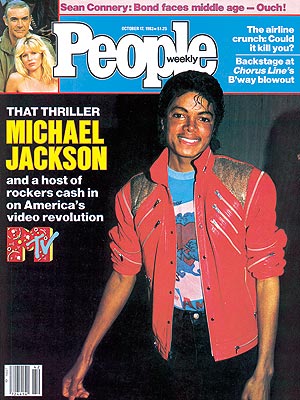

Transformer (II of III)

Probably the only time I ever agreed with Stanley Crouch. 🙂 His view is now more mainstream among Black thinkers.
Transformer (I of III)
The key moment here is at the very end, when Mike is on the run from folks trying to capture him—detain him, constrain him, define him. The smile on his face as he infuriates King Eddie is more than just Bugs Bunnyish cleverness; it’s bliss. (He’s completely in his element here, a combo of Eshu, the Yoruba Trickster God and the mysterious magician from/for the [African] world.) He tries to run away. Seemingly trapped, he then turns into sand, confounding his opponents. The moment works because since it’s Michael Jackson, you think he actually did that. Fifty years of morphing into any shape, every shape. A half-century of re-defining American and world entertainment. Michael showed us that magic wasn’t just possible in fantasy, but actually present, in the world, in us. He continued to produce it, on his own terms, and allowed us to bear witness so we could tell the tale of a man who spent an entire life transforming pain into pleasure.
One Step Forward, Two Steps Back
History was indeed made yesterday. It was the kind of history that Obama likes to make. The President had chosen someone in his own (personal and ideological) image.
If I wasn’t paying attention, I’d think that Obama was the most progressive president I’ve ever seen. And maybe he is. But maybe that’s just not good enough.
The more I turn on the radio, the more disturbed I get. Isn’t anyone going to challenge him on any of this? I think we can both enjoy the history and ask critical questions.
The Last Word On………

“Star Trek” ? WOW! GOT-D*&N!!!!! And the movie’s great, too! LOL! 🙂

“X-Men Origins: Wolverine” ? Wait for the DVD. The filmmakers just didn’t care enough here, which in the post-“Dark Knight” era, is a sin.

“Doomsday,” “Smallville”‘s Season 8 finale? Powerful—from the little I saw of it. The Big Reveal near the very end was both a tremendous cheat and a great idea! I never thought he would die. 🙂

“Stand,” Tavis Smiley’s first (*snicker*) documentary? I heard him describe this on 89.3 WPFW-FM, and I curled up in a fetal position. If this millionaire’s idea of a documentary is giving him, West, Dyson, et. al. even more airtime, then we’re sunk. Thank God for the white folks at NPR and PBS, who fund real (softish) Black documentaries every once in a while. *SIGH* 😦
The Wonderful Nature of Truth!
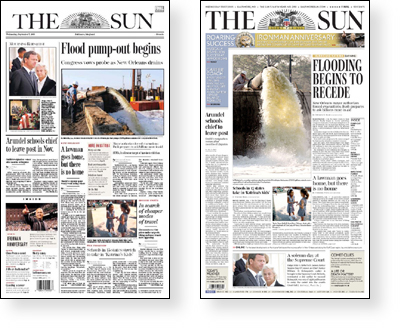
Thank you, David Simon.
Senate Committee on Commerce, Science, and Transportation
Subcommittee on Communications, Technology, and the Internet
Hearing on the Future of Journalism, May 6, 2009Testimony of David Simon (Baltimore Sun, 1982-95, Blown Deadline Productions, 95-09, Baltimore, Md.)
Thank you all for the invitation and opportunity to speak on this issue today, but I start by confessing reluctance.
My name is David Simon and I used to be a newspaperman in Baltimore. Head and heart, I was a newspaperman from the day I signed up at my high school paper until the day, eighteen years later, when I took a buyout from the Baltimore Sun and left for the fleshpots of Hollywood.
To those colleagues who remain at newspapers, I am therefore an apostate, and my direct connection to newspapering –having ended in 1995 – means that as a witness today, my experiences are attenuated.
Ideally, rather than listening to me, you should be hearing from any number of voices of those still laboring in American journalism. I am concerned that the collective voice of the newsroom itself – the wisdom of veteran desk editors, rewrite men and veteran reporters is poorly represented in this process. But of course newspapers are obliged to cover Congress and its works, and therefore the participation of most working journalists in today’s hearing would compromise some careful ethics. I know your staff tried to invite working journalists but were rebuffed on these grounds. And so, tellingly, today’s witness list is heavy with newspaper executives on the one hand, and representatives of the new, internet-based media on the other.
And so, I’ve accepted the invitation, though to be honest, I’m tired of hearing myself on this subject; I’ve had my say in essays that accompany this testimony, and in the episodes of a recent television drama, and I would be more inclined to hear from former colleagues if they were in a position to speak bluntly.
I am glad, at least, to be testifying beside Steve Coll, who labored at the Washington Post for two decades and whose coverage of complex issues upholds the highest journalistic standards. And I will leave to Mr. Coll a more careful and considered analysis of where journalism and newspapering must travel. I fully agree with his fundamental argument that non-profit status is the industry’s last hope, and I believe his thoughts on the subject are more advanced and detailed than my own.
If Mr. Coll can be prescriptive, I will do my best to be diagnostic. I’ll set him up by concentrating on what went wrong in American newspapering.
What I say will likely conflict with what representatives of the newspaper industry will claim for themselves. And I can imagine little agreement with those who speak for new media. From the captains of the newspaper industry, you will hear a certain martyrology – a claim that they were heroically serving democracy to their utmost only to be undone by a cataclysmic shift in technology and the arrival of all things web-based. From those speaking on behalf of new media, weblogs and that which goes twitter, you will be treated to assurances that American journalism has a perfectly fine future online, and that a great democratization in newsgathering is taking place.
In my city, there is a technical term we often administer when claims are plainly contradicted by facts on the ground. We note that the claimant is, for lack of a better term, full of it. Though in Baltimore, of course, we are explicit with our nouns.
High-end journalism is dying in America and unless a new economic model is achieved, it will not be reborn on the web or anywhere else. The internet is a marvelous tool and clearly it is the informational delivery system of our future, but thus far it does not deliver much first-generation reporting. Instead, it leeches that reporting from mainstream news publications, whereupon aggregating websites and bloggers contribute little more than repetition, commentary and froth. Meanwhile, readers acquire news from the aggregators and abandon its point of origin –namely the newspapers themselves.
In short, the parasite is slowly killing the host.It is nice to get stuff for free, of course. And it is nice that more people can have their say in new media. And while some of our internet commentary is – as with any unchallenged and unedited intellectual effort – rampantly ideological, ridiculously inaccurate and occasionally juvenile, some of it is also quite good, even original.
Understand here that I am not making a Luddite argument against the internet and all that it offers. But democratized and independent though they may be, you do not – in my city — run into bloggers or so-called citizen journalists at City Hall, or in the courthouse hallways or at the bars and union halls where police officers gather. You do not see them consistently nurturing and then pressing sources. You do not see them holding institutions accountable on a daily basis.
Why? Because high-end journalism – that which acquires essential information about our government and society in the first place — is a profession; it requires daily, full-time commitment by trained men and women who return to the same beats day in and day out until the best of them know everything with which a given institution is contending. For a relatively brief period in American history – no more than the last fifty years or so – a lot of smart and talented people were paid a living wage and benefits to challenge the unrestrained authority of our institutions and to hold those institutions to task. Modern newspaper reporting was the hardest and in some ways most gratifying job I ever had. I am offended to think that anyone, anywhere believes American institutions as insulated, self-preserving and self-justifying as police departments, school systems, legislatures and chief executives can be held to gathered facts by amateurs pursuing the task without compensation, training, or for that matter, sufficient standing to make public officials even care to whom it is they are lying or from whom they are withholding information.
The idea of this is absurd, yet to read the claims that some new media voices are already making, you would think they need only bulldoze the carcasses of moribund newspapers aside and begin typing. They don’t know what they don’t know – which is a dangerous state for any class of folk — and to those of us who do understand how subtle and complex good reporting can be, their ignorance is as embarrassing as it is seemingly sincere. Indeed, the very phrase citizen journalist strikes my ear as nearly Orwellian. A neighbor who is a good listener and cares about people is a good neighbor; he is not in any sense a citizen social worker. Just as a neighbor with a garden hose and good intentions is not a citizen firefighter. To say so is a heedless insult to trained social workers and firefighters.
So much for new media. But what about old media?
When you hear a newspaper executive claiming that his industry is an essential bulwark of society and that it stands threatened by a new technology that is, as of yet, unready to shoulder the same responsibility, you may be inclined to empathize. And indeed, that much is true enough as it goes.
But when that same newspaper executive then goes on to claim that this predicament has occurred through no fault on the industry’s part, that they have merely been undone by new technologies, feel free to kick out his teeth. At that point, he’s as fraudulent as the most self-aggrandized blogger.
Anyone listening carefully may have noted that I was bought out of my reporting position in 1995. That’s fourteen years ago. That’s well before the internet ever began to seriously threaten any aspect of the industry. That’s well before Craig’s List and department-store consolidation gutted the ad base. Well before any of the current economic conditions applied.
In fact, when newspaper chains began cutting personnel and content, their industry was one of the most profitable yet discovered by Wall Street money. We know now – because bankruptcy has opened the books – that the Baltimore Sun was eliminating its afternoon edition and trimming nearly 100 editors and reporters in an era when the paper was achieving 37 percent profits. In the years before the internet deluge, the men and women who might have made The Sun a more essential vehicle for news and commentary – something so strong that it might have charged for its product online – they were being ushered out the door so that Wall Street could command short-term profits in the extreme.
Such short-sighted arrogance rivals that of Detroit in the 1970s, when automakers – confident that American consumers were mere captives – offered up Chevy Vegas, and Pacers and Gremlins without the slightest worry that mediocrity would be challenged by better-made cars from Germany or Japan.
In short, my industry butchered itself and we did so at the behest of Wall Street and the same unfettered, free-market logic that has proved so disastrous for so many American industries. And the original sin of American newspapering lies, indeed, in going to Wall Street in the first place.
When locally-based, family-owned newspapers like The Sun were consolidated into publicly-owned newspaper chains, an essential dynamic, an essential trust between journalism and the communities served by that journalism was betrayed.
Economically, the disconnect is now obvious. What do newspaper executives in Los Angeles or Chicago care whether or not readers in Baltimore have a better newspaper, especially when you can make more putting out a mediocre paper than a worthy one? The profit margin was all. And so, where family ownership might have been content with 10 or 15 percent profit, the chains demanded double that and more, and the cutting began – long before the threat of new technology was ever sensed.
But editorially? The newspaper chains brought an ugly disconnect to the newsroom, and by extension, to the community as well. A few years after the A.S. Abell Family sold The Sun to the Times-Mirror newspaper chain, fresh editors arrived from out of town to take over the reins of the paper.
They looked upon Baltimore not as essential terrain to be covered with consistency, to be explained in all its complexity year in and year out for readers who had and would live their lives in Baltimore. Why would they? They had arrived from somewhere else, and if they could win a prize or two, they would be moving on to bigger and better opportunities within the chain.So, well before the arrival of the internet, as veteran reporters and homegrown editors took buyouts, newsbeats were dropped and less and less of Baltimore and central Maryland were covered with rigor or complexity.
In a city in which half the adult black males are without consistent work, the poverty and social services beat was abandoned. In a town where the unions were imploding and the working class eviscerated, where the bankruptcy of a huge steel manufacturer meant thousands were losing medical benefits and pensions, there was no longer a labor reporter. And though it is one of the most violent cities in America, the Baltimore courthouse went uncovered for more than a year and the declining quality of criminal casework in the state’s attorney’s office went largely ignored.
Meanwhile, the editors used their manpower to pursue a handful of special projects, Pulitzer-sniffing as one does. The self gratificationof my profession does not come, you see, from covering a city and covering it well, from explaining an increasingly complex and interconnected world to citizens, from holding basic institutions accountable on a daily basis. It comes from someone handing you a plaque and taking your picture.
The prizes meant little, of course, to actual readers. What might have mattered to them, what might have made the Baltimore Sun substantial enough to charge online for content would have been to comprehensively cover its region and the issues of that region, to do so with real insight and sophistication and consistency.
But the reporters required to achieve such were cleanly dispatched, buyout after buyout, from the first staff reduction in 1992 to the latest round last week, in which nearly a third of the remaining newsroom was fired. Where 500 men and women once covered central Maryland, there are now 140. And the money required to make a great newspaper – including, say, the R&D funding that might have anticipated and planned for the internet revolution – all of that went back to Wall Street, to CEO salaries and to big-money investors. The executives and board chairman held up their profit margins and got promoted; they’re all on some golf course in Florida right now, comfortably retired and thinking about things other than journalism. The editors took their prizes and got promoted; they’re probably on what passes for a journalism lecture circuit these days, offering heroic tales of past glory and jeremiads iads about the world they, in fact, helped to bring about.
But the newspapers themselves?
When I was in journalism school in the 1970s, the threat was television and its immediacy. My professors claimed that in order to survive, newspapers were going to have to cede the ambulance chasing and reactive coverage to TV and instead become more like great magazines. Specialization and detailed beat reporting were the future. We were going to have to explain an increasingly complex world in ways that made us essential to an increasingly educated readership. The scope of coverage would have to go deeper, address more of the world not less. Those were our ambitions. Those were my ambitions.
In Baltimore at least, and I imagine in every other American city served by newspaper-chain journalism, those ambitions were not betrayed by the internet. We had trashed them on our own, years before. Incredibly, we did it for naked, short-term profits and a handful of trinkets to hang on the office wall. And now, having made ourselves less essential, less comprehensive and less able to offer a product that people might purchase online, we pretend to an undeserved martyrdom at the hands of new technology.
I don’t know if it isn’t too late already for American newspapering. So much talent has been tom from newsrooms over the last two decades and the ambitions of the craft are now so crude, small-time and stunted that it’s hard to imagine a turnaround. But if there is to be a renewal of the industry a few things are certain and obvious:
First, cutting down trees and printing a daily accounting of the world on paper and delivering it to individual doorsteps is anachronistic. And if that is so, then the industry is going to have to find a way to charge for online content. Yes, I have heard the post-modern rallying cry that information wants to be free. But information isn’t. It costs money to send reporters to London, Fallujah and Capitol Hill, and to send photographers with them, and to keep them there day after day. It costs money to hire the best investigators and writers and then to back them up with the best editors. It costs money to do the finest kind of journalism. And how anyone can believe that the industry can fund that kind of expense by giving its product away online to aggregators and bloggers is a source of endless fascination to me. A freshman marketing major at any community college can tell you that if you don’t have a product for which you can charge people, you don’t actually have a product.
Second, Wall Street and free-market logic, having been a destructive force in journalism over the last few decades, are not now suddenly the answer. Raw, unencumbered capitalism is never the answer when a public trust or public mission is at issue. If the last quarter century has taught us anything – and admittedly, with too many of us, I doubt it has – it’s that free-market capitalism, absent social imperatives and responsible regulatory oversight, can produce durable goods and services, glorious profits, and little of lasting social value. Airlines, manufacturing, banking, real estate –is there a sector of the American economy where laissez-faire theories have not burned the poor, the middle class and the consumer, while bloating the rich and mortgaging the very future of the industry, if not the country itself? I’m pressed to think of one.
Similarly, there can be no serious consideration of public funding for newspapers. High-end journalism can and should bite any hand that tries to feed it, and it should bite a government hand most viciously. Moreover, it is the right of every American to despise his local newspaper – for being too liberal or too conservative, for covering X and not covering Y, for spelling your name wrong when you do something notable and spelling it correctly when you are seen as dishonorable. And it is the birthright of every healthy newspaper to hold itself indifferent to such constant disdain and be nonetheless read by all. Because in the end, despite all flaws, there is no better model for a comprehensive and independent review of society than a modern newspaper. As love-hate relationships go, this is a pretty intricate one. An exchange of public money would pull both sides from their comfort zone and prove unacceptable to all.
But a non-profit model intrigues, especially if that model allows for locally-based ownership and control of news organizations. Anything that government can do in the way of creating non-profit status for newspapers should be seriously pursued. And further, anything that can be done to create financial or tax-based incentives for bankrupt and near-bankrupt newspaper chains to transfer or even donate unprofitable publications to locally-based non-profits should also be considered.
Lastly, I would urge Congress to consider relaxing certain anti-trust prohibitions with regard to the newspaper industry, so that the Washington Post, the New York Times and various other newspapers can sit down and openly discuss protecting their copyright from aggregators and plan an industry wide transition to a paid, online subscriber base. Whatever money comes will prove essential to the task of hiring back some of the talent, commitment, and institutional memory that has been squandered.
Absent this basic and belated acknowledgment that content has value — if indeed it still does after so many destructive buyouts and layoffs – and that content is what ultimately matters, I don’t think anything else can save high-end, professional journalism.
Thank you for your time and again, for your kind invitation.
 Drums in the Global Village