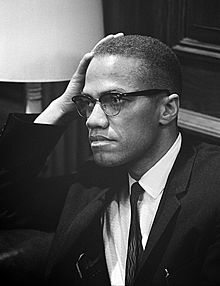
Malcolm X, Tomorrow?
The time has come for the Negro (African) to forget and cast behind him his hero worship and adoration of other races, and to start out immediately, to create and emulate heroes of his own.
We must canonize our own saints, create our own martyrs, and elevate to positions of fame and honor Black men and women who have made their distinct contributions to our racial history…Africa has produced countless numbers of men and women, in war and in peace, whose lustre and bravery outshine that of any other people. Then why not see good and perfection in ourselves?
Ours the Right to Our Doctrine
We must inspire a literature and promulgate a doctrine of our own without any apologies to the powers that be. The right is ours and God’s. Let contrary sentiment and cross opinions go to the winds. Opposition to race independence is the weapon of the enemy to defeat the hopes of an unfortunate people. We are entitled to our own opinions and not obligated to or bound by the opinions of others.
— Marcus Garvey, African Fundamentalism
Every now and then, there is a tendency among scholars to resurrect the memory of a historical icon and claim to have newly found information that will lay to rest all previous works about the known giant, thus breathing life into their own dead “scholarly” existence. This occurs maybe once in a lifetime; we, of my generation, are fortunate because history has rewarded us with the opportunity to witness it twice in the alleged re-telling/re-creation of the life of Saint Malcolm X. Yes, I do believe, as the Honorable Marcus Mosiah Garvey wrote, that Malcolm X is worthy of sainthood.
What is it about Malcolm that makes his tale so magnificent?
Mr. Ossie Davis summed it up beautifully: “Malcolm was/is our manhood our living Black manhood; and in honoring him we honor the best in ourselves.”
I contacted several elders expecting them to be angry about the recent book by Professor Manning Marable on Malcolm X. However, they all responded calmly and analytically, a testament to their time spent in our struggle. In fact, their responses made me question my reaction. Maybe, I was too reactionary. But upon reflection I concluded it was merely an expression of the depth of analysis of the personality of Brother Malcolm and what his example means to different generations among the oppressed. It was then that I decided to respond from my generation’s vantage point. This is merely an attempt to add paper to discourse.
Malcolm stated: “The price of Freedom is death.” The slave must die in order for the freeman to live. Both cannot occupy the body at the same time. Whenever an act is revealed about a person by another the question must be raised: was this information necessary to develop the image/character of the person?
In 1971 William Styron wrote a book about Saint Nat Turner. It was an attempt to attack the sanity and manhood of Mr. Turner and reduce him to the level of a deranged savage using the appropriate language. Our esteemed Elder, Dr. John H. Clarke saw the need to assemble nine writers and to publish ‘Ten Black writers’ response to William Styron’s Nat Turner’; thus reaffirming the value of Nat Turner’s life and revolutionary role to his people.
Certain aspects of Malcolm’s personality are similar to that of Nat Turner. Nat’s willingness to fight for his people even at the risk of death is an example of manhood and bravery at its best. Malcolm’s willingness to speak and defend the rights of his people even at the risk of death, is a direct parallel, because history informs us that he could have ‘punked out’ and lived longer. However, such men can not take the “easy way out.” Many of us don’t understand why; and that explains why we are still here.
What we are witnessing is not an attack upon Malcolm’s character for the previous, or current, generation. The previous generation knows of Malcolm by virtue of having been present during his lifetime. The current generation has been exposed to Malcolm just one generation removed from his physical transformation. The opinions of either group, whether they be negative or positive, are not who the negative depiction of Malcolm’s character is designed to influence.
The destruction of Malcolm’s character is aimed at future generations. The oppressors of African People clearly understand that if Malcolm’s life example is properly studied and taught, it could serve as a tool to liberate the minds of the oppressed, especially the young males. By looking ahead in a diabolical crystal ball, with the goal of keeping African people permanently oppressed, they have collectively decided to systematically destroy the character of one of our great revolutionaries.
The example of Malcolm’s life and his transformation into an intellectual and cultural revolutionary, if properly taught and understood could serve as a liberating tool for the oppressed. The oppressors understand that by destroying Malcolm’s image today, you don’t have to be concerned about Malcolm tomorrow. The youth of today will not want to study and emulate Malcolm tomorrow, nor will their children.
The oppressed can never be provided with a satisfactory solution to their dilemma by the oppressor. A solution, principally among the males, is an example of manhood; especially that of a male transformed from fighting against the aspirations of his people into a man that fought for the aspirations of his people. And whenever the oppressor can recruit one from the oppressed lot to aide them in the systematic, historical destruction of such an example, it will definitely be done. This, the oppressed who are mentally conscious, must expect. The oppressors will never miss an opportunity to extend their reign of oppression in each generation. What the oppressed must do is respond to such an attack in kind i.e. paper for paper, and move forward with the business of mental liberation.
Mekhat (121512)