Independent Audio/Video You Should Check Out (Eighth In A Long-Running Series)

VOXUNION MEDIA
January 2007
FreeMix Radio: The Original Mix Tape Radio Show FM8
 
The online edition of this mix tape is now available and contains a new year’s mix including music from: Pharaohe Monch, Head-Roc, Paris, Blitz, Nas, Common, Floetry, Hi-Tek, Buju Banton, Sizzla, and much more.
Also included is the launch of Project Blackout/Whitewash and FreeMix’s Top 10 Stories Under-reported in 2006 with special guest host The Angry Emcee. You cannot afford not to hear this.
Click here to download and visit VOXUNION.COM for the stream/download option and much more. 

Independent Audio/Video You Should Check Out (Sixth In A Long-Running Series)


VOXUNION MEDIA
FreeMix Radio
December 13, 2006

A threepart interview series with John Judge.  Judge is a staffer with Congresswoman Cynthia McKinney (D-Ga.), a volunteer with C.H.O.I.C.E.S. (a counter-military recruitment organization) and member of COPA (Coalition On Political Assassinations).  He discusses McKinney’s filing for impeachment of Bush, the military’s dependence on the poor, Black and Latino youth and the continuing impact of political assassinations of Malcolm X, Martin Luther King and John and Robert Kennedy.

Independent Audio/Video You Should Check Out (Fifth In A Long-Running Series)


From my friend Malik Russell.

————

THE DOCUMIXOLOGIST published a new podcast entitled “AMOS WILSON: MIND-WARRIOR” on 12/10/2006 4:23:18 AM, posted by Melki.

————————————————————————

AMOS WILSON: MIND-WARRIOR

The late Dr. Amos Wilson, noted pyschologist, drops serious science on the issue of racism and white supremacy. He addresses the particular issues of raising Black children without passing down an inferiority complex.

Remembering 13th and Locust, 25 Years Later

A sad anniversary approaches—the 25th anniversary of the fatal shooting of Daniel Faulkner. Mumia Abu-Jamal, a former member of the Philadelphia branch of the Black Panther Party who was convicted of the crime in 1982, has been under lock and key for 25 years this month.

The NNPA News Service originally distributed this story in December 2001. Here is the full version, with some pictures added from the Web.

For the record, I did try to find Maureen Faulkner at the time. I was unsuccessful. 

Special thanks to Linn Washington for making this story happen.

There have been some changes since this story was published. Lydia Barashango’s husband, the Rev. Ishakamusa Barashango, joined the Ancestors. Abu-Jamal has written two more books since this article. (Here are links to all of his books thus far.) And to the relief of many of his supporters, Abu-Jamal’s legal team and strategy have significantly changed.

Meanwhile, you might find this interesting.

————–

Mumia Abu-Jamal’s Family Faces Future While Fighting Fear
20th Anniversary of 1981 Shooting Approaches

By Todd Steven Burroughs
NNPA News Editor

[ORIGINALLY PUBLISHED DECEMBER 2001]

PHILADELPHIA (NNPA)—A poster of Mumia Abu-Jamal, Philadelphia radio newscaster-turned-international death penalty cause celebre, hangs at a gathering of relatives in a local hotel suite.

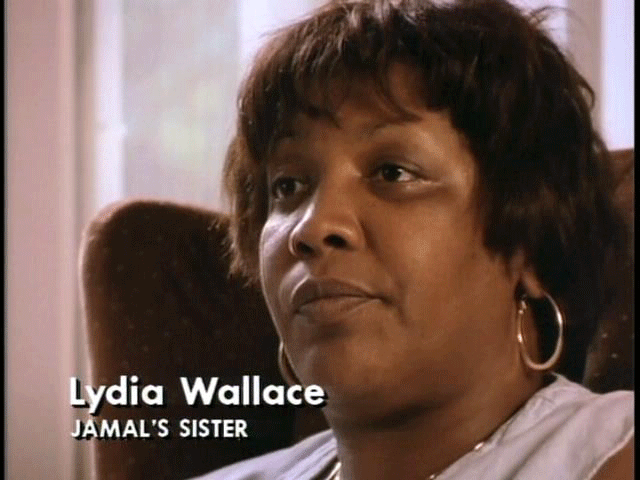
At times, Lydia Barashango, Abu-Jamal’s sister, held the camcorder. Her husband, the Rev. Ishakamusa Barashango, knelt down to a potted plant in the center of the room. As he began to pour libations, he began to call on the ancestors, “known and unknown.” Family members responded by repeating the word, “Ashe,” a West African term loosely meaning “the power to make it so.”

The name Edith Cook, Abu-Jamal’s late mother, was called. They had gathered in her name, proclaimed Rev. Barashango, “because everybody in here is either related to her. And if not directly related to her, spiritually related to her.” She died during Abu-Jamal’s second decade in prison.

It was the day after Thanksgiving, and Lydia had organized a get-together in Philadelphia to renew family ties, begin discussions about purchasing a family estate outside of the city, the making of a family quilt, and updating all about the latest in Abu-Jamal’s case.
mumiareasondoubt_3e

Next Sunday will mark the 20 years behind bars for Abu-Jamal, the 47-year-old former Black Panther. He is on death row in Waynesburg, Pa. for the killing of Daniel Faulkner, a White police officer, on the early morning of Dec. 9, 1981.

Abu-Jamal and Faulkner were shot after the former journalist tried to stop a confrontation between his brother, William Cook, and Faulkner on a Philadelphia city street early in the morning of Dec. 9. Faulkner died at the scene.

Locust

Abu-Jamal’s family continues to fight to prove his innocence while seeking to live normal lives. It’s a difficult balance to maintain. Although they have not been behind bars, his relatives have also been locked up—chained to the country’s best-known death row prisoner by blood and by choice.

“I feel my life has been in limbo for the past 20 years,” explains Lydia. “I would really like to move out of Philadelphia, but not until Mumia is free.”

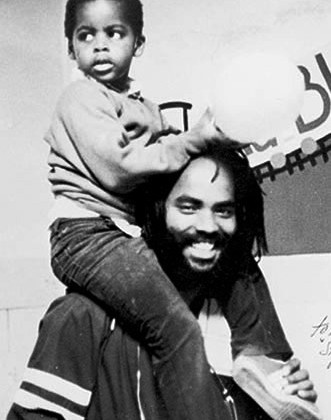
The feeling of suspension, with strong tinges of fear, permeates the air around the family of the man born Wesley Cook. Abu-Jamal has four brothers—Keith, Ronnie, William, and his twin Wayne-and a sister, Lydia. He has three children-Jamal, Lateefa and Mazi (Mumia’s hyphenated Arabic surname means “father of Jamal.”). Jamal, the oldest of the trio and one of the most outspoken family members, has his own wait; he is serving a near 16-year sentence on weapons possession.

Lateefa and Mazi were able to attend the post-Thanksgiving family meeting. Mazi—a tall, dark-skinned man with his father’s build, presence and smooth baritone—made a rare visit to the city for the family. Lateefa, more petite than her older brother, lives in Philadelphia. Both display a sense of directness and reserve.
Mumia-Abu-Jamal-with-son-331x420

Abu-Jamal’s only daughter Lateefa is married with two children. Lydia’s husband, Rev. Barashango—pastor of the Temple of the Black Messiah, an African-centered interfaith church in Philadelphia—performed the wedding ceremony.

“I always said Lateefa was a little princess waiting for her daddy to come home,” says Lydia. It’s been a long wait. Lateefa was 8-year-old when her father first went to jail. She is now 28 and doesn’t closely follow the case because “sometimes it’s unbearable.”

At one point in the family ceremony, Keith softly addressed the small group of about 15 family members and close family friends. A correspondent for the National Newspaper Publishers Association, a federation of more than 200 Black newspapers, was the only journalist allowed to attend the family gathering. Keith outlined the family’s history. He talked about how losing his wife last year made him “want you to know who I am, and I want to know who you are.”

Then he talked not about one of the world’s most famous leftist causes, but about his little twin brothers and a family charge.

“When we (Lydia and I) were younger, we were given the twins” by their mother to watch over and take care of, he says, struggling to maintain his composure. Keith then recalled that his mother made Wayne’s well-being Lydia’s responsibility, while Keith was given Wesley.

Regardless of the family assignments, Keith said: “It has impacted all of us that he has been incarcerated for these 20 years.”

Lydia grabbed Keith by the waist, and said, “We’re in a very, very precarious position…We’re in a position where they would rather have Mumia than the man that confessed to the murder.”

Abu-Jamal’s legal team earlier this year produced an affidavit from Arnold Beverly, a man who says he was hired by the mob to kill Faulkner because the White police officer had been interfering with department-approved mob activity on Faulkner’s beat. Abu-Jamal’s 1982 prosecutors, his former legal team, and a city judge all have dismissed Beverly’s claims.

Philadelphia’s Fraternal Order of Police and other Faulkner supporters have long called Abu-Jamal a cop-killer—a murderer who got convicted after a fair trial. Believing Abu-Jamal is stalling the inevitable, they are angry that many anti-death penalty activists call him a “political prisoner.”

Lydia recalled how in the first years after Abu-Jamal’s 1982 conviction, she battled her journalist brother using his favorite weapons—pen and paper.

“Get your [explicative] out of there and come on home,” she wrote. “I don’t want my brother to be a martyr.” She was so mad she didn’t visit or write him for two years.

“I thought that he could say something to make the system let him go,” Lydia says. She says she knows better now. “He responded as if nothing ever happened,” Lydia recalled when she re-established the relationship.

The family talks more about battling the American justice system than Maureen Faulkner, the slain officer’s widow. Lydia claims Faulkner knows Abu-Jamal is innocent and is allowing herself to be used as a “poster child” for wives of police officers.

The widow and the Fraternal Order of Police have made the same charges about Abu-Jamal’s supporters. They claim Abu-Jamal’s supporters know he’s guilty and are using the author of three books as a poster child of the radical left.

A plaque in Faulkner’s honor is scheduled to be officially unveiled in Philadelphia at 13th and Locust—the corner where he was fatally shot—at a ceremony this Sunday.

Keith and Lydia are making their own plans for the future.

At Lydia’s request, Abu-Jamal has designed a family crest. Work on a quilt has also begun. Lydia also introduced the idea of family fundraising for an estate in her mother’s name. Migration once again equals familial security, as it was for Edith, who migrated with her brother to Philadelphia from segregated North Carolina in the 1940s.

It’s time to move away from the city, Lydia says.

“We’re fearful. We’re fearful of the police officers,” says Lydia. “My nephews, my sons—especially all the males in our family—we advise them not to be in Philadelphia.”

© Copyright 2001, 2006 by the National Newspaper Publishers Association and Todd Steven Burroughs, Ph.D.

Independent Audio/Video You Should Check Out (Fourth In A Long-Running Series)

Another thing worth checking out.

          IMMEDIATE RELEASE

Contact:    MELKI @       Onemelki@gmail.com
 
WAS MARTIN LUTHER KING A REPUBLICAN?


NEW HIPHOP & JAZZ ‘DOCUMIXTORY’ PODCAST ENDS SPECULATION ON WHERE HE STOOD ON THE ISSUES

RARE SPEECHES MIXED OVER A CORNUCOPIA OF GROOVES


November 16, 2006–Washington, D.C.—With current attempts by Republican candidates for office to label Martin Luther King, Jr., a Republican, and ongoing attempts by mainstream media to portray MLK as a “Dreamer,” author and Documixologist Melki releases his latest Documix, entitled “MLK: Blak At Ya.”

Melki fuses rare Marvin Gaye grooves with hiphop, funky R&B, and soul music as a backdrop to some of MLK’s most poignant speeches. In “Blak at Ya,” Dr. Martin Luther King, Jr. discusses the following topics: Racism in America; America’s War Machine, Threats to his Life and the American Value System, in audio recordings culled from speeches rarely if ever heard by the American public.

Interjected as well into the nearly 40-minute Documix are comments from various generations of African Americans about what MLK meant to them. One of the key questions asked was “Would things be different for African Americans if MLK were alive today?” The answers are both raw and powerful.

“I thought it insane for folks to attempt to co-opt MLK in one way or another, especially with so much of his audio out there for people to hear themselves,” said Melki, the author of 21 Hustle, a futuristic hiphop, sci-fi and mystical novel set in the year 2021. “If people can now transform MLK into a ‘conservative,’ then it’s not out the question to pick up a newspaper 50 years from now and see Dubya listed as a 5-time winner on Jeopardy,” joked Melki.

Melki is also the producer of several documixes including one on the Iraqi War entitled “The Low-IQ War MIX.”

The Documix is available for downloads and streaming. The ‘MLK: Blak at Ya’ Documix is G-rated and available for commercial media and educational uses free of charge. To hear or download the Podcast of this Documix visit here.

Ed Bradley, Our New Ancestor

After reading the stories below, check out these interviews. And don’t forget to watch the “60 Minutes” tribute this Sunday night.

NEW YORK (CNN) — Ed Bradley, the longtime “60 Minutes” correspondent who reported on subjects ranging from jazz musicians to the Columbine school shootings, has died. He was 65. 

Bradley died Thursday at New York’s Mount Sinai Hospital of leukemia, according to staff members at the CBS program.

Bradley joined “60 Minutes” during the 1981-82 season after two years as White House correspondent for CBS News and three years at “CBS Reports.” His reporting over the years won him a Peabody Award, 19 Emmys and a Robert F. Kennedy Journalism Award, among many others.

CNN’s John Roberts, who worked with Bradley at CBS, said the newsman was “always a person you could sit down with and he could keep you intrigued for hours at a time with the stories he could tell.”

Roberts called Bradley a “first-rate” journalist.

“He clearly was a field reporter,” said Howard Kurtz, the Washington Post media reporter. “He did not want to be chained to a desk.” Kurtz also hosts CNN’s “Reliable Sources.”

“He was somebody who liked being out there on the story, whether it was in the Vietnam War or whether it was doing investigative work or bringing alive the plight of families who were dealing with illnesses or violence or other issues he covered,” Kurtz added.

Bradley was known for his thoughtful, mellifluous voice and often deceptively relaxed interviewing style. In 2000, he conducted the only television interview with condemned Oklahoma City bomber Timothy McVeigh. His hourlong report on the plight of Africans dying of AIDS, “Death by Denial,” won a Peabody.

Bradley, a great music lover, also interviewed Miles Davis, Lena Horne and Paul Simon, among other performers. He once moonlighted as a disc jockey, earning $1.50 an hour spinning records while working as a teacher by day.

Bradley began his career in radio at WDAS in Philadelphia, Pennsylvania, in 1963. In 1967 he moved to New York and radio station WCBS, and then joined CBS News as a stringer in the Paris bureau in 1971.

After a stint in Saigon (now Ho Chi Minh City), Vietnam, he came to Washington in 1974. He covered Jimmy Carter’s presidential campaign in 1976.

CNN’s David Fitzpatrick, a former CBS producer who worked with Bradley, said there were tears in the halls of CBS News after word of his passing.

“He was gracious,” Fitzpatrick said. “He would always have a smile.”

Bradley is survived by his wife, Patricia Blanchet.

——-

Ed Bradley, The News Pioneer Who Never Lost His Cool

By Wil Haygood
Washington Post Staff Writer
Friday, November 10, 2006; C01


Ed Bradley had cool like a vault has money.

The celebrated “60 Minutes” newsman, who died yesterday of leukemia at 65, was certainly learned, absolutely a globe-trotter, and highly honored. But it was his cool that drew bearhugs from men and cheek-to-cheek kisses from women all over the world.

Deborah Willis, a professor of photography and imaging at New York University, came of age in Philadelphia — Bradley’s birthplace — during the 1970s, when the newsman was routinely showing up on national news broadcasts. Women were pointing to his picture in Jet and Ebony, in Time and Newsweek. Ed Bradley came to the American party with crossover cachet.

“He had this style that everyone tried to emulate,” says Willis.

Willis chatted with Bradley two months ago in Manhattan. Bradley had arrived at the New York Historical Society to listen to her interview the artist Betye Saar. Afterward, “He complimented me on my interview! Do you know how much that meant to me?” she says.

Willis noticed how people watched Bradley at her lecture. “There was the cool pose that wasn’t posing. He personified this look. It was a constructed self, constructed from a history of men who knew what it meant to be masculine and cool.”

After college, Bradley taught school and did some unpaid disc jockey work. But he knew he had a voice, and the kind of diction that might lend itself to a job with a microphone. He started on the news side of CBS radio in 1967. Soon enough he was in Vietnam. It was a kind of trial assignment.

“They made no promises to him when he went to Vietnam,” says Lee Thornton, who covered Jimmy Carter’s White House for CBS along with Bradley, both among the first blacks to do so.

But reputations were made in the Vietnam jungle. When Bradley emerged, with a thick but well-coiffed Afro and beard, his profile began to soar.

“He had his own kind of jazz,” says Thornton, who now hosts the cable talk show “A Moment With,” which is taped at the University of Maryland.

“He had a swagger and class. Mind you, he was not the first generation of black males at the networks. Hal Walker preceded him [at CBS]. But he brought his generation’s feeling of: ‘I have a right to be here. So let me show you.’ ”

Thornton remembers overhearing Bradley talking to “60 Minutes” producers as he made a follow-up pitch on the telephone shortly after his initial job interview for the program. “He was not, in the beginning, wanted by ’60 Minutes.’ I was there the day he kept making his case to them. I listened from one of those little booths near him. His case to them was: ‘I’m good, period.’ ”

He often turned his interviews into gabfests, into something akin to a kitchen chat at Thanksgiving. (They took on far more intensity when he was interviewing murderers or bombers.) And there were those across black America who wondered if as many black legends — Lena Horne, Muhammad Ali — would have been profiled were it not for his presence.

“Ed was as comfortable talking to Lena Horne as standing out on the White House lawn,” says Thornton. “What he brought to ’60 Minutes’ was not only the diversity of his person — his hipness, his music — but he extended that to the stories he covered. Thereby introducing America to those things.”

Thornton never saw meanness in Bradley. But a temperamental moment does stand out: “I was at CBS when an assignment editor asked Ed to do something. Ed didn’t like the story idea. He didn’t think it was up to his level. Ed stood up and looked at the editor and said, ‘Find. Yourself. Another. Dude.’ Oh, Lord, he was funny.”

Bradley’s pioneering presence on the air was widely noted. Last year he received a lifetime achievement award from the National Association of Black Journalists, in a ceremony here in Washington. He seemed genuinely moved at the event, staring at a screen as snatches of his memorable interviews scrolled by.

His hair had long gone gray. He had an earring. And he had raindrops in his eyes when he accepted the award from longtime BET newscaster Ed Gordon.

“Ed’s demeanor said to America: ‘Not everybody comes from the same cookie cutter,’ ” Gordon said yesterday. ” ‘But here we are.’ ”

Gordon says many black journalists are bedeviled by the prospect of being labeled “a black journalist,” convincing themselves they are shortchanging their breadth and scope. Bradley never ran away from his cultural pride, Gordon says, finding poetry where it existed. “Ed knew he was smart enough to do any story, be it on the Oklahoma City bomber or Lena Horne. That’s what was great about Ed.”

A bevy of friends had been gathering at Mount Sinai Hospital in New York in the waning days of Bradley’s life. Among them was Charlayne Hunter-Gault, a longtime friend.

Hunter-Gault, who has had her own distinguished career in journalism, used to run into Bradley all the time. He’d be on his way someplace. Lugging bags, looking bleary-eyed, off to another time zone, just back from another time zone. She didn’t understand it: All those honors, well into his 60s, running like a college intern. “I’d say, ‘Ed, you’ve got nothing to prove.’ He’d say, ‘I’ve got a job to do.’ ”

She walked into his hospital room the other day and he was tussling with the covers, moving his legs, his arms. “He was fighting,” says Hunter-Gault. “It made me think of that Sterling Brown poem, ‘Strong Men Keep A’Comin.’ ”
You sang Me an’ muh baby gonna shine, shine

Me an’ muh baby gonna shine

The strong men keep-a-comin’ on

The strong men git stronger