Rev. Sharpton’s statement
Rev. Jackson’s statement

Roland Martin’s audio interview with Obama
Obama’s Iowa victory speech
Rev. Sharpton’s statement
Rev. Jackson’s statement
Roland Martin’s audio interview with Obama
Obama’s Iowa victory speech

All year I’ve been amused by the journalistically fostered idea that white Americans, the (voting) majority of this country, are ready to actually go into small booths in November 2008 and, privately and deliberately, elect a Black male as POTUS. Before he gets assassinated.
Late last night, I was in bed with the great passion of my life—Rolling Stone. 🙂 It documented the overdose of optimism that is part of Obamaland. I read this article days after watching an interview Bill Moyers did with esteemed political scientist Ron Walters. Our brother seemed, well, cautiously optimistic about Barack Obama, too.
I just have a hard time believing it. I know I’m not the only one. Yes, this is the America of Condi and Oprah and Will Smith, but it’s also the America of Jena 6 and Megan Williams and institutional, if not blatant, racism in every aspect of American life—especially politics. Remember the McCain “slur” in South Carolina? Or “Harold at the Playboy party?”
Yes, the Oprah thing LOOKED impressive. But in America, it’s those angry “Washington Journal” (white) callers who actually vote. Ask Karl Rove about this. 🙂
If Walters hadn’t said what he did on Tee Vee about Obama’s chances, I’d just dismiss all of this as media hype generated by the yearning for the End of White Guilt. Let’s see what Iowa, New Hampshire and especially South Carolina will yield.

Some people think so. My verdict: Stop HATING! Black people do not OWN our brother MLK.

See the above? Well, it isn’t torture—at least, not according to America’s elite mainstream media. Well, at least not yet. See, they haven’t made up their minds.
Whenever I think “Democracy Now!” sounds too strident, all I have to do is hear the MSM’s hand-wringing over the obvious to again be reminded why we need national, professional advocacy journalism based in the United States.

…………last week’s “Bill Moyers Journal” report on media ownership by people of color?
No?
Well, then, here it is.
NOVEMBER 19th UPDATE: Here’s the follow-up on the larger issue of consolidation.

………..from Bruce Springsteen in his recent Rolling Stone interview.
You gotta get the mag to read all of what I read, ’cause most of it is not online.


And then, in 2008, there was none. Damn. Money really does talk, and talk well, huh? DAMN! What happened to subsidizing your BRANDS? Oh, that’s right; the network is the CW now. Boy, am I naive! LOL! 🙂

Clearly, after 16 years of geek bliss, it’s finally time to leave the house on Saturday mornings. 🙂 I will always have great memories of the Great Animated Superhero Cartoon Commercial Television Era of 1992 (the year “Batman: TAS” premiered on Fox Kids on weekday afternoons) to 2008. “X-Men,” “Spider-Man: TAS,” “Phantom 2040” , “Gargolyes” and “Superman: TAS” followed on Fox Kids, Kids WB! or in weekdaily or weekend first-run syndication (not counting UPN Kids, ’cause it just showed repeats of the other network shows), all to great acclaim from fanboys (read: me 🙂 ).

And on and on, “Fantastic Four: TAS,” “Iron Man: TAS,” “Silver Surfer: TAS” (my all-time favorite) “The Avengers: TAS,” and more, as the ’90s turned into ’00s. Up through “The Batman” (a show I only tolerated until it began to take itself seriously, writing-wise, at the start of its fourth season) and “Legion of Super Heroes.”

With Fox Kids and Kids’ WB! gone, at 39 I really can’t make the audience investment anymore, following the remaining cartoons to cable or wherever. *SIGH* At least there are now a lot of (direct–to-) DVD animated films from which to choose.


Time to take those Saturday art classes—sculpture? painting?— I keep claiming I want. And perhaps I should start pulling out my “How-To-Write-A-Screenplay” books and my African myth anthologies……..


SENTENCES: The Life of MF Grimm
By Percy Carey and Ronald Wimberly
Vertigo Books/DC Comics
$19.99, ISBN: 978-1-4012-1046-5
He was thisclose to getting out of The Life for good before the bullets came for his spine. But Percy Carey himself makes it hard to feel sorry for him before and after he was paralyzed from the waist down. Carey grew up in the ‘Hood before it became glamorized in 1990s song and film, and rolled with it simultaneously on his own and its terms. So he simultaneously produced hiphop and pain, strife and glory, street legend status and a criminal record.
So goes “Sentences,” the story of MF Grimm, a.k.a. “The Grimm Reaper,” and his battles using guns on the New York City streets and using words onstage as a rapper with serious potential undercut by tragedy. Carey’s first-person account, published in graphic novel form by DC Comics’ Vertigo imprint, is awash with paradox: shootouts in the afternoon and MC battles that same night; the boring monotony of drug dealing, and the most powerful love mixed in with the most violent hate.

This kind of nonfiction genre’s usual suspects show up—anger, the informant, jail life, redemption, realization, determination. Along the way, the reader gets a bi-coastal idea of how hiphop formed from the days of Run-DMC’s label-approved party jams through MF Doom’s independent moves. Carey was clearly a player: he met Chuck D, once shared a stage with KRS-One, assisted several Death Row Record artists (including Snoop Dogg), and even once interviewed Nas for “Right On!” magazine. As Grimm himself doesn’t fail to point out, he got shot before Corporate Music America learned to pimp that as a marketing move.
Carey relays his tale with a stark power that would make Ernest Hemingway pause and Donald Goines smile. Unfortunately, the wheelchair-bound hiphop artist has no profound thoughts to deliver, only the typical I-couldn’t-resist-the-lure-of-the-streets-so-don’t-let-this-happen-to-you lessons. His memories, regardless, are painful to re-live, even (and perhaps especially) in cartoon form, thanks to Ronald Wimberly. The artist’s superbly realistic but cartoony style, coupled with his brilliant uses of black space, almost produces sound—especially that of the revolving beauty and pain of the author’s personal journey into moral purgatory. Carey seeks to, and succeeds in, understanding his own demons, and he seems glad to be back to square one, ready to make new journeys out of his life.

The following hit all the marks.
I’m certain you know about Dr. Pipher’s public stand.
AMY GOODMAN: Mary Pipher, clinical psychologist and acclaimed author. I asked her to talk about her latest book, Writing to Change the World.
MARY PIPHER: You know, how Pete Seeger always said about music: it isn’t whether or not it’s good, it’s what it’s good for. And I didn’t come at writing as an academic or as a poet or a creative writer. I came at writing as a social activist, and I want every one of my books to have a very powerful effect in changing the culture. And so, I have spent a lot of time figuring out how to do it. And the way to do it is have a deeply personal voice, my own authentic voice that comes from deep within myself, and my writing and speaking voice are virtually identical. And then, the other way to do it is through stories, because you can’t argue with a story. You know, people can argue with you if you stand up and say what you believe or don’t believe, but if you tell them a story and tell them a story that opens their heart, they will change. So that’s what the book is about, is writing in a way that we can effect change.
And I talk about this idea that the point of my kind of writing is to empower the powerless, to give voice to people who have no voice, but also to educate readers in what I call the moral imagination. And that is the ability to understand the world from other people’s points of view. And that’s an extremely big problem in America right now, is people don’t have much moral imagination, so that when they talk about, say, “illegal aliens,” they don’t have a story, they don’t have a face, they don’t have a picture of a real person. They have almost no empathy with the person they’re talking about.
I remember when Sensenbrenner was talking about gaming the asylum system and how we had to go after those terrorists gaming the asylum system. At that point I had just happened to have been back to Bellevue in New York City to visit their unit for victims of torture. The people on that unit that were seeking asylum were Buddhist monks from Tibet. And I just thought, “Man, Sensenbrenner hasn’t been here. You know, he hasn’t been to Center for Victims of Torture in Minneapolis.”
And so, the job of the change writer, from my point of view, is to say I respect you as a reader, and I know if I tell you the truth, as I see it, having spent some time listening to people and asking them — you know, Simone Weil had that question, “What is your experience?”– asking people, “What is your experience?” which I did when I wrote Middle of Everywhere, my book on refugees. I spent three years asking people that. And it greatly enhanced my own moral imagination to listen to all those stories. You also have a good job for enhancing your moral imagination. But that’s the job of the writer: to help other people’s moral imagination grow, basically.
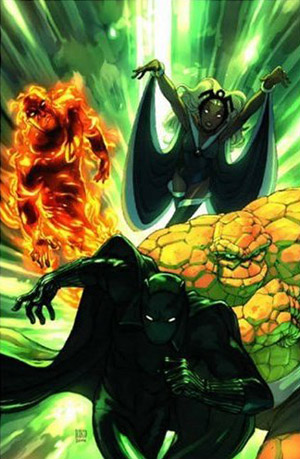
The above—a Fantastic Four briefly led by T’Challa, with significant backup from Storm—was probably the only good thing to come out of Marvel Comics’ Civil War.
***
BLACK PANTHER 24-29
WRITER: Reginald Hudlin
PENCILLERS: Marcus To and Koi Turbull (24); To (25); Francis Portela (26-27; pencils and inks on 28-29);
INKERS: Don Ho, Jeff de los Santos (24-25), Sal Regla and Nick Nix (24); Victor Olazaba (26-27)
PLOT: The Civil War continues in 24 and 25. In the aftermath, King T’Challa and Queen Storm find a special crib in which to crash, and an important task. Then a refurbished Foursome meet the Marvel Zombies…….
FANTASTIC FOUR 544-548
WRITER: Dwayne McDuffie
PENCILLER: Paul Pelletier
INKER: Rick Magyar
PLOT: The “new” Fantastic Four go up against The Silver Surfer and The Frightful Four.
VERDICTS: As far as Hudlin’s BLACK PANTHER goes, I eagerly await his NEXT storyline—which, hopefully, will be in Wakanda. The Civil War crossover issues try their best to solidify the Panther-Storm relationship, but nothing else happens, except a couple of sub-plots. Continuity again takes a walk, even from less than five years ago: Panther and Falcon talk about upgrading Falcon’s wings, when Panther ALREADY DID THAT in the pages of CAPTAIN AMERICA AND THE FALCON. The Marvel Zombie storyline is not even worth discussing.
McDuffie had me cheering through his episodes of “Justice League Unlimited,” so I’m happy to report that his Fantastic Four is quite solid, albeit surface-level. Add Pelletier’s lovely art, and you’ve got a more-than-decent read.
Fanboys pitched a fit when T’Challa—who, in McDuffie’s book, at least, was a little more like the character Priest envisioned—was able to arm-lock Ol’ Chrome Dome. I guess they forgot when Stan Lee had Spider-Man do pretty much the same thing back in the day. Meanwhile, I got a little tired of seeing Sue captured for the 400th time and watching The Frightful Four try to get it together yet AGAIN, but the stories were entertaining, and I guess that’s the (only) point in 2007, right?
AUGUST 29th UPDATE (BLACK PANTHER 30 and FANTASTIC FOUR 549): Hudlin’s dialogue is still uneven, 30 issues into his BP run. *SIGH*.
McDuffie putting in Sue’s mouth the words “I. AM NOT. A HOSTAGE,” and her subsequent taking DOWN of three of the Frightful Four/Five by her damn self, was worth the price of the mag alone. 🙂 Again, if the goal is fun, the brothers are trying their best.