Masterpiece.
P.S. I’m off to see it tomorrow for the THIRD time, but I’ll see it again with anyone who wants to see it.
Masterpiece.
P.S. I’m off to see it tomorrow for the THIRD time, but I’ll see it again with anyone who wants to see it.
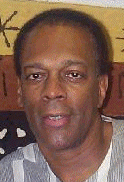
It was great hearing Bob Law’s voice on the radio again. The occasion was a new documentary film he’s narrating.
Enjoyed the recent NPR discussion about it, and Black radio. I agree with the host—the time for Black Activist Commercial Radio might be past, but not necessarily for the same reasons she brought up. Check here for my five-year-old rant on the subject. Here are a couple of great books and two great radio programs on the subject.

I like “NOVAScienceNOW,” even though I’m not hosting it. 🙂 Believe me, that’s high praise. It’s clear we’re in the Golden Age of the Magazine—the BROADCAST magazine. I’m happy that I can listen to three national Black(ish) radio newsmagazines in a week, watch the NOVA spinoff show every summer and check out what the brother’s doing on “History Detectives,” but it’s hard to let the dream go of working full-time for a national (Black) general interest magazine. (Aside: It’s really too bad that too many of these broadcast magazines don’t have full-time [or sometimes any!] correspondents.) Soon it’ll be time for the local library to get my Gordon Parks autobiographies, I guess.
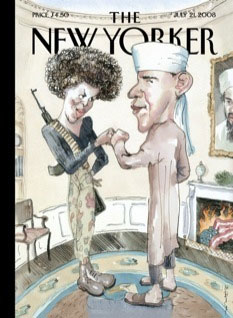
Okay. A work of satire. I get it. Confront the enemy directly, blah, blah, blah…….. But boy, some folks are really upset! I got a relative who wants to [CENSORED] The New Yorker building!
The news media pretend it’s hard to tell a deliberate slam from a sham these days. For instance, The Reverend Nutslicer. Does anyone other than me believe Jackson Sr. purposely made his “gaffe” so that white moderates in swing states would be more comfortable voting for Obama in November? Saying what he said while wired to a FOX News microphone? C’mon……..
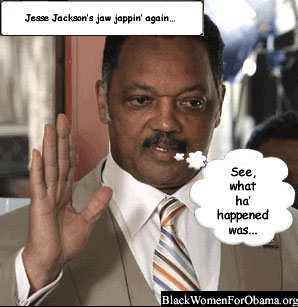
I mean, how upset could Jackson really be about what Obama said (and repeated last night), since The Good Reverend has said the exact same things for years and years? (I never forgot how, in the 1990s, Jackson Sr., discussing crime in the Black community, publicly talked about how relieved he now was to discover that the person walking down the street at night right behind him was white.) I mean, the fact that his son is going to get Obama’s Senate seat (and didn’t Jesse Jr. set the speed record for responses? 😉 ) has nothing to do with allathis, right? 🙂
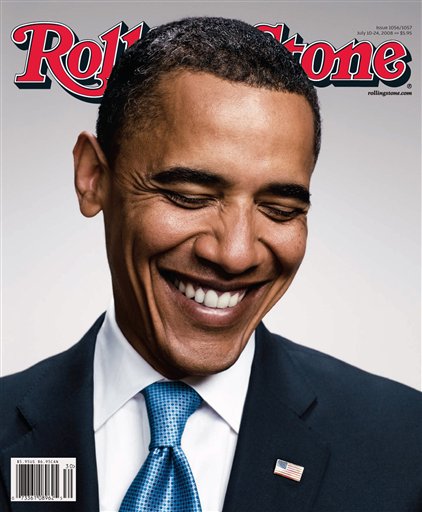
Was in bed the other night with the love of my life—Rolling Stone magazine 🙂 —and all I gotta say is this: Boy, it’s clearly good to be the King. RS Publisher Jann Wenner does a puff-piece Q+A, and then commissions a sidebar all about how Obama’s people are impressive because they actually wield power the way power is SUPPOSED to be wielded? I’m for Obama too, but Sheesh! I’m tempted to put this post in the “Advertising” category. 🙂

I was very inspired by this one story. I guess most radio folks see themselves in this way, in this man.

The following book review was originally published in the May/June 2007 issue of The Crisis magazine, right before the 40th anniversary of the Newark Rebellion. This was the last article my great friend and mentor, Judy Dothard Simmons, helped me with before she became an Ancestor. I miss her. Much thanks also to Phil Petrie, who was Acting Editor-in-Chief of The Crisis at the time.
Besides changing the present year, other minor editorial alterations have been made to this version.

The Newark, N.J. Insurrection Revisited
No Cause for Indictment: An Autopsy of Newark.
By Ronald Porambo.
With New Introduction and Afterword.
425 pp.,Melville House, $18.95.Newark has always lived in the shadow of New York City. Those of us who grew up in Newark after the 1967 urban disturbances lived in that shadow, too. In the 1970s and 1980s, I kept hearing occasional references to “the riot.” Later, while studying American history, I discovered that New Jersey’s largest city is permanently twinned with Detroit for spurring the creation of the National Advisory Commission on Civil Disorders. Known as the Kerner Commission Report, it declared that America was “moving toward two societies, one Black, one white—separate and unequal.”
Detroit, the home of Motown and the nation’s automotive industry, got a Pulitzer-Prize winning newspaper series on its insurrection and, roughly twenty years later, international television exposure through executive producer Henry Hampton’s historic, multiple award-winning documentary series, “Eyes On The Prize.” Newark, on the other hand, got the shaft. When it bothered to cover Newark, the elite media ignored the mid-20th century cultural Mecca it had become, starring LeRoi Jones/Amiri Baraka, Little Jimmy Scott, Nathan Heard, Sarah Vaughan and Connie Francis. Since the 1970s, the city’s only nitty-gritty, nonfiction mirror was a well-written but quickly forgotten expose´. The scribe was a young, mentally unbalanced Italian-American gonzo journalist who ultimately got three bullets lodged in his skull and, years later, died a murderer’s death.
Ronald Porambo’s book, No Cause For Indictment, originally published in hard cover by Holt, Rinehart and Winston in 1971, is being re-issued by Melville House, a small publisher in Hoboken, N.J., a city near Newark.
I was well into college when I first read Porambo’s attempt to push the scapegoated victims of the 1967 rebellion into history’s sunshine. In the book’s comprehensive, biting pages, I learned that Newark was different from many American cities that were private dance halls for Mafia-administrated corruption, drugs, and police brutality against Negroes and Latinos. Newark, wrote Porambo, was distinctive before the 1967 insurrection because the mob openly owned all local levers of power: it “controlled the mayor’s office, main facets of the administrative government, and also enjoyed a candid relationship—a euphemism—with the Newark Police Department.”
The original No Cause was a masterwork of contemporary local history. Porambo spent three years on the city’s streets tracking down virtually all of the families of people victimized by the official machine in the war for Newark. He tied personal interviews, riot reports and FBI and other public transcripts into a misery mosaic. The bold, machine-gun narrative shifts back and forth between the sights, sounds and smells of the 1960s and up to the early days of the city’s first Black administration. Most of the people Porambo depicts seem stalked by frustration, fear, or post-rebellion cynicism.
Writing when the literary journalism of Tom Wolfe and Hunter S. Thompson was being lauded just a few miles away in New York City, Porambo—a proud nonconformist who had either quit or been fired from nearly every newspaper he worked for in New Jersey—had hoped to make it big. “Newspaper folks are supposed to chase stories with zeal and determination, and most do,” writes ex-journalist Fred Bruning, a longtime Porambo friend and co-worker, in the new Afterword. “Porambo brought something exceptional to the enterprise—a nearly psychotic kind of single-mindedness and unyielding resolve. He plunged so deeply into the story that, watching from the sidelines, one might wonder….if the guy would ever re-surface.”
This work ethic shines through. No Cause stands with the best of long-form narrative journalism, then and now. The difference is that Wolfe and Thompson wrote about their white, counter-culture adventures in first person for national white magazines. The Newark-based Porambo’s interest in poor Black New Jerseyans—they’re not even from Harlem!—didn’t strike the imagination of the white lettered world when Holt took a chance on a first-time author. In this reissue Warren Sloat, Porambo’s editor, points out in the introduction that even getting shot in both legs shortly after the book’s publication, allegedly by some people who were upset with him for naming names, didn’t push the young author into the journalistic firmament, didn’t produce the big numbers.
Porambo traces the roots of the 1967 rebellion to Newark officialdom’s Italian-dominated, Mob-controlled tribalism and racism. These were enforced by a police department that clashed repeatedly with the city’s growing Negro population, many of poor, virtually all of them displaced from the South. People leaving Jim Crow for a better life working in Northern industrial cities like Newark quickly filled crumbling, rat-infested apartments and tolerated sub-standard education. All too often they became the victims of raining gunfire and clubs, from street disputes with other poor Blacks and from the omnipresent police.
Porambo explains ghetto police brutality as an instance of how white fear in Newark quickly turned into white racism. “Police use unlawful violence against the powerless as a psychological tool to deter crime and establish status. The ghetto’s vicious hoodlums deserve no better than they get, but this brutal attitude eventually becomes a habitual response to ghetto residents at the least challenge or rebuff….A riot pushed this disdain to a frightful extreme: the running felons of yesterday had become merged in the minds of police with faceless, innocent human beings who just happened to get in the way.”
The Negro community Porambo wrote about had no access to city government except through token Negro officials who played the Mafia’s game. Newark’s working-class Italians found Baraka, the poetry-spouting militant, a convenient scapegoat. They did not, however, find their own Anthony Imperiale, who publicly ridiculed Martin Luther King and cobbled together his own vigilante group, guilty of disturbing anyone’s peace. Neither did the police. The city’s two newspapers, The Star-Ledger and The Newark Evening News, explains the author, did a yeoman’s job of reporting, and believing, what the police said.
Newark’s civil rights leadership did what it could until Newark blew up one July night. The police badly beat a Black cab driver named John Smith. National Guardsman, state troopers and local police formed an ad-hoc squad of counter-violence that led to the slaying of more than 20 Blacks over six days. Police claimed they were protecting themselves from “snipers,” but post-riot studies showed that frenzied police were often reacting to their own bullets, ricocheting off of the riot zone’s brick buildings. This tripod of white authority, enraged that Blacks had destroyed white property while leaving its own stores untouched, smashed any window flaunting a “Soul Brother” sign.
No police officer, state trooper or National Guardsman was ever indicted for any of the fatal shootings or the destruction of Black property. In the still-smoldering ashes, the city’s Black Power Movement, led symbolically and literally by Baraka, helped Kenneth Gibson become the city’s first Black mayor in 1970.
Meanwhile, a disappointed Porambo–the former Golden Gloves champion boxer, a cat who had always kept both his journalism and his life street level—degenerated into an urban Zorro, a robber of drug dealers. Several obits discuss his “moonlighting” as an armed robber during his journalism career in the 1960s and 1970s, and his three-month stint in jail for bribing a police officer to get him coroner’s photos of 1967’s victims for the book. By the time he got life for murdering a drug dealer in 1983 (the police found him dying with the bullets in his head), his tired wife vanished and the three children, on their way into adulthood, deliberately lost touch. The death of their daughter, Ronda, during a hospital stay in the 1990s, pushed the despair deeper.
In jail with brain damage, Porambo was, like his magnum opus, eventually remaindered. He died in his cell last October, after choking on an orange. No Cause represents that best of what his manic energy channeled, the only child that remained.
As a Newark native son who was three years old when No Cause was published, my complaint with the book is that Porambo’s sidewalk is always cracked. Sunlight did pierce through the Brick City’s clouds occasionally, creating new opportunities that were not all awash in ironic, American, Third World-ghetto pessimism. Newark continues to produce Black cultural leadership for America and the world, and historically it has taken great pride in being a city that attempted to implement the more pragmatic goals of the Black Power Movement in the 1970s. My view of Newark, however, is just one of several hundred thousand of personal epilogues to Porambo’s panorama of gloom.
In this forty-first anniversary year of the Newark insurrection, the city has been largely successful in destroying its own memory. Cory Booker—a young, Ivy League-educated politician unconnected with even the memory of the Mafia and the graying Black Powerites—will commemorate the milestone from behind the mayor’s desk. One of Baraka’s sons, Ras, was appointed to a citywide council seat when Donald Tucker, a politician of the Black Power era, died in office in late 2005, but Ras, the young school administrator and poet, didn’t have his electoral math together. Booker’s Barack Obama-like star quality generated “Street Fight,” an Oscar-nominated documentary about his first, unsuccessful mayoral campaign against Old Guard mayor Sharpe James, and a year-long, fly-on-the-wall New York Times series about his first 12 months in office. In 2008, the city is suddenly visible and important to those finding new value in living just outside post 911-Manhattan.
The mid-century decay is being swept aside, one demolished public housing complex at a time. The Prudential Insurance’s Co. national headquarters, a downtown staple for over a century, is now joined by a beautiful performing arts center and a minor-league baseball stadium. Another downtown fixture, The Star-Ledger, is now the city’s sole daily newspaper and a Pulitzer Prize-winning voice for the Northern New Jersey suburbs. The Mafia-City Hall connection is still remembered, however—it’s mentioned occasionally and quickly in “Sopranos” reruns. With a perpetually amnesiac past, it’s now the Latino population’s fight to create new City Hall closet space by ignoring the skeletons.
The only public monument to yesteryear’s beatings and killings is a Rutgers University website. Disposed with the debris, the roll call of the dead—Isaac Harrison, Michael Pugh, Eloise Spellman, Billy Furr, among others—is acknowledged almost solely in Porambo’s beautifully authoritative, but ultimately depressing, tome, thanks to a volatile shoe-leather reporter permanently enraged about the powerlessness of the city’s Black poor, and his refusal to let it—them—go.
Copyright (c) 2007, 2008 by Todd Steven Burroughs, Ph.D.
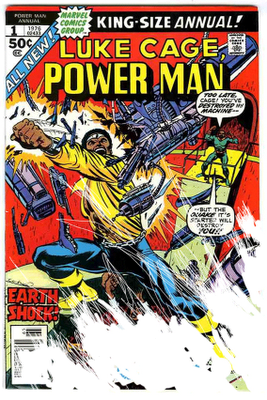
You know you’re bored when you finally find an article in your apartment that you’ve been (thinking about) searching for FOR YEARS. 🙂 I finally found this blurb in my old copy of the 100th anniversary issue of Wizard magazine, published eight years ago. Something to think about while we’re all enjoying “Hancock.” 🙂
Black Power!
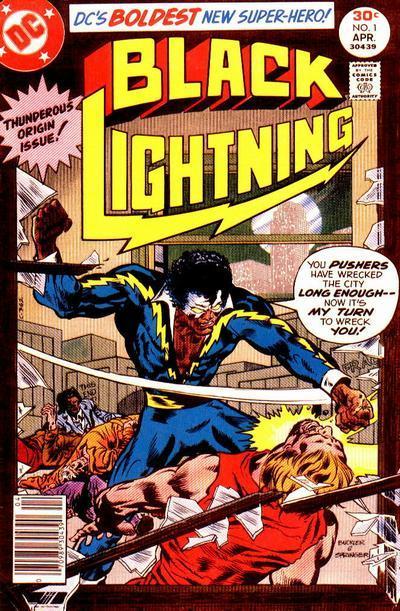
Ten easy steps for making a genuine stereotypical, borderline offensive, 1970s Black superhero.
1. BLACK IS BEAUTIFUL! Make them Black. Seems obvious, but nobody included that on the memo for “Blackhawk,” and look where that went.
2. ALWAYS BET ON BLACK The character MUST be called “Black” something, like Black Goliath, Black Lightning, Black Panther, etc., to offset how all the white heroes’ names start with “white,” like…..uh……..
3. DRESS FOR SUCCESS When designing the costume, pepper freely with high collars, plunging V-necks and chains. And the Afro’s a must.
4. TALK THE TALK Aside from a healthy dose of “jive turkey” and “brotha,” give your new crimefighter a believable ethnic catch phrase, like “Sweet Christmas.”
5. WALK THE WALK Make ’em good and angry, so they’ll lash out at billboards and fences and stuff when they’re talking to themselves.

6. UP WITH PEOPLE Unlike guys like Superman and Aquaman, they’re one of the people. Have the grocer give him an apple when he walks by.
7. STAY GOLDEN He might act all tough and grouchy, but beneath that hairy, V-necked chest beats a heart of gold. Unless The Man gets in his way, that is.
8. DO THE TIME Give him a criminal background, just like Superma…uh, no, like Batma…er, no, bad example. Like Iron M–ah, maybe we should move on to #9.
9. SLUM IT UP These guys are rarely members of the Avengers and JLA. They’re more likely private investigators, ex-thugs for hire, social workers, stuff like that.
10. FUBU The stories have to have the air of authenticity to them: the situations the characters find themselves in because of who they are, their day-to-day problems and struggles they must hear. You need somebody who can relate to these issues. Get somebody white to write it.
Copyright (c) 2000 by Wizard magazine.
P.S. For more on Black superheroes, you should check out this and this and this.
2010 UPDATE: Enjoyed reading this.
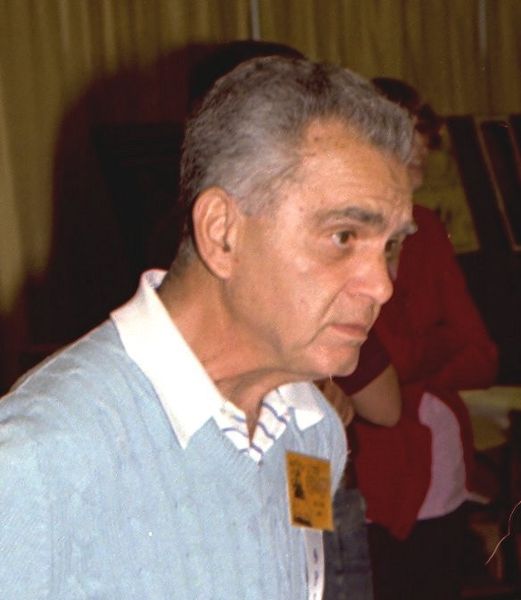
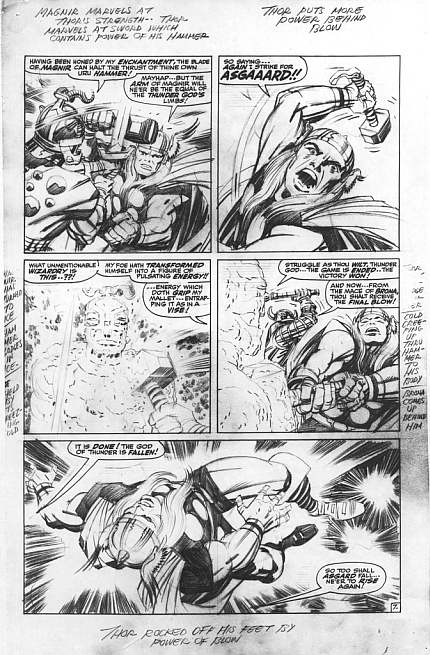
The new biography of Jack Kirby really isn’t that; it’s an authorized, more-polite-than-it-should-be version of his life used as an excuse to showcase his great art. And thank God for it.
Jack Kirby is responsible for two-thirds of every childhood smile I ever made. Period. The Fantastic Four. The Silver Surfer. The Incredible Hulk. The Mighty Thor. The Black Panther. The Uncanny X-Men. ‘Nuff said.
Thanks to Mark Evanier for putting it together. He told the story of a man who created hundreds of universes in order to take care of his most important one: his wife and children. Jack Kirby, the immortal hero whose superpower was unlimited imagination.