……”Read A Book.”
Um……Damn. I don’t know whether I should congratulate it or attack it.
Here’s the story behind it.
……”Read A Book.”
Um……Damn. I don’t know whether I should congratulate it or attack it.
Here’s the story behind it.

The following hit all the marks.
I’m certain you know about Dr. Pipher’s public stand.
AMY GOODMAN: Mary Pipher, clinical psychologist and acclaimed author. I asked her to talk about her latest book, Writing to Change the World.
MARY PIPHER: You know, how Pete Seeger always said about music: it isn’t whether or not it’s good, it’s what it’s good for. And I didn’t come at writing as an academic or as a poet or a creative writer. I came at writing as a social activist, and I want every one of my books to have a very powerful effect in changing the culture. And so, I have spent a lot of time figuring out how to do it. And the way to do it is have a deeply personal voice, my own authentic voice that comes from deep within myself, and my writing and speaking voice are virtually identical. And then, the other way to do it is through stories, because you can’t argue with a story. You know, people can argue with you if you stand up and say what you believe or don’t believe, but if you tell them a story and tell them a story that opens their heart, they will change. So that’s what the book is about, is writing in a way that we can effect change.
And I talk about this idea that the point of my kind of writing is to empower the powerless, to give voice to people who have no voice, but also to educate readers in what I call the moral imagination. And that is the ability to understand the world from other people’s points of view. And that’s an extremely big problem in America right now, is people don’t have much moral imagination, so that when they talk about, say, “illegal aliens,” they don’t have a story, they don’t have a face, they don’t have a picture of a real person. They have almost no empathy with the person they’re talking about.
I remember when Sensenbrenner was talking about gaming the asylum system and how we had to go after those terrorists gaming the asylum system. At that point I had just happened to have been back to Bellevue in New York City to visit their unit for victims of torture. The people on that unit that were seeking asylum were Buddhist monks from Tibet. And I just thought, “Man, Sensenbrenner hasn’t been here. You know, he hasn’t been to Center for Victims of Torture in Minneapolis.”
And so, the job of the change writer, from my point of view, is to say I respect you as a reader, and I know if I tell you the truth, as I see it, having spent some time listening to people and asking them — you know, Simone Weil had that question, “What is your experience?”– asking people, “What is your experience?” which I did when I wrote Middle of Everywhere, my book on refugees. I spent three years asking people that. And it greatly enhanced my own moral imagination to listen to all those stories. You also have a good job for enhancing your moral imagination. But that’s the job of the writer: to help other people’s moral imagination grow, basically.
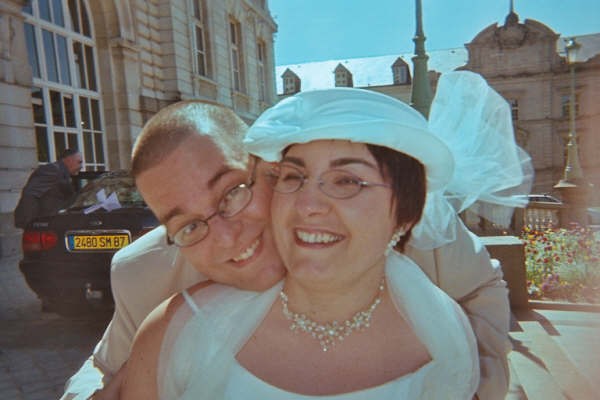
On a good day online, you make a good friend. Pascal, from France, is one.
“Meeting” at the Black Panther Message Board at least three years ago, we have swapped comic trade paperbacks across the Atlantic. I have a complete set of Christopher J. Priest’s take on the Marvel Comics superhero the Black Panther (sans the Kasper Cole storyline ) in French trade paperbacks, thanks to him. They are my prize possessions.

Anyway, he emailed me earlier today (sending me a .jpeg of his wedding picture from last year; I like that they both have glasses 🙂 ) to tell me that he and his wife are expecting a new comic geek to come forth. The end of January, he says.

At least a couple of the couples I know are well on the way of poppin’ ’em out. 🙂 Adina’s little girl, her first, is due this December—I believe around the time my friend Jared’s wife Yari is expecting, their second.
Now, my friend Val….well, I lost count of the amount. 🙂 I think three.
So here’s my tribute to all the young meres (and peres) I know, courtesy of one of my all-time favorite artists, Basia:
*****
she’s gonna be a perfect mother,
perfect mother
in her mind there’s no doubt
though no one could show her how to be
a perfect mother, perfect mother
people say–she’s too young
should a child have a child?hers is gonna be a perfect baby
raised according to the old prescription:
cuddle it daily and smother with kisses
’cause there’s nothing more important
just make sure that she never missesa perfect mother, perfect mother
people say–she’s too young
no one could ever show her howbabies grow, then they tend to leave us
that’s how it’s always been and always will be
deep down inside you never stop wishing
for the hope to be certain that your
boy or girl
will be forever needing youhers is gonna be a perfect baby
raised according to the old prescription:
cuddle it daily and smother with kisses
’cause there’s nothing more important…
who knows better–
all her life she missed her

…….and WOW!!!!!!!!!!!!!!!!!!!!!!!!!!!!!!!!!!!!!!!!
(Don’t worry; NO SPOILERS here 🙂 )
Better ending than “Jedi.” The “Deathly Hallows” climax(es) would rank about a “6” if 10 was, say, the apex of “LOTR: Return Of The King.”
As a Hyattsville librarian told me today after I proudly announced my accomplishment: “The first 500 pages were hard to wade through, but the last 200 pages….” Yep. I agree. Can’t wait to see this one on the big screen in 2010 or whenever.
See the word is that Rowling’s gone on to other topics. God Bless her.


Damn.

Here’s a list of videos from youtube.
Damn.

AUG. 18 UPDATE: I got the following from Kalamu.
YOUNGBLOODS, ELDERS and FRIENDS:
Legendary jazz drummer and political activist-musician Max Roach died yesterday. The funeral will be at Riverside Church in Manhattan on Friday, August 24th with services at 11 AM and viewing Max for the last time at 9 AM. (Directions below)
WKCR FM 89.9 will be playing Max Roach’s music 24 hours a day until Wednesday, August 22nd at 9 PM. Youngbloods who haven’t heard his repertoire should take this chance to dig one of the greatest musical geniuses of the twentieth century.
One of the founders of Bebop in the 1940s Max played with Duke Ellington, Dizzy Gillespie, Charlie Parker, Charles Mingus, Miles Davis, Sonny Rollins, Clifford Brown, Bud Powell and Coleman Hawkins, among many others. Generally regarded as the greatest jazz drummer of all time, Max was a creative genius who crossed over into many other genres and integrated political activism and his commitment to African-American self determination into music that included classical jazz, bebop, African, Afro-Cuban, avant garde and some music which can only be classified as “Max Roach Music.”
Max traveled to Africa to expand the scope of his music. He played with ensembles from Japan and Cuba as well as with avant-garde artists and hip-hoppers. In the 1970s and 1980s he organized a ten piece all-percussion ensemble, performed solo drum concerts, worked with a regular jazz quartet, founded a quintet (actually a sextet) featuring only Max and five horns without any chords or bass, and Max worked on innumerable innovative collaborations with other artists and performed with women jazz instrumentalists at a time when women were generally limited to performing as vocalists in the Jazz scene.
Max Roach’s commitment to African-American self-determination was always a integral part of his music. In 1960, before the main thrust of the Black Power movement, Max wrote the music for the incredible “Freedom Now Suite” with lyrics by Ossie Davis and featuring the vocals of Abbey Lincoln. Max’s militancy got him blacklisted by the major record labels and many of the white-owned clubs in the 1960’s. However, the white music moguls could still neither his musical genius nor his commitment to Black freedom and self-determination.
With Charles Mingus, Max co-founded Debut Records, one of the first artist-owned labels in music history. Following his blacklisting Max, Mingus
and other Black musicians including Eric Dolphy, Roy Eldridge, Abbey Lincoln, Tommy Flanagan, Booker Little and Jo Jones recorded the Newport Rebels album and set up the Jazz Artists’ Guild Festival as a protest against the commercialization of the promoters who controlled the Newport Jazz Festival.
Max didn’t just survive the blacklisting, he prevailed. As long as he lived, there was no force on earth that could still Max’s voice or make him dampen his message to gain commercial acceptance. After the “Freedom Now Suite,” Max Roach continued to dedicate his music to militant opposition to racism in America and oppression of African people on the continent and in the Caribbean.
Max’s greatest legacy will always be his music. But inextricably linked to his music will be his commitment to freedom and to his people. In the end, the people recognized Max’s genius and defeated the attempts of the racists in the recording music industry to marginalize him. Thus, Max’s victory is a lesson and a testament to the power of the people to define our own culture.
In the spirit of self-definition, let us join the celebration of Max’s music and his life. Google him. Read about Max, his life and his times. And listen to the round-the- clock festival featuring Max Roach’s music on WKCR at 89.9 FM from now until Wednesday, August 22nd at 9 PM.
Max’s funeral will be on Friday, August 24th at Riverside Church in Manhattan. Viewing will be at 9 AM. Services at 11 AM.
Riverside Church is on 122nd Street between Riverside Drive and Claremont Avenue. There are entrances at Claremont Avenue and on Riverside Drive. Nearest subway stop is the #1 at 125th Street (at Broadway). Walk south one block to Tiemann Place, turn right (West) one block to Claremont Avenue, turn left (south) one block to 122nd Street. You can also take the M4 or the M104 to 122nd Street and Broadway or the M5 to 122nd Street and Riverside Drive. For a map,
see: http://www.tiny.cc/Riverside815 .
Peace,
Ronald B. McGuire
AUGUST 27th UPDATE: Please listen to/watch today’s “Democracy Now!” to hear excerpts of the funeral and interviews.

Here are some details. Here’s his bio and some links.

4:45 P.M. UPDATE: Here’s a full bio on our new Ancestor:
DR. ASA G. HILLIARD, III [Baffour Amankwatia, II]
Biographical SketchBy RUNOKO RASHIDI
Dr. Asa G. Hilliard, III, is the Fuller E. Callaway
Professor of Urban Education at Georgia State
University, with joint appointments in the Department
of Educational Policy Studies and the Department of
Educational Psychology/Special Education. A teacher,
psychologist, and historian, he began his career in
the Denver Public Schools, teaching psychology,
mathematics and American History. He earned a B.A. in Psychology, M.A. in Counseling, and Ed.D. in
Educational Psychology from the University of Denver,
where he also taught in the College of Education, and
in the College of Arts and Sciences in the Honors
Program in philosophy. Dr. Hilliard served on the
faculty at San Francisco State University for 18
years. During that time he was a Department Chair for
2 years, Dean of Education for 8 years, and was
consultant to the Peace Corps and Superintendent of
Schools in Monrovia, and school psychologist, during
his six years in Liberia, West Africa.He has helped to develop several national assessment
systems, such as proficiency assessment of
professional educators, and developmental assessments of young children and infants. He is a Board Certified Forensic Examiner and Diplomate of both the American Board of Forensic Examiners and the American Board of Forensic Medicine. He served as lead expert witness in several landmark federal cases on test validity and bias, including Larry P v. Wilson Riles in California, Mattie T. v. Holliday in Mississippi, Deborah P. V. Turlington in Florida, and also in two Supreme Court cases, Ayers v. Fordice in Mississippi, and Marino v. Ortiz in New York City.Dr. Hilliard is a founding member and First Vice
President of the Association for the Study of
Classical African Civilizations. He has conducted
Ancient African History study tours to Egypt for 15
years, is the co-developer of an educational
television series on Ancient Kemetic (Egyptian
history). He has produced videotapes and educational
materials on African history through his production
company, Waset Educational Productions. He is
Co-Founder, with his daughter, Nefertari Patricia
Hilliard-Nunn, of Makare Publishing.Dr. Hilliard has written more than four hundred
research reports, articles and books on testing,
Ancient African History, teaching strategies, African
culture, and child growth and development. He served
with Dr. Barbara Sizemore as Chief Consultant on the
Every Child Can Succeed television series, produced by
the Agency for Instructional Technology.Dr. Hilliard has consulted with many of the leading
school districts, publishers, public advocacy
organizations, universities, government agencies and
private corporations on valid assessment, African
content in curriculum, teacher training, and public
policy. Several of his programs in curriculum,
assessment, and valid teaching have become national
models. He has worked on projects with the National
Academy of Sciences, and has spoken at the National
Aeronautics and Space Administration (NASA), the
Smithsonian Institution, and the National Geographic
Society. He has been visiting professor at many
Universities, including Oakland University, Stanford
University, University of New Mexico, and Harvard
University.Dr. Hilliard has served on such boards as the Agency
for Instructional Technology, Zero to Three, The
Public Education Fund Network, American Association of Colleges for Teacher Education, The Far West Regional Laboratory for Educational Research and Development, and The Center for Applied Linguistics.His most recent books are:
- The Maroon Within Us: Selected Essays on African American Community Socialization, Baltimore: Black Classics Press;
- SBA: The Reawakening of the African Mind, Gainesville, Florida: Makare Publishing;
- African Power, Gainesville, Florida: Makare
Publishing;- Co-author of Young, Gifted and Black, Boston [Winner of American Education Research Association Award for Excellence], Beacon Press
- Co-Author with Nefertari Hilliard-Nunn of True of Voice: The Poetry of Listervelt Middleton, Makare Publishing.
Selected Awards
Morehouse College “Candle in the Dark Award in
Education”National Alliance of Black School Educators
“Distinguished Educator Award”American Evaluation Association, President’s Award
Republic of Liberia Award as Knight Commander of the
Humane Order of African RedemptionNew York Society of Clinical Psychologists Award for
Outstanding Research, Scholarly Achievement, and
Humanitarian Service.Association of Black Psychologists Distinguished
Psychologist AwardAssociation of Teacher Educators Distinguished
Leadership AwardHonorary Degree, DePaul University Doctor of Humane
LettersHonorary Degree, Wheelock College Doctor of Education
American Psychological Association, Fellow
Kappa Delta Pi Honor Society Laureate Chapter
American Educational Research Association Committee on
the Role & Status of Minorities in Education, Research
& Development Distinguished Career Contribution AwardAmerican Association of Higher Education Black Caucus,
Harold Delaney Exemplary Educational Leadership AwardAmerican Association of Colleges for Teacher, one time
only Thurgood Marshall Award for Excellence, on the
occasion of the 50th anniversary observance of the
Brown versus Board of Education Topeka DecisionCopyright © 1998 Runoko Rashidi. All rights reserved.
Posted/Revised: December 14, 2006.
Webpage design: Kenneth Ritchards

5:35 P.M. UPDATE: From the 100 Black Men of Atlanta:
ATLANTA, Aug. 13 /PRNewswire-USNewswire/ — The following is being issued by 100 Black Men of Atlanta, Inc.:
“100 Black Men of Atlanta, Inc. and its members are deeply saddened by the loss of its member, Asa G. Hilliard, Ph.D.
“A teacher,historian,psychologist, activist and leader, Dr. Hilliard served as a formidable catalyst for social change as well as a beacon for the preservation and
advocacy of African cultures throughout the world.“Dr. Hilliard served as the chairman of 100 Black Men of Atlanta’s Programs Committee and was a leading contributor to the ongoing development of Project Success, the organization’s flagship program, which provides tutoring, academic support, cultural enrichment and scholarships to students attending Atlanta Public Schools from challenged communities. His impact upon our organization, its members and the communities we serve has been immeasurable.
“We also would like to offer our sincerest sympathies to the Hilliard family, our thoughts and prayers are with you. The nation has experienced a significant loss today. Dr. Hilliard was truly an American hero and we pay homage to his legacy.”

AUGUST 14 UPDATE: Just got this today. This sister always does a good job heralding a New Ancestor.
AfricaWithin.com
PRESS RELEASE
August 13, 2007
For Immediate ReleaseContact:
WebMaster@AfricaWithin.com
www.AfricaWithin.com
Amankwatia Baffour II [Dr. Asa Grant Hilliard III]
22 August 1933 – 12 August 2007By Kwaku Person-Lynn, Ph.D.
CAIRO, KEMET (Egypt) – August 2007 – One of the giants in the academic world left us this past weekend in the most appropriate place it could happen, in Cairo, Kemet (Egypt), where he studied, wrote about, lectured, researched, conducted tour groups and redeemed his soul. He was attending the ASCAC (Association for the Study of Classical African Civilizations) Conference, an organization he co-founded, and giving lectures to the Pastor Jeremiah Wright tour group.
Early reports state that he passed due to complications of contracting malaria. More details are yet to come and funeral arrangements have not been made thus far.
Those of us who knew Baba Baffour, and/or were familiar with him, knew him as one of the premier scholars/researchers/educators/authors this world has ever seen. He was supremely dedicated to the total liberation and education of Afrikan peoples specifically, but humanity in general. It was his efforts that primarily started the Curriculum of Inclusion Movement, balancing school curriculums by adding information and lessons on Afrikan people. He was an educational psychologist, but dedicated his life to improving teaching/learning methods for children, and educating Afrikan people about our history. Family was the highest point of his consciousness.
In an interview I conducted with Baba Baffour, seeing parents as the first teachers, he stated, “What kids get from us most of the time are instructions: ‘do this,’ ‘don’t do that,’ ‘watch out for this,’ ‘watch out for that.’ That’s a monologue. What has to happen, if you want to activate the child’s intelligence, and release that intelligence, that child has to be invited to engage in questioning, in critique, all of those kinds of things. Parents have to organize their communication with children. All we have to do is remember to do it. We know how to do it, but we slip into some awfully bad habits.
“I’m not quite sure what the reasons are for those bad habits, but they are very prominent among our people. You know: ‘shut up,’ ‘be quiet,’ ‘sit down.’ That may give you control over the child’s behavior, but doesn’t give the child’s mind anything. The child has, if the mind is going to grow, it’s got to chew on something. It’s got to turn it over, try it out and not be directed from moment to moment. Nurturing that independent critical orientation is a part of what a parent has to do for a child.”
In the land he loved so much, Baba Baffour wanted to go beyond just admiring our ancient past, where the foundation of civilization existed. Being pro-active he did the following. “Somewhere in the late sixties, mid sixties to late sixties, I became acquainted with people who enhanced my information about Afrika, especially classical Afrikan civilizations. I knew that at some point I had to do more work to share this information. I tried to figure out a way to do that, mainly through slide presentations and lectures and so forth. But it occurred to me, that it would be much more powerful to be able to examine concretely whatever is left of that civilization, where it is right now.
The way to do that would be through a study tour. So my wife and I designed a study tour and tried to locate people who were really serious about study. We’re not interested in folk who want to collect ashtrays and float on the Nile and do all that. It’s a very hard working tour. We were up early and we go to bed late. We felt by being on the site, by visiting the museums, by visiting the monuments, by getting some sense of the space, geography, time perspective, that would help to make more real what this thing was in the past.”
In his parting statement, which applies even today, he leaves us with, “Let me say the thing that’s of course on my mind. We require a massive mobilization of Afrikan people around the world. We need to see what the future looks like for us in the next thirty to forty years. We need to take a long view. In fact, we need to think about the next two hundred years. To be real conservative, where do we want Afrikan people to be in the world twenty years from now? If you get an answer to that question that’s anywhere near correct, it tells you what you got to do now to get ready for that.
“I’m concerned because we are not now doing what we need to do to get ready for the world I think we would like to have, if we thought about it. I just would really hope we begin to mobilize our thoughts and ultimately our resources toward creating a new future for Afrikan people. That we revise and revitalize the continent so we will be safe wherever we live, anywhere in the world.
“And for the young, there was an old Bible verse that my mother emphasized when I was growing up, I still live by it and think of it all the time. One of the few I can remember completely. It was II Timothy 2:15 which says, ‘Study to show yourself approved unto God, not unto man, a workman that need not be ashamed, rightly dividing the word of truth.'”
Amankwatia Baffour II [Dr. Asa Grant Hilliard III]
# # #
by Dr. Kwaku Person-Lynn


GREAT CHOICE! I couldn’t like Jabari’s book any more if somebody paid me.


I’m glad the brother is stepping into the historic continuum of Black magazine journalism on such a (deserved) high level. We know well his past work, and The Ancestors are watching…….


……then Cornel West should be very happy with these two tributes. LOL! 🙂
Here’s more, if you want it.

Ebony and Jet are online. No, a real site. Really. With punchy, well-written, original content on it. More proof we’re in the 21st century. 😉

The whole family in front of me had round glasses of some type—some Harryish, some real.
We were in line, outside, in downtown College Park, Maryland.
For The Book.
Evangelists and snarky, too-cool passerby college students couldn’t spoil our mood. In front of me, mostly 10-year-olds, dressed in black cloaks and black wizard hats I’d see all evening. In back, mostly teens, sans stuff.
Darkness was setting. The Wait Had Begun.
I’m an Old School Geek, so this particular fetish took some time to develop. I mean, I just like the movies. But since this was the last one—the last book, the last Friday/Saturday midnight book release party—I had to go to Vertigo.

One little girl was going to make sure the Vertigo folks kept their word about the 10:15 p.m. opening. She stuck her face up against the window and announced, “Two minutes.”
The doors opened on time. Staffer Jennifer Cook was in full let’s-have-fun-kids mode—y’know, the way she always is with grownups who enter Vertigo. 🙂 Kids in tonight’s standard uniform, circled on the floor. She asked them how many have read all the books more than once. Most, if not all, raised their hands.
While looking at the long line, my eye caught something from my childhood: “Charlotte’s Web.”
(Jen to Kids: “Should we trust Snape?”)
That book spawned a great animated film and a live-action movie. But it never created its own culture. I wondered what it would have been like to have a “Charlotte’s Web” club, where kids would walk around dressed as pigs or spiders carrying signs saying “SOME PIG.”
(Jen to Kids, hosting a kind of Harry Potter version of “Jeopardy”: “The Weasley’s home is called THIS.”)
A palm reader was present, while a magician worked the crowd.
One beautiful young sister, looking about 10, not only had the full hood, but the Gryffindor scarf. You know the one.

Slowly, the line became a polite crowd. At least 100, including a tall guy who had on a trench and a “Mad-Eye” Moody eye.
The Bookstore Master Plan was also in effect: some of the patrons were looking at other books.
(Jen to Kids, announcing a Harry Potter quiz: “If you’re not careful, I’ll break out into a bad British accent.”)
Zero hour. Or, more appropriately, the Witching Hour.
My number was Four. I quickly squeezed my way out the store. Knowing now there would be no more.


