
And stealing from “Rocky And Bullwinkle” was the right move for this headline, considering the subversive content here.
Thanks to Rolling Stone (it again!) for finding this.
Â
And stealing from “Rocky And Bullwinkle” was the right move for this headline, considering the subversive content here.
Thanks to Rolling Stone (it again!) for finding this.
Black Voices In Commentary
The Trotter Group [Editorial Team: DeWayne Wickham, Wayne Dawkins, Rochelle Riley, Cheriss May]
August Press, ISBN: 0963572091
128 pp., $15.95

Reviewed by Todd Steven Burroughs
Trotter Group members are neither irreverent nor famous. Although known to other journalists, they are hardly household names. Unless he does a national forum on print media coverage of Black communities, most will never get a call from Tavis Smiley’s booking agents to be on those February C-SPAN rhetoric marathons. That’s because the vast majority of Trotter members are seasoned print journalists who work(ed) hard at major white newspapers every day, far away from the national infotainment spotlight. The privilege to speak their communal Black-but-objective journalistic mind for their respective Metro or Op-Ed pages was a hard-earned one, back in the mass media era that now seems to have peaked. So, for as long as they can, they use their salaried opportunities to document their lives and opinions through their Black perspectives, educating white readers and re-affirming Black ones.

The 23 columnists here—among those who gather every year in the name of William Monroe Trotter, an agitating, early 20th century Black newspaper publisher—meld the past and present by making sure important local, regional and national Black stories got told. Even though most of the columns here range roughly from 2004 through 2006, collectively they weave strands of African-American history from Jim Crow up through “Hustle And Flow.†Pieces of memory, fragments of encounters, reporting of current events—all are here, dispatched from Boston, Detroit, Virginia, and other regions, intersecting in a multi-faceted piece of geography called Black America. This amalgamation allows the brief tale of a 23-year-old voter in Milwaukee to share space with the account a 103-year-old Tulsa, Oklahoma riot survivor preaching a revival in Seattle. The book’s slightly heartbreaking coda, “Memories,†contain the final first-person goodbyes from the Trotter members who are now Ancestors. Asante Sana, Vernon Jarrett, Norman Lockman, Peggy Peterman, Gregory Freeman and Lisa Baird, and other prominent Black journalists who seem to be dying every month.
 
Vernon Jarrett, One Of My Scribe AncestorsÂ
This collection adds well to Wickham’s own Black columnist anthologies, “Fire At Will,†his 1989 solo effort, and his 1995 edited work, “Thinking Black: Some Of The Nation’s Best Black Columnists Speak Their Mind.†This book, an unnamed sequel to the latter, keeps good company with the small group of first-person books written within the last two decades by Black journalists who have toiled in the journalistic mainstream. Many of these authors and columnists injected African-American perspectives in America’s public sphere while Smiley was still getting coffee for Tom Bradley and Michael Eric Dyson was cooped up in a library researching his master’s thesis. 🙂
But as 2007 approaches, these Black establishment voices seem, well, too traditional (read: old) in the blogging age. The tight newspaper spaces work against, not with, these pieces. The lack of intensity throughout reveals that these writers either do not have, or regularly use, the power to really witness in the ways The Village Voice, The Nation or I.F. Stone’s Weekly, to name three examples, made famous in the middle of the last century. The almost unvarying middle-of-the-road political perspectives read very corporate, restrained; none of the independent, righteous rage of, say, a Mumia Abu-Jamal or an Ann Coulter—or a Trotter, frankly!—is found here.

Many of the journalists included here would, for the most part, consider that last criticism somewhat of a compliment. They have sought broad community attention to educate and illuminate, not to provide fodder for Bill O’Reilly. They are proud of their white mainstream affiliations and the power they have traditionally carried. They are not trying to be cute, popular, or controversial. They would not fit well between Tom Joyner’s old-school jams and “Melvin’s Love Lines.â€
But in a new-media world of tens of thousands of amateur journalists using new toys that provide worldwide distribution without having to paint within established white lines, it might be difficult to make future opinionated Black scribes care about this important distinction. Then again, maybe the illusion of white power, coupled with steady green power, would be enough for many of them, after all. Choices abound because of the barrier-busting work of the Trotter Group. It’s just too bad those options don’t include a Black equivalent of Slate or Salon—some professional journalistic forum that would allow these veteran writers to stretch out and loosen up.
If the platform-shoe-d journalistic generation fails to inspire its multi-platformed media successors, however, it can at least pass into eldership knowing it succeeded in telling important African-American stories to, and for, teachers, churchgoers, politicians, bakers, dentists and supermarket cashiers back when the authority of a major metropolitan newspaper still meant something. That temporary glory is more than enough for it.
Note From Malik: This column was written originally in 2000. I’m re-issuing it in response to the recent police shootings of Sean Bell, an unarmed African American man in Queens, New York.

“The Adventures of Melki” is a fictional hiphop/social commentary column that addresses social problems from the perspective of a young Black male.
————————-
The fictional adventures of Melki represents one of the various manifestations or alter-egos of FLUID: The Mental Realm of Hiphop. Melki, otherwise known as DJ Fluid, must make mixed-tapes to live. Trapped in the “NOW†and judged by the public aka “Da Heads,†he must constantly outdo his previous mix or disappear into the dimensional void of “WUZ.â€

Melki lay there bleeding from eight bullet holes, staring at the wide-eyed cops. His eyes pleaded WHY? But, he barely had the strength to stay conscious, much less say something. The color from the ever-increasing amount of squad cars blended in the night sky like a patriotic sherbet. Damn, thought Melki, I just bought this sweatsuit with matching kicks. Now I’ve got to clean blood out of them. What could I use to get these stains out? Refusing to give up the ghost, he held on, supplementing his own breath with that of the ancestors, clinging to life like a blade of grass surrounded by cement, he clutched tightly the final copy of his demo tape on disc.
Cops stood around him joking. “I thought he had a gun,” he overheard one say.
His thoughts drifted back to six hours earlier in the studio laying tracks for his upcoming album. He thought he was on his way to meet a rep from Def Jam, instead Death sent his.
SIX Hours ago… “Yo, Sun, I want you to bring those lyrics again. This time with more emotional content,â€Â demanded Melki.
Ra stared at Melki in a confused state. “’Emotional content’? Kid, you got break down what ya saying.â€
Melki took a deep breath. “You know, the same type of energy that you’d bring if this was a fight with someone that tried to take ya cake or Game Seven of the NBA finals. Emotional content, Sun, you feeling me? After this cut, we through and I can bring my demo to the reps from Def Jam on time,†spouts Melki.Â
“Okay, Okay, Fluid, I gotcha, let’s do this again, ’cause I gots to get my lady something for our 3-month anniversary,†said Ra.
Melki, otherwise known as DJ Fluid, kicks up the speakers and brings in the baseline, as RA gets ready to release his verbal barrage. Ra starts swerving his head back and forth and with emotional content, catches the beat like clockwork:
“Till I begin, in it to win it
The flow, impacts in a minute
We travel with comets like Bennett
Flip rent like project tenants
Moreover I snatch the pennant
Grammar—I break and bend it
Tell Lies, just like the Senate
Nose grows, Pinocchio
I implode
Where can U go?
For Justice….
TWO Hours ago…Melki pulls out his cellular, anxiously dialing the digits to stardom. His demo was done. He was now officially on his way to Bling-Bling Land, and wondered what designer jean suit he’d wear to the Soul Train Awards. Akademic or Sean John?
“Yo, Who dis?”
“It’s me, Melki. Yo, kid the demo is done! I should be able to drop it off around ten, Cool?â€
“Cool.”
Grinning, Melki packs his gear and carefully slides his demo into the pocket of his black hoody. “Yo, Ra, let me catch a ride uptown.â€
Ra stares at Melki. “I told you I got to make a few runs, you ready? Cause I’m ready,†spurts Ra, biting on a chew stick.
An HOUR ago…Joe Soldin and Mickey sat in their unmarked squad car, checking out honey dips passing by. Mickey had followed his father into the police force and after 4 years of patrolling the black community, he knew them better than they knew themselves. In his mind, he was the Thin Blue Line preventing complete chaos. They wuz animals, he thought. Most of them, ‘cept my partner Joe. Joe had come up in the hood and now escaped it. He loved his suburban community, and hated anyone or anything reminding him of where he came from. He’d risen above that now. He knew how to keep these fools in check. The only thing they respect is a glock.
THIRTY Minutes ago… Melki and Ra zoomed uptown in Ra’s new SUV. In-between emceeing and writing lyrics, Ra had worked three jobs to achieve this piece of American pie. Melki threw in one of his old mixed tapes and Ra bopped his head wildly in accord with his normal behavior. Melki looked at Ra and realized why Ra never drank or smoked—he didn’t need it.Â
“Yo, Melki, peep this, our first video, we could be coming out the sky in a spaceship….” Suddenly sirens erupt behind Ra and Melki. “Damn,” says Ra, looking at Melki. “What these fools want? Melki, you ain’t got no warrants or nothing, right?”
“Naw, fool, I ain’t no criminal, I just do music.â€
 
Melki and Ra sit there hands on the wheel, while the unmarked car behind them sat there for what seemed like hours. Finally two officers came out the vehicle, one white, the other black. Glocks drawn they scurried to the car and pointed their pistols point blank at the two occupants. Sweat began to drip from Melki’s eyebrow to his nose to the floor.
“Get out, punks. How you pay for this jeep? Huh? These are our streets, Nigga, so I’m gonna say this once, get out slowly and onto the ground, you know the position.â€
Melki and Ra slowly crawl out and squat on hands and knees on the cold cement. Without warning, Joe Soldin clubs Ra with the butt of his glock and just starts beating him senseless.
“See what ya friend got,†says Mickey. “We got something for you to, so tell us what you got in the truck.â€
“Huh?” Melki says, “I ain’t got nothing, idiots, nothing, just this,” quickly pulling his demo tape out, half-blinded by the siren lights and moans from Ra.Â
He hears Mickey scream, “He’s got a gun!” Before Melki could respond, the two cops blast away 22 shots, eight of which strike Melki in the back. Melki lay there in a pool of blood, wondering which would come first—an ambulance or death. This ain’t the way the video supposed to end, he thought.

“Every respectable, half-way competent social scientist who has paid attention at all to the issues of crime and delinquency know: that crime is endemic in all social classes: that the administration of justice is grossly biased against the Negro and the lower class defendant; that arrest and imprisonment is a process reserved almost exclusively for the black and the poor; and that the major function of the police is the preservation, not only of the public order, but of the social order—that is, of inequality between man and man. To blather on and on about the slum as a breeding place of crime, about lower class culture as generating milieu of delinquency—a presumably liberal explanation of the prevalence of crime among the poor-is to engage (surely, almost consciously) in ideological warfare against the poor in the interest of maintaining the status quo. It is one of the most detestable forms of blaming the victim.†– “Blaming the Victim” by William Ryan
Malik Russell is an activist, journalist and criminal justice expert.
A sad anniversary approaches—the 25th anniversary of the fatal shooting of Daniel Faulkner. Mumia Abu-Jamal, a former member of the Philadelphia branch of the Black Panther Party who was convicted of the crime in 1982, has been under lock and key for 25 years this month.
The NNPA News Service originally distributed this story in December 2001. Here is the full version, with some pictures added from the Web.
For the record, I did try to find Maureen Faulkner at the time. I was unsuccessful.
Special thanks to Linn Washington for making this story happen.
There have been some changes since this story was published. Lydia Barashango’s husband, the Rev. Ishakamusa Barashango, joined the Ancestors. Abu-Jamal has written two more books since this article. (Here are links to all of his books thus far.) And to the relief of many of his supporters, Abu-Jamal’s legal team and strategy have significantly changed.
Meanwhile, you might find this interesting.
————–
Mumia Abu-Jamal’s Family Faces Future While Fighting Fear
20th Anniversary of 1981 Shooting Approaches
By Todd Steven Burroughs
NNPA News Editor
[ORIGINALLY PUBLISHED DECEMBER 2001]
PHILADELPHIA (NNPA)—A poster of Mumia Abu-Jamal, Philadelphia radio newscaster-turned-international death penalty cause celebre, hangs at a gathering of relatives in a local hotel suite.
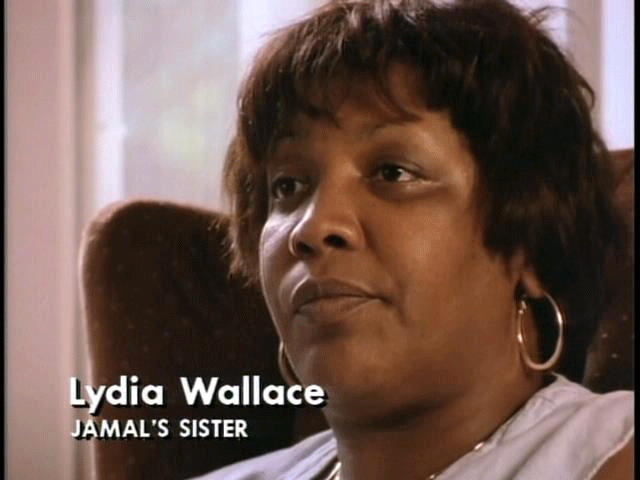
At times, Lydia Barashango, Abu-Jamal’s sister, held the camcorder. Her husband, the Rev. Ishakamusa Barashango, knelt down to a potted plant in the center of the room. As he began to pour libations, he began to call on the ancestors, “known and unknown.” Family members responded by repeating the word, “Ashe,” a West African term loosely meaning “the power to make it so.”

The name Edith Cook, Abu-Jamal’s late mother, was called. They had gathered in her name, proclaimed Rev. Barashango, “because everybody in here is either related to her. And if not directly related to her, spiritually related to her.” She died during Abu-Jamal’s second decade in prison.
It was the day after Thanksgiving, and Lydia had organized a get-together in Philadelphia to renew family ties, begin discussions about purchasing a family estate outside of the city, the making of a family quilt, and updating all about the latest in Abu-Jamal’s case.
Next Sunday will mark the 20 years behind bars for Abu-Jamal, the 47-year-old former Black Panther. He is on death row in Waynesburg, Pa. for the killing of Daniel Faulkner, a White police officer, on the early morning of Dec. 9, 1981.
Abu-Jamal and Faulkner were shot after the former journalist tried to stop a confrontation between his brother, William Cook, and Faulkner on a Philadelphia city street early in the morning of Dec. 9. Faulkner died at the scene.

Abu-Jamal’s family continues to fight to prove his innocence while seeking to live normal lives. It’s a difficult balance to maintain. Although they have not been behind bars, his relatives have also been locked up—chained to the country’s best-known death row prisoner by blood and by choice.
“I feel my life has been in limbo for the past 20 years,” explains Lydia. “I would really like to move out of Philadelphia, but not until Mumia is free.”
The feeling of suspension, with strong tinges of fear, permeates the air around the family of the man born Wesley Cook. Abu-Jamal has four brothers—Keith, Ronnie, William, and his twin Wayne-and a sister, Lydia. He has three children-Jamal, Lateefa and Mazi (Mumia’s hyphenated Arabic surname means “father of Jamal.”). Jamal, the oldest of the trio and one of the most outspoken family members, has his own wait; he is serving a near 16-year sentence on weapons possession.

Lateefa and Mazi were able to attend the post-Thanksgiving family meeting. Mazi—a tall, dark-skinned man with his father’s build, presence and smooth baritone—made a rare visit to the city for the family. Lateefa, more petite than her older brother, lives in Philadelphia. Both display a sense of directness and reserve.
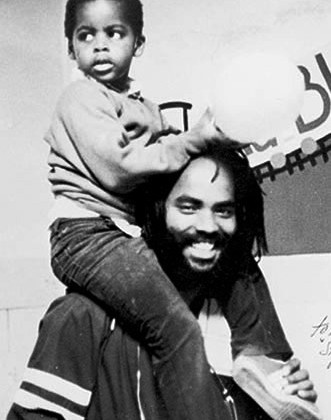
Abu-Jamal’s only daughter Lateefa is married with two children. Lydia’s husband, Rev. Barashango—pastor of the Temple of the Black Messiah, an African-centered interfaith church in Philadelphia—performed the wedding ceremony.
“I always said Lateefa was a little princess waiting for her daddy to come home,” says Lydia. It’s been a long wait. Lateefa was 8-year-old when her father first went to jail. She is now 28 and doesn’t closely follow the case because “sometimes it’s unbearable.”
At one point in the family ceremony, Keith softly addressed the small group of about 15 family members and close family friends. A correspondent for the National Newspaper Publishers Association, a federation of more than 200 Black newspapers, was the only journalist allowed to attend the family gathering. Keith outlined the family’s history. He talked about how losing his wife last year made him “want you to know who I am, and I want to know who you are.”

Then he talked not about one of the world’s most famous leftist causes, but about his little twin brothers and a family charge.
“When we (Lydia and I) were younger, we were given the twins” by their mother to watch over and take care of, he says, struggling to maintain his composure. Keith then recalled that his mother made Wayne’s well-being Lydia’s responsibility, while Keith was given Wesley.
Regardless of the family assignments, Keith said: “It has impacted all of us that he has been incarcerated for these 20 years.”
Lydia grabbed Keith by the waist, and said, “We’re in a very, very precarious position…We’re in a position where they would rather have Mumia than the man that confessed to the murder.”
Abu-Jamal’s legal team earlier this year produced an affidavit from Arnold Beverly, a man who says he was hired by the mob to kill Faulkner because the White police officer had been interfering with department-approved mob activity on Faulkner’s beat. Abu-Jamal’s 1982 prosecutors, his former legal team, and a city judge all have dismissed Beverly’s claims.
Philadelphia’s Fraternal Order of Police and other Faulkner supporters have long called Abu-Jamal a cop-killer—a murderer who got convicted after a fair trial. Believing Abu-Jamal is stalling the inevitable, they are angry that many anti-death penalty activists call him a “political prisoner.”
Lydia recalled how in the first years after Abu-Jamal’s 1982 conviction, she battled her journalist brother using his favorite weapons—pen and paper.
“Get your [explicative] out of there and come on home,” she wrote. “I don’t want my brother to be a martyr.” She was so mad she didn’t visit or write him for two years.
“I thought that he could say something to make the system let him go,” Lydia says. She says she knows better now. “He responded as if nothing ever happened,” Lydia recalled when she re-established the relationship.

The family talks more about battling the American justice system than Maureen Faulkner, the slain officer’s widow. Lydia claims Faulkner knows Abu-Jamal is innocent and is allowing herself to be used as a “poster child” for wives of police officers.
The widow and the Fraternal Order of Police have made the same charges about Abu-Jamal’s supporters. They claim Abu-Jamal’s supporters know he’s guilty and are using the author of three books as a poster child of the radical left.
A plaque in Faulkner’s honor is scheduled to be officially unveiled in Philadelphia at 13th and Locust—the corner where he was fatally shot—at a ceremony this Sunday.
Keith and Lydia are making their own plans for the future.
At Lydia’s request, Abu-Jamal has designed a family crest. Work on a quilt has also begun. Lydia also introduced the idea of family fundraising for an estate in her mother’s name. Migration once again equals familial security, as it was for Edith, who migrated with her brother to Philadelphia from segregated North Carolina in the 1940s.
It’s time to move away from the city, Lydia says.
“We’re fearful. We’re fearful of the police officers,” says Lydia. “My nephews, my sons—especially all the males in our family—we advise them not to be in Philadelphia.”
© Copyright 2001, 2006 by the National Newspaper Publishers Association and Todd Steven Burroughs, Ph.D.
 
My nephew just told me about this project. I hope he truly finds the audience who will devour this as well as white kids inhale those “Potter” books and children of all ages and colors absorb the movies. I’m sure the audio version of Chapter 11 on the site will help.
 Â
Â
Went to the ceremony last Friday. Shook Morgan Freeman’s hand and told him that, to me, he’d always be Easy Reader from “The Electric Company.” 🙂
So the Foundation (based in my adopted hometown of Hyattsville! Woo-woo!) gave out its Legacy Awards for Black literary excellence.
Emcee S. Epatha Merkerson (yep, the sister from NBC’s “Law And Order”) could not have been funnier.Â
The physical award was especially cool—a beautiful statue of Djhuiti. No joke, bay-bee!
Here’s the winners, most of whom were there to pick up their awards and speechify:
NONFICTION: John Hope Franklin (for “Mirror To America: The Autobiography of John Hope Franklin”)
First Finalist: Donald Bogle (for “Bright Boulevard, Bold Dreams”)
Second Finalist: Lisa Farrington (for “Creating Their Own Image: The History of African-American Women Artists”)
CONTEMPORARY FICTION: Clyde W. Ford (for “The Long Mile” )
DEBUT FICTION: Denise Nicholas (for “Freshwater Road” )
FICTION: Nancy Rawles (for “My Jim”)
First Finalist: David Anthony Durham (for “Pride of Carthage”)
Second Finalist: Tayari Jones (for “The Untelling”)
The Madam C.J. Walker Award went to Yao Hoke Glover III and Simba Sana, founders of Karibu Books. W. Paul Coates and Bill Cox were the individual recipients of the North Star Award. Those non-competitive awards acknowledge outstanding contributions to the world of Black books.
Meanwhile……..

While we’re talking about Black writers, thought I’d also add this article. The Sister Elder is the editor of this, the compilation of the “little magazine” she helped launch.
……….get two.
Then get ’em to write a needed book.
And there ya go.
Congrats to one of them, who just advanced to candidacy in her Ph.D. program!
C’mon, you know you’re interested. 🙂 So here’s a Q+A article.
Thought this email—which I’ve copyedited a little—was interesting. Clearly Brian Lamb of C-SPAN, a fellow Hoosier, loves Tavis.
10/26/06
Tavis Smiley was at the world-famous Karibu Bookstore last week. He was there to promote his new book. The book talks about Tavis on a personal level, detailing his family history. Tavis had a troubled past as a youth and he talks about how he overcame it.
Tavis says he was upset with Oprah and Larry King. As everyone knows, if you go on “Oprah” or “Larry King,” this normally helps with the success of your book, movie or album. Neither Oprah nor Larry have invited Tavis to their shows for any of his books, as Tavis pointed out. Tavis pointed out that although he has not been on any major (national) talk show, one of his books was on The New York Times bestseller list and the current book is three spots away from reaching that list.
He thanks both his fans and supporters for the success of the books and the outlets that allowed him to promote his books.
Of course, one could say that Tavis himself is a media outlet and may not need the help of Oprah or Larry King to support his book.Â
Here is a small video clip of Tavis speaking on these issues.


