Response To Saul Williams' Oprah Letter


Got this from Kalamu. It’s in response to this.

Notes on “An Open Letter to Oprah Winfrey”

By Taalam Acey

I want to approach this critique cautiously if only because these ideas are  among my most sincere. I applaud you for writing your “Open Letter to Oprah Winfrey,” and though it took me awhile to get around to reading it, I’m glad I did. When James Baldwin remarked that, “The poet or the revolutionary is there to articulate the necessity,” I’m sure that your open letter was the sort of agitation he had in mind.

I was not born of a minister and school teacher. Instead my parents were Black Nationalists in Imamu Amiri Baraka’s Committee for a Unified Newark. Unlike you, I was influenced by both Rakim and June Jordan. I affirm these things because they will no doubt color the critique that follows.

As for the illustrious Ms. Winfrey, I too grew up watching her on television. As a teen, my mother had me read Alice Walker’s “The Color Purple.” In the film, Ms. Winfrey’s portrayal of Sofia was exactly how I envisioned it. It was not surprising that she garnered one of that film’s 11 Oscar nominations (though, the film somehow didn’t win a single Oscar).

Of more relevance here, however, is that Ms. Winfrey, ironically, played a major role in my appreciation for gangsta rap. In 1989, Harpo, her company, produced (and she starred in) Gloria Naylor’s “The Women of Brewster Place.” Back then I was sure that white America despised young Black men. However, in my 18th year, her mini-series convinced me that Black women might hate us even more. I felt demonized. Though, I didn’t care much for “hard core rappers” beforehand, after Brewster Place, my feelings of betrayal rendered their messages vital.

A few months later, when Ms. Winfrey donated $1 million dollars to your alma mater, I remember thinking it had to be a function of her guilt.

Since then, she has given repeatedly and contributed to the education of hundreds of Morehouse students. I no longer doubt her sincerity. Still, I have come to believe there is a dichotomy in her perception of young black males. She has gone on record about being sexually abused by relatives (including a 19 year old cousin) beginning when she was 9 years old. However, she also credits moving in with her father as saving her life. In fact, while Vernon Winfrey was named by her mother as only one of a few potential fathers, he nevertheless took responsibility for Oprah and refused paternity tests throughout her life.

I mention none of this to be disrespectful to Ms. Winfrey. She is a self-made billionaire, Television Hall of Fame inductee and media mogul. Yet, she is also human and, like the rest of us, her past experiences may shed light on her current convictions.

Thus, having discussed the above, I’d like to assert that many of today’s rap lyrics conform more to the values of her 19-year-old cousin than they do those of her father.

I love Hip-Hop. It is and has always been sacred to me. There was something spiritual about Rakim’s flow and something evangelical about KRS-One’s diatribes. In high school, I spent time with Queen Latifah and was pretty close with Cut Master DC (of “Brooklyn’s in the House” fame). I attended shows at Union Square, The Tunnel and even The Castle in the South Bronx. I almost don’t know where to stop… During my teens, I got to drive Red Alert from a show in Jersey back to NY and talked him to death. I remember dancin’ to Crash Crew records, arguing over who was the best emcee in the Fearless Four, losing my mind when the Sugar Hill Gang and The Furious Five did a record together. There are entire Slick Rick, Rakim and Biggie songs that I still know word for word. Believe me, I too am a hip hop head.

Hip Hop in its organic form is [Grandmaster Flash and The Furious Five featuring] Melle Mel’s “The Message.” Nevertheless, there’s always been room for Ice Cube and Snoop. They had a story to tell. Our problem now has become that the stories are being told ad nauseam and by people who not only haven’t lived them, but aren’t inspired to tell them.

I’m into Spoken Word, one of many forms of poetry. There can be no doubt that rap is another. True, all rappers are not poets. But, even by the definition you applied, all Spoken Word artists aren’t poets either. Few artists of any artform operate from a sincerely vulnerable place. That is not a Hip-Hop phenomenon.

The problem is bigger than vulnerability. When you declared, “There is no true hatred of women in Hip Hop,” I can only assume that you meant in the Hip-Hop that you and other “Backpackers” support—those of you who choose “to associate…with the more “conscious” or politically astute artists of the Hip Hop community.” Surely you don’t believe that today’s rappers intend their endless litany of “Bitch,” “Ho,” and “Slut” as displays of affection.

I agree with you that, at our root, we inherently worship the feminine. Sadly it seems that for most of us now, at all points above our root, we’ve begin to worship money more. The problem with most of Hip-Hop is that it’s being co-opted. I cannot imagine what, if any point, you were attempting by mentioning that 50 Cent and George Bush share a birthday. I agree that George Bush is one of the gangsters that control this country, but I am certain that 50 Cent is not one of the “gangsters” that controls Hip-Hop. He may control his entourage and his bank account, but not much more. Curtis Jackson is an “artist,” not a mogul. So can you tell me if Lyor Cohen or Jimmy Iovine share a birthday with Bush? That might be slightly relevant.

You are right that “Censorship will never solve our problems.” Boycotting the sponsors of a radio show that made disparaging remarks about young black girls isn’t censorship though. In America, dollars vote. It is not censorship to use your dollars to vote a bigot off the air. The dramatic decline in the sale of rap records since 2005 is also not due to censorship. People are voting for change. We no longer care to support songs about how your car and house are better than mine because you’re really good at selling crack to my children.

This is a serious social issue and has nothing to do with the depiction of G*d in Christianity or any other religion. I’ve heard the argument about the proper Holy Trinity being man, woman and child, previously. I’ve attended lectures about instances of chauvinism in organized religion. Still I take issue with the logic that the Western depiction of G*d has driven emcees crazy.

You concluded by saying:

“If we are to sincerely address the change we are praying for then we must first address to whom we are praying.”

That’s the point, emcees have begun praying to mammon. Most mainstream rappers no longer take pride in their lyricism. They simply write whatever the record company believes it can easily sell. The problem is selfishness, not religion. Believe me, we haven’t reached this point in our history because too many rappers have become obsessed with studying the Bible.

This particular weapon of mass destruction is NOT the one that asserts that a holy trinity would be “a father, a male child, and a ghost.” This weapon of mass destruction IS wealthy racist white men who exploit and mass market poor young black men who are willing to denigrate themselves for money. We do not require disconnected excuses, only change.

The primary problem with rappers today is selfishness. That’s the very quality that separated Oprah’s father from her 19-year-old cousin. I’ll end by saying there’s nothing more vulnerable than a broke talentless rapper in the hands of a racist white media mogul. In the end, I hope you understand that these notes are not about you and I but, instead, the masses of oppressed people who deserve to know the truth.

In Brotherhood,

Taalam Acey

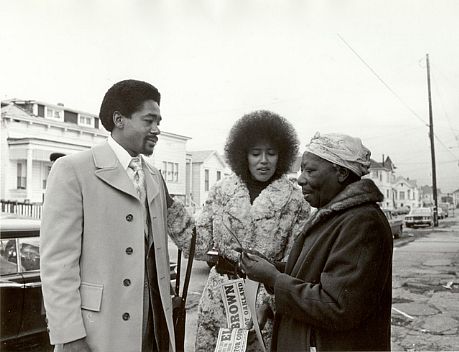
Was Former Black Panther Leader Elaine Brown A Government Agent?

Making the Internet rounds. Except for some absolutely necessary spacing, I have not edited the dispatches.

Elaine Brown’s Open Statement to the Green Party
 
May 1, 2007

Vicious Rumormongering Will Not Deter Me from My Campaign for the Green Party Presidential Nomination

The vicious rumor being floated among Green Party members that I am or ever have been a government agent is a lie. I have never consorted with the U.S. government or any of its myriad agencies against the interests of black people, the Black Panther Party—of which I was a leading member—or any other people. I have dedicated my very life to the freedom of all oppressed people. Because these rumors are unfounded, unsupported by one scintilla of evidence or any citation to any specific act, they are, in the end, indefensible and, therefore, all the more insidious. I stand on my history of struggle in the Black Panther Party and since that time as the strongest refutation of this lie.

On the occasion of my announcing my candidacy for the Green Party presidential nomination, Mike Feinstein, a ranking California Green, and Nan Garrett, chair of the Georgia Green Party, launched this sinister campaign to discredit me, Feinstein, in a series of telephone calls to key Greens across the country after meeting me in March, and Garrett, in a recent, nationally-distributed, vitriolic email. It is particularly ironic that, while neither Feinstein nor Garrett has any history of involvement with the cause of the freedom of black people, they would challenge the credentials of the former Chairman of the Black Panther Party. This dangerous rumormongering is especially egregious as to Garrett, who, as a lawyer, makes her accusation without even the appearance of presenting evidence.

Their lie is based on a statement made at a meeting held by Cynthia McKinney in 2000, when she was a Congresswoman. Even though this meeting was not a Congressional hearing, Feinstein and Garrett would elevate its record to an “official” document. McKinney, who claimed to be conducting an investigation into the FBI’s COINTELPRO activities against blacks, had invited only two former members of the Black Panther Party to her meeting to serve as ‘witnesses,’ Kathleen Cleaver and Elmer “Geronimo” Pratt. At the meeting, Pratt is recorded to have asserted that I was an “agent.” ­This is a statement he has never dared make directly to me, and I challenge him now to do so and to present one iota of evidence to support his J. Edgar Hoover-like accusation against me. And, I would assert that, as McKinney has stood by surreptitiously and allowed her so-called forum to be used to validate Pratt’s lie, she has endorsed that lie.

Cleaver and Pratt were expelled from the Black Panther Party in early 1971 as conspirators in a plot led by Eldridge Cleaver to take over the Party, whereby they denounced Huey P. Newton, Bobby Seale, David Hilliard, Fred Hampton and others, called for their deaths and declared the Weather Underground group the “vanguard” of revolution. Their attack against the Party resulted in internecine violence and, even, death. All of this is documented in the Black Panther Party newspaper, housed in its entirety in an archive at Stanford University.

One other glaring irony in all of this is that, while Feinstein is promoting McKinney as the Green Party presidential candidate, despite that McKinney remains a Democrat to this day, it is McKinney who has engaged in activity that has undermined the efforts of black people for freedom, specifically in her vote in favor of the Bill Clinton “three-strikes” crime bill.

Raising suspicion about someone as a traitor, a “government agent,” was a key tactic employed by the FBI under its COINTELPRO operations against the Black Panther Party. The resulting distrust frustrated our efforts and destroyed lives. That was what the FBI intended. When J. Edgar Hoover declared in 1968 that the Party was “the greatest threat to the internal security of the United States,” he announced he would wage a campaign to discredit, disrupt and destroy the Black Panther Party. While the Party is long gone and Hoover is dead, COINTELPRO is, clearly, very much alive.

Given all of this, I call for the resignations from the Green Party of Mike Feinstein and Nan Garrett.  In the alternative, I urge the Green Party leadership to impeach Feinstein and Garrett or otherwise remove them from their ranking positions. Their rumor-mongering has done more than defame and endanger me. It has embroiled the Green Party in destructive, counterproductive activity and at a critical crossroad.

The mass rejection of Bush and his policies has opened a door for opposition. It is the Democrats, however, who are poised to walk through that door, and only to replace this Bush with another Clinton. The Green Party proffers a progressive agenda, though it has failed to gain the support of the very constituencies it would serve—especially blacks—the majority of whom remain dedicated to the Democratic Party. I stand, and still, as a prospective nominee for the presidency who is singularly committed to the Green Party agenda, capable of bringing blacks into the Party ranks, veteran in articulating the contradictions between black and other poor and working people and the Democrats, and able to stir national debate on the issues, toward the election of more Greens and, ultimately, real progressive change in the United States of America.  
 
ElaineBrown.Org 2007

———————

Sent To TheBlackList By: Panthershepcat@aol.com
 
—– Original Message —–

From: k.cleaver@att.net
To: Panthershepcat@aol.com
Sent: Tuesday, May 08, 2007 1:22 PM
Subject: FW: Re: FW: notes

————– Forwarded Message: ————–

My First remembrance of Elaine brown was while I was conducting security for Elrage Cleaver, October 1968?. After Elrage gave a rousing speech at Pauley Pavillion, UCLA, this girl came to the security gate crying and begging to meet Elrage.   She was escorted to Bunchy Carter, whom I was standing with and he began to question her. She said that she was Elaine brown and was in awe of Elrage and wanted to meet him. Bunchy arraged the meeting after consulting w/Elrage.   During that period, I was assisting Bunchy w/developing his security forces and techniques and made note of this breech of protocol?.(Elrage later explained that she only wanted him to fuck her and he saw it as his duty to implement his “Dick Power” program).   The next time I remember seeing Elaine was a couple of m onths later because it’d been reported to me that she was John Huggins’ new lover while his wife Erika was pregnant . At that time Elaine was dubbed as another girl who wanted to have sex w/men in leadership positions which placed her in a higher suspicion in my security files. Bunchy and I were sharing an apartment and I remember that night we discussed John Huggins’ relationship w/Elaine and how displeased Bunchy was w/John’s sexual activities w/this girl because Bunchy felt very close to Erika and didn’t want her to find this out.

 I had no idea that but a few weeks after this (1/17/69) on the campus of UCLA at a carefully pre-arranged* meeting between the US group and the Panthers, that elaine brown would incite a ruckus by slapping one of the US members whom she also had sexual relations with, then ran to John Huggins screaming that “She’d” been assaulted by this US member! John Huggins immediately pulled a 357 magnum from his waist and shot at the US member who returned fire resulting in Huggins and Bunchy’s deaths ! ! During the police investigation, Elaine brown lied and wrongfully attested that the Steiner Brothers had murdered Bunchy and John w/out provocation. She then continued this lie all the way to the witness stand in LA Superior court resulting in the wrongful conviction of 1 st degree murder of George and Larry St einer who are still being persecuted  till this day. (her testimony a matter of public record).  The pandemonium and turmoil that ensued the death of our most revered leader Bunchy, made it nearly impossible to get hold of the raging fratricidal situation but as soon as the smoke began to clear. the pieces began to fall into place clearly implicating elaine brown as the instigator of the entire deathly drama !   This information was known to me “Prior” to my agreement to continue Bunchy’s program in the capacity of Deputy Minister of Defense of the Liberation Forces there in Southern California . So it is impossible for Elaine to have joined any formation of which I was in charge as I was very meticulous/selective re new membership . Futher, I am sure that we never permitted membership to ANYONE who testified for the pig so-called justice system as they were known, as “Snitches and/or “Rats”.  My security reports were sent to various leaders in the movement but was continually watered down by those “Leaders” who had become victim to elaine’s sexual manipulations. Each time I received reports of elaine brown popping up in Oakland, Chicago, Connecticutt, etc., I’d act quickly to banish her and I’d then render whatever form of discipline necessary to those who’d hosted her.   Our main obstacle in handling this at that time was the sad alienation of Elrage who had by then fled and was our International Ambassador?and was adamant in giving Elaine brown “another chance “. So it was decided that she would be sent to work w/Elrage and she’d finally be out of our hair.   Elrage told me years later that that was the biggest mistake he’d made while there cuz as soon as she got to Algeria, unity began to crumble ?,and before he could rectify the situation, Elaine was gone .  It was now 1970 and Huey had just been released. Elaine somehow ended up right in Huey’s bed and as Huey told me in 1988, “She kept cocaine and sexy women on him everyday/night”. Huey also admitted that it was Elaine who’d inflamed his hatred against Elrage resulting in the infamous phone call that marked a clear split in the top leadership of that important sector of the Black Liberation Movement.  During that stint in Quentin 1988,Huey refused to leave the prison unless I was released first because he stated that he had ordered key exculpatory witnesses not to testify on my behalf because he was misled to believe what agents like Elaine brown wanted him to believe. I remember Huey reflecting on the strange fact that was revealed in my trial that Elaine brown’s name was on th e receipt from the paint shop that changed the color of my car and how that bit of info opened his ever-drugged eyes to suspect. Then he told me that he learned that she’d testified for the pigs lying on those brothers, as he put it, when everyone knew that they did not shoot Bunchy nor John. H e said it took months for him to raise out of that euporia and realize that he was surrounded by agents. He then put Elaine in his “Panther Jail” but was over taken by a barrage of “Advisors who’d constantly tell him that he was going thru a severe stage of paranoia?.” Next thing he said he remembered was that Elaine was out of his jail and had gotton Masai to get her back in the mix?.All throughout these conversations, Huey made sure to mention Elaine brown’s complicity as an fbi agent ,including her occasional meetings w/the “same white dude”. I remember stopping him to say that way back in 1970, Nsondi (aka Sandra “Red” Pratt) was the first to report to me about elaine’s meeting w/this white fella at a LAX hotel.  We now know that the white dude was the same “Kennedy” super-mind- control CIA chief of psy-war operations against many key forces for Black Liberation?including SCLC !

There is much much more irrefutable evidence that continues to expose this sad sally for the COINTEL conspirators? but do not lose sight of the fact that this girl Elaine was brought to ucla for psychiatric treatment which seems to be a pre-requisite for patsies of elaine’s type and that she was but one, tho a very important one, of so many others who were used, unwittingly, as moles, provocateurs, et cet ad nauseam.

It’s a low down dirty and a doggone shame that here in 2007 elaine is still being used to now attack the beautiful Fighter for True Justice Cynthia Mckinney and if there is more I can do to assist, don’t hesitate to let me know.

Geronimo ji Jaga

Asante Sana, New Ancestor Judy Dothard Simmons

My friend and mentor Judy Dothard Simmons died over the weekend. She was a good person who happened to be a great writer. A poet, she was a pioneer of Black news-talk radio (New York’s WLIB-AM) and national magazine journalism (Essence, Ms. ).

I thought I’d share a couple of her (group) emails from last year. They say a lot about her.

—————-

From: “Judy Simmons” <dexta@cableone.net>
To: “Judy Simmons” <dexta@cableone.net>
Subject:
Date: Sat, 12 Aug 2006 09:40:42 -0500

Dear Elisha,

It’s Saturday again. The week has flown by since you stopped here and graciously brought the Noni juice. I’m so glad you did that. It not only restored my basic support to me, but it also warms my heart that you are generous and understanding in your wonderful way.

I have decided not to have a laparoscopy. The second thing Dr. Huh said after introducing himself was that he didn’t want to do surgery on me because I would probably die on the table. Only one person, a doctor in Anniston who had never examined me before, raised the specter of ovarian cancer. That set everything rocketing off like crazy.

Then I arrive at UAB and nobody can see through the calcified fibroid tissue all over the place to discern where the womb is, what shape it’s in, or what kind of tissue the “mass” is. This takes us through cat scan, cat scan with liquid (not the dye, something else for contrast); vaginal echo, and ultimately MRI, which was supposed to give the one true answer for where to insert for a needle biopsy.

No dice.

Meanwhile, when they finally take of a couple of liters of fluid, within thirty minutes I have a fully formed stool, which hadn’t happened for a month.

The fluid that was removed does not seem to be coming back, and my bowel (with colace) is working two or three times a day. I have no pain, and my breathing is not labored. I do not have cancer.

Why go looking for a disease I show little sign of instead of looking at the disease I clearly have—congestive heart failure—which is known to produce fluid and symptoms of the sort I’m displaying? So, since surgery is surgery, laparoscopic or otherwise, and the doctor said in my hearing that maybe he could get in and out in 15 minutes and that wouldn’t be so bad, cutting me (invading the envelope) seems more of a risk than the possible diagnosis is worth.

Bear in mind that any mass, cancerous or not-cancerous, would sooner or later require surgery to remove, and it was made clear to me that no responsible practitioners are going to put me under general anesthetic and do the two- to four-hour (or more) operation to remove mass.

Who’s to say that where he goes in for the laparoscopy is going to be any more productive of non-fibroid tissue than all the other tests that showed him he can’t see what’s there anyway?

He talked about needing to find an anesthesiologist who was willing to take a chance on a heart in the shape mine is in, even for a spinal and sedation.

He said that even if it were cancer and he treated it with chemo first, it would eventually boil down to needing surgery and that isn’t an option.

So, basically, I would be submitting to a life-threatening procedure so the doctors can be certain about something that can only degrade the quality of my life by causing me risk, discomfort, and a healing procedure that, right now, my body is telling me in no uncertain terms that it is not up to. And since this good body has always risen to the occasion, no matter how I’ve jeopardized and neglected it, I’m listening now that it says, “Judy, I just can’t make this one. It’s asking too much.”

My Anniston cardiologist had a full-fledged two-year-old temper tantrum yesterday because I told him I would not get a pacemaker (for the ninth or tenth time; by the way, the UAB teaching hospital flower-of-the-south medical-center cardiology gods said a pacemaker would do me no earthly good, as I suspected). Then my cardiology said he didn’t think I had cancer—which is why I was sent to UAB oncology on the say so of a gynecology who had never examined before he stuck is finger into me in the hospital bed and opined with deep seriousness that I really, really, probably had ovarian cancer.

The cardiology told me yesterday he thought the fluid in my abdomen was consequent to right-side heart failure, but he refused to treat me for that unless I had a laparoscopy (which would never have occurred to him if this other guy hadn’t raised the cancer issue).

So, my cardiologist turned me back over to my primary care physician and refused to give me the benefit of his cardiology expertise on how to manage the excess fluid
collecting in the abdomen from diuretics and heart failure. There are medical manipulations he can do—he told me that—but unless I consent to a tissue diagnosis (which, again, we have no guarantee they will get, all other tests having shown no markers for cancer, he won’t help me any further.

There was more stuff he vented which showed he thinks he has made me live, and that I have had no part in making decisions that resulted in his being able to help me, and preventing him from injuring me.

I grasped his hand in a shake and told him I was grateful to him for his help. Badtemperedly, he shook off my hand and snapped, “Don’t be grateful to me.” I took hold of his hand again, said again that I am grateful to him, and he basically threw me out of his office.

I’m listening to the fine classical jazz collection I’ve amassed over the years, putting my affairs in order, loving my dog and my friends, and generally having a good time for the first time in fifteen or twenty years. I am walking through the valley of the shadow of death and feeling damn good about it. I fear no evil, for I AM always and ever living.

So, for more info, call.

Judy

From: “Judy Simmons” <dexta@cableone.net>
To: “Judy Simmons” <dexta@cableone.net>
Subject:
Date: Mon, 4 Sep 2006 17:53:33 -0500

Sixty-two doesn’t feel the same as thirty-three, and I think folks who say it does are lying. These great Indian seers who don’t breathe earthly air and put on and take off bodies like togas—I guess I’m ain’t one uh them. Also I just figured out that some of the unaccustomed sensations I have been thinking are ill health are signs of a body used for six decades.

I’m sittin’ up here in the house following the U.S. Tennis Open on tv. I listen to these people rattle on—the anchors, pundits, and hosts—and I’m torn between shooting them all with my high-vibration consciousness death ray or plunging back down to the depths where they don’t swim, sharks though they are. The death ray hasn’t worked so far, and being under water has its own drawbacks.

So, here I am, missing my radio show after twenty years, and without any media outlet for my spleen. I really liked being on WLIB AM, NY when it started the news-talk format in the 1980s. Then Philippe Wamba, the chief editor who made Africana.com an engaging web stop, put up with me from 2000-2002. He hired me as staff writer, editor, columnist, and insecure egotist. We both found out I was too old a dog (mid-40s) to do any corporation’s stupid pet tricks. He was kind, and kept me going for two years until he left and died some months later in an automobile accident in an African country. (If it were Europe, I would know it matters which country things happen in, but since it’s the Dark Continent, it’s all the same.)

Okay, so clearly I don’t have enough social life here, so when I want to party or converse, I’m just realizing, I send off one of these mass mailings. I figure the delete key is handy enough, so you shouldn’t get too annoyed, and a few people tell me they like getting what I write. For me, I’m realizing, it’s doing my radio show, which was very extemporaneous. It’s whatever it is that makes me need to be a public communicator (writer, broadcaster, contributor of information and sometimes knowledge).

Why don’t I do a blog? Because I don’t expect people to come to me. I have to be where they can catch my drift, as it were. And besides, this is personal in an immediate way. Feedback comes quickly as people are moved to give some—it’s not required—and I imagine how some of you look while reading this. It keeps me off the streets, and it’s about all the effort I’m up to giving.

And, I’m developing my communications skills. Language keeps changing. Plus, as I enlarge my understanding of how we people operate, I keep an ear out for the rhythm, cadence, and tones of the times. It’s about the gestalt. The way images move nowadays has so much to do with what people see and hear. When I was in psych school back in the day—(I could have said “school a million years ago”) but I think the “back” phrase has a more satisfying crunch; what do you think?)—anyway, when I took psych we talked about gestalt. As I understood it, it meant getting a whole picture that’s more than the separate pixels, stimuli, responses, actions, and so forth put together like a jigsaw puzzle. The individual pieces say “sky,” “grass,” “cloak,” or whatever, but the whole picture calls out emotional, aesthetic, and intellectual responses that are more than cardboard interlocking on a table.

Another question people ask me is why didn’t I stay in media and become an internationally famous personality. Well, seldom is one allowed to do such things on one’s own terms, and refuse to or can’t do them on any other.

So, those are some of my reflections this day. I didn’t rave on about how I can’t stand the most of what’s going on in our culture, given that the sole raison d’etre for much of it is the mindless and soulless pursuit of material wealth. There’s a difference between being the master of money and the servant of it. Guess which most us are.

Love, Judy

May 10 UPDATE: Here’s the official death announcement.

Judy Dothard Simmons

Judy Dothard Simmons, a noted poet, journalist, author and broadcaster, died on Sunday, May 6 in Anniston, Alabama from heart complications.

Since the 1970s, Judy’s thought-provoking writings and broadcasts had won her national acclaim. She had been a senior editor at Essence and Ms. magazines. Also, she had been managing editor for the NAACP’s Crisis magazine, a columnist for Harvard University/Time Warner’s Africana.com, and an editor at Black Enterprise. During the early 1980s Judy had a popular radio talk show on New York’s first Black commercial talk station WLIB and also on Pacifica’s WBAI. Her articles had appeared in The Village Voice, American Legacy Woman, and others. Also, she had been a guest on Donahue.

During the 1990s, Judy returned to Alabama and was a columnist for The Anniston Star. A celebrated poet, she was a Revson Fellow at Columbia University and did graduate work in poetry. Judy was the author of several books of poetry and essays including Decent Intentions, Judith’s Blues, and A Light in the Dark. She was also a contributor to the book Wild Women Don’t Wear No Blues. Her vibrant voice will be sorely missed.

Arrangements are being handled by Ervine Funeral Home in Anniston, Ala.: (256) 237-1717.

Liked That Tavis and Gwen Ifill………..


……………pointed out the difference between them: Tavis as the “more like an advocacy journalist” (his words) on the soapbox, Gwen the MSM journalist who is uncomfortable with expressing opinion.

Although Tavis’ journalistic credentials are up for debate (are talk show hosts “real” journalists or “honorary” journalists?), I’m glad he’s there to explain, and show, the difference between the two of them. I’ve read too much of Ida B. Wells and Frederick Douglass to believe all Black journalists—MSM and others—are from that tradition, although they all claim it. (Who wouldn’t, right? 🙂 )

But allathat’s my issue. Since America is the home of the First Amendment and I’m not King of the Universe, I can’t stop anybody from claiming or not claiming anything.

And since anyone can say he or she is a journalist, perhaps all of this is moot, and we should just all define our unlicensed roles for ourselves. Like Tavis and Gwen did, and do.

And so I’ll continue to give what I believe to be an educated analysis as a credentialed historian of Black media, and Black MSM journalists can reply, “SO?? That doesn’t make your word final.” And the beat will go on.

Saul Williams' Open Letter To Oprah Winfrey


From Kalamu. 

An open letter to Oprah 4/18/7: From Saul Williams

Dear Ms. Winfrey,

It is with the greatest respect and adoration of your loving spirit that I write you. As a young child, I would sit beside my mother everyday and watch your program. As a young adult, with children of my own, I spend much less time in front of the television, but I am ever thankful for the positive effect that you continue to have on our nation, history and culture. The example that you have set as someone unafraid to answer their calling, even when the reality of that calling insists that one self-actualize beyond the point of any given example, is humbling, and serves as the cornerstone of the greatest faith. You, love, are a pioneer.

I am a poet.

Growing up in Newburgh, N.Y., with a father as a minister and a mother as a schoolteacher. At a time when we fought for our heroes to be nationally recognized, I certainly was exposed to the great names and voices of our past. I took great pride in competing in my church’s Black History Quiz Bowl and the countless events my mother organized in hopes of fostering a generation of youth well versed in the greatness as well as the horrors of our history. Yet, even in a household where I had the privilege of personally interacting with some of the most outspoken and courageous luminaries of our times, I must admit that the voices that resonated the most within me and made me want to speak up were those of my peers, and these peers were emcees. Rappers.

Yes, Ms. Winfrey, I am what my generation would call “a Hip Hop head.” Hip Hop has served as one of the greatest aspects of my self-definition. Lucky for me, I grew up in the 80s when groups like Public Enemy, Rakim, The Jungle Brothers, Queen Latifah, and many more realized the power of their voices within the artform and chose to create music aimed at the upliftment of our generation.

As a student at Morehouse College where I studied Philosophy and Drama, I was forced to venture across the street to Spelman College for all of my Drama classes, since Morehouse had no theater department of its own. I had few complaints. The performing arts scholarship awarded me by Michael Jackson had promised me a practically free ride to my dream school, which now had opened the doors to another campus that could make even the most focused of young boys dreamy, Spelman. One of my first theater professors, Pearl Cleage, shook me from my adolescent dream state. It was the year that Dr. Dre’s “The Chronic” was released and our introduction to Snoop Dogg as he sang catchy hooks like “Bitches ain’t shit but hoes and tricks…” Although it was a playwriting class, what seemed to take precedence was Ms. Cleage’s political ideology, which had recently been pressed and bound in her 1st book, Mad at Miles. As, you know, in this book she spoke of how she could not listen to the music of Miles Davis and his muted trumpet without hearing the muted screams of the women that he was outspoken about “man-handling.” It was my first exposure to the idea of an artist being held accountable for their actions outside of their art. It was the first time I had ever heard the word “misogyny.” And as Ms. Cleage would walk into the classroom fuming over the women she would pass on campus, blasting those Snoop lyrics from their cars and jeeps, we, her students, would be privy to many freestyle rants and raves on the dangers of nodding our heads to a music that could serve as our own demise.

Her words, coupled with the words of the young women I found myself interacting with forever changed how I listened to Hip Hop and quite frankly ruined what would have been a number of good songs for me. I had now been burdened with a level of awareness that made it impossible for me to enjoy what the growing masses were ushering into the mainstream. I was now becoming what many Hip Hop heads would call “a Backpacker”—a person who chooses to associate themselves with the more “conscious” or politically astute artists of the Hip Hop community. What we termed as “conscious” Hip Hop became our preference for dance and booming systems. Groups like X-Clan, A Tribe Called Quest, Brand Nubian, Arrested Development, Gangstarr and others became the prevailing music of our circle. We also enjoyed the more playful Hip Hop of De La Soul, Heiroglyphics, Das FX, Organized Konfusion. Digable Planets, The Fugees, and more. We had more than enough positivity to fixate on. Hip Hop was diverse.

I had not yet begun writing poetry. Most of my friends hardly knew that I had been an emcee in high school. I no longer cared to identify myself as an emcee and my love of oratory seemed misplaced at Morehouse where most orators were actually preachers in training, speaking with the Southern drawl of Dr. King although they were 19 and from the North. I spent my time doing countless plays and school performances. I was in line to become what I thought would be the next Robeson, Sidney, Ossie, Denzel, Snipes… It wasn’t until I was in graduate school for acting at NYU that I was invited to a poetry reading in Manhattan where I heard Asha Bandele, Sapphire, Carl Hancock Rux, Reggie Gaines, Jessica Care Moore, and many others read poems that sometimes felt like monologues that my newly acquired journal started taking the form of a young poets’.

Yet, I still noticed that I was a bit different from these poets who listed names like: Audre Lourde, June Jordan, Sekou Sundiata, etc., when asked why they began to write poetry. I knew that I had been inspired to write because of emcees like Rakim, Chuck D, LL, Run DMC… Hip Hop had informed my love of poetry as much or even more than my theater background which had exposed me to Shakespeare, Baraka, Fugard, Genet, Hansberry and countless others. In those days, just a mere decade ago, I started writing to fill the void between what I was hearing and what I wished I was hearing. It was not enough for me to critique the voices I heard blasting through the walls of my Brooklyn brownstone. I needed to create examples of where Hip Hop, particularly its lyricism, could go. I ventured to poetry readings with my friends and neighbors, Dante Smith (now Mos Def), Talib Kweli, Eryka Badu, Jessica Care Moore, Mums the Schemer, Beau Sia, Suheir Hammad…all poets that frequented the open mics and poetry slams that we commonly saw as “the other direction” when Hip hop reached that fork in the road as you discussed on your show this past week. On your show you asked the question, “Are all rappers poets?” Nice. I wanted to take the opportunity to answer this question for you.

The genius, as far as the marketability, of Hip Hop is in its competitiveness. Its roots are as much in the dignified aspects of our oral tradition as it is in the tradition of “the dozens” or “signifying.”

In Hip Hop, every emcee is automatically pitted against every other emcee, sort of like characters with super powers in comicbooks. No one wants to listen to a rapper unless they claim to be the best or the greatest. This sort of braggadocio leads to all sorts of tirades, showdowns, battles, and sometimes even deaths. In all cases, confidence is the ruling card. Because of the competitive stance that all emcees are prone to take, they, like soldiers begin to believe that they can show no sign of vulnerability. Thus, the most popular emcees of our age are often those that claim to be heartless or show no feelings or signs of emotion.

The poet, on the other hand, is the one who realizes that their vulnerability is their power. Like you, unafraid to shed tears on countless shows, the poet finds strength in exposing their humanity, their vulnerability, thus making it possible for us to find connection and strength through their work. Many emcees have been poets. But, no, Ms. Winfrey, not all emcees are poets. Many choose gangsterism and business over the emotional terrain through which true artistry will lead. But they are not to blame. I would now like to address your question of leadership.

You may recall that in immediate response to the attacks of September 11th, our president took the national stage to say to the American public and the world that we would “…show no sign of vulnerability.” Here is the same word that distinguishes poets from rappers, but in its history, more accurately, women from men. To make such a statement is to align oneself with the ideology that instills in us a sense of vulnerability meaning “weakness.” And these meanings all take their place under the heading of what we consciously or subconsciously characterize as traits of the feminine. The weapon of mass destruction is the one that asserts that a holy trinity would be a father, a male child, and a ghost when common sense tells us that the holiest of trinities would be a mother, a father, and a child: Family.

The vulnerability that we see as weakness is the saving grace of the drunken driver who because of their drunken/vulnerable state survives the fatal accident that kills the passengers in the approaching vehicle who tighten their grip and show no physical vulnerability in the face of their fear. Vulnerability is also the saving grace of the skateboarder who attempts a trick and remembers to stay loose and not tense during their fall. Likewise, vulnerability has been the saving grace of the African American struggle as we have been whipped, jailed, spat upon, called names, and killed, yet continue to strive forward mostly non-violently towards our highest goals. But today we are at a crossroads, because the institutions that have sold us the crosses we wear around our necks are the most overt in the denigration of women and thus humanity. That is why I write you today, Ms. Winfrey. We cannot address the root of what plagues Hip Hop without addressing the root of what plagues today’s society and the world.

You see, Ms. Winfrey, at its worse, Hip Hop is simply a reflection of the society that birthed it. Our love affair with gangsterism and the denigration of women is not rooted in Hip Hop; rather it is rooted in the very core of our personal faith and religions. The gangsters that rule Hip Hop are the same gangsters that rule our nation. 50 Cent and George Bush have the same birthday (July 6th). For a Hip Hop artist to say, “I do what I wanna do/Don’t care if I get caught/The DA could play this mothafuckin tape in court/I’ll kill you” epitomizes the confidence and braggadocio we expect an admire from a rapper who claims to represent the lowest denominator. When a world leader with the spirit of a cowboy (the true original gangster of the West: raping, stealing land, and pillaging, as we clapped and cheered.) takes the position of doing what he wants to do, regardless of whether the U.N. or American public would take him to court, then we have witnessed true gangsterism and violent negligence. Yet, there is nothing more negligent than attempting to address a problem one finds on a branch by censoring the leaves.

Name calling, racist generalizations, sexist perceptions, are all rooted in something much deeper than an uncensored music. Like the rest of the world, I watched footage on AOL of you dancing mindlessly to 50 Cent on your fiftieth birthday as he proclaimed, “I got the ex/if you’re into taking drugs/ I’m into having sex/ I ain’t into making love” and you looked like you were having a great time. No judgment. I like that song too. Just as I do James Brown’s “Sex Machine” or Grandmaster Flash’s “White Lines.” Sex, drugs, and rock and roll is how the story goes.

Censorship will never solve our problems. It will only foster the sub-cultures of the underground, which inevitably inhabit the mainstream.

   Oshun

There is nothing more mainstream than the denigration of women as projected through religious doctrine. Please understand, I am by no means opposing the teachings of Jesus, by example (he wasn’t Christian), but rather the men that have used his teachings to control and manipulate the masses. Hip Hop, like Rock and Roll, like the media, and the government, all reflect an idea of power that labels vulnerability as weakness. I can only imagine the non-emotive hardness that you have had to show in order to secure your empire from the grips of those that once stood in your way: the old guard. You reflect our changing times. As time progresses we sometimes outgrow what may have served us along the way. This time, what we have outgrown, is not hip hop; rather it is the festering remnants of a God depicted as an angry and jealous male, by men who were angry and jealous over the minute role that they played in the everyday story of creation. I am sure that you have covered ideas such as these on your show, but we must make a connection before our disconnect proves fatal.

We are a nation at war. What we fail to see is that we are fighting ourselves. There is no true hatred of women in Hip Hop. At the root of our nature we inherently worship the feminine. Our overall attention to the nurturing guidance of our mothers and grandmothers as well as our ideas of what is sexy and beautiful all support this. But when the idea of the feminine is taken out of the idea of what is divine or sacred then that worship becomes objectification. When our governed morality asserts that a woman is either a virgin or a whore, then our understanding of sexuality becomes warped. Note the dangling platinum crosses over the bare asses being smacked in the videos. The emcees of my generation are the ministers of my father’s generation. They too had a warped perspective of the feminine. Censoring songs, sermons, or the tirades of radio personalities will change nothing except the format of our discussion. If we are to sincerely address the change we are praying for then we must first address to whom we are praying.

Thank you, Ms. Winfrey, for your forum, your heart, and your vision. May you find the strength and support to bring about the changes you wish to see in ways that do more than perpetuate the myth of enmity.

In loving kindness,
Saul Williams

"It's Men's Attitude, Stupid!": A Commentary About Imus, Hiphop And Sexism

Just got this from Akila Worksongs.  

“It’s Men’s Attitude, Stupid!”: A Commentary About Imus, Hiphop And Sexism

By Byron Hurt

April 24, 2007

As a response to the Don Imus fallout surrounding his racist and sexist rant hurled at the blameless Rutgers University women’s basketball team – and to the dramatic shift and intense media glare on hip-hop’s sexism and misogyny – Russell Simmons and Dr. Benjamin Chavis Muhammad, leaders of the New York-based Hip-Hop Summit Action Network, bowed under mounting criticism and pressure, and announced this week that they will make a strong push to have the words “nigger,” “bitch,” and “ho” bleeped on mainstream public radio stations nationwide.

That is not enough.

As an anti-sexist activist, pro-feminist African-American male, I have had the unique and interesting experience of rolling up my sleeves and working with thousands of boys and men in the United States around sexism, men’s violence against women, and homophobia. I have worked with boys and men across race, education, and class lines, and I know how deep and complex these issues are. In my lectures and workshops, I acknowledge my own past as someone who was sexist, and who, as a heterosexual man, behaved badly with women. I am also very candid about how I still grapple with certain gender issues that to this day confuse me. I challenge guys to speak out about sexism, and inspire men to join in the effort to end men’s physical, emotional, and sexual violence against women. I show men how all of these issues hurt men as well as women.

Over the past 14 years years, I have been in the belly of the beast delivering this message. I’ve been in locker rooms with male athletes, on U.S. Marine Corps bases with young Marines, on-campus with black and white fraternity members, and in closed-door sessions with men in positions of authority at colleges and universities. I have also addressed, to a lesser degree, men in law enforcement, and batterers in court mandated battering intervention programs.

My current mission is to engage young men from the hip-hop generation – men who, it seems, are today’s lone scapegoats for centuries-old patriarchy, sexism and misogyny. Let the truth be told, hip-hop’s misogyny is indefensible and must be confronted. But hip-hop is surely not the only place where boys and men are informed about girls and women. From the recent Supreme Court decision to ban partial birth abortion, to “men’s interests” magazine covers donning scantily clad female celebs, to hard and soft-core pornograghy that subjugate women – men are bombarded daily with messages about gender. Even as a woman, Senator Hillary Clinton, mounts a formidable campaign to become the first female president of the United States, the messages about gender in popular culture are clear – men rule the world, and women are sex objects, bitches and ho’s.

Hip-hop’s sexism is only a piece of a much larger puzzle.

I am a hip-hop fan. At 37 years old, hip-hop music has been the soundtrack of a huge chunk of my life. But as I learned more about gender issues as an original member of Northeastern University’s Mentors in Violence Prevention Program, I began to question hip-hop’s ever-present macho themes and images. I grew up with hip-hop, but hip-hop did not grow up with me. I became so weary of hip-hop’s testosterone that, in 2000, I decided to do something about it. Over a period of six years, I directed and produced Hip-Hop: Beyond Beats and Rhymes, an award-winning PBS documentary film about violence, sexism, and homophobia. The film premiered at the Sundance Film Festival to standing ovations in 2006, and won best documentary at the San Francisco Black Film Festival.

The film is getting around. It is being shown on college campuses from Howard University to Harvard University. And last month, Firelight Media launched a year-long community engagement campaign to use the film as a media literacy tool in communities across the country. National and local community partners include: A Call to Men, Mothers Day Radio, YWCA–Racial Justice Project, Gender PAC, Youth Movement Records, Reflect Connect Move, HOTGIRLS, Inc., Dr. Martin Luther King Jr. Community Center, Center for Family Policy and Practice, and The P.E.A.C.E. Initiative. Additional events are planned in collaboration with this year’s Essence Music Festival, the Congressional Black Caucus, Rikers Island, and the Open Society Institute. The goal is to help young people, using hip-hop as a catalyst for discussion, think critically about the myriad gender issues in hip-hop specifically, and in the larger American culture in general.

The Ford Foundation has also pitched in providing resources for a Hip-Hop: Beyond Beats and Rhymes Historically Black College Tour to further conversations about the gender politics of Hip-Hop culture on black college campuses.

For several years now, the Hip-Hop Summit Action Network has done some great work for the hip-hop community. Through a series of national workshops, panels, and seminars called “Hip-Hop Summits,” Simmons and Muhammad have helped register thousands of young people to vote, have confronted the unjust Rockerfeller Drug Laws, which disproportionately sentences black and brown men for non-violent drug offenses, and they do much to educate aspiring artists and businessmen before they enter the music industry. As hip-hop entrepreneurs, they do much to give back.

But Simmons and Muhammad’s action plan to have radio stations bleep the words “bitch” and “ho” on public airwaves is at best, a Band-Aid solution for a much larger problem. As Jackson Katz, author of The Macho Paradox: Why Some Men Hurt Women and How All Men Can Help, says “… if men’s violence against women truly carried a significant stigma in male culture, it is possible that most incidents of sexist abuse would never happen.” I agree. Men who are not sexist need to send the message to other men that sexism and misogyny is not cool.

As men, we are woefully uneducated about gender issues. Many of us, with some exceptions, have never had a serious conversation about sexism. For decades, women all over the country have led the charge to eliminate men’s sexism and violence. But largely due to male privilege and sexism, men across racial lines have not listened. We posture, we resist, and we call it male bashing. I know, because I was once one such man. As Don Imus did so cunningly in the week after his transgression, we deflect and push blame onto someone else. In Imus’ case, hip-hop, whose face is largely black and male, was the convenient bogeyman. As men, we all need to acknowledge our sexism and take responsibility for our actions, and then work hard to change. Men are conditioned to be sexist, and we can be conditioned to become anti-sexist with education and leadership.

If Russell Simmons and Benjamin Muhammad really want to confront sexism in hip-hop, they have to begin by using their leadership, money, and status to educate the hip-hop community about the roots of sexism, and what we can do to change it. As hip-hop executives, they must own up to their own sexist attitudes and behaviors, and then, firmly reject sexism in hip-hop culture beyond bleeping offensive words. He must ask his cronies in positions of power and influence in the industry to do the same.

If the lyrics are to change, then the sexist attitudes that live on the edge of male rappers’ tongues, must change. That is going to take real work over a long period of time. Bleeping sexist words just won’t cut it.

Joan Morgan


Tricia Rose

Simmons and Muhammad must mount a campaign using artists with credibility, heart, and a strong desire for gender equality (that combination will be hard to find – but is possible) to send the message to all men that sexism and violence against women is – in hip-hop parlance – wack. I challenge Simmons and Muhammad to put their money where their mouth is and use their national “Hip-Hop Summit” tour to address hip-hop’s sexism and misogyny in a real and meaningful way. I dare Simmons and Muhammad to organize panel discussions with hip-hop feminists like Joan Morgan, Tricia Rose, Aishah Durham, Elizabeth Mendez-Berry, Carla Stokes, Rosa Clemente, Tracey Sharpley-Whiting, Monifa Bandele, April Silver and others, who have for years, railed against hip-hop’s sexism. Put them on the same dais with hip-hop executives and artists. Bring in some of the countries most skilled and experienced anti-sexist male activists to roll up their sleeves and work with male rappers and hip-hop heads. Conduct workshops and training sessions led by men like myself, Quentin Walcott, Don MacPherson, Ted Bunch, Antonio Arrendel, Tony Porter, Kevin Powell, Bikari Kitwana, Mark Anthony Neal, Asere Bello, Tim’m West, Juba Kalamka, and other profeminist men who love hip-hop, but who do not accept its hyper aggression, sexism, and homophobia. Make a real commitment to ending sexism and misogyny in hip-hop, not a paper-thin, disingenuous, and contrived public relations charade.

Not all men are sexist. Not all men in hip-hop are sexist. Not all rappers are sexist. Like me, many men within the hip-hop generation reject the macho and sexist manifestos contained in hip-hop lyrics and in music videos. When men with credibility, status, and a love for hip-hop stand up publicly to denounce sexism with conviction, it gives other men, good men, the space to do the same.

Byron Hurt is an anti-sexist activist, writer, college lecturer, and a filmmaker. His documentary “Hip-Hop: Beyond Beats and Rhymes” premiered at the 2006 Sundance Film Festival, and aired nationally on PBS’ Emmy award-winning series, Independent Lens. Byron is married and currently lives in Plainfield, N.J. He can be reached at info@bhurt.com. His website is www.bhurt.com.