Book Reviews: Cracks and Currents In The Obama Era

Redefining Black Power: Reflections on the State of Black America.
Edited by Joanne Griffith.
City Lights Books.
207 pp. $16.95.

The Classroom and The Cell: Conversations on Black Life in America.
Mumia Abu-Jamal and Marc Lamont Hill.
Third World Press.
177 pp. $14.95.

Three years in, and the major accomplishment of the Age of Obama is to create new topics—and new schisms—among the Black progressive Left. In the G.W. Bush era, Tavis Smiley and Tom Joyner were still blood brothers, Rev. Al Sharpton had no problem marching on what was unambiguously a White House, and Black activists of all stripes, Elders to hiphop heads, had national conventions to talk about the Black Agenda. That old newsreel was right: time does indeed march on—but as a lot of Nationalists used to say, all change is not progress.

The questions continue: How hard should they/we be on Obama? Is he relevant, and if so, how?

These two current-event books are not just about Obama; in fact, the second only has one chapter devoted to him. But in this election year, these new discussions have to be viewed through the largest mirror in the room. The term discussion is used because these are Black public documents—Black controlled, edited and oriented “public media,” so to speak. Both of these discussions would have been better, with more current charging through them, as substantive articles in national Black magazines. But Quickie Q+A is a book format more and more Black writers are choosing, because, lacking an African-centered “Charlie Rose”-type of nightly program, it has more permanence in the 140-character universe.

Griffith plays the skeptic, asking her guests about responsibility, but she’s clearly leading the witnesses—which include Michelle Alexander, Ramona Africa, Vincent Harding, Linn Washington Jr., Julianne Malveaux and other current African-American luminaries—to where she (and ultimately, they) wants to go: to the idea that it is up to us, not him, to change the current state of Black America. (Alexander’s chapter is particularly illuminating, because it becomes clear that she a worthy successor—and soon peer!—to Ancestor Derrick Bell.)  To the questioner Griffith, this book is just the middle of a long-ranging discussion that will continue as long as Obama is in office. The interviewees range from those who think he’s co-opted to those who think he’s handcuffed by what Martin Luther King called the triple evils of racism, militarism and economic exploitation. Including a harsh critic of Obama like, say, Glen Ford of Black Agenda Report (mentioned by two interviewees!) would have made this a much better book; then the discussion would have been expanded to Obama’s policies. (Disclaimer: this writer has contributed to Black Agenda Report.) So the range of dialogue stays in the realm of critically optimistic.

Ironically, Mumia Abu-Jamal and Marc Lamont Hill have a more nuanced and critical discussion in their one, straightforward Obama chapter. As Abu-Jamal tells Hill: “We can claim Obama, but that don’t make us his. You can claim him, but it ain’t like he claiming you.” Hill’s directness matches Abu-Jamal’s: Talking about the imperialist philosophy Obama has embraced, the Black public intellectual and television host exclaims: “He’s doing the best possible rendition of a White president, and can’t even get credit for it!” He points out that Blacks defending Obama “is a vote against White supremacy,” but it’s ultimately a vote for a Black president who defends white power. Abu-Jamal doesn’t disagree.

These books, separately and especially together, successfully ground Black America with some facts and perspectives as 34 million descendants of slaves continue to argue on the way to the voting booth this November. (Reading these two books, one after the other, made me long for Smiley’s “State of the Black Union” discussions during African Heritage Month.) But eventually, either next January or January 2017, the Age of Obama will be over, and Black Leftist activists will again feel comfortable enough to retrieve their dashikis and book major halls for national Black political conventions. Will the recent taste of power leave a sour residual in their mouths, or will they realize they had no real power at all? Time will tweet as it marches.

Coming Soon: "A Lie Of Reinvention: Correcting Manning Marable's Malcolm X"

Coming in May.

From the Coda:

We are publicly arguing about a book because it was a book, The Autobiography of Malcolm X, that intellectually birthed so many Black people in the first place. The Autobiography allowed Malcolm to enter our minds, where he witnessed our rebirths. For many of us, he is still there, advising ever since like some sort of Race Man sensei. As for Manning Marable, his legacy is what it is and will and should be, for good and ill, like every other human on Planet Earth. But, speaking just for myself now, history is more important to me than either any biographer or any biographical subject. (And that includes El-Hajj Malik.) My issue is that this biographical subject deserved a much more thoroughly researched work. Ultimately, the book that Marable wrote can only be countered by another, more definitive book. And so, we humbly offer this book as a collection of notes for that future biography.

This book is strongly critical. Good. Harsh public criticism is the appropriate response to harsh public actions, harsh public cultural distortions and harsh public accommodations to the first two. It is also necessary when there are too many, for whatever reason, which refuse to separate critique from tribute. We are unapologetic in our tone because in wasting this grand opportunity, we believe that Manning Marable, our new Ancestor, owes us an apology. And yes, part of this criticism is personal because he personally made decisions, virtually on his own, that produced poor history—one now absorbed by an anti-intellectual popular culture—about a world-historical figure. And that, too, we believe is a reality that should be publicly stated. And as far as speaking ill of the dead is concerned, William Strickland, one of our contributors, reminds us that that idea was “a standard Manning did not adhere to himself.” But even if he did, that would be irrelevant to us.

Manning Marable doesn’t need our tribute; others will take care of that. (While this chapter was being written, Columbia University and the Schomburg were moving forward with a Manning Marable Memorial Conference, scheduled for April 2012.) The issue for us is preserving accurate historical memory, and it must be preserved in concrete word and in strong deed. Preserving memory is more important than preserving some sort of intellectual operational unity in deference to Manning Marable’s long history or trying to figure out a way to use, to salvage, what he did with “Reinvention” for the larger Movement. Manning Marable should be remembered—for all his contributions. (And the quality of those contributions are, and will continue to be, argued and debated.) But most of us in this volume, addressing the Malcolm biography and its writer directly—as writers, as part of this tradition of Afro-American critical thought—didn’t go to high school or college with Marable or with his children. We haven’t been taught by him or lectured under him at Columbia. We don’t owe Manning Marable any money. We owe history. We owe Africana Studies. Our larger commitment to historical memory dwarf any concerns about offending Manning Marable’s admirers, colleagues, friends and students. History is our prime concern, and we actively choose not to make shinola or its counterpart out of it.

Homegirl

Once apon a time there was a little girl in the ghetto (in my home ghetto, in fact) who wanted to be a princess. She had the talent (and, yes, beauty) to get away with it. She could sing with the range of her godmother and the articulation, the clarity of her cousin. She found that she could sing white songs in a very Black way. And so, she got the tiara and the castle. The Prince, however, brought out the ghetto in her that was hidden.  Monsters dwelled and haunted endlessly. And so she died from everything. (Whitney Houston, 1963-2012)

Change! (2)


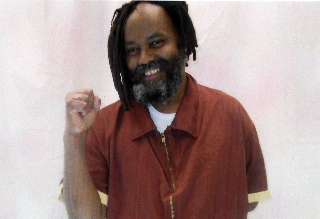
PHOTO AND CAPTION FROM NATIONAL LAWYERS GUILD: SCI Mahanoy, February 2, 2012. Mumia Abu-Jamal celebrates his move off of death row with Heidi Boghosian and Professor Johanna Fernandez. This was Mumia’s second contact visit in 30 years. His transfer to general population  comes after a federal court ruled that instructions to jurors during his trial influenced them to choose death. A broad people’s movement secured this victory, and it can now refocus on the goal of freedom. Join us on April 24, Mumia’s birthday, as we Occupy the Justice Department in Washington, DC!

****************************************************

Double WOW! So this is what Mumia looks like in 2012! And he’s hugging folks! Let’s find out more from these folks hugging Mumia:

Comrades, Brothers and Sisters:

Heidi Boghosian and I just returned from a very moving visit with Mumia. We visited yesterday, Thursday, February 2. This was Mumia’s second contact visit in over 30 years, since his transfer to General Population last Friday, Jan 27. His first contact visit was with his wife, Wadiya, on Monday, January 30.

Unlike our previous visits to Death Row at SCI Greene and to solitary confinement at SCI Mahanoy, our visit yesterday took place in a large visitor’s area, amidst numerous circles of families and spouses who were visiting other inmates.  Compared to the intense and focused conversations we had had with Mumia in a small, isolated visiting cell on Death Row, behind sterile plexiglass, this exchange was more relaxed and informal and more unpredictably interactive with the people around us…it was more human.  There were so many scenes of affection around us, of children jumping on top of and pulling at their fathers, of entire families talking intimately around small tables, of couples sitting and quietly holding each other, and of girlfriends and wives stealing a forbidden kiss from the men they were there to visit (kisses are only allowed at the start and at the end of visits). These scenes were touching and beautiful, and markedly different from the images of prisoners presented to us by those in power. Our collective work could benefit greatly from these humane, intimate images.

When we entered, we immediately saw Mumia standing across the room. We walked toward each other and he hugged both of us simultaneously. We were both stunned that he would embrace us so warmly and share his personal space so generously after so many years in isolation.

He looked young, and we told him as much. He responded, “Black don’t crack!”  We laughed.

He talked to us about the newness of every step he has taken since his release to general population a week ago. So much of what we take for granted daily is new to him, from the microwave in the visiting room to the tremor he felt when, for the first time in 30 years, he kissed his wife.  As he said in his own words, “the only thing more drastically different than what I’m experiencing now would be freedom.” He also noted that everyone in the room was watching him.

The experience of breaking bread with our friend and comrade was emotional. It was wonderful to be able to talk and share grilled cheese sandwiches, apple danishes, cookies and hot chocolate from the visiting room vending machines.

One of the highlights of the visit came with the opportunity to take a photo. This was one of the first such opportunities for Mumia in decades, and we had a ball! Primping the hair, making sure that we didn’t have food in our teeth, and nervously getting ready for the big photo moment was such a laugh! And Mumia was openly tickled by every second of it.

When the time came to leave, we all hugged and were promptly instructed to line up against the wall and walk out with the other visitors. As we were exiting the prison, one sister pulled us aside and told us that she couldn’t stop singing Kelly Clarkson’s line “some people wait a lifetime for a moment like this.” She shared that she and her parents had followed Mumia’s case since 1981 and that she was overjoyed that Mumia was alive and in general population despite Pennsylvania’s bloodthirsty pursuit of his execution.  We told her that on April 24 we were going to launch the fight that would win Mumia’s release: that on that day we were going to Occupy the Justice Department in Washington DC. She told us that because she recently survived cancer she now believed in possibility, and that since Mumia was now in general population she could see how we could win. She sent us off with the line from Laverne and Shirley’s theme song – “never heard the word impossible! “- gave us her number, and asked us to sign her up for the fight.

We’re still taking it all in. The journey has been humbling and humanizing, and we are re-energized and re-inspired!!

In the words of City Lights editor Greg Ruggiero:

“Long Term Goal: End Mass Incarceration. Short Term Goal: Free Mumia Abu-Jamal!”

–Johanna Fernandez