
Marita Golden has a new book out. Here’s the publicity material.
A Conversation with Marita Golden,
editor of
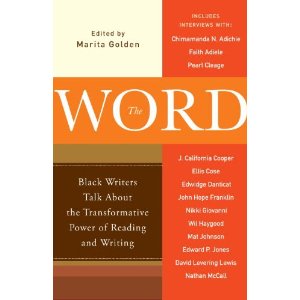
THE WORD: Black Writers Talk About the Transformative Power of Reading and Writing
(Broadway Paperbacks Original, on sale January 18, 2011)
What inspired you to choose to focus this book on the power of reading and writing?
There has been so much public and contentious debate and discussion about the skills of young people, the failure of public schools, and the future of reading and the book swirling around us. I had not seen much from Black writers on this topic, so I wanted to provide our voices in the discussion.
Why do you feel this is a topic particularly pertinent to the African-American community?
African Americans have been so important to the vitality of American literature—historically and contemporaneously—that these are issues that are very important in our community. It’s also pertinent because a disproportionate number of Black youth attend schools where they do not succeed academically so these questions resonate in the Black community.
What was your process to determine which writers you wanted to interview?
I wanted to interview a diverse group of writers; writers who are celebrated in the way that Nikki Giovanni is, as well as new voices like Mat Johnson, as well as scholars like David Levering Lewis and biographers like Wil Haygood.
You interview so many amazing black writers—Edwidge Danticat, Pearl Cleage, Ellis Cose just to name a few. What were you most struck by in these interviews? Did you discover any common threads in their experiences with reading or were you surprised by the differences?
I think the common thread for all of the authors interviewed in the book, including myself, is that reading became a safe and valued place for us as children where we discovered possibilities. Writing became a map we used to find our way and our dreams realized in the world.
What were some of the most powerful examples of how reading and writing unlocked astounding possibilities for the authors you spoke with? How were their lives forever changed?
In many ways the stories the writers share about the power of reading and writing in their lives is a story of how both acts became a bridge that they crossed into a wider world and a broader sense of themselves and what they could do. Edwidge Danticat grew up in a repressive society in Haiti and for her parents the act of writing was seen as very dangerous because of what writing could reveal. As a result, she never shared with her parents much of her writing so that they would not worry about her, and yet she has become the country’s most articulate literary spokesperson. Writing gave her courage and a way to speak loudly in the world. She has said that writing is the way that we leave our footmark in the world.
Edward P. Jones was encouraged by his illiterate mother and by caring teachers in high school to read and write. Both endeavors gave him a way to honor the difficult experiences of his childhood and the tragedy that was so much a part of his mother’s life because of the limitations imposed on her because she could not read and write. He grew up to be a writer of international acclaim, so once again reading and writing were empowering tools.
With literacy rates—especially among young African Americans—on the decline, how do you feel THE WORD contributes to the conversation? Do you hope to foster discussion around this issue with the book?
Yes, I hope the book will be read by all students and will serve as an inspiration for them to read more. I’d like to see the book used and discussed in all schools, not just inner city schools. Certainly these acclaimed writers have much to say to youth about the importance and role of reading and writing as an engine for creating a successful life. Even in the Facebook age, the world is still governed and created by those who master literacy and language. Students could research the authors in the book as a way of discovering their lives and their blueprints for success.
To schedule an interview with Marita Golden, please contact Justina Batchelor, 212-572-2247 or jbatchelor@randomhouse.com .
 Drums in the Global Village