
Bayou, Volume One.
Jeremy Love.
ZudaComics.com.
$14.45.
It’s common knowledge that the classic, pre-Disney-ized children’s stories of yesterdecade were, in actuality, horror tales designed to scare good behavior into children. Don’t go down that road. Don’t go into that house. Don’t chat with that talking animal, and for goodness sakes, don’t follow him!
The first volume of “Bayou” really scared me because it took the whimsical horror of “Alice in Wonderland” and meshed it with the real-life terror of Jim Crow, in all its pre-Rosa Parks grisly gore and anger. This graphic novel, written and drawn by the superbly talented Jeremy Love, has the deceptive look of a children’s book, but it’s a serious meditation on life and death, bravery and freedom, seen through the eyes of Lee Wagstaff, a tough, resilient girl who refuses to let her daddy be lynched. All because Lily, a white girl and Lee’s friend, was swallowed by a mysterious ogre in the Bayou.
The masterwork is published by DC Comics’ new online imprint, ZudaComics. “Bayou” is the first-ever Zuda book. The story is copyrighted by Gettosake, which should be very proud of itself. Once again, DC shows it has an eye for stories of great quality.
Love won five of 10 Glyph awards this year—a five-for-five sweep of its nominations. (The Glyphs are given out by the East Coast Black Age of Comics Convention.) “Bayou” won Story of the Year, Best Writer, Best Artist, Best Female Character and Best Comic Strip.
Part Two cannot come to me fast enough. Hurry, DC!

Heroes of Film, Comics and American Culture.
Lisa M. DeTora.
McFarland & Company, Inc.
327 pp. $39.95.

This book is right on time because there are rumors in the electronic air that Steve Rogers, killed during Marvel’s Civil War and during the even darker days of the end of the second Bush term, will return to life this summer.
[JUNE 28th UPDATE: Yep, he’s back.]
Jason Dittmer wrote about Cap in this scholarly anthology, which seeks to examine the relationship of fictional heroes to American domestic life. The book is broad, with its 18 authors looking askew at heroes ranging from the newly-domesticated sheriff in the classic flick “High Noon” to the action engaged by a pregnant Xena, Warrior Princess. (A real-life examination of the impact of 9-11 on national discourse deals with the issue of racism.)
So Captain America, Dittmer writes, “was created [by Joe Simon and Jack Kirby in the 1940s] as a symbolic wall to keep the interior space of the nation pure.” When Stan Lee and Kirby revived him in the 1960s, the theme was “debate over the meaning of America itself.” I wonder what he would say about Rogers’ resurrection during the Age of Obama—-the rebirth of hope during the Era of Hope?
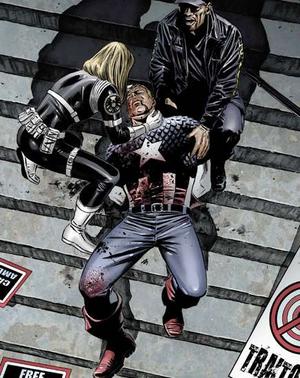
Highlights include Ronald C. Thomas Jr.’s discussion of “Rockefeller Republican” Tony Stark as an extension of his Iron Man identity (and Ol’ Shellhead, of course, being the “embodiment” of the military-industrial complex) and Marc Edward DiPaolo’s deconstruction of Batman as a restrained version of Bush(‘s War On Terror policies) or, as the author put it, “part Donald Trump, part Vampire.”
Dittmer and the other authors plow over ideas well-tread by generations of fanboys and fangirls. (Ex: As a comic, Cap works best as Cap, not Steve, and works best in a battle setting, not one of domestic tranquility.) But as a member of both the scholarly and geek camps, it’s good to see this kind of treatment.
 Drums in the Global Village